Researchers at TU Berlin (Germany) have revolutionized VCSEL production by replacing Bragg mirrors with nano-precise surface gratings. The production time is reduced by 50 percent, while at the same time different laser wavelengths can be realized in parallel on one wafer.
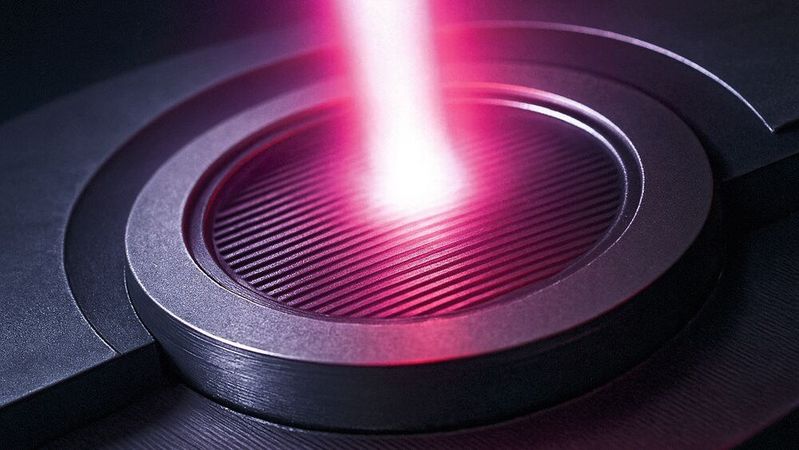
Schematic representation of a microlaser with a surface grating structured with nanometer precision. The compact semiconductor laser generates a directed beam of light with a beam profile that is precisely tailored to the respective application.
(Image: AG Reitzenstein/TU Berlin)
Researchers at TU Berlin have developed an innovative approach for the production of VCSEL laser diodes that should make the manufacturing industry sit up and take notice. The team led by Prof. Dr. Stephan Reitzenstein from the "Optoelectronics and Quantum Devices" department, in collaboration with the University of Łódź (Poland), has developed a method that reduces production times by 50 percent by replacing the complex upper Bragg mirrors with precisely etched optical gratings, while at the same time realizing different laser wavelengths in a single production step.
Proven Technology With New Possibilities
VCSELs (Vertical Cavity Surface Emitting Lasers) have been in use for more than two decades and have established themselves as key components. These laser diodes, which emit their light perpendicular to the semiconductor chip, can couple the laser beam into optical fibers very well, unlike laser diodes with lateral light emission. The reason for this is the round geometry with a small design as well as good beam quality and focusability. VCSELs are therefore used in large data centers for the efficient transmission of information between servers. They are also used in cell phones for facial recognition.
Grids Instead of Elaborate Mirror Layers
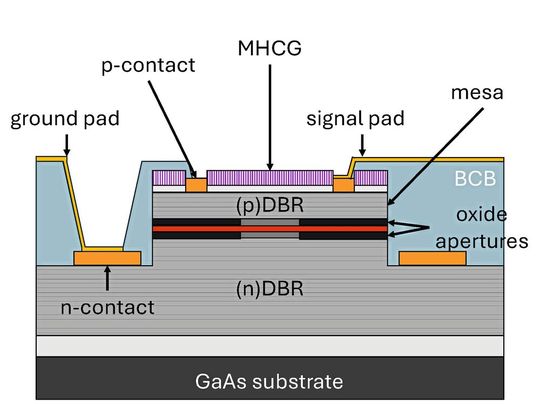
A VCSEL essentially consists of an active layer in which the light particles are created, as well as layers of so-called Bragg mirrors above and below it. They repeatedly reflect the light back into the active layer so that it stimulates the creation of further light particles there—the typical laser effect. The upper mirror layers reflect the laser light slightly less, allowing part of the laser beam to escape and be used.
The new technology promises considerable cost savings in industrial production. While the conventional production of the complex mirror layers takes around twelve hours, the Berlin researchers can save around six hours with their grid-based solution. "The big difference is that we no longer have to apply so many semiconductor layers one after the other. This is a lengthy and expensive process," explains first author Niels Heermeier.
Precision in the Nanometer Range Enables Flexibility
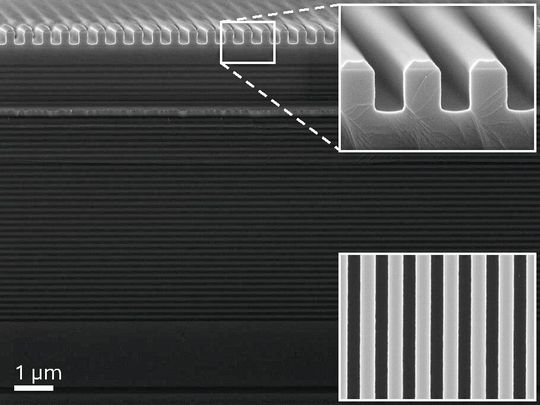
The wavelength of the laser beams can be adjusted by the thickness of the bars in the grating, their spacing and the depth of the grooves. Below the grating you can see the few Bragg mirrors above the active layer (light gray) in which the radiation is generated. Below this there are many layers of Bragg mirrors. (Image taken with an electron microscope).
(Image: AG REitzenstein/ TU Berlin)
"The even more important advantage of the line grating is that laser diodes with different output wavelengths can be manufactured simultaneously on a semiconductor wafer in a single production step," explains Heermeier. For this purpose, several geometric parameters of the line grating are varied during the etching process depending on the diode: the thickness of the grating bars, their distance from each other and the depth of the etched grooves between them. "We don't have this flexibility when applying the mirror layers, as these have to grow on the entire wafer and therefore define the properties for all laser diodes in a uniform way."
Extremely high accuracy is required in order to be able to precisely manufacture the new microlasers with their individual properties: The sizes may deviate from their target value by less than five nanometers. Compared to the distance between the earth and the moon of almost 249,000 miles, this would correspond to a maximum permissible deviation of 7 feet. This achievement was only possible thanks to an electron beam lithography system available at the department and procured with funding from the German Research Foundation (DFG) and TU Berlin, which has to be adapted to its task by the researchers in a complex process.
Broad Range of Applications in Growth Markets
Schematic structure of the new microlaser with the lower layer of Bragg mirror pairs (DBR), the active layer in red, the few layers of Bragg mirror pairs above (DBR) and the grating (MHCG).
(Image: AG Reitzenstein/TU Berlin)
The potential applications are diverse and target current growth markets. In addition to the proven application in data centers for efficient signal coupling in fiber optic cables, the microlasers could also be used for the lidar process (light detection and ranging), which plays a major role in autonomous driving. Here, arrangements with laser diodes of different wavelengths, such as those that can be easily produced with the new process, deliver significantly better resolution.
The new VCSEL diodes could also become an important building block for the hardware of so-called neuromorphic computing with optical processors, which Stephan Reitzenstein's team is developing together with colleagues at the Universities of Berkeley and MIT in Boston. These computers are designed in the same way as the human brain and work with optical components and light as information carriers instead of electrical circuits.
Date: 08.12.2025
Naturally, we always handle your personal data responsibly. Any personal data we receive from you is processed in accordance with applicable data protection legislation. For detailed information please see our privacy policy.
Consent to the use of data for promotional purposes
I hereby consent to Vogel Communications Group GmbH & Co. KG, Max-Planck-Str. 7-9, 97082 Würzburg including any affiliated companies according to §§ 15 et seq. AktG (hereafter: Vogel Communications Group) using my e-mail address to send editorial newsletters. A list of all affiliated companies can be found here
Newsletter content may include all products and services of any companies mentioned above, including for example specialist journals and books, events and fairs as well as event-related products and services, print and digital media offers and services such as additional (editorial) newsletters, raffles, lead campaigns, market research both online and offline, specialist webportals and e-learning offers. In case my personal telephone number has also been collected, it may be used for offers of aforementioned products, for services of the companies mentioned above, and market research purposes.
Additionally, my consent also includes the processing of my email address and telephone number for data matching for marketing purposes with select advertising partners such as LinkedIn, Google, and Meta. For this, Vogel Communications Group may transmit said data in hashed form to the advertising partners who then use said data to determine whether I am also a member of the mentioned advertising partner portals. Vogel Communications Group uses this feature for the purposes of re-targeting (up-selling, cross-selling, and customer loyalty), generating so-called look-alike audiences for acquisition of new customers, and as basis for exclusion for on-going advertising campaigns. Further information can be found in section “data matching for marketing purposes”.
In case I access protected data on Internet portals of Vogel Communications Group including any affiliated companies according to §§ 15 et seq. AktG, I need to provide further data in order to register for the access to such content. In return for this free access to editorial content, my data may be used in accordance with this consent for the purposes stated here. This does not apply to data matching for marketing purposes.
Right of revocation
I understand that I can revoke my consent at will. My revocation does not change the lawfulness of data processing that was conducted based on my consent leading up to my revocation. One option to declare my revocation is to use the contact form found at https://contact.vogel.de. In case I no longer wish to receive certain newsletters, I have subscribed to, I can also click on the unsubscribe link included at the end of a newsletter. Further information regarding my right of revocation and the implementation of it as well as the consequences of my revocation can be found in the data protection declaration, section editorial newsletter.
"It is important that the wavelength of the light from the laser diodes is exactly the same. However, even the smallest deviations in production can lead to different wavelengths," explains Reitzenstein. With the new method, it would be possible to measure the wavelengths after production of the optical chip and then match them exactly by means of subsequently etched grating structures.
Quantum Physics As A Research Bonus
The new microlasers are also interesting for basic research, as the researchers from the collaborating working group in Poland were able to realize the exotic quantum state of a "Bose-Einstein condensate" with light particles in conventional VCSEL diodes for the first time by chance. This phenomenon can now be investigated in more detail with the new, more easily adjustable laser diodes.
The team is already planning the next development step: the complete replacement of the lower mirror layers with grating structures. "However, this task is much more complex because the substrate material of the diode must then be removed on the underside," Reitzenstein points out. From his point of view, the new Center for Integrated Photonics Research (CIPHOR) is therefore of particular importance as a central component of the new experimental physics building on the East Campus of TU Berlin. This will be built from 2028 and will open up new production possibilities with excellently equipped clean rooms. (heh)



:quality(80)/p7i.vogel.de/wcms/a0/47/a04725ef9bd09fb6c9341a1bea1b5d93/0130443083v1.jpeg "Here, a type of plastic pallet is produced by thermoforming (vacuum forming or deep drawing) at the corresponding division of New England Plastics in the USA. This division, which specializes in so-called liners, is now part of Ringmetall ... (Image:New England Plastics)")
:quality(80)/p7i.vogel.de/wcms/e3/42/e342b3c593ea92d56604d3be969e9c9a/0130437231v1.jpeg "Daimler Truck will be building even more trucks at its Czech plant in Cheb in the future. This is because it is now being expanded for strategic cost-saving reasons ... (Image:Daimler Truck)")
:quality(80)/p7i.vogel.de/wcms/23/99/23992bf2dcdc432c9b7209c34a4a7c48/0129733089v1.jpeg "Stork relies on the modular Neoswiss turning system from Iscar to shorten the set-up times for its sliding headstock lathes and work more productively. (Image:Iscar)")
:quality(80)/p7i.vogel.de/wcms/7d/e2/7de2923434b2f1a78ba5482d8d335269/0113143253v1.jpeg "In our China Market Insider we regularly provide you with relevant information directly from China. (Image:© Eisenhans - stock.adobe.com)")
:quality(80)/p7i.vogel.de/wcms/b7/36/b736dfebc16c42d6901d0d0e1f390493/3d-druck-20factory-20--20ki-20generiert-1920x1079v1.png "(Source: AI-generated)")
:quality(80)/p7i.vogel.de/wcms/79/b2/79b21aad663f4a7bd4472afc1c1afc62/0130433994v1.jpeg "Mission Joyride: The free-flying robot (shown here in the rendering) will relieve the ISS crew of logistics tasks from 2027 with its two mechanical arms. (Image:Icarus Robotics)")
:quality(80)/p7i.vogel.de/wcms/6b/45/6b4546fa6ebf305c3660326909363f32/0130437089v1.jpeg "Industrial AI in action: Rockwell Automation presents practical solutions for self-controlling production systems at the Hannover Messe. (Image:Rainer Jensen, Deutsche Messe)")
:quality(80)/p7i.vogel.de/wcms/78/e9/78e9188c25a8a94e67c34c9bf8ffe495/visual-agile-20robots-20and-20google-20deepmind-20partner-20to-20bring-20intelligence-20to-20robotics-2500x1406v1v1.jpeg "Together, the partners are developing adaptable, intelligent robots for a wide range of applications (Image:Agile Robots SE)")
:quality(80)/p7i.vogel.de/wcms/59/a2/59a2b11f0aa1b700eff02addd5de8703/adobestock-1788280853--c2-a9-20satria-20-e2-80-93-20stock-adobe-com-5081x2860v1v1.jpeg "Quantum computers require extreme cooling to temperatures close to absolute zero in order to keep qubits stable. (Image:satria - stock.adobe.com)")
:quality(80)/p7i.vogel.de/wcms/62/5f/625f41e87ebfef156a98c8e6393e32fd/0130211654v1.jpeg "Axial flux motors have some advantages over radial flux motor—but their production is currently still expensive. (Image:RWTH Aachen University)")
:quality(80)/p7i.vogel.de/wcms/f6/ae/f6aec4f6241b36ed5e3a990ac9176b42/0130429460v1.jpeg "Verne, Pony.ai and Uber want to launch a robotaxi service in Europe. (Image:Verne)")
:quality(80)/p7i.vogel.de/wcms/d7/88/d788699f2974708a332baa4e7a62fa9e/0130438967v1.jpeg "Skoda is withdrawing from China. The brand has produced well over three million vehicles there. (Image:Skoda car)")
:quality(80)/p7i.vogel.de/wcms/b0/43/b043b86899837532aad62d63368a917a/0130371361v1.jpeg "Skoda leaves the chinese market.
(Image:Skoda)")
:quality(80)/p7i.vogel.de/wcms/c3/c4/c3c4ce270b083eeac55654148611f064/0130237945v1.jpeg "China is not giving up on hydrogen, but is intensifying its efforts. (Image:freely licensed from Pixabay)")
:quality(80)/p7i.vogel.de/wcms/ee/09/ee09acbd6dc896df25affaa9e871e6e5/0130440053v1.jpeg "IMS chip module for simple system integration into an ion mobility spectrometer. (Image:Fraunhofer IPMS)")
:quality(80)/p7i.vogel.de/wcms/10/6c/106cd22de5f68a0f74639d654827228c/0130345302v1.jpeg "Made in India: According to the India Electronics and Semiconductor Association (IESA), the country should be able to produce between 75 and 80 million chips by the beginning of 2027, once the plants currently under construction become operational. (Image:Pixabay (Montage: Sebastian Gerstl))")
:quality(80)/p7i.vogel.de/wcms/a5/ed/a5ed6fda029d362732a293d6b19d74c4/0130444216v1.jpeg "Thirteen executives from the Chinese chip industry have drawn up a plan to achieve an 80% self-sufficiency rate for semiconductors by 2030. (Image:Maxim_Kazmin - stock.adobe.com)")
:quality(80)/p7i.vogel.de/wcms/31/a6/31a646018b34d8e0a44bfc8bf17837f6/0130361632v1.jpeg "For many companies, PFAS are considered indispensable in electronics production. (Image:freely licensed)")
:fill(fff,0)/images.vogel.de/vogelonline/companyimg/76800/76895/65.jpg "FAULHABER_120mm.jpg ()")
:quality(80):fill(efefef,0)/p7i.vogel.de/wcms/67/af/67af6debad886/skz-whitepaper-future-trends-coverbild.png "SKZ Whitepaper_Future Trends_Coverbild")
:quality(80)/p7i.vogel.de/wcms/59/a1/59a15c8730bec86f5951d0bfc7ff5f63/0125154353v1.jpeg "Quantum light module for optical coherence tomography (OCT) or spectroscopy measurements in the MIR range using \"undetected photons\". (Image:FBH/Schurian.com)")
:quality(80)/p7i.vogel.de/wcms/27/cb/27cbb3856fe6b3e444afa237d620010f/0125932779v1.jpeg "Demonstrator of the QuantumCascade project. The thin glass board developed and manufactured by Fraunhofer IZM has a base area of 80 mm x 100 mm. The integrated lasers and drivers can be controlled via a programmable interface. (Image:Fraunhofer IZM)")