The Ferdinand Braun Institute (FBH) offers technical components related to optoelectronics, semiconductor lasers, and quantum technologies. Specifically, it focuses on practical applications such as compact quantum sensing, medical diagnostics using quantum light sources, and lidar. A selection of developments.
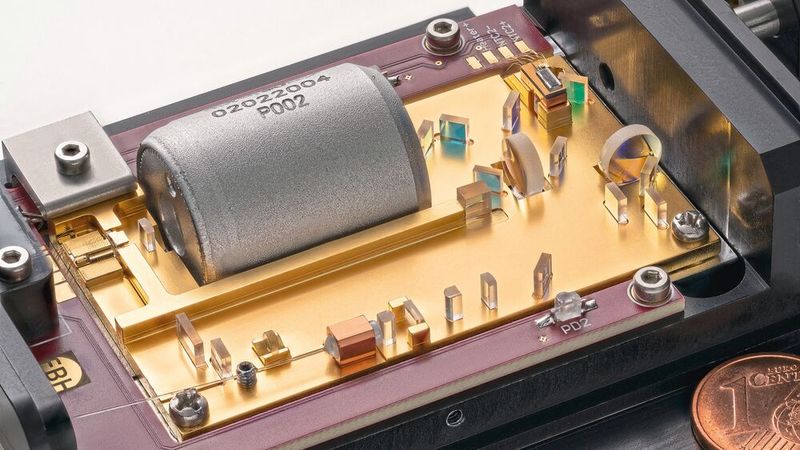
Quantum light module for optical coherence tomography (OCT) or spectroscopy measurements in the MIR range using "undetected photons".
(Image: FBH/Schurian.com)
The Ferdinand-Braun-Institut (FBH) is an internationally recognized research institute from Berlin, which belongs to the Leibniz Association and specializes in applied research and the development of semiconductor technologies. It is a leading research institute in Europe, particularly in the fields of ultra-high frequency technology, optoelectronics and quantum technologies. The article presents a selection of technological developments and provides insights into optoelectronics.
Quantum Technologies for Medical Diagnostic Procedures
The FBH has developed special quantum light sources for medical applications. They support the early detection of cancer thanks to hyperspectral imaging. High-power diode lasers with a specific wavelength of 720 nm are used for this purpose. The central element is entangled photon pairs, which are generated simultaneously in the mid-infrared (MIR) and near-infrared (NIR) range.
This is realized using the "Measurement by Undetected Photons" method. Here, a tissue sample is only irradiated with MIR photons, while the actual measurement is carried out indirectly via the detection of NIR photons. As the image data is recorded in the more cost-effective and efficient NIR range, the cost of sensors and light sources can be significantly reduced compared to the MIR range. The modules developed at the FBH enable rapid measurements and can therefore help to simplify cancer diagnostics.
Pulsed High-Power Diode Lasers for Lidar
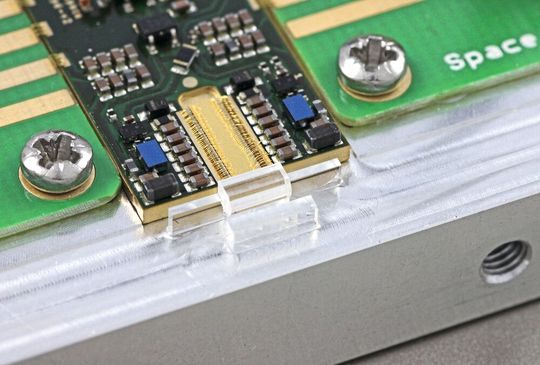
High current nanosecond laser driver with integrated ridge waveguide laser diode for lidar applications.
(Image: FBH/P. Immerz)
Time-resolved lidar applications (time-of-flight) require reliable and high-performance pulsed laser diodes. The experts at FBH have developed specially designed, grating-stabilized diode lasers that are capable of generating extremely short, high-power laser pulses.
For medium ranges, FBH offers ridge waveguide lasers that deliver pulse powers of over 20 W with a lateral beam profile (M² factor of around 3). For long distances, broadband laser diodes with pulse powers of up to 420 W are available. In addition, laser bars with 48 emitters have been developed that even generate pulse powers of over 2,000 W.
All these components can be compactly accommodated in butterfly housings, which already contain electronic control, micro-optics and thermal management. A simple, user-friendly demonstrator allows uncomplicated integration and control and only requires a single voltage source for operation.
Additive Manufacturing, Laser Core Fusion and Energy Transfer
FBH provides high-performance diode laser modules for demanding applications in additive manufacturing (laser-generated metal 3D printing), inertial fusion energy (IFE) and wireless energy transmission over long distances (power beaming).
The "SAMBA" diode laser system, which achieves an output of several kilowatts, is designed for additive manufacturing processes with aluminum, for example. This system is currently undergoing practical testing in cooperation with partners from industry. Furthermore, the FBH, together with the University of Glasgow, has produced special single-mode high-power diodes for possible applications in space-based "power beaming", which will also be presented.
Together with industrial partner Trumpf, FBH also offers multi-junction laser bars that have been specially designed for use in future IFE systems and offer high performance with a stable grating structure.
Quantum Sensor Technology with Ceramic 3D Printing Processes
With the help of lithography-based additive manufacturing of technical ceramics (such as aluminum oxide), the FBH is creating new possibilities for the construction of compact quantum sensor systems. This process makes it possible to produce components with complex structures that are both mechanically resilient and lightweight. Production cycles can be flexibly designed and quickly adapted to changing requirements.
As a concrete example, the FBH is presenting a miniaturized frequency reference based on rubidium laser spectroscopy. The researchers precisely mount its optical components on 3D-printed ceramic substrates using hybrid microintegration. The result is a robust, compact overall system with a volume of 7 ml and a weight of 15 g. Such systems are particularly suitable for mobile and later use in space.
Integrated Chip Platforms Based on GaAs
In semiconductor technology, FBH has extensive expertise in the manufacture of gallium arsenide-based (GaAs) laser diodes and integrated optical components. Specifically, the institute is presenting new photonic integrated GaAs circuits (PICs) that combine active amplification with passive waveguides. Among other things, this results in ring resonator-coupled lasers that can provide outputs of around 14 mW at a wavelength of around 1,050 nm.
Date: 08.12.2025
Naturally, we always handle your personal data responsibly. Any personal data we receive from you is processed in accordance with applicable data protection legislation. For detailed information please see our privacy policy.
Consent to the use of data for promotional purposes
I hereby consent to Vogel Communications Group GmbH & Co. KG, Max-Planck-Str. 7-9, 97082 Würzburg including any affiliated companies according to §§ 15 et seq. AktG (hereafter: Vogel Communications Group) using my e-mail address to send editorial newsletters. A list of all affiliated companies can be found here
Newsletter content may include all products and services of any companies mentioned above, including for example specialist journals and books, events and fairs as well as event-related products and services, print and digital media offers and services such as additional (editorial) newsletters, raffles, lead campaigns, market research both online and offline, specialist webportals and e-learning offers. In case my personal telephone number has also been collected, it may be used for offers of aforementioned products, for services of the companies mentioned above, and market research purposes.
Additionally, my consent also includes the processing of my email address and telephone number for data matching for marketing purposes with select advertising partners such as LinkedIn, Google, and Meta. For this, Vogel Communications Group may transmit said data in hashed form to the advertising partners who then use said data to determine whether I am also a member of the mentioned advertising partner portals. Vogel Communications Group uses this feature for the purposes of re-targeting (up-selling, cross-selling, and customer loyalty), generating so-called look-alike audiences for acquisition of new customers, and as basis for exclusion for on-going advertising campaigns. Further information can be found in section “data matching for marketing purposes”.
In case I access protected data on Internet portals of Vogel Communications Group including any affiliated companies according to §§ 15 et seq. AktG, I need to provide further data in order to register for the access to such content. In return for this free access to editorial content, my data may be used in accordance with this consent for the purposes stated here. This does not apply to data matching for marketing purposes.
Right of revocation
I understand that I can revoke my consent at will. My revocation does not change the lawfulness of data processing that was conducted based on my consent leading up to my revocation. One option to declare my revocation is to use the contact form found at https://contact.vogel.de. In case I no longer wish to receive certain newsletters, I have subscribed to, I can also click on the unsubscribe link included at the end of a newsletter. Further information regarding my right of revocation and the implementation of it as well as the consequences of my revocation can be found in the data protection declaration, section editorial newsletter.
The FBH is also developing GaAs amplifier chips that can be incorporated into various passive waveguide platforms using integrated transfer printing processes. In future, these technologies will be incorporated into larger projects such as the European pilot line APECS and the Research Fab Microelectronics Germany (FMD). (heh)



:quality(80)/p7i.vogel.de/wcms/2c/d6/2cd65bff6624dbdc007f2315307612fe/0130800023v1.jpeg "An international consortium led by Tata Steel Nederland has made significant progress in the development of new zinc-coated ultra-strong steels. (Image:Tata Steel)")
:quality(80)/p7i.vogel.de/wcms/f0/e0/f0e05856a96a9afa991a8dd9f4aceb04/0131242862v1.jpeg "Humanoid robots are the focus of the \"TUM RoboGym (powered by Neura)\". (Image:Neura Robotics)")
:quality(80)/p7i.vogel.de/wcms/c3/be/c3be858b644b6f52c83ea025a6f596ad/0130477152v1.jpeg "With the \"DUO\" version of the \"POWER-Skate XL\", loads can be moved in all directions. (Image:HTS)")
:quality(80)/p7i.vogel.de/wcms/92/87/9287ce9327245bdcd01af627044b34c8/0131221372v1.jpeg "Here, Binder provides information on a standardized portfolio and, above all, on improvements for the assembly of M12 connectors, which are now easier to handle and even safer ... (Image:Binder)")
:quality(80)/p7i.vogel.de/wcms/fc/5c/fc5c314369136a0f2b4819ca4011ce80/0131048280v1.jpeg "It all depends on the overall IO-Link package. If the interaction between sensors, powerful masters and a manufacturer-independent configuration tool is right, a significant increase in machine performance is possible. (Image:Baumer)")
:quality(80)/p7i.vogel.de/wcms/69/a2/69a26de87302feccb0ad51bc5eefae4d/0131155056v1.jpeg "Quantum Mate with integrated cobot takes over manual, repetitive tasks in an automated, reliable and efficient process. (Image:Galdabini)")
:quality(80)/p7i.vogel.de/wcms/72/54/7254c0031573057a049e5879cba0de85/0130912407v1.jpeg "The serial interface still has its legitimacy in the age of Industry 4.0: it is still used, for example, to connect peripheral devices such as scanners. (Picture: ©Guy - stock.adobe.com)")
:quality(80)/p7i.vogel.de/wcms/c1/70/c170fd5c52c08ceb4bc2b58eb94ea95f/newsimage421365-2048x1151v1v1.jpeg "Diving robot from TU Bergakademie Freiberg before its first dive at the Malter dam (Image:Andreas Hiekel/TUBAF)")
:quality(80)/p7i.vogel.de/wcms/30/76/3076278d4a7b51a5c566581a20135afc/54963580015-cdcb4657c5-k-2047x1151v1v1.jpeg "The Nancy Grace Roman space telescope was completed in the largest clean room at NASA's Goddard Space Flight Center. It is due to be launched into space in September 2026. (Image:NASA/Jolearra Tshiteya / CC BY 4.0)")
:quality(80)/p7i.vogel.de/wcms/3a/08/3a08d5a0623b4d32294e8108d639f237/nivalon-20medical-20-1626x914v1v1.png "EvoFlex implant from Nivalon Medical consists of a bone-like ZTA ceramic that is precisely adapted to the anatomy of each patient. (Image:Nivalon)")
:quality(80)/p7i.vogel.de/wcms/55/93/55936485100842cd9e83fa3ec053e9c1/2-995x560v1v1.png "The research team at the Technical University of Munich measures and controls the tendon forces on the robot. The aim of the research project is to develop new control concepts. (Image:TU Munich)")
:quality(80)/p7i.vogel.de/wcms/c2/df/c2df275b52afda5130ec90662fc767af/adobestock-1858604981--c2-a9-20vladyslav-20andrukhiv-20-e2-80-93-20stock-adobe-com-ki-generiertv1.jpeg "Artificial sun on earth: Start-ups in China are working to accelerate the development of the virtually inexhaustible energy source of nuclear fusion with AI. (Source: © Vladyslav Andrukhiv - stock.adobe.com/AI-generated)")
:quality(80)/p7i.vogel.de/wcms/94/6b/946b136b4478d8b80e3d9e62041e7274/0131259520v1.jpeg "The Craft test bench in Berlin is used to develop future propulsion systems for sustainable aviation. The aim is to minimize noise while maintaining the efficiency of aircraft engines. (Image:DLR)")
:quality(80)/p7i.vogel.de/wcms/5a/14/5a14b26a5d4495d3a192e90e5c216251/ai-catl-sodium-batteries-vs-lithium-revolution-1800x1012v1v1.jpeg "The supplier CATL is bringing its first sodium-ion batteries into series production. Although not in the automotive industry, this step is set to follow soon. (Image:CATL)")
:quality(80)/p7i.vogel.de/wcms/68/43/68433001d98374eb72f51b4a7db590fe/0131229290v1.jpeg "Charging infrastructure provider Evoltra will operate as Citywatt Development in the future. (Image:Citywatt)")
:quality(80)/p7i.vogel.de/wcms/70/46/7046f2dbbbbabf4b5c37a811b6e31c3c/brembo-sensify-1750x984v1v1.jpeg "Brembo is now mass-producing the \"Sensify\" brake platform. (Picture:Brembo)")
:quality(80)/p7i.vogel.de/wcms/98/11/981107e7d149b2ff970c574cdd73f158/0131183152v1.jpeg "An optical phased array (OPA) counteracts strong optical crosstalk. For this purpose, the antenna geometry is arranged asymmetrically. (Image:Amy Pan / MIT)")
:quality(80)/p7i.vogel.de/wcms/a3/2e/a32e8b8bb38bd5c1cfd27b043baf72b7/0131203375v1.jpeg "Alliance for the AI age: Sony and TSMC join forces to produce next-generation smart image sensors (Image:Brunox983/Pixabay)")
:quality(80)/p7i.vogel.de/wcms/f9/5d/f95d24afa8d7ffb2c27916d0f329c670/0131192604v1.jpeg "Symbolic image: Kontron has a positive outlook for 2026, but must restructure. (Image:AI-generated)")
:quality(80)/p7i.vogel.de/wcms/c7/6b/c76b7659a76e1dd6e9b007340a12c70b/0131171547v1.jpeg "Circular economy in practice: in future, automated systems will save intact battery cells for reuse. (Image:Rainer Betz/Fraunhofer IPA)")
:fill(fff,0)/images.vogel.de/vogelonline/companyimg/76800/76895/65.jpg "FAULHABER_120mm.jpg ()")
:quality(80)/p7i.vogel.de/wcms/0c/ac/0cacda94ed641488ba0ac4b9daa2bce5/0130073615v1.jpeg "Part of the experimental set-up for a quantum physics experiment in the laboratory of the Institute of Physics at Humboldt-Universität zu Berlin, Adlershof (Germany) campus. (Image:HU Berlin/S. Klenke)")
:quality(80)/p7i.vogel.de/wcms/01/cd/01cdc983aaeea1859522a45a312cae9d/0127869932v1.jpeg "Directly printed, without an oven: with the new Laser-Assisted Melt Printing (LAMP), researchers at Kiel University fuse glass particles into solid, transparent structures. (Image:Christina Anders, Kiel University)")