Develop reliable, more efficient machines with our tips for hydraulics and pneumatics. Learn, for example, when to use piston instead of bladder accumulators, where to download free CAD data for pipe connection components, and how to make pneumatic control systems more compact.
For the energy transition to succeed, machines and systems must operate energy-efficiently.
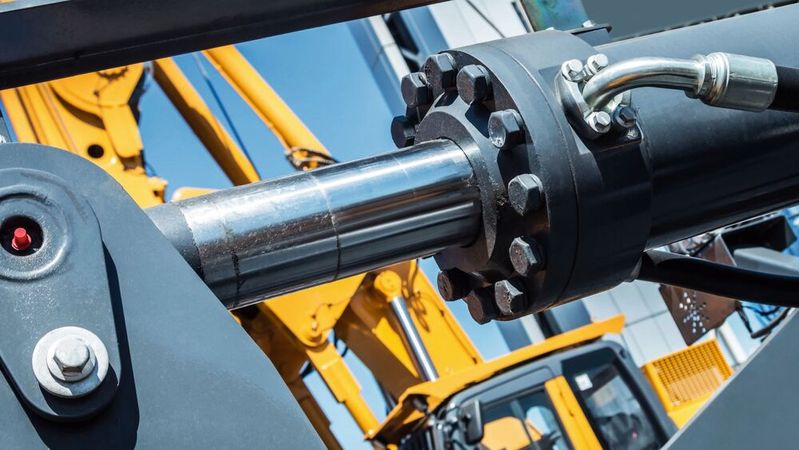
In machine construction, designs are often oversized by five to ten percent as a precaution. However, this causes machines to waste unnecessary energy. This can be avoided by 1. determining the actual requirements and 2. working with an open approach to technology. To determine requirements, questions such as the following are helpful: How much load is being moved? At what speed? How is power transmitted? What variations of machine and drive concepts exist? Which combinations are efficient? This systematic analysis—ideally using a morphological matrix—forms the basis for efficient solutions that are subsequently simulated in the CAD system. If loads of up to one ton need to be moved, electromechanical solutions are usually a good choice. Between two and four tons, it depends on the application. Above five tons, hydraulics are generally more efficient, even for stationary machines. The Hydraulics Initiative provides support and expertise for the use of hydraulics.
Prevent Seal Failure With FFKM
The cleanroom-certified production of the seal enables full traceability and validation support.
(Image: Angst+Pfister)
In the pharmaceutical, chemical, semiconductor, and energy industries, even a small leak can lead to production downtime, regulatory violations, or costly contamination. Seals in these environments face challenging conditions: exposure to aggressive chemicals, temperatures above 482°F, frequent cleaning cycles with steam, plasma, or solvents, vacuum and cleanroom requirements with zero tolerance for outgassing, as well as mechanical stress from pressure fluctuations, acidic gases, or HPHT conditions. Some companies in such high-stress environments use standard elastomers. However, this can result in frequent seal failures, unplanned downtime, regulatory risks, and high operational costs. A better alternative is to use seals made of perfluoroelastomers (FFKM), such as the Evolast seals from Angst+Pfister, produced in Italy and now part of a group-wide offering. They are characterized by chemical resistance, ranging from acids and bases to strong solvents. The seals are temperature-stable from –51°F to 644°F, suitable for cleanroom-compatible production with traceability, and compliant with FDA, USP Class VI, EU 1935/2004, NORSOK, NACE, ISO 23936/2. The manufacturer offers application-specific variants—from standard O-rings to custom-molded parts and plates.
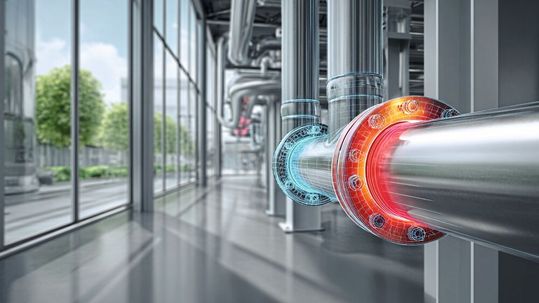
Free CAD Data for Pipe Connection Components
Voss Fluid, a manufacturer of line and connection systems for mobile and stationary hydraulics, provides designers with an online CAD database on its website. This database offers permanent free access to high-quality CAD data for over 15,000 pipe connection components in more than 80 common 3D and 2D formats. The data can be directly integrated into the users' CAD systems. Users gain insights into all dimensions and technical data through the database. This allows designers to find the component that suits them using various search options. With the shopping cart function, they can save items and request a non-binding quote directly. A planned update for autumn 2025 will enhance the platform with new products, customs tariff numbers, material specifications, and a convenient size comparison feature using model dimensioning.
Compliant With the F-Gas Regulation And Practical: CO2 As A Refrigerant
The refrigerant R744 (carbon dioxide) has a GWP value of 1, which is significantly below international requirements.
Refrigerants not only ensure the necessary cooling performance in cooling and temperature control devices but also determine whether a device is environmentally friendly and complies with legal regulations. Among these requirements is the EU F-Gas Regulation 2024/573, which mandates that manufacturers and users within the European Union must ensure by the end of 2025 that the refrigerants used have a GWP (Global Warming Potential) value of no more than 150. Many device manufacturers are therefore switching to alternative refrigerants. But which refrigerant should be used? This warrants a closer look, as the GWP limit of 150 allows for some flexibility. SMC, for example, is gradually converting its cooling and temperature control devices to the refrigerant R744 (CO2), which has a GWP value of only 1. The HRSC series will be the first to make the switch. Unlike most refrigerants, carbon dioxide is neither toxic nor flammable. Due to its properties, it meets the A1 classification according to the ASHRAE-34 standard. Devices equipped with this refrigerant can therefore also be transported by air. The non-flammability—a crucial property of CO2—significantly increases application safety, for example, in the electronics or semiconductor industry. Additionally, the non-flammable devices offer greater flexibility regarding installation space.
Bladder or Piston Accumulator?
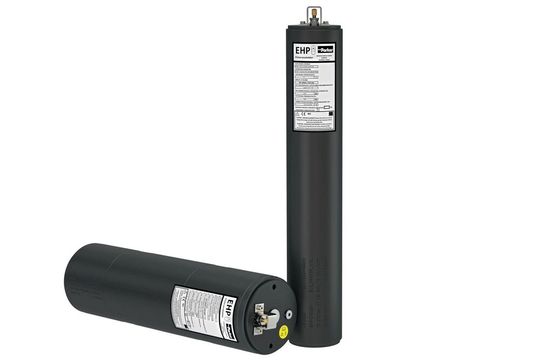
For gas bottle installations, piston hydraulic accumulators are usually the better choice due to their robust design and better hydraulic properties. Bladder hydraulic accumulators are only practical under certain conditions and with appropriate protective measures.
(Image: Parker Hannifin)
In gas bottle installations, both bladder and piston hydraulic accumulators are used. For external gas storage, the hydraulic accumulator should have identical connection cross-sections at the gas and hydraulic connections to allow unrestricted gas flow between the gas bottle and the accumulator. The gas bottle itself is equipped with a corresponding connection at one end and a gas filling valve at the other end. When designing a piston hydraulic accumulator, care must be taken to ensure that the piston does not hit during the operating cycle. On the other hand, bladder hydraulic accumulators should be dimensioned so that they are filled to a maximum of 75% to avoid overstretching the bladder. Additionally, for bladder hydraulic accumulators, a special transfer barrier tube is required at the gas end to prevent the bladder from being squeezed into the gas bottle line. However, this design limits gas flow due to the narrow neck of the transfer barrier tube. Due to these technical limitations, users often prefer piston hydraulic accumulators as they offer higher reliability and better flow conditions. In summary: For gas bottle installations, piston hydraulic accumulators are usually the first choice due to their robust construction and better hydraulic properties. Bladder hydraulic accumulators are only suitable under certain conditions and with appropriate protective measures.
Date: 08.12.2025
Naturally, we always handle your personal data responsibly. Any personal data we receive from you is processed in accordance with applicable data protection legislation. For detailed information please see our privacy policy.
Consent to the use of data for promotional purposes
I hereby consent to Vogel Communications Group GmbH & Co. KG, Max-Planck-Str. 7-9, 97082 Würzburg including any affiliated companies according to §§ 15 et seq. AktG (hereafter: Vogel Communications Group) using my e-mail address to send editorial newsletters. A list of all affiliated companies can be found here
Newsletter content may include all products and services of any companies mentioned above, including for example specialist journals and books, events and fairs as well as event-related products and services, print and digital media offers and services such as additional (editorial) newsletters, raffles, lead campaigns, market research both online and offline, specialist webportals and e-learning offers. In case my personal telephone number has also been collected, it may be used for offers of aforementioned products, for services of the companies mentioned above, and market research purposes.
Additionally, my consent also includes the processing of my email address and telephone number for data matching for marketing purposes with select advertising partners such as LinkedIn, Google, and Meta. For this, Vogel Communications Group may transmit said data in hashed form to the advertising partners who then use said data to determine whether I am also a member of the mentioned advertising partner portals. Vogel Communications Group uses this feature for the purposes of re-targeting (up-selling, cross-selling, and customer loyalty), generating so-called look-alike audiences for acquisition of new customers, and as basis for exclusion for on-going advertising campaigns. Further information can be found in section “data matching for marketing purposes”.
In case I access protected data on Internet portals of Vogel Communications Group including any affiliated companies according to §§ 15 et seq. AktG, I need to provide further data in order to register for the access to such content. In return for this free access to editorial content, my data may be used in accordance with this consent for the purposes stated here. This does not apply to data matching for marketing purposes.
Right of revocation
I understand that I can revoke my consent at will. My revocation does not change the lawfulness of data processing that was conducted based on my consent leading up to my revocation. One option to declare my revocation is to use the contact form found at https://contact.vogel.de. In case I no longer wish to receive certain newsletters, I have subscribed to, I can also click on the unsubscribe link included at the end of a newsletter. Further information regarding my right of revocation and the implementation of it as well as the consequences of my revocation can be found in the data protection declaration, section editorial newsletter.
Compressed Air Systems: How to Avoid And Eliminate Leaks
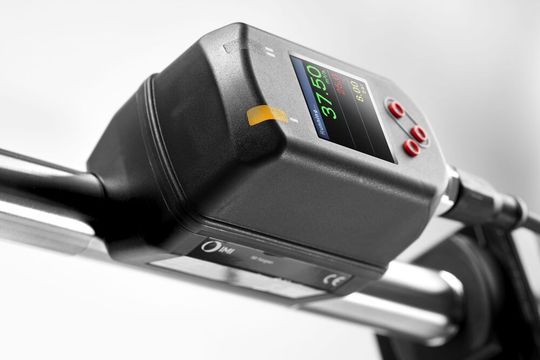
M/80 Inline Flow Sensor from Imi Norgren
(Image: Imi Norgren, Gareth Walker)
Compressed air leaks are a common and costly problem in industrial plants, often going unnoticed. Energy losses due to leakage can account for up to 30 percent of the energy consumption in a compressed air system. Regular inspections and maintenance enable the detection of leaks, improving efficiency and reducing waste. Routine system checks conducted quarterly or semi-annually allow leaks to be identified in often overlooked areas such as aging pipes, fittings, flanges, distributors, hoses, and couplings. Corroded pipes, worn connectors, or damaged hoses can lead to significant leakage, while improperly sized components further strain the system. Monitoring devices like flow and pressure sensors make leak detection more permanent and efficient. For example, the new M/80 inline flow sensor from Imi Norgren operates on the principle of thermal dispersion and reliably detects even small flow rates, which are typical of leaks. This enables quick action to minimize downtime.
Preventive maintenance is important: Regular inspection and cleaning of filters, dryers, and similar components prevent pressure drops due to contamination. Adhering to maintenance schedules and correctly sizing components are also crucial. Over- or undersized parts can lead to an inefficient system. Another option is shutting down temporarily unused parts of the piping system. Subsystems often remain pressurized even during extended periods of inactivity. By using shut-off or start-up/vent valves, these areas can be temporarily isolated, thereby reducing leaks and saving energy.
Proportional Pneumatics: Two Control Types, One Hardware
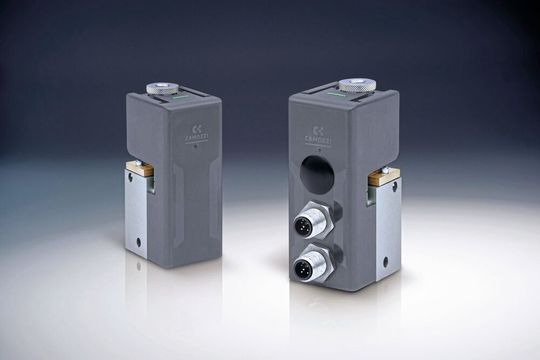
With the Twin-Control functionality of the Open Frame Controller (OFC) from Camozzi Automation, complex motion and force requirements can be combined in one system.
(Image: Camozzi Automation)
With the Open Frame Controller (OFC), Camozzi Automation has developed a modular, configurable control system that can function as a pressure, flow, or position controller. The highlight is the Twin-Control functionality, allowing the controller to switch between two control modes—for instance, from position to force control.
This allows a cylinder to be precisely positioned with just one 3/3-way proportional valve before seamlessly transitioning into a force-controlled pressing operation. Similarly, switching between flow rate control for speed regulation and pressure control for force adjustment is possible—without additional hardware.
The OFC uses two independently operating control loops. Switching is achieved through various interfaces such as switch inputs, IO-Link, or industrial fieldbuses (e.g., EtherCAT, Profinet). This saves space, reduces cycle times, and increases the flexibility of the application.
The Special-Application-Functions (SAFs) are also interesting. These firmware extensions are tailored specifically to user requirements. They enable individual mapping of internal control variables, diagnostic data, and control variables. Additionally, control parameters—such as P, I, or D components—can be adjusted during operation to dynamically respond to changing load situations.
The Twin-Control functionality of the Open Frame Controller combines dual functionality in a single component. For design and development, this means: less hardware, more flexibility.
This is how vacuum pumps stay cool when it gets hot outside
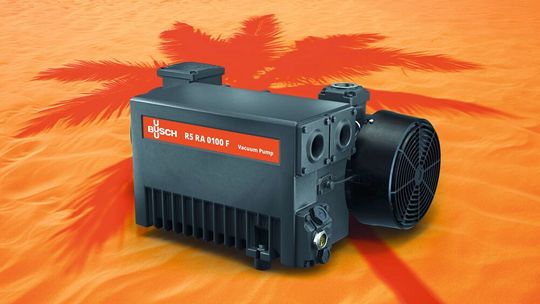
To ensure the reliability and longevity of vacuum pumps, they must be kept cool during hot weather.
(Image: Busch Vacuum Solutions)
At higher ambient temperatures, the oil in vacuum pumps breaks down faster than in cooler environments. This means it needs to be replaced more frequently, increasing maintenance costs. In technical rooms with temperatures exceeding 104°F, vacuum pumps can even overheat and fail. The effectiveness of natural ventilation through vents and cooling openings varies depending on temperature and wind speed and is not always sufficient. Particularly in confined spaces, installing a fan system to divert warm air and draw in cool air is a highly effective way to keep the technical room cool. Thermal management solutions and an intelligent design of the technical room are other important factors: By venting the exhaust air from vacuum pumps out of the technical room, heat dissipation into the room can be reduced by up to 35 percent. Pay attention to the proper material selection for piping, as it can become hot. By installing retrofitting kits for heat recovery, available for certain vacuum pumps, up to 80 percent of the energy consumed by the vacuum pumps can be recovered and utilized. Additionally, a well-thought-out design of the technical room can help prevent overheating. For instance, ensuring sufficient spacing between pumps allows for adequate air circulation.
Future-Proof Authentication with Universal RFID Readers



:quality(80)/p7i.vogel.de/wcms/53/f7/53f7dadbe4d656a3fd4f4077445f29f6/0129828707v1.jpeg "Thanks to its compact design and drilling/unscrewing function, the Fire Birdie is suitable for applications with limited installation space and frequent tool changes. (Image:Marcel Kraibühler)")
:quality(80)/p7i.vogel.de/wcms/da/4d/da4da8d34671dc6bce80e496212de877/0129850788v1.jpeg "Mate-XT Go supports the arms and shoulders during overhead work and repetitive tasks and is designed to significantly reduce muscle strain in everyday working life. (Image:Comau)")
:quality(80)/p7i.vogel.de/wcms/95/97/95976dbaac68b249eb65e74c5aad5300/0129651893v1.jpeg "The C2.0 centric clamps, the S2 fixed jaw clamps and the \"gredoc\" zero-point clamping systems are used for machining the raw parts. Fastening is carried out with width across flats 27. (Image:Gressel)")
:quality(80)/p7i.vogel.de/wcms/57/1b/571b8895efb299d70846bbdbd7af2338/0130043886v1.jpeg "Servo hydraulics independent of the control system: The servo hydraulics software module is integrated directly into the b Maxx 5500 servo drive (pictured: Mehmet Sari, Export Sales Manager at Hürsan Pres (left), Özgür Deniz Demirbaş, Country Manager at Baumüller Turkey) (Image:Baumüller)")
:quality(80)/p7i.vogel.de/wcms/3b/27/3b27f6c5848be73acecb04054bf0a146/0130115209v1.jpeg "Spectroscopic glucose measurement with infrared spectroscopy enables more regular measurements without physical strain. (Image:Endrich)")
:quality(80)/p7i.vogel.de/wcms/3f/cc/3fccb748b0fe16f1f61249d94c72f126/0130149439v1.jpeg "Requirements for integrated power supply systems: Precise AC and DC power supply systems that not only provide energy, but also reliably combine measurement, analysis and system integration. (Image:Schulz Electronic)")
:quality(80)/p7i.vogel.de/wcms/fd/93/fd93e01c16f5a4709278499d981a459c/0130061090v1.jpeg "Revealed: These servo drives are assembled at Aerotech in Fürth. (Image:Aerotech)")
:quality(80)/p7i.vogel.de/wcms/cb/8a/cb8ae7f5205365efce3e7285154fc3cf/0130132198v1.jpeg "Markus Huber (left) and Nicolai Friis from TU Wien know how to make quantum computers multidimensional in order to perform computing operations even better. (Image:TU Vienna / A. Rommel)")
:quality(80)/p7i.vogel.de/wcms/63/21/6321beb732bf7d92640df46d7aa77573/0130125122v1.jpeg "As part of the Carbon Lab Factory Lausitz, a pilot plant for the production of sustainable, cost-effective and competitive carbon fibers will be built at the Guben site. (Image:Fraunhofer IAP / Kristin Stein)")
:quality(80)/p7i.vogel.de/wcms/53/4f/534fe0f168f6ee070ded4a48faca4cef/business-wire-main-image-1103x620v1.jpeg "The new UR AI Trainer, developed by Universal Robots and Scale AI, is the first direct lab-to-factory solution for AI model training.
(Source: Universal Robots)")
:quality(80)/p7i.vogel.de/wcms/08/70/087062e2e1a9b9add5777410dd746ee9/adobestock-1923991605-5607x3156v1v1.jpeg "A new type of tactile sensor, inspired by human skin, even recognizes grains of sand. (Image:Curioso.Photography - stock.adobe.com)")
:quality(80)/p7i.vogel.de/wcms/7f/08/7f087d7013424d123ab7275cd2e3fe55/adobestock-809456218--c2-a9-20degimages-20-e2-80-93-20stock-adobe-com-ki-generiert-4179x2351v1v1.jpeg "The digital upgrading of existing machines conserves resources, saves energy and reduces the need for new production. (Image:Degimages - stock.adobe.com/AI-generated)")
:quality(80)/p7i.vogel.de/wcms/90/db/90db3087d3af0560fcdb4dbc42443ce1/0130157448v1.jpeg "The switch to SDV is the most complex transformation the industry has ever had to master. The end consumer gets a vehicle that gains rather than loses value over its lifetime. (Image:Sonatus)")
:quality(80)/p7i.vogel.de/wcms/73/f0/73f00bb99a23197db05bb584fe78f20f/0130080581v1.jpeg "The \"China Speed\" analysis by Roland Berger shows that the speed of development has only a limited connection with labor costs. (Image:freely licensed at Pexels)")
:quality(80)/p7i.vogel.de/wcms/2f/5b/2f5ba6a150b52c2b8efada560c5cdafe/0130143442v1.jpeg "Automotive suppliers are facing a severe crisis, which is primarily due to a combination of structural change and economic problems. (Image:freely licensed at Pexels)")
:quality(80)/p7i.vogel.de/wcms/22/d0/22d03cd48e992435338b59464c428d41/0129739814v1.jpeg "More electric vehicles on the roads mean a higher demand for electricity - which should ideally be covered by renewable energies. (Image:BMW)")
:quality(80)/p7i.vogel.de/wcms/94/7a/947ac066b98cbcd3470e83ff9da3e25f/0130096114v1.jpeg "The use of amorphous steels in the stator enables a significant reduction in losses and increases the efficiency of modern electric motors in vehicle drives. (Image:Horse Powertrain)")
:quality(80)/p7i.vogel.de/wcms/e5/f1/e5f171d3d7ae021332cc0aeae4d6e299/0130127049v1.jpeg "In collaboration with Shanghai Jiao Tong University, Lenovo has presented a silicon anode battery under the name \"ED1000\" as a proof of concept for mobile workstations. (Image:Lenovo)")
:quality(80)/p7i.vogel.de/wcms/fa/69/fa696e59706b96fff02283dd74cc2398/0130129635v1.jpeg "Samsung Co-CEO Jun Young-hyun wants to respond to the AI-driven boom in demand in the memory market with contracts for up to five years. This should provide more planning security in the traditionally volatile storage business. At the same time, however, this is likely to increase the pressure on customers to secure precise long-term requirements, prices and supply chains. (Image:Samsung)")
:quality(80)/p7i.vogel.de/wcms/31/a8/31a883a47b86634c382923e78fd9a4c9/0130133225v1.jpeg "Figure 1: GMSL-capable point-to-point connection. (Image:ADI)")
:fill(fff,0)/p7i.vogel.de/companies/67/eb/67eba621ef6ea/logo2.png "logo2 (Wuxi InfiMotion)")

:quality(80):fill(efefef,0)/p7i.vogel.de/wcms/67/ae/67ae0b9ac31f8/elatec-wp-universal-reader.png "Elatec WP Universal Reader")
:quality(80)/p7i.vogel.de/wcms/50/3e/503eb8ce345336e6cbed9fa585e17be4/0127631042v1.jpeg "Compair has developed an AI-based compressed air management system. (Image:CompAir)")
:quality(80)/p7i.vogel.de/wcms/40/c5/40c5051cebdb10fdee9a283303434d9d/0129881741v1.jpeg "3D-printed tools and other components contribute to energy-saving, precise processes. (Image:Gerhard Schubert GmbH)")