HistoryMercedes E-Class: More than Average for 30 Years
From
Wolfram Nickel/SP-X
5 min Reading Time
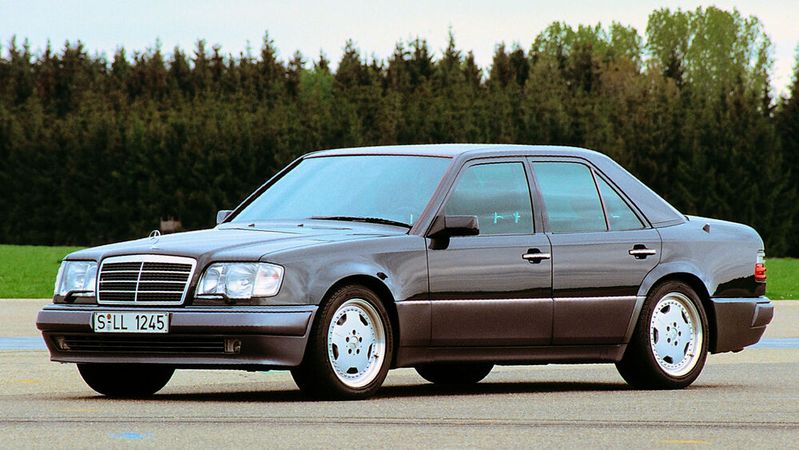
In June 1993, Mercedes refreshed the old series W 124 by renaming it the E-Class. E stands for "Executive", allowing the star carriers to outpace pursuers like the BMW 5 Series and Audi A6. Now, the first E-Class is becoming a classic car.
In June 1993, Mercedes refreshed the almost ten-year-old W 124 series by designating it as the E-Class.
(Image: Mercedes-Benz)
The heart of the brand: Mercedes has sold more than 16 million units of the "medium class" vehicles to date, since the Type 170 V in 1947 set the foundation for this highly successful line of premium sedans and wagons. Those who purchased a "Ponton-Benz," the "Fintail," or the "Stroke Eight" in the first post-war decades were considered affluent, and the star emblem was a symbol of societal success.
But everyone else could also enjoy the comfort of a Mercedes - at every taxi stand. However, in June 1993, the shine of the star suddenly dimmed. Dark economic clouds after German reunification and young competitors from Munich and Ingolstadt began to pose a challenge to the Mercedes models 200 to 500 E of the W 124 series, which were initially celebrated as cool but by then almost ten years old. For the first time in 30 years, Daimler-Benz AG had to cut jobs. What to do?
A facelift for the aging W-124 models and a nomenclature structured according to "classes," following the example of the S-Class introduced in 1972, was the solution. Thus, the "medium class" was transformed into the E-Class. E officially stood for Executive according to the explanation, but a more fitting interpretation would have been E for success. The first E-Class proved to be a guiding star, outperforming BMW and Audi. Mercedes sold around 240,000 units of the W-124 series in 1993, roughly double the sales of the Audi 100 or BMW 5 Series.
Competition from abroad
Indeed, the redesigned Swabian business class bridged the gap to an era where the E-Class had to increasingly attract customers in emerging Asian markets and defend against attacks from many new premium players from Acura to Lexus. Not to be forgotten are the French, Italians, and Swedes, who revitalized their passion for luxury and lifestyle since the late 1980s with models like the Alfa 164, Lancia Kappa, Citroen XM, Peugeot 605, Renault Safrane, and Volvo 960, causing a sensation.
It fit that Peugeot suddenly claimed to be the world's largest diesel engine manufacturer. German taxi drivers didn't care about that, they continued to love the Daimler as an almost indestructible diesel long-distance runner. This was preferably as an E 200 D with 55 kW/75 hp. Yes, this Mercedes miser in chauffeur service had a power rating that today is only sufficient for small cars.
1993 was the year of the old masters - Alain Prost celebrated his fourth Formula 1 world championship title, Steffi Graf won in her 100th Wimbledon final, and Steven Spielberg's dinosaurs in "Jurassic Park" broke all box office records - for the old W 124, a transformation to the E-Class required just some chrome polish, a badge radiator grille in the style of the S-Class (W 140), powerful V8 engines, and new four-valve diesel engines to outshine premium newcomers of European or Asian origin.
Environmental consciousness and fun
Finally, the spirit of the time had carried important social issues from the early days of the W 124 into the following decade: rapidly growing environmental awareness, but also the old song "I want fun, I step on the gas." Therefore, the Benz now evolved as the E 60 AMG with a powerful 6.0-liter V8 producing 280 kW/381 PS, becoming the chief dynamo among German company cars, not even the Ferrari Mondial accelerated faster to 100 km/h.
At the same time, Mercedes dared to use new technology for the sake of the environment, allowing the diesel engines to shake off their image as soot machines through oxidation catalysts and exhaust gas recirculation.
For each customer, the appropriate engine and the adequate body style, this artistry reached its temporary peak in the first E-Class from Mercedes. Never before had there been such a wide range of engines in a business class model series. The power range for the petrol engines with four, six, or eight cylinders extended from 80 kW/109 PS to 280 kW/381 PS, and for the diesel engines with four, five, and six cylinders, it ranged from 55 kW/75 PS to 108 kW/147 PS. Since 1985, there was also the optional all-wheel drive system 4Matic in response to Audi's Quattro offensive.
Last true Mercedes
Today, the new sixth generation of the "Executive" class (W 214) is hailed by experts as the "last E-Class of the old automotive world," before the exclusively fully electric models. The W 124 series is regarded by many fans as the "last true Mercedes." This may also be because, in various forms such as sedan, lifestyle estate T-model, ambulances, hearses, coupes, convertibles, and up to six-door limousines (at 5.54 meters, Germany's longest vehicle), the W 124 was omnipresent in life and traffic before the turn of the millennium.
Date: 08.12.2025
Naturally, we always handle your personal data responsibly. Any personal data we receive from you is processed in accordance with applicable data protection legislation. For detailed information please see our privacy policy.
Consent to the use of data for promotional purposes
I hereby consent to Vogel Communications Group GmbH & Co. KG, Max-Planck-Str. 7-9, 97082 Würzburg including any affiliated companies according to §§ 15 et seq. AktG (hereafter: Vogel Communications Group) using my e-mail address to send editorial newsletters. A list of all affiliated companies can be found here
Newsletter content may include all products and services of any companies mentioned above, including for example specialist journals and books, events and fairs as well as event-related products and services, print and digital media offers and services such as additional (editorial) newsletters, raffles, lead campaigns, market research both online and offline, specialist webportals and e-learning offers. In case my personal telephone number has also been collected, it may be used for offers of aforementioned products, for services of the companies mentioned above, and market research purposes.
Additionally, my consent also includes the processing of my email address and telephone number for data matching for marketing purposes with select advertising partners such as LinkedIn, Google, and Meta. For this, Vogel Communications Group may transmit said data in hashed form to the advertising partners who then use said data to determine whether I am also a member of the mentioned advertising partner portals. Vogel Communications Group uses this feature for the purposes of re-targeting (up-selling, cross-selling, and customer loyalty), generating so-called look-alike audiences for acquisition of new customers, and as basis for exclusion for on-going advertising campaigns. Further information can be found in section “data matching for marketing purposes”.
In case I access protected data on Internet portals of Vogel Communications Group including any affiliated companies according to §§ 15 et seq. AktG, I need to provide further data in order to register for the access to such content. In return for this free access to editorial content, my data may be used in accordance with this consent for the purposes stated here. This does not apply to data matching for marketing purposes.
Right of revocation
I understand that I can revoke my consent at will. My revocation does not change the lawfulness of data processing that was conducted based on my consent leading up to my revocation. One option to declare my revocation is to use the contact form found at https://contact.vogel.de. In case I no longer wish to receive certain newsletters, I have subscribed to, I can also click on the unsubscribe link included at the end of a newsletter. Further information regarding my right of revocation and the implementation of it as well as the consequences of my revocation can be found in the data protection declaration, section editorial newsletter.
This E-Class could do it all: state limousine, elegant cabriolet for the rich and famous from St. Moritz to Santa Barbara, and stylish taxi. Taxi? That's exactly what will end with the new W 214 series, vans are meant to take over this function.
It was the taxi drivers who subjected every E-Class to a special endurance test in everyday life. Once the so-called teething troubles were cured (early W 124, for example, had rattling noises), the star was always considered the epitome of solidity.
Design award for the '95 model
Fitness and body shaping were also trends since the 1990s, and thus the 1995 introduced mid-class Mercedes series W 210 with four eyes looked out into the world and received the "red dot" design award for it. The wide range of models of this visual highlight extended from the E 200 Diesel to the E 55 AMG. After the moose test debacle of the A-Class, this optical eyecatcher was kept on course by the standard driving safety system ESP.
The year 2002 saw the introduction of the Euro as cash, and Mercedes proudly announced an investment of two billion euros in the third E-Class (W 211). Safety (adaptive front airbags, active bi-xenon cornering lights), environmental friendliness (from 2006, the E 320 BlueTec was considered the "cleanest" diesel worldwide), and dynamics were given particular importance in the development of the models E 200 CDI to E 63 AMG. In 2005, an E 320 CDI set a world record by driving faster than all others: reaching 224 km/h over 160,000 kilometers.
"Those who do not move with the times are left behind by time."
With this quote from the poet Friedrich Schiller, Mercedes-Benz celebrated the W 212 series introduced in 2009 as the most aerodynamic premium sedan in the world. Especially for the Chinese market, there was now a long version, and in the rest of the world, the E-Class also evoked strong emotions as a new coupe and convertible.
By the time of the 2016 generational change of the E-Class (W 213), plug-in hybrids were already part of good social etiquette. But maximum power, now at 450 kW/612 hp, continued to be a must.
The E-Class holds significant historical relevance, as explained by expert Martin Heinze from the vintage car valuation organization Classic Analytics: "The W 124, as the mother of all E-Classes, has now become one of the most popular Mercedes classics, even surpassing its predecessors, the W 123 and Stroke Eight. The four-seater convertible and the T-models are particularly popular, and the most valuable piece is the top model 500 E, which in good condition is hardly available for less than 50,000 euros."



:quality(80)/p7i.vogel.de/wcms/a0/47/a04725ef9bd09fb6c9341a1bea1b5d93/0130443083v1.jpeg "Here, a type of plastic pallet is produced by thermoforming (vacuum forming or deep drawing) at the corresponding division of New England Plastics in the USA. This division, which specializes in so-called liners, is now part of Ringmetall ... (Image:New England Plastics)")
:quality(80)/p7i.vogel.de/wcms/e3/42/e342b3c593ea92d56604d3be969e9c9a/0130437231v1.jpeg "Daimler Truck will be building even more trucks at its Czech plant in Cheb in the future. This is because it is now being expanded for strategic cost-saving reasons ... (Image:Daimler Truck)")
:quality(80)/p7i.vogel.de/wcms/23/99/23992bf2dcdc432c9b7209c34a4a7c48/0129733089v1.jpeg "Stork relies on the modular Neoswiss turning system from Iscar to shorten the set-up times for its sliding headstock lathes and work more productively. (Image:Iscar)")
:quality(80)/p7i.vogel.de/wcms/7d/e2/7de2923434b2f1a78ba5482d8d335269/0113143253v1.jpeg "In our China Market Insider we regularly provide you with relevant information directly from China. (Image:© Eisenhans - stock.adobe.com)")
:quality(80)/p7i.vogel.de/wcms/b7/36/b736dfebc16c42d6901d0d0e1f390493/3d-druck-20factory-20--20ki-20generiert-1920x1079v1.png "(Source: AI-generated)")
:quality(80)/p7i.vogel.de/wcms/79/b2/79b21aad663f4a7bd4472afc1c1afc62/0130433994v1.jpeg "Mission Joyride: The free-flying robot (shown here in the rendering) will relieve the ISS crew of logistics tasks from 2027 with its two mechanical arms. (Image:Icarus Robotics)")
:quality(80)/p7i.vogel.de/wcms/6b/45/6b4546fa6ebf305c3660326909363f32/0130437089v1.jpeg "Industrial AI in action: Rockwell Automation presents practical solutions for self-controlling production systems at the Hannover Messe. (Image:Rainer Jensen, Deutsche Messe)")
:quality(80)/p7i.vogel.de/wcms/78/e9/78e9188c25a8a94e67c34c9bf8ffe495/visual-agile-20robots-20and-20google-20deepmind-20partner-20to-20bring-20intelligence-20to-20robotics-2500x1406v1v1.jpeg "Together, the partners are developing adaptable, intelligent robots for a wide range of applications (Image:Agile Robots SE)")
:quality(80)/p7i.vogel.de/wcms/59/a2/59a2b11f0aa1b700eff02addd5de8703/adobestock-1788280853--c2-a9-20satria-20-e2-80-93-20stock-adobe-com-5081x2860v1v1.jpeg "Quantum computers require extreme cooling to temperatures close to absolute zero in order to keep qubits stable. (Image:satria - stock.adobe.com)")
:quality(80)/p7i.vogel.de/wcms/62/5f/625f41e87ebfef156a98c8e6393e32fd/0130211654v1.jpeg "Axial flux motors have some advantages over radial flux motor—but their production is currently still expensive. (Image:RWTH Aachen University)")
:quality(80)/p7i.vogel.de/wcms/f6/ae/f6aec4f6241b36ed5e3a990ac9176b42/0130429460v1.jpeg "Verne, Pony.ai and Uber want to launch a robotaxi service in Europe. (Image:Verne)")
:quality(80)/p7i.vogel.de/wcms/d7/88/d788699f2974708a332baa4e7a62fa9e/0130438967v1.jpeg "Skoda is withdrawing from China. The brand has produced well over three million vehicles there. (Image:Skoda car)")
:quality(80)/p7i.vogel.de/wcms/b0/43/b043b86899837532aad62d63368a917a/0130371361v1.jpeg "Skoda leaves the chinese market.
(Image:Skoda)")
:quality(80)/p7i.vogel.de/wcms/c3/c4/c3c4ce270b083eeac55654148611f064/0130237945v1.jpeg "China is not giving up on hydrogen, but is intensifying its efforts. (Image:freely licensed from Pixabay)")
:quality(80)/p7i.vogel.de/wcms/ee/09/ee09acbd6dc896df25affaa9e871e6e5/0130440053v1.jpeg "IMS chip module for simple system integration into an ion mobility spectrometer. (Image:Fraunhofer IPMS)")
:quality(80)/p7i.vogel.de/wcms/10/6c/106cd22de5f68a0f74639d654827228c/0130345302v1.jpeg "Made in India: According to the India Electronics and Semiconductor Association (IESA), the country should be able to produce between 75 and 80 million chips by the beginning of 2027, once the plants currently under construction become operational. (Image:Pixabay (Montage: Sebastian Gerstl))")
:quality(80)/p7i.vogel.de/wcms/a5/ed/a5ed6fda029d362732a293d6b19d74c4/0130444216v1.jpeg "Thirteen executives from the Chinese chip industry have drawn up a plan to achieve an 80% self-sufficiency rate for semiconductors by 2030. (Image:Maxim_Kazmin - stock.adobe.com)")
:quality(80)/p7i.vogel.de/wcms/31/a6/31a646018b34d8e0a44bfc8bf17837f6/0130361632v1.jpeg "For many companies, PFAS are considered indispensable in electronics production. (Image:freely licensed)")
:quality(80)/p7i.vogel.de/wcms/bc/4e/bc4e14bd8e4bb96db3eca578e3365784/0124034767v1.jpeg "Even with the luxury lounge in the rear, the Nio ET9 makes the established Europeans look outdated. (Image:Nio)")
:quality(80)/p7i.vogel.de/wcms/52/39/52393e89d0896d2c0289ce012bb0f731/0127590831v1.jpeg "The glass tailgate of the 1985 Volvo 480 ES referenced the legendary 1800 ES \"Snow White's Coffin,\" but technically, the 480 ES embodied progress. (Image:Volvo)")