Actually, Volkswagen is celebrating three anniversaries this year: the well-known "Bulli" was launched 75 years ago. The "LT," which stands for Lasten-Transporter (cargo transporter), has been around for half a century. And also the "Polo" subcompact car made its debut in the automotive world 50 years ago, although it cannot, of course, be categorized under Volkswagen Commercial Vehicles (VWN) production.
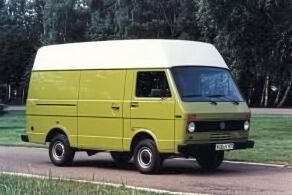
"LT" stands for "Lasten-Transporter" (Cargo Transporter). It was introduced in Berlin 50 years ago.
(Image: Volkswagen Commercial Vehicles)
The LT transporter, often somewhat disparagingly referred to as a "panel van," is featured in this profile simply because you are currently reading a logistics trade magazine, and the "workhorse" LT is therefore favored over the other two jubilees.
The world premiere of the "LT" took place in April 1975 in Berlin. The "big brother" of the "Bulli," which by then was already in its second generation, successfully expanded the product range from Hanover. Since its market launch in 1950, the terms "Volkswagen" and "Transporter" have been closely intertwined. However, since the "Bulli" was not intended for very heavy loads, Volkswagen developed a model positioned below heavy trucks but above the VW Bus: a cargo transporter in the segment of 2.8 to 3.5 tons gross vehicle weight. For the naming of the newcomer, the Lower Saxons were distinctly pragmatic: "LT" stands, as mentioned above, for "Lasten-Transporter." The numbers 28, 31, and 35 were appended, simply indicating the permissible gross weight of the transporter, albeit separated by commas.
Many Variants Available From the Start
As the automotive group states, they listened to their customers' wishes even back then and offered the "LT" with two wheelbases and two roof variants from the start. The spatial miracle was available as a panel van, station wagon, bus, flatbed, double cab, and even as a chassis with a cab for further expansion.
Even before the development of the "LT," it was established within the company that the ratio of traffic area to utility area should be better than that of the rear-engine Transporter. Therefore, the engineers designed a vehicle with space-saving cab-over-engine construction and a front engine, positioned between the driver and passenger seats, above the front axle; the vehicle, however, was still driven by the rear axle. Without a rear engine, the entire cargo area was available for use as a cargo transporter. Yet, as Volkswagen notes in a retrospective, the "LT" remained compact: compared to the T2 "Bulli," the "LT" grew by just 34 centimeters in length and 30 centimeters in width. With 7.85 cubic meters of cargo space, the 50-year-old celebrant offered over 50 percent more loading volume.
Ergonomics was Previously a Foreign Concept
Even though the then-new bestseller from Hanover might have appeared somewhat "boxy" by today's standards, there was pride in the ergonomic component, which had been somewhat neglected in commercial vehicles until then. For instance, the cab was developed with the help of work scientists. Thanks to this collaboration, the controls for the equipment were placed close to the driver. The large front windshield and extra-large exterior mirrors also benefited the driving personnel.
More driving comfort was promised, among other things, by the independent suspension on the front axle—a feature that was not standard among competitors even years later. Initially, the "LT" was available with either a 2.0-liter four-cylinder petrol engine (from the Audi 100) or a 2.7-liter four-cylinder diesel engine from the English manufacturer Perkins, which was replaced in 1979 by VW's first own six-cylinder diesel. Although the new 2.4-liter engine in the "LT" delivered only eight more horsepower than its English predecessor, it offered significantly more torque and ran very smoothly. So smoothly, in fact, that even Volvo installed this engine in its first six-cylinder passenger cars.
Model Maintenance or Genuine Metamorphosis?
Like its smaller brother, the "Bulli," the "LT" has undergone several model updates over the years—here are just a few highlights: In 1983, the six-cylinder turbodiesel was introduced, making the "LT" the most powerful transporter in Europe with 75 kilowatts (102 horsepower). In 1985, the "LT 55" was added, boasting a total weight of 5.6 tons. In 1993, the series received a facelift, including a new radiator grille and plastic elements in the area of the taillights.
The sheer size of the cargo transporter quickly sparked interest among campers (not only in this country): due to its obvious quality and reliability, combined with large usable space within compact dimensions, the "LT" became a popular base for motorhomes. In 1988, alongside the compact California (based on the third generation (T3) of the "Bulli"), Volkswagen also presented a motorhome based on the "LT." With the Florida, the Hanoverians offered a fully-fledged motorhome for four people with a bathroom.
Date: 08.12.2025
Naturally, we always handle your personal data responsibly. Any personal data we receive from you is processed in accordance with applicable data protection legislation. For detailed information please see our privacy policy.
Consent to the use of data for promotional purposes
I hereby consent to Vogel Communications Group GmbH & Co. KG, Max-Planck-Str. 7-9, 97082 Würzburg including any affiliated companies according to §§ 15 et seq. AktG (hereafter: Vogel Communications Group) using my e-mail address to send editorial newsletters. A list of all affiliated companies can be found here
Newsletter content may include all products and services of any companies mentioned above, including for example specialist journals and books, events and fairs as well as event-related products and services, print and digital media offers and services such as additional (editorial) newsletters, raffles, lead campaigns, market research both online and offline, specialist webportals and e-learning offers. In case my personal telephone number has also been collected, it may be used for offers of aforementioned products, for services of the companies mentioned above, and market research purposes.
Additionally, my consent also includes the processing of my email address and telephone number for data matching for marketing purposes with select advertising partners such as LinkedIn, Google, and Meta. For this, Vogel Communications Group may transmit said data in hashed form to the advertising partners who then use said data to determine whether I am also a member of the mentioned advertising partner portals. Vogel Communications Group uses this feature for the purposes of re-targeting (up-selling, cross-selling, and customer loyalty), generating so-called look-alike audiences for acquisition of new customers, and as basis for exclusion for on-going advertising campaigns. Further information can be found in section “data matching for marketing purposes”.
In case I access protected data on Internet portals of Vogel Communications Group including any affiliated companies according to §§ 15 et seq. AktG, I need to provide further data in order to register for the access to such content. In return for this free access to editorial content, my data may be used in accordance with this consent for the purposes stated here. This does not apply to data matching for marketing purposes.
Right of revocation
I understand that I can revoke my consent at will. My revocation does not change the lawfulness of data processing that was conducted based on my consent leading up to my revocation. One option to declare my revocation is to use the contact form found at https://contact.vogel.de. In case I no longer wish to receive certain newsletters, I have subscribed to, I can also click on the unsubscribe link included at the end of a newsletter. Further information regarding my right of revocation and the implementation of it as well as the consequences of my revocation can be found in the data protection declaration, section editorial newsletter.
And after 21 years and over 470,000 "LT" units produced, the time was ripe in 1996 for a successor: the "LT2." For its development, Volkswagen Commercial Vehicles entered into a cooperation with Mercedes-Benz. The diesel engines were now installed longitudinally under a short hood, the entry was significantly lower, and there was the possibility to easily move between the front seats to the rear loading or passenger compartment. In 2006, after almost 340,000 units, the production of the "LT2" at the Stöcken plant also came to an end. (bm)
Timeline
1975 – The "LT" (Lasten-Transporter) premieres in Berlin in April.
1983 – Optimized installation position of the engine allows for a third seat in the cab. Additionally, a third wheelbase for flatbeds up to 4.6 meters in length is available.
1985 – "LT 55" with a total weight of 5.6 tons is launched. Switchable "4x4" all-wheel drive available.
1993 – Updated turbo diesel with intercooler and 70 kilowatts (95 horsepower).
1996 – The "LT2" with, among other things, the TDI engines replaces the previous "LT."
2002 – A 2.8-liter four-cylinder diesel makes the "LT2" an "Express" vehicle.
2006 – The successor "Crafter" sees the light of the automotive world.



:quality(80)/p7i.vogel.de/wcms/2c/d6/2cd65bff6624dbdc007f2315307612fe/0130800023v1.jpeg "An international consortium led by Tata Steel Nederland has made significant progress in the development of new zinc-coated ultra-strong steels. (Image:Tata Steel)")
:quality(80)/p7i.vogel.de/wcms/f0/e0/f0e05856a96a9afa991a8dd9f4aceb04/0131242862v1.jpeg "Humanoid robots are the focus of the \"TUM RoboGym (powered by Neura)\". (Image:Neura Robotics)")
:quality(80)/p7i.vogel.de/wcms/c3/be/c3be858b644b6f52c83ea025a6f596ad/0130477152v1.jpeg "With the \"DUO\" version of the \"POWER-Skate XL\", loads can be moved in all directions. (Image:HTS)")
:quality(80)/p7i.vogel.de/wcms/92/87/9287ce9327245bdcd01af627044b34c8/0131221372v1.jpeg "Here, Binder provides information on a standardized portfolio and, above all, on improvements for the assembly of M12 connectors, which are now easier to handle and even safer ... (Image:Binder)")
:quality(80)/p7i.vogel.de/wcms/fc/5c/fc5c314369136a0f2b4819ca4011ce80/0131048280v1.jpeg "It all depends on the overall IO-Link package. If the interaction between sensors, powerful masters and a manufacturer-independent configuration tool is right, a significant increase in machine performance is possible. (Image:Baumer)")
:quality(80)/p7i.vogel.de/wcms/69/a2/69a26de87302feccb0ad51bc5eefae4d/0131155056v1.jpeg "Quantum Mate with integrated cobot takes over manual, repetitive tasks in an automated, reliable and efficient process. (Image:Galdabini)")
:quality(80)/p7i.vogel.de/wcms/72/54/7254c0031573057a049e5879cba0de85/0130912407v1.jpeg "The serial interface still has its legitimacy in the age of Industry 4.0: it is still used, for example, to connect peripheral devices such as scanners. (Picture: ©Guy - stock.adobe.com)")
:quality(80)/p7i.vogel.de/wcms/c1/70/c170fd5c52c08ceb4bc2b58eb94ea95f/newsimage421365-2048x1151v1v1.jpeg "Diving robot from TU Bergakademie Freiberg before its first dive at the Malter dam (Image:Andreas Hiekel/TUBAF)")
:quality(80)/p7i.vogel.de/wcms/30/76/3076278d4a7b51a5c566581a20135afc/54963580015-cdcb4657c5-k-2047x1151v1v1.jpeg "The Nancy Grace Roman space telescope was completed in the largest clean room at NASA's Goddard Space Flight Center. It is due to be launched into space in September 2026. (Image:NASA/Jolearra Tshiteya / CC BY 4.0)")
:quality(80)/p7i.vogel.de/wcms/3a/08/3a08d5a0623b4d32294e8108d639f237/nivalon-20medical-20-1626x914v1v1.png "EvoFlex implant from Nivalon Medical consists of a bone-like ZTA ceramic that is precisely adapted to the anatomy of each patient. (Image:Nivalon)")
:quality(80)/p7i.vogel.de/wcms/55/93/55936485100842cd9e83fa3ec053e9c1/2-995x560v1v1.png "The research team at the Technical University of Munich measures and controls the tendon forces on the robot. The aim of the research project is to develop new control concepts. (Image:TU Munich)")
:quality(80)/p7i.vogel.de/wcms/c2/df/c2df275b52afda5130ec90662fc767af/adobestock-1858604981--c2-a9-20vladyslav-20andrukhiv-20-e2-80-93-20stock-adobe-com-ki-generiertv1.jpeg "Artificial sun on earth: Start-ups in China are working to accelerate the development of the virtually inexhaustible energy source of nuclear fusion with AI. (Source: © Vladyslav Andrukhiv - stock.adobe.com/AI-generated)")
:quality(80)/p7i.vogel.de/wcms/2c/1f/2c1fb590b96de7ca3ca029564b063865/0131218954v1.jpeg "Xpeng brings the X9 to Germany. (Picture:Xpeng)")
:quality(80)/p7i.vogel.de/wcms/94/6b/946b136b4478d8b80e3d9e62041e7274/0131259520v1.jpeg "The Craft test bench in Berlin is used to develop future propulsion systems for sustainable aviation. The aim is to minimize noise while maintaining the efficiency of aircraft engines. (Image:DLR)")
:quality(80)/p7i.vogel.de/wcms/5a/14/5a14b26a5d4495d3a192e90e5c216251/ai-catl-sodium-batteries-vs-lithium-revolution-1800x1012v1v1.jpeg "The supplier CATL is bringing its first sodium-ion batteries into series production. Although not in the automotive industry, this step is set to follow soon. (Image:CATL)")
:quality(80)/p7i.vogel.de/wcms/68/43/68433001d98374eb72f51b4a7db590fe/0131229290v1.jpeg "Charging infrastructure provider Evoltra will operate as Citywatt Development in the future. (Image:Citywatt)")
:quality(80)/p7i.vogel.de/wcms/98/11/981107e7d149b2ff970c574cdd73f158/0131183152v1.jpeg "An optical phased array (OPA) counteracts strong optical crosstalk. For this purpose, the antenna geometry is arranged asymmetrically. (Image:Amy Pan / MIT)")
:quality(80)/p7i.vogel.de/wcms/a3/2e/a32e8b8bb38bd5c1cfd27b043baf72b7/0131203375v1.jpeg "Alliance for the AI age: Sony and TSMC join forces to produce next-generation smart image sensors (Image:Brunox983/Pixabay)")
:quality(80)/p7i.vogel.de/wcms/f9/5d/f95d24afa8d7ffb2c27916d0f329c670/0131192604v1.jpeg "Symbolic image: Kontron has a positive outlook for 2026, but must restructure. (Image:AI-generated)")
:quality(80)/p7i.vogel.de/wcms/c7/6b/c76b7659a76e1dd6e9b007340a12c70b/0131171547v1.jpeg "Circular economy in practice: in future, automated systems will save intact battery cells for reuse. (Image:Rainer Betz/Fraunhofer IPA)")
:fill(fff,0)/images.vogel.de/vogelonline/companyimg/76800/76895/65.jpg "FAULHABER_120mm.jpg ()")
:fill(fff,0)/p7i.vogel.de/companies/68/a4/68a47beec75ce/logo-cmyk-de.jpeg "logo-cmyk-de (https://www.datatec.eu/)")
:quality(80)/p7i.vogel.de/wcms/bd/19/bd193e4348b982e061a99792c2c8d667/0123660410v1.jpeg "Since 1950, the VW bus has been moving people and goods worldwide. This year, the Hanover-based company celebrates 75 years of Bulli. (Image:VWN)")
:quality(80):fill(efefef,0)/p7i.vogel.de/wcms/67/ad/67adf4a647532/elatec-wp-machine-authentication.png "Elatec WP Machine Authentication")
:quality(80)/p7i.vogel.de/wcms/25/c6/25c6f47fcadcaa82105c5e18c61b11c6/0125505785v1.jpeg "The VW Multivan is also available as a hybrid with all-wheel drive. (Image:VWN)")
:quality(80)/p7i.vogel.de/wcms/d6/0d/d60d6ab294b2b1d5d45e90e9a32e0c0c/0126376061v1.jpeg "The highly efficient new 3.4 US gallons diesel engine MAN D30 is expected to be the last generation of diesel engines from Nuremberg. At the same time, battery production has started at the Nuremberg site. (Image:MAN)")