With over 8,000 tons of clamping force and shot weights of well over 100 kilograms – record-breaking performances are being achieved in aluminum die-casting and plastic injection molding. What is causing the current boom in mega facilities?
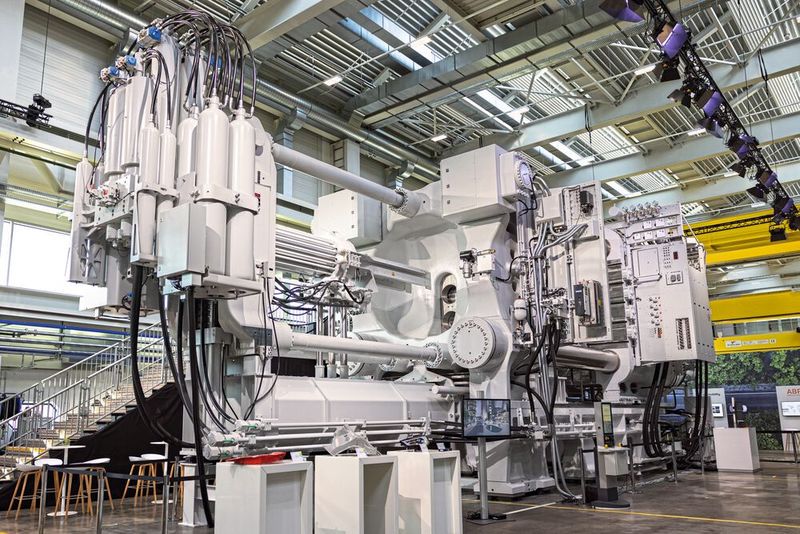
200 kilograms of liquid aluminum in a single "shot": The megacasting facilities of the Carat series from Bühler were presented to the European professional audience for the first time.
(Image: Sagar Shiriskar/Bühler AG)
Less weight, better packaging, and lower costs in material use and logistics: These are the advantages Volvo expects from the two mega-casting facilities that will manufacture large parts of the aluminum floor structure of a new electric vehicle in a single "shot" at the Torslanda plant starting in 2024.
Bühler recently presented such a facility, the Carat 840 type, with a closing force of 8,400 tons, to a professional audience from the die casting and automotive industry at an event in St. Valentin/Austria. The opportunity to see such a facility will not come often. With a base area of 160 square meters and a height of 7.60 meters, the Carat 840 is hardly suitable as a trade fair model. Moreover, it is not even the largest megacasting facility from Bühler: The Carat 920 even brings a closing force of 9,200 tons.
Gallery
The facility shown in St. Valentin can pour more than 200 kilograms of liquid aluminum into a mold within milliseconds, creating complex contours with high precision.
Cornel Mendler, Managing Director Die Casting of the Bühler Group, describes the advantage of so-called megacasting: "Large cast parts reduce complexity in production because between 70 and 100 parts can be replaced by a single die-cast part of a size up to 1.80 x 1.80 meters." To simplify the logistics of these large parts, the cast parts are mostly manufactured in the immediate vicinity of the vehicle's final assembly.
An attractive, but limited market
This concept pays off for Bühler. Cornel Mendler: "More than ten OEMs have already decided to apply megacasting." Suppliers are also interested. For instance, Handtmann will commission a "Carat 610 extended" with a clamping force of 6,100 tons and a shot weight of up to 128 kilograms of aluminum in its light metal casting production in Biberach later this year.
As attractive as this technology currently seems for the automotive industry - at Bühler, there is an openness to also discuss its limits. So far, applications outside the auto industry are rare. Martin Lagler, Director Global Product Management & Marketing Die Casting: "Facilities with a closing force of 8,000 tons are primarily used to manufacture rear ends, front ends, or battery housings. Other industries rarely require such large components in comparable quantities." However, the potential is significant enough that the automotive experts at Bühler are well-utilized: "Die casting of large structural components is now part of the process of car production," says Martin Lagler.
Injection molding: The 10,000-ton mark falls
The "Mobility Days" took place at the plastic machinery manufacturer Engel, which not only produces its own large-scale plants in St. Valentin but, as a partner of Bühler, manufactures the closing units for the Carat machines – and in its field of competence, is driving forward exactly the same trend as Bühler in aluminum die casting. Franz Füreder, Head of the Business Unit Automotive at Engel: "In the automotive industry, injection molding machines with closing forces of over 5,000 tons are increasingly being used - a demanding market segment in which we are very present with a share of over 50 percent."
Currently, the largest Engel machines have a closing force of 8,400 tons. Two of these facilities were recently delivered to the USA, and the delivery logistics alone, with 29 truckloads, is a challenge. Engel points out that the facilities, with a length of 29.3 meters and a width of 6.4 meters, are relatively small in relation to closing force and shot weight (maximum 122 kilograms) thanks to the two-platen design.
However, even with 8,400 tons, the limit has not yet been reached in injection molding. Anders Nybäck, Vice President of the Business Unit Technical Moulding at Engel: "We are currently planning an injection molding machine with a clamping force of 11,000 tons – for a company from the automotive industry."
The technological trend behind this is very similar to die casting: "We see that increasingly more very large components are being produced by injection molding. Components for which other processes were used until now or that were assembled from several individual parts – such as large-scale structural components and lightweight body components or glazing. Here, the production of very large components in a single process step saves energy, time, and raw materials."
Date: 08.12.2025
Naturally, we always handle your personal data responsibly. Any personal data we receive from you is processed in accordance with applicable data protection legislation. For detailed information please see our privacy policy.
Consent to the use of data for promotional purposes
I hereby consent to Vogel Communications Group GmbH & Co. KG, Max-Planck-Str. 7-9, 97082 Würzburg including any affiliated companies according to §§ 15 et seq. AktG (hereafter: Vogel Communications Group) using my e-mail address to send editorial newsletters. A list of all affiliated companies can be found here
Newsletter content may include all products and services of any companies mentioned above, including for example specialist journals and books, events and fairs as well as event-related products and services, print and digital media offers and services such as additional (editorial) newsletters, raffles, lead campaigns, market research both online and offline, specialist webportals and e-learning offers. In case my personal telephone number has also been collected, it may be used for offers of aforementioned products, for services of the companies mentioned above, and market research purposes.
Additionally, my consent also includes the processing of my email address and telephone number for data matching for marketing purposes with select advertising partners such as LinkedIn, Google, and Meta. For this, Vogel Communications Group may transmit said data in hashed form to the advertising partners who then use said data to determine whether I am also a member of the mentioned advertising partner portals. Vogel Communications Group uses this feature for the purposes of re-targeting (up-selling, cross-selling, and customer loyalty), generating so-called look-alike audiences for acquisition of new customers, and as basis for exclusion for on-going advertising campaigns. Further information can be found in section “data matching for marketing purposes”.
In case I access protected data on Internet portals of Vogel Communications Group including any affiliated companies according to §§ 15 et seq. AktG, I need to provide further data in order to register for the access to such content. In return for this free access to editorial content, my data may be used in accordance with this consent for the purposes stated here. This does not apply to data matching for marketing purposes.
Right of revocation
I understand that I can revoke my consent at will. My revocation does not change the lawfulness of data processing that was conducted based on my consent leading up to my revocation. One option to declare my revocation is to use the contact form found at https://contact.vogel.de. In case I no longer wish to receive certain newsletters, I have subscribed to, I can also click on the unsubscribe link included at the end of a newsletter. Further information regarding my right of revocation and the implementation of it as well as the consequences of my revocation can be found in the data protection declaration, section editorial newsletter.
Micromobility: The bodywork from a single shot?
The market situation for mega injection molding is similar to that of megacasting. "We see increasing need and demand. However, injection molding machines with closing forces of over 5,500 tons remain a niche market," explains Anders Nybäck. This niche is highly interesting for Engel, however, as they have extensive experience and competence to offer and can efficiently build and deliver the mega machines with their worldwide production network. Engel is also targeting new applications. Franz Füreder: "For instance, the growing market of micro-mobility, especially in China, is exciting for us: small vehicles with a plastic body in one shot – that's highly efficient." (kt)



:quality(80)/p7i.vogel.de/wcms/a0/47/a04725ef9bd09fb6c9341a1bea1b5d93/0130443083v1.jpeg "Here, a type of plastic pallet is produced by thermoforming (vacuum forming or deep drawing) at the corresponding division of New England Plastics in the USA. This division, which specializes in so-called liners, is now part of Ringmetall ... (Image:New England Plastics)")
:quality(80)/p7i.vogel.de/wcms/e3/42/e342b3c593ea92d56604d3be969e9c9a/0130437231v1.jpeg "Daimler Truck will be building even more trucks at its Czech plant in Cheb in the future. This is because it is now being expanded for strategic cost-saving reasons ... (Image:Daimler Truck)")
:quality(80)/p7i.vogel.de/wcms/23/99/23992bf2dcdc432c9b7209c34a4a7c48/0129733089v1.jpeg "Stork relies on the modular Neoswiss turning system from Iscar to shorten the set-up times for its sliding headstock lathes and work more productively. (Image:Iscar)")
:quality(80)/p7i.vogel.de/wcms/7d/e2/7de2923434b2f1a78ba5482d8d335269/0113143253v1.jpeg "In our China Market Insider we regularly provide you with relevant information directly from China. (Image:© Eisenhans - stock.adobe.com)")
:quality(80)/p7i.vogel.de/wcms/b7/36/b736dfebc16c42d6901d0d0e1f390493/3d-druck-20factory-20--20ki-20generiert-1920x1079v1.png "(Source: AI-generated)")
:quality(80)/p7i.vogel.de/wcms/79/b2/79b21aad663f4a7bd4472afc1c1afc62/0130433994v1.jpeg "Mission Joyride: The free-flying robot (shown here in the rendering) will relieve the ISS crew of logistics tasks from 2027 with its two mechanical arms. (Image:Icarus Robotics)")
:quality(80)/p7i.vogel.de/wcms/6b/45/6b4546fa6ebf305c3660326909363f32/0130437089v1.jpeg "Industrial AI in action: Rockwell Automation presents practical solutions for self-controlling production systems at the Hannover Messe. (Image:Rainer Jensen, Deutsche Messe)")
:quality(80)/p7i.vogel.de/wcms/78/e9/78e9188c25a8a94e67c34c9bf8ffe495/visual-agile-20robots-20and-20google-20deepmind-20partner-20to-20bring-20intelligence-20to-20robotics-2500x1406v1v1.jpeg "Together, the partners are developing adaptable, intelligent robots for a wide range of applications (Image:Agile Robots SE)")
:quality(80)/p7i.vogel.de/wcms/59/a2/59a2b11f0aa1b700eff02addd5de8703/adobestock-1788280853--c2-a9-20satria-20-e2-80-93-20stock-adobe-com-5081x2860v1v1.jpeg "Quantum computers require extreme cooling to temperatures close to absolute zero in order to keep qubits stable. (Image:satria - stock.adobe.com)")
:quality(80)/p7i.vogel.de/wcms/62/5f/625f41e87ebfef156a98c8e6393e32fd/0130211654v1.jpeg "Axial flux motors have some advantages over radial flux motor—but their production is currently still expensive. (Image:RWTH Aachen University)")
:quality(80)/p7i.vogel.de/wcms/f6/ae/f6aec4f6241b36ed5e3a990ac9176b42/0130429460v1.jpeg "Verne, Pony.ai and Uber want to launch a robotaxi service in Europe. (Image:Verne)")
:quality(80)/p7i.vogel.de/wcms/d7/88/d788699f2974708a332baa4e7a62fa9e/0130438967v1.jpeg "Skoda is withdrawing from China. The brand has produced well over three million vehicles there. (Image:Skoda car)")
:quality(80)/p7i.vogel.de/wcms/b0/43/b043b86899837532aad62d63368a917a/0130371361v1.jpeg "Skoda leaves the chinese market.
(Image:Skoda)")
:quality(80)/p7i.vogel.de/wcms/c3/c4/c3c4ce270b083eeac55654148611f064/0130237945v1.jpeg "China is not giving up on hydrogen, but is intensifying its efforts. (Image:freely licensed from Pixabay)")
:quality(80)/p7i.vogel.de/wcms/ee/09/ee09acbd6dc896df25affaa9e871e6e5/0130440053v1.jpeg "IMS chip module for simple system integration into an ion mobility spectrometer. (Image:Fraunhofer IPMS)")
:quality(80)/p7i.vogel.de/wcms/10/6c/106cd22de5f68a0f74639d654827228c/0130345302v1.jpeg "Made in India: According to the India Electronics and Semiconductor Association (IESA), the country should be able to produce between 75 and 80 million chips by the beginning of 2027, once the plants currently under construction become operational. (Image:Pixabay (Montage: Sebastian Gerstl))")
:quality(80)/p7i.vogel.de/wcms/a5/ed/a5ed6fda029d362732a293d6b19d74c4/0130444216v1.jpeg "Thirteen executives from the Chinese chip industry have drawn up a plan to achieve an 80% self-sufficiency rate for semiconductors by 2030. (Image:Maxim_Kazmin - stock.adobe.com)")
:quality(80)/p7i.vogel.de/wcms/31/a6/31a646018b34d8e0a44bfc8bf17837f6/0130361632v1.jpeg "For many companies, PFAS are considered indispensable in electronics production. (Image:freely licensed)")
:fill(fff,0)/images.vogel.de/vogelonline/companyimg/76800/76895/65.jpg "FAULHABER_120mm.jpg ()")
:quality(80)/p7i.vogel.de/wcms/30/9b/309b188aec7856dc2e4efdc53e715529/0112969982v1.jpeg "Beeindruckend: Die Mega-Spritzgießanlagen in Zwei-Platten-Technik von Engel haben eine Schließkraft von 8.400 Tonnen und sind 27 Meter lang. Sie bieten viel Platz für das Werkzeug. (Bild: Engel)")
:quality(80)/p7i.vogel.de/wcms/99/70/9970023a337aa30640cd65b3b79f869c/0113126011v1.jpeg "Mit 8.400 Tonnen ist auch beim Spritzgießen noch nicht das Ende der Fahnenstange erreicht.(Bild: Engel)")
:quality(80)/p7i.vogel.de/wcms/60/30/6030c46da2c6de321d9be0a31c331d65/0112969994v1.jpeg "Franz Füreder, Leiter der Business Unit Automotive bei Engel.(Bild: Engel)")
:quality(80)/p7i.vogel.de/wcms/cf/26/cf262f049484135b056e92f048499e25/0112969992v1.jpeg "Cornel Mendler, Managing Director Die Casting der Bühler-Gruppe.(Bild: Bühler)")
:quality(80)/p7i.vogel.de/wcms/eb/9f/eb9f3da11ab6e979c15c195ff516b2ec/0130128194v1.jpeg "Clamping force 110,000 kilonewtons! This is the largest injection molding machine in the world currently under construction. It is being built at Engel in Austria and bears the name Duo 1200 US. Eight tie bars ensure stability. Find out more about this giant of plastics processing ... (Image:Angels)")
:quality(80)/p7i.vogel.de/wcms/1d/a8/1da8ef4a3d204b44a835fd10e8c98c57/bild1-886x498v1v1.jpeg "According to its own statements, Aulbach Automation is the market leader in deburring presses for large castings and has delivered 23 deburring presses for megacasting by September 2025 alone. (Bild: Roemheld)")