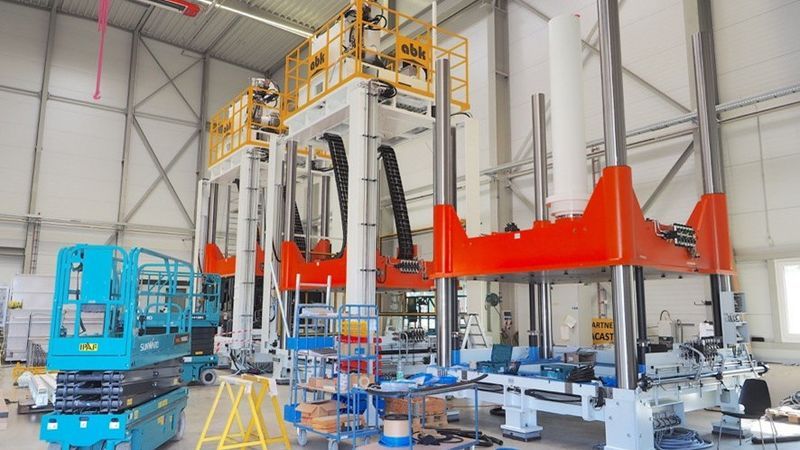
Giga and megacasting components made from aluminum casting, which can measure several square meters, impose high demands on deburring technology. Only through precise handling technology can the ton-heavy tools be accurately positioned and the required tolerances maintained.
According to its own statements, Aulbach Automation is the market leader in deburring presses for large castings and has delivered 23 deburring presses for megacasting by September 2025 alone.
(Bild: Roemheld)
The introduction of mega and gigacasting processes is transforming the automotive industry: Single-piece structural components such as front and rear underbodies, as well as battery housings made from aluminum die casting, replace hundreds of individual components that need to be welded. This technology, utilized by companies like Tesla and Volvo, simplifies production, reduces weight, and improves the rigidity of the components. At the same time, it imposes new requirements on the post-processing of the cast parts.
This is the specialty of Aulbach Automation, a press manufacturer based in Mömlingen, Lower Franconia. The company, with 70 employees, specializes in the production of highly specialized deburring presses for the foundry industry. In 2021, it entered the mega and gigacasting segment, focusing on the processing of large cast parts measuring over 3 x 2.5 meters (~9.84 x 8.2 feet) and weighing between 80 and 120 kilograms (~176 to 264 pounds). “The decision at the time was bold and risky—since we started without a contract. That’s why we are now a step ahead of the competition,” says Managing Director Ulrich Krimm. Today, Aulbach Automation claims to be the market leader in deburring presses for large castings and has delivered 23 deburring presses for megacasting by September 2025.
Tools Must Be Changed Safely, Quickly, and Automatically
The combined offering of press and tool from a single source has contributed to success. Most of the international customers, primarily from the automotive industry and machinery sectors, take advantage of it. Together with the sister company Aulbach Deburring Technology, the machine manufacturer offers complete solutions that are perfectly coordinated. “We know and master the entire process,” emphasizes Krimm. “This combination is unique and gives us a decisive competitive advantage.” The construction time for a custom press is about 35 weeks. As development, design, welding, painting, control cabinet construction, and assembly of the presses, as well as tool manufacturing, all take place at the same location, coordination processes are kept short.
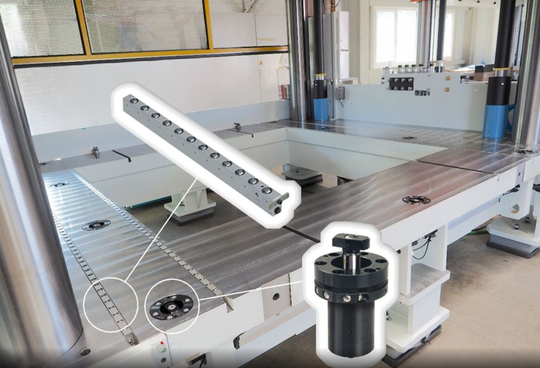
Hydraulic double-acting swivel-clamping elements are used on the press table. Their design eliminates any edge interferences that could hinder the insertion of tools. To facilitate the insertion and removal of heavy tools, transport rails have also been integrated into the surface of the table.
(Source: Roemheld)
At the heart of modern deburring presses is increasingly the ergonomics, safety, and efficiency of tool changes—core competencies of the setup time optimizer Roemheld from Laubach in Middle Hesse. A central challenge in deburring large cast parts lies in the safe and precise handling of tools weighing up to 30 tons. Automated solutions are the first choice in terms of workplace safety and productivity due to their dimensions and weights. In fully automated plant concepts, such as complete megacasting die casting facilities, they are standard. Depending on the requirements, the tools are brought to the press via crane or transport cart, lifted onto hydraulic transport rails from Roemheld using vacuum lifters or robots, and then precisely inserted into the press, positioned, and clamped. The removal is carried out in reverse order.
Partnership for Over a Decade
For more than ten years, Aulbach Automation has relied on tool clamping and changing systems from the Roemheld Group for this purpose. Since then, components from the clamping technology specialist—especially powered tool changing systems, ball and roller rails, and tool clamping elements—have been standardly installed on the large-format deburring presses. "There are many reasons why we favor these products: their precision, short delivery times, reliability, durability, and the excellent coordination of the elements, as well as convincing service. All of this makes Roemheld an ideal partner for us," explains André Pfeifer, Technical Project Manager at Aulbach Automation. As a success example, he cites a megacasting facility from the Swiss Bühler Group. In 2022, it delivered two complete die casting systems, including an Aulbach deburring press equipped with Roemheld's tool clamping and changing technology, to a production plant of Volvo Cars in Sweden.
On the press table, hydraulic double-acting swivel-clamping elements are used—just like in most deburring presses that Aulbach Automation equips with Roemheld components. "Despite their compact design, they achieve clamping forces between 60 and 412 kilonewtons," explains Pfeifer. This allows for the compensation of clamping edge tolerances of ±1.5 millimeters and ensures secure clamping of even hard-to-reach areas. "The force is transmitted efficiently, as the clamping piston is moved in such a way that a simultaneous 45° rotation is executed during a lifting phase. This allows for safe and edge-free insertion of the tools." The uniqueness of the clamping system lies in its high operational safety: the monitoring of the release, switching, and clamping positions is done inductively, and the swivel mechanism is additionally protected by a spring-loaded overload protection and a manual emergency operation. To facilitate the insertion and removal of heavy tools, transport rails from Roemheld are also integrated into the surface of the table.
Date: 08.12.2025
Naturally, we always handle your personal data responsibly. Any personal data we receive from you is processed in accordance with applicable data protection legislation. For detailed information please see our privacy policy.
Consent to the use of data for promotional purposes
I hereby consent to Vogel Communications Group GmbH & Co. KG, Max-Planck-Str. 7-9, 97082 Würzburg including any affiliated companies according to §§ 15 et seq. AktG (hereafter: Vogel Communications Group) using my e-mail address to send editorial newsletters. A list of all affiliated companies can be found here
Newsletter content may include all products and services of any companies mentioned above, including for example specialist journals and books, events and fairs as well as event-related products and services, print and digital media offers and services such as additional (editorial) newsletters, raffles, lead campaigns, market research both online and offline, specialist webportals and e-learning offers. In case my personal telephone number has also been collected, it may be used for offers of aforementioned products, for services of the companies mentioned above, and market research purposes.
Additionally, my consent also includes the processing of my email address and telephone number for data matching for marketing purposes with select advertising partners such as LinkedIn, Google, and Meta. For this, Vogel Communications Group may transmit said data in hashed form to the advertising partners who then use said data to determine whether I am also a member of the mentioned advertising partner portals. Vogel Communications Group uses this feature for the purposes of re-targeting (up-selling, cross-selling, and customer loyalty), generating so-called look-alike audiences for acquisition of new customers, and as basis for exclusion for on-going advertising campaigns. Further information can be found in section “data matching for marketing purposes”.
In case I access protected data on Internet portals of Vogel Communications Group including any affiliated companies according to §§ 15 et seq. AktG, I need to provide further data in order to register for the access to such content. In return for this free access to editorial content, my data may be used in accordance with this consent for the purposes stated here. This does not apply to data matching for marketing purposes.
Right of revocation
I understand that I can revoke my consent at will. My revocation does not change the lawfulness of data processing that was conducted based on my consent leading up to my revocation. One option to declare my revocation is to use the contact form found at https://contact.vogel.de. In case I no longer wish to receive certain newsletters, I have subscribed to, I can also click on the unsubscribe link included at the end of a newsletter. Further information regarding my right of revocation and the implementation of it as well as the consequences of my revocation can be found in the data protection declaration, section editorial newsletter.
Precise Positioning and Secure Clamping
At the pressing ram, 90-degree swivel clamps are used, equipped similarly to the clamping elements on the press table. "The Roemheld clamping technology in the pressing ram and press table ensures that even large-format, heavy tools are securely fixed and held in position—crucial for process safety and repeat accuracy in megacasting," emphasizes Pfeifer. The tolerances of the clamping solution are within a few tenths of a millimeter, effortlessly meeting the required component tolerances.
All clamping elements are centrally powered by a Roemheld hydraulic unit, whose performance is tailored to the components. The modular unit controls and monitors all functions. In case of production interruptions, an energy-saving standby mode is automatically activated. The clamping technology control is integrated into the machine control system of the deburring press. It is based on a Siemens control system, enhanced by Aulbach Automation with its own intuitive user interface, allowing for quick access to all processes.
We see that our customers' requirements are becoming increasingly individualized.
Among the advantages of automated tool changing are reduced setup times and increased process safety. For the operator, improved ergonomics and safety while working at the press are particularly important. While the frequency of tool changes in the megacasting area is typically low, the quality of the changing process is paramount. Inaccurate positioning or incorrect clamping of tools can damage them and lead to faulty components, resulting in costly production downtimes.
Safety for People, Tools, and Processes
To create the conditions for further growth, Aulbach Automation has constructed a new assembly hall with a lifting capacity of 63 tons in 2024, where large presses can be assembled in an upright position. Looking ahead, Krimm anticipates a continually growing international demand for increasingly larger megacasting deburring presses. Therefore, the machine manufacturer plans to expand the sizes of the presses beyond the current dimensions. "We also see that our customers' requirements are becoming increasingly individualized," says the managing director. "In the future, specific adjustments will certainly be more necessary. With Roemheld as a partner, we are confident in our ability to develop solutions that meet our customers' high expectations."



:quality(80)/p7i.vogel.de/wcms/eb/2b/eb2bd1b8487afe577b37363cd02f16ff/0113143253v1.jpeg "In our China Market Insider, we regularly provide you with relevant information straight from China. (Image:© Eisenhans - stock.adobe.com)")
:quality(80)/p7i.vogel.de/wcms/dd/b8/ddb8edc98c49b384734ab2432b297eb5/adobestock-1913662309--irene-stock-adobe-com-ki-generiertv1.jpeg "Rotary joints are used in grippers and swivel mechanisms to allow assemblies to rotate or swivel smoothly relative to one another, even under very high loads (illustrative image). (Source: Irene - stock.adobe.com / KI-generiert)")
:quality(80)/p7i.vogel.de/wcms/d1/ef/d1ef6b6f7d4543f7999980bacccaf22b/0133499261v1.jpeg "As the growing imbalance in trade relations with China continues to widen, the EU Chamber of Commerce foresees a day when trade with China will have to be seriously reevaluated ... (Image: AI-generated)")
:quality(80)/p7i.vogel.de/wcms/fe/1f/fe1fa5ee713f94deaba963dc24c3abc5/0133299273v1.jpeg "The Flexistar enables highly flexible production of laser-welded tubes thanks to its tool-free clamping system. (Image:Because Technology, LLC)")
:quality(80)/p7i.vogel.de/wcms/60/ef/60ef4f07e4829b2c2929befc0f353c58/0133511729v1.jpeg "Humanoid robots can match human performance in certain tasks. (Image:Gemini / AI-generated)")
:quality(80)/p7i.vogel.de/wcms/2e/99/2e99726b522e4b35b690e25eb6a42643/0133463991v1.jpeg "Robotics: In AMR applications, connection technology must reliably transmit power, signals, and data despite vibration and shock loads—in very confined spaces and in a way that allows for regular maintenance. (Image:Hyperever)")
:quality(80)/p7i.vogel.de/wcms/d0/18/d01801e3d5dbd7bc9d0b4f60408b630c/0133468429v1.jpeg "Quality requirements for film packaging are on the rise. At the same time, many companies are turning to recyclable film materials, which, however, have their own challenges. Fraunhofer researchers have therefore developed a fast system that detects problems in real time. (Image:Fraunhofer IKTS)")
:quality(80)/p7i.vogel.de/wcms/b1/06/b106cf44923ce39565c3264982fd20eb/0133414574v1.jpeg "Robots Build Robots: At the new Ubtech factory, automated systems even handle parts of the material supply and logistics for the production of humanoid robots. (Image:Ubtech)")
:quality(80)/p7i.vogel.de/wcms/c0/52/c052f405eb55fc3d08c4837e77206fc0/adobestock-2021845957--aucartstudio-stock-adobe-com-ki-generiertv1.jpeg "An innovation from China to combat extreme summer heat: A novel coating lowers temperatures. (Source: © AucArtStudio – stock.adobe.com_AI-generated)")
:quality(80)/p7i.vogel.de/wcms/66/a7/66a7b78159caeacce57136529688799f/0133503398v1.jpeg "Sunlight Makes Stone! These stone blocks weren't made the traditional way. Instead, they were additively manufactured from sand using a laser. In the future, however, the laser is set to be replaced by concentrated sunlight—if the startup Addisol is successful... (Image:Addisol / F. Fiedler)")
:quality(80)/p7i.vogel.de/wcms/72/b9/72b995c2c8d812c5e2115cbef31e035a/0133462727v1.jpeg "Eggl manufactures center hoods that are precisely tailored to each cooking island—whether standard size or custom shape. They are made entirely of stainless steel and are individually customized in terms of size and filter arrangement. (Image:SPI)")
:quality(80)/p7i.vogel.de/wcms/13/5d/135dfae6229ceaf5c55467a43e8f7257/adobestock-1879961393--ardi-stock-adobe-com-ki-generiertv1.jpeg "Annoying chatterboxes or awkward silences in response to questions—a moderator should specifically prepare for difficult situations in order to navigate them effectively. (Image:ardi - stock.adobe.com_AI-generated)")
:quality(80)/p7i.vogel.de/wcms/aa/a2/aaa2c6dd2daa24b485cddbf9297590c0/0133467318v1.jpeg "Battery Monitoring: Battery monitoring using electrochemical impedance spectroscopy offers several advantages. (Image:TI)")
:quality(80)/p7i.vogel.de/wcms/39/b2/39b21bf03be1683831862239a369987c/0133469638v1.jpeg "Data from autonomous vehicles and robots operating autonomously is in high demand, and Ruqi wants to capitalize on this. (Image:Ruqi Mobility)")
:quality(80)/p7i.vogel.de/wcms/8a/bb/8abbb6217220595edc1549ac9b84f307/0133429906v1.jpeg "The IAA in Hanover showcased the ambitions of Chinese commercial vehicle manufacturers in Europe. (Image:Wehner - VCG)")
:quality(80)/p7i.vogel.de/wcms/0c/53/0c5313ef91c14b6df0d0996efc33c8ad/jpg03568-bearbeitetv1.jpeg "The category winners of the 2027 German Car of the Year award. (Source: GCOTY)")
:quality(80)/p7i.vogel.de/wcms/48/15/4815da27c45973ca629a99b375ac3aef/0133509585v1.jpeg "Ventuno Q RoadTest: Designed to help the Element14 community gain practical insights from real-world tests using the Ventuno Q. (Image:Farnell/Element14)")
:quality(80)/p7i.vogel.de/wcms/17/2b/172bd132f9febdfcbcedba292ad0504d/aufmacherv1.jpeg "Micro-Epsilon offers a wide range of IO-Link-compatible sensors. (Source: Micro-Epsilon Messtechnik GmbH & Co. KG)")
:quality(80)/p7i.vogel.de/wcms/ca/b4/cab46fd26d19d6a2febca032048200b6/0133471827v1.jpeg "Photonics SDK for C and Python: Computational operations are now abstracted as standard mathematical functions. (Image:Q.ANT)")
:quality(80)/p7i.vogel.de/wcms/92/b2/92b2ed5299cde450c0764f4f64468395/0133505895v1.jpeg "The \"Iris 100\" test system for high-precision volume production of microLEDs uses a spectrometer and a high-resolution camera. (Image:Teradyne)")
:fill(fff,0)/images.vogel.de/vogelonline/companyimg/76800/76895/65.jpg "FAULHABER_120mm.jpg ()")
:fill(fff,0)/p7i.vogel.de/companies/69/de/69de1b7403b0d/simtos-logo.jpeg "simtos-logo (SIMTOS)")
:quality(80)/p7i.vogel.de/wcms/cf/3d/cf3dc24f96dbc78c602ea575ec45d657/0131798987v1.jpeg "Time is the most important factor. At the start of a fixture construction project, AMF assembles a cross-functional team with individuals from design, production, and procurement, as well as a project manager. They communicate without hierarchies and on equal footing, enabling them to make decisions in two hours that might take others two weeks. (Image:AMF)")
:quality(80)/p7i.vogel.de/wcms/a7/17/a717ab2c04cbd5a936e25d990fe66b9b/0125791006v1.jpeg "The doubling of cutting edges, the use of PcBN high-performance cutting materials, and the robust clamping system result in a significant productivity increase in valve seat machining. (Image:Mapal)")