In many industries, hydraulic systems are considered the ultimate solution, especially when high forces and loads are involved. However, there is competition—for example, in the form of electromechanical cylinders with ball screws (KGT). Electromechanical drive elements are conquering more and more application fields and also perform well in the heavy-duty sector.
"Ball screw drives are more energy-efficient, precise, compact, low-maintenance, and environmentally friendly, and they can replace hydraulics in many applications," argues Andreas Kaiser, Senior Sales Manager DACH/NL at KGT provider Rollon GmbH. "While the initial investment is slightly higher, it quickly pays off thanks to reduced operating costs. Over the lifecycle, users benefit from significant cost savings."
Advantages And Disadvantages of Hydraulic Systems
Hydraulic systems ensure high power transmission and maximum power density. However, their characteristics also include higher sensitivity to high temperatures and energy losses due to heat. Maintenance can be complex and is not always predictable. Additionally, there is a risk of leaks, which can lead to energy losses and environmental pollution. The requirements for the cleanliness of hydraulic oil are also high, and the viscosity of the oil changes with age and oil temperature.
Strengths of Ball Screws
For certain applications, switching to ball screw drives is therefore worthwhile. These offer high energy efficiency (80% of input power), enable more precise control of speed and positioning, higher speeds, and require less maintenance and generate less noise. Typically, fewer components are needed; the system complexity is lower, and integration into electronic controls can be easier: since ball screw drives are electrically powered, they are often easier to integrate into digital control systems than hydraulic cylinders, which require additional valves and regulators. Furthermore, (apart from lubricant) there is no risk of leakage.
What Do Ball Screw Manufacturers Say?
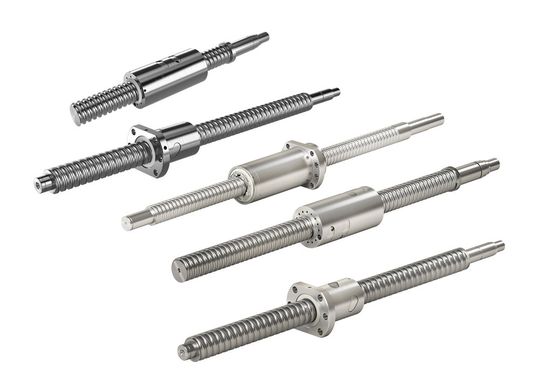
Shuton-Ipiranga is the specialist for ball screws within the Rollon Group
(Image: Rollon)
A specialist in ball screw drives, for example, is Shuton-Ipiranga, which belongs to the Rollon group. Their high-performance models are used in machine tools, injection molding technology, presses, automation systems, lifting equipment, semiconductor manufacturing, and elevation devices. Andreas Kaiser explains: "In production, we use both the economical rolling process, e.g., for simpler transport applications, as well as the highly precise, flexible, and durable whirling process to meet all requirements."
Customized Solutions for Heavy-Duty Applications
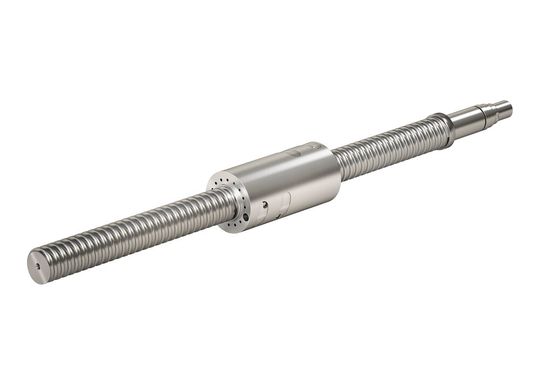
Whirled heavy-duty ball screw drives offer high load capacity in a compact design and are available in various diameters and spindle lengths. Nearly all parameters of these components can be individually tailored to an application—whether spindle diameter, pitch, direction of rotation, stroke length, load capacity, design, nut configuration, ball return system, lubrication, etc. Zero backlash is also possible.
Andreas Kaiser emphasizes that the flexibility in the profiles ensures that ball screw drives can handle very high loads despite their compact dimensions. "For example, we can achieve higher load capacities by using a larger profile while maintaining the same size," he explains. Different coatings provide the necessary protection, for instance, in harsh environments or hygiene-sensitive areas such as the food industry.
Typical Application Fields for Electromechanical Systems
The ball screws of the XL Xtrem Load product family from Shuton-Ipiranga have been optimized for heavy-duty applications.
(Image: Rollon)
Ball screw drives are particularly interesting when precision, energy efficiency, and a clean working environment are crucial, such as in many assembly tasks or material handling. Other possible application areas include plastic injection molding machines (opening/closing of mold halves, clamping, tensioning), forming technology (pressing, rolling, bending), test benches and measurement systems—for example, in the automotive industry—, CNC and machine tools, as well as conveyor and lifting technology.
For high safety requirements, a safety nut can be used. These are self-locking nuts that prevent the ball screw nut from loosening on its own. Safety is also a central topic in liquid valve technology. Ball screw drives with spring preload ensure that no flow occurs in the event of a power failure. Designers of simulators—for instance, for pilot training, Formula 1 teams, or amusement parks—are increasingly relying on ball screw drives instead of hydraulics. A characteristic feature in this application is the varying load distribution.
From Medical Technology to Hydraulic Steel Structures
In medical technology, the high positioning and repeat accuracy, as well as the quiet operation of ball screws, come into play. These ensure precise control of movements and forces, for example, in surgical robots and hospital beds. Leakage-free operation is also an important aspect.
Date: 08.12.2025
Naturally, we always handle your personal data responsibly. Any personal data we receive from you is processed in accordance with applicable data protection legislation. For detailed information please see our privacy policy.
Consent to the use of data for promotional purposes
I hereby consent to Vogel Communications Group GmbH & Co. KG, Max-Planck-Str. 7-9, 97082 Würzburg including any affiliated companies according to §§ 15 et seq. AktG (hereafter: Vogel Communications Group) using my e-mail address to send editorial newsletters. A list of all affiliated companies can be found here
Newsletter content may include all products and services of any companies mentioned above, including for example specialist journals and books, events and fairs as well as event-related products and services, print and digital media offers and services such as additional (editorial) newsletters, raffles, lead campaigns, market research both online and offline, specialist webportals and e-learning offers. In case my personal telephone number has also been collected, it may be used for offers of aforementioned products, for services of the companies mentioned above, and market research purposes.
Additionally, my consent also includes the processing of my email address and telephone number for data matching for marketing purposes with select advertising partners such as LinkedIn, Google, and Meta. For this, Vogel Communications Group may transmit said data in hashed form to the advertising partners who then use said data to determine whether I am also a member of the mentioned advertising partner portals. Vogel Communications Group uses this feature for the purposes of re-targeting (up-selling, cross-selling, and customer loyalty), generating so-called look-alike audiences for acquisition of new customers, and as basis for exclusion for on-going advertising campaigns. Further information can be found in section “data matching for marketing purposes”.
In case I access protected data on Internet portals of Vogel Communications Group including any affiliated companies according to §§ 15 et seq. AktG, I need to provide further data in order to register for the access to such content. In return for this free access to editorial content, my data may be used in accordance with this consent for the purposes stated here. This does not apply to data matching for marketing purposes.
Right of revocation
I understand that I can revoke my consent at will. My revocation does not change the lawfulness of data processing that was conducted based on my consent leading up to my revocation. One option to declare my revocation is to use the contact form found at https://contact.vogel.de. In case I no longer wish to receive certain newsletters, I have subscribed to, I can also click on the unsubscribe link included at the end of a newsletter. Further information regarding my right of revocation and the implementation of it as well as the consequences of my revocation can be found in the data protection declaration, section editorial newsletter.
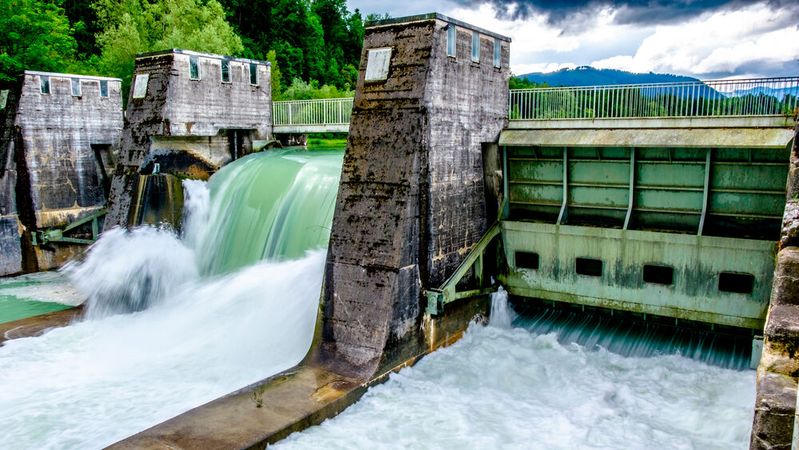
An interesting application field for heavy-duty ball screw drives is hydraulic steel structures, with their high mechanical loads and challenging requirements regarding weather and environmental conditions. Applications such as lock gates, spillway gates, and ferry docks benefit from features like high efficiency, resistance to heat and cold, and the absence of oil. Additionally, the space-saving design of ball screw drives allows for more compact constructions.
Summary
Ball screw drives ensure efficient power transmission with high positioning and repeatability accuracy, high load capacity, and compact design. "Of course, not all hydraulic applications can be replaced by ball screw drives. For instance, hydraulics will certainly continue to be used in agricultural, forestry, and construction machinery," limits Andreas Kaiser. "However, in many applications, switching to ball screw drives makes sense."



:quality(80)/p7i.vogel.de/wcms/07/cb/07cba19795692cf2e320109a7b0a1d72/0131704313v1.jpeg "The Federal Statistical Office certifies Germany a slight increase in production and export in retrospect of the first months of the second quarter of 2026. The Iran war remains a braking factor. And China has also significantly increased its exports... (Image: Yellow Boat - stock.adobe.com)")
:quality(80)/p7i.vogel.de/wcms/ea/8a/ea8a1e0ef5a0a69e5084a8510d2757c4/0131673017v1.jpeg "Thanks to their hybrid concept with aerodynamic and aerostatic lift, the innovative airships from Italian manufacturer Flo Fleet S. r. l. are ideal for monitoring infrastructure technology. (Image:Flo Fleet)")
:quality(80)/p7i.vogel.de/wcms/2b/1b/2b1b87bc2d119e694b6beeb0871650a4/0131667846v1.jpeg "Processing of zirconium oxide blanks for the production of dentures. (Image:LWDESIGN)")
:quality(80)/p7i.vogel.de/wcms/bb/35/bb356ba28bb69f630106e974cc31f7ac/0130502317v1.jpeg "Stefan Innerhofer is the founder and managing director of regineering GmbH. (Image:Lapp)")
:quality(80)/p7i.vogel.de/wcms/20/e3/20e37e3c6e65d7e80ee4950b7facfb94/0131675932v1.jpeg "Elon Musk's space company SpaceX can look forward to a second rental agreement for computing power for AI applications. The latest deal will start at the end of the year with none other than Google ... (Image:SpaceX)")
:quality(80)/p7i.vogel.de/wcms/c0/84/c084fef6805d6256644e2a85847fadae/0131652645v1.jpeg "The fanless industrial embedded PC named Rocksmart RSX1000 (Image:Werock)")
:quality(80)/p7i.vogel.de/wcms/61/4a/614aa5816dcfc72ecb01032b2bb85255/igus-20iggy-20rob-20home-3507x1973v1v1.jpeg "Specifically designed for use in the service sector, igus has developed a new cost-effective and CE-compliant humanoid robot called Iggy Rob Home. (Image: Igus SE & Co. KG)")
:quality(80)/p7i.vogel.de/wcms/b0/24/b024e79381e1e57cb9f26a9d6d019306/0113143253v1.jpeg "In our China Market Insider, we regularly provide you with relevant information directly from China. (Image:© Eisenhans - stock.adobe.com)")
:quality(80)/p7i.vogel.de/wcms/e6/fb/e6fbfdceb3cc554df04a9561397d166f/pexels-markusspiske-9858904-1613x908v1v1.jpeg "The annual report of the German Patent and Trade Mark Office (DPMA) shows a significantly increasing dynamic in patent applications, particularly in battery technology. (Image: Pexels)")
:quality(80)/p7i.vogel.de/wcms/28/0e/280e666d448f3e37b4035a044aaaf514/chatgpt-20image-2010--20juni-202026-2c-2009-22-18-1456x819v1.png "Especially small and medium-sized enterprises find it difficult to apply for funding, says Hentschel Funding Consultancy. They also underestimate the modalities that need to be observed to obtain approval. But here you will learn how it's done ... (Image: AI-generated image (OpenAI))")
:quality(80)/p7i.vogel.de/wcms/10/52/10528a21cc61c663c8ada27078ed9c08/0131697322v1.jpeg "The German-French fighter jet will probably remain just a thought forever. Because German Chancellor Friedrich Merz and his French counterpart Emmanuel Macron have decided that it simply won't work with Airbus and Dassault ... (Image: Karambasamba)")
:quality(80)/p7i.vogel.de/wcms/2c/cf/2ccfbe89abb0380e42b194591003dfad/bam-20schwei-c3-9fnaht-800x450v1v1.jpeg "Special alloys, so-called low transformation temperature filler materials (LTT), change the structure of the weld seam during cooling in such a way that residual tensile stresses are significantly reduced. (Image:Image)")
:quality(80)/p7i.vogel.de/wcms/08/41/08411f15eb953e1f9f734d792e99f3e9/0131722999v1.jpeg "Is the lithium-air battery the next \"big\" thing? CATL, at least, is investing in its research efforts in this regard. (Image: freely licensed on Pixabay)")
:quality(80)/p7i.vogel.de/wcms/db/dc/dbdcad4df88c4f396f5b373a1fd0b2d1/0131707030v1.jpeg "The current Astra is rolling off the production line in Rüsselsheim (Image: Opel)")
:quality(80)/p7i.vogel.de/wcms/00/06/0006d38cbd9db4024c37dbfcc744cd0e/0131550253v1.jpeg "Zonal E/E architectures impose new requirements on the internal connection technology of software-defined vehicles (Image: TE Connectivity)")
:quality(80)/p7i.vogel.de/wcms/a5/95/a595ecb65b14015348c06c713391200a/0131564465v1.jpeg "The BYD Dolphin G DM-i competes in the small car segment. (Image:BYD)")
:quality(80)/p7i.vogel.de/wcms/8d/97/8d979210bcfe60d059d4553fd2bbdfb8/0131669814v1.jpeg "Under management pressure, the rapid release of software often outweighs its quality. (Image:Dall-E / AI-generated)")
:quality(80)/p7i.vogel.de/wcms/5c/19/5c19577054bec8f1fd7b11bb2fe239d4/0131653956v1.jpeg "Time synchronization in measurement technology: Protocols like IEEE 1588 or \"White Rabbit\" allow distributed measurement data to be synchronized down to the picosecond range today. (Image: TSEP)")
:quality(80)/p7i.vogel.de/wcms/04/a5/04a55af7c725abd266c1afc3a4f494a8/0131668052v1.jpeg "TSMC CEO C.C. Wei sees a chip shortage on the global market for years to come, driven by the high demands of the ongoing AI boom. However, the company intends to keep prices stable despite fully utilized capacities. (Image:TMSC)")
:quality(80)/p7i.vogel.de/wcms/e2/ad/e2ad633822cc5b7d5fe78af362ce6fd8/newsimage422541-1631x917v1v1.png "Privacy Guardrail addresses the exact moment when confidential text becomes an AI prompt. (Image: DFKI)")
:fill(fff,0)/images.vogel.de/vogelonline/companyimg/76800/76895/65.jpg "FAULHABER_120mm.jpg ()")
:fill(fff,0)/p7i.vogel.de/companies/69/88/69882c428938e/tmts2026-ticec-banner-en-2000px.png "tmts2026-ticec-banner-en-2000px (https://www.tmts.tw/en)")
:fill(fff,0)/p7i.vogel.de/companies/69/de/69de1b7403b0d/simtos-logo.jpeg "simtos-logo (SIMTOS)")
:quality(80)/p7i.vogel.de/wcms/a6/d1/a6d103fe8e9d6c3d4c47d766f3495a3a/0124604069v1.jpeg "Visualization of the hydraulic cylinder functional principle: Condition-based maintenance and digital assistance systems are state-of-the-art in hydraulics. (Image: ©dizfoto1973 - stock.adobe.com)")
:quality(80)/p7i.vogel.de/wcms/0f/56/0f566d957a53b5bdda658d3bcef90486/0127131321v1.jpeg "Modern injection molding machines come with either electric or hydraulic actuators, depending on the application. (Image: ©TongTa - stock.adobe.com)")
:quality(80)/p7i.vogel.de/wcms/c2/15/c2153f8019c7856f38baa218ac21a2ed/0126419125v1.jpeg "Components in and around machine tools: The EMO is a source of inspiration and a trade show for innovations. (Image:VDW)")