Laser weldingJoining sandwich structures and sheets using laser
From
Juliana Pfeiffer
3 min Reading Time
Researchers from the Fraunhofer Institute IWS have developed a laser process that welds delicate hollow chamber structures with cover sheets into lightweight sandwich panels.
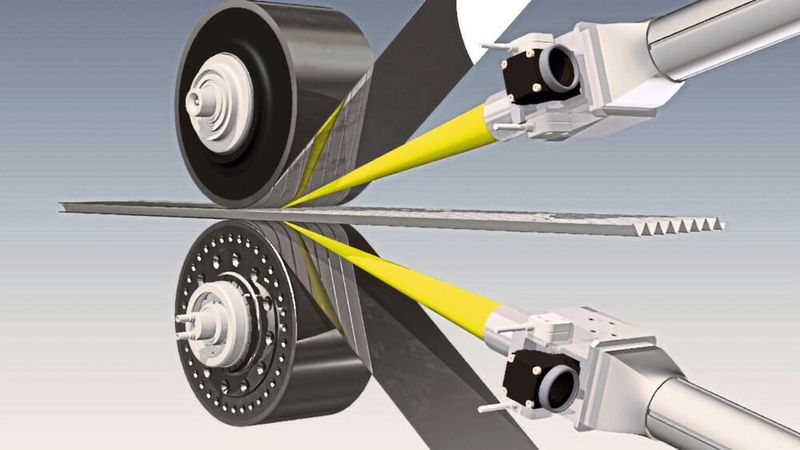
This is how laser-based sandwich plating works: The system transports a flexible strip of hollow metallic inner structures between two rollers, unrolling the lower and the upper metal cover sheets. Two lasers are aimed at the ultra-thin gap between the inner structure strip and the cover sheet, melting the surfaces of the metal layers. The rollers press the sheets and inner structures together; the metal melt solidifies and permanently fixes them together.
(Image: Fraunhofer IWS)
Modern lightweight construction has long been helping in the automotive and aircraft industries to save fuel and material and to reduce environmental impact. Instead of heavy steel plates, many engineers often use sandwich panels. Despite their significantly lower weight compared to solid steel, these are durable enough for partitions and ceilings in vehicles, aircraft, or halls.
Such sandwich panels and profiles consist of honeycomb-, trapezoidal-, web-, or spherical-like hollow chamber structures. Typical starting materials are thin steel, aluminum, plastics, or other materials. Manufacturers weld or glue thin sheets onto these inner structures on both sides.
Traditional extrusion reaches its limits
A railway wagon construction company has used lightweight aluminum profiles for its vehicle technology. Until now, the extrusion process has been used for this purpose. Disadvantage: It does not allow for arbitrarily thin inner webs. About 1.5 millimeters were considered the technological lower limit. Faced with this challenge, the company approached the Fraunhofer IWS. The request: to save as much material and weight as possible and to use delicate inner structures.
This technology allows the production of lightweight panels and profiles much faster and more cost-effectively than with conventional methods such as extrusion.
Andrea Berger, researcher at Fraunhofer IWS
The employees of the Fraunhofer IWS solved this challenge with a laser welding roller machine. Through this machine, they guide a flexible core layer made of very lightweight inner structures between two rollers, over which a cover sheet unrolls on the top and bottom. Scanner-controlled lasers aim obliquely from both sides into the thin gap between the core layer and the cover sheet.
There, they heat the metal surfaces with pinpoint accuracy. Depending on the chosen sheet material, temperatures locally reach between 660 and over 1,400 degrees Celsius. The rollers then press the slightly molten surfaces of the core layer and cover so firmly together that they permanently bond.
The new, laser-based "sandwich plating" offers significant technological, economic, and ecological potential for the industry, emphasize the researchers: "With this technology, lightweight panels and profiles can be produced much faster and more cost-effectively than with conventional methods such as extrusion," says Andrea Berger, researcher at Fraunhofer IWS. "Moreover, the new process does not require adhesives and other additional materials. This facilitates the recycling of the lightweight structures produced with it."
Laser process reduces energy consumption and facilitates recycling
Such particularly lightweight panels can be produced in a continuous process using the rolling method. Compared to traditional methods such as extrusion at high temperatures, laser welding saves a lot of energy, as the high-energy light only needs to melt the metal surfaces locally and very thinly.
It is also suitable for cost-effective mass production. Even the laboratory prototype achieves a high production speed. "Developed to an industrial scale, such facilities could produce more than ten running meters of lightweight sheet metal per minute," estimates Andrea Berger. Moreover, such machines can be quickly retooled for new profile or plate structures.
In contrast, extrusion requires a different tool for each application when the customer orders a new plate model. The laser sandwich plating also allows for the production of stable structures that are only a few tenths of a millimeter thin. This mitigates, for example, the mentioned dilemma in wagon construction.
This broader application of lightweight construction:
reduces material consumption in the supply industry
can reduce the weight of vehicles, aircraft, and ships and
save fossil fuels or electricity
Another ecological benefit arises at the end of the component lifecycle: Laser-joined sandwich panels contain neither adhesive nor solder or other foreign substances that would have to be laboriously separated later in recycling plants.
Marko Seifert, head of the Heat Treatment and Coating department at Fraunhofer IWS, sees suppliers for shipyards and vehicle manufacturers as possible early adopters of the new process. First application scenarios could be, for example, lightweight stairs or ship partitions, in which, thanks to the hollow inner structures of the panels, power cables can be laid invisibly.
The new technology could also quickly establish itself for truck trailers and hall construction. For the next steps, the Fraunhofer researchers are looking for partners to bring the idea into application.
Date: 08.12.2025
Naturally, we always handle your personal data responsibly. Any personal data we receive from you is processed in accordance with applicable data protection legislation. For detailed information please see our privacy policy.
Consent to the use of data for promotional purposes
I hereby consent to Vogel Communications Group GmbH & Co. KG, Max-Planck-Str. 7-9, 97082 Würzburg including any affiliated companies according to §§ 15 et seq. AktG (hereafter: Vogel Communications Group) using my e-mail address to send editorial newsletters. A list of all affiliated companies can be found here
Newsletter content may include all products and services of any companies mentioned above, including for example specialist journals and books, events and fairs as well as event-related products and services, print and digital media offers and services such as additional (editorial) newsletters, raffles, lead campaigns, market research both online and offline, specialist webportals and e-learning offers. In case my personal telephone number has also been collected, it may be used for offers of aforementioned products, for services of the companies mentioned above, and market research purposes.
Additionally, my consent also includes the processing of my email address and telephone number for data matching for marketing purposes with select advertising partners such as LinkedIn, Google, and Meta. For this, Vogel Communications Group may transmit said data in hashed form to the advertising partners who then use said data to determine whether I am also a member of the mentioned advertising partner portals. Vogel Communications Group uses this feature for the purposes of re-targeting (up-selling, cross-selling, and customer loyalty), generating so-called look-alike audiences for acquisition of new customers, and as basis for exclusion for on-going advertising campaigns. Further information can be found in section “data matching for marketing purposes”.
In case I access protected data on Internet portals of Vogel Communications Group including any affiliated companies according to §§ 15 et seq. AktG, I need to provide further data in order to register for the access to such content. In return for this free access to editorial content, my data may be used in accordance with this consent for the purposes stated here. This does not apply to data matching for marketing purposes.
Right of revocation
I understand that I can revoke my consent at will. My revocation does not change the lawfulness of data processing that was conducted based on my consent leading up to my revocation. One option to declare my revocation is to use the contact form found at https://contact.vogel.de. In case I no longer wish to receive certain newsletters, I have subscribed to, I can also click on the unsubscribe link included at the end of a newsletter. Further information regarding my right of revocation and the implementation of it as well as the consequences of my revocation can be found in the data protection declaration, section editorial newsletter.



:quality(80)/p7i.vogel.de/wcms/a0/47/a04725ef9bd09fb6c9341a1bea1b5d93/0130443083v1.jpeg "Here, a type of plastic pallet is produced by thermoforming (vacuum forming or deep drawing) at the corresponding division of New England Plastics in the USA. This division, which specializes in so-called liners, is now part of Ringmetall ... (Image:New England Plastics)")
:quality(80)/p7i.vogel.de/wcms/e3/42/e342b3c593ea92d56604d3be969e9c9a/0130437231v1.jpeg "Daimler Truck will be building even more trucks at its Czech plant in Cheb in the future. This is because it is now being expanded for strategic cost-saving reasons ... (Image:Daimler Truck)")
:quality(80)/p7i.vogel.de/wcms/23/99/23992bf2dcdc432c9b7209c34a4a7c48/0129733089v1.jpeg "Stork relies on the modular Neoswiss turning system from Iscar to shorten the set-up times for its sliding headstock lathes and work more productively. (Image:Iscar)")
:quality(80)/p7i.vogel.de/wcms/7d/e2/7de2923434b2f1a78ba5482d8d335269/0113143253v1.jpeg "In our China Market Insider we regularly provide you with relevant information directly from China. (Image:© Eisenhans - stock.adobe.com)")
:quality(80)/p7i.vogel.de/wcms/b7/36/b736dfebc16c42d6901d0d0e1f390493/3d-druck-20factory-20--20ki-20generiert-1920x1079v1.png "(Source: AI-generated)")
:quality(80)/p7i.vogel.de/wcms/79/b2/79b21aad663f4a7bd4472afc1c1afc62/0130433994v1.jpeg "Mission Joyride: The free-flying robot (shown here in the rendering) will relieve the ISS crew of logistics tasks from 2027 with its two mechanical arms. (Image:Icarus Robotics)")
:quality(80)/p7i.vogel.de/wcms/6b/45/6b4546fa6ebf305c3660326909363f32/0130437089v1.jpeg "Industrial AI in action: Rockwell Automation presents practical solutions for self-controlling production systems at the Hannover Messe. (Image:Rainer Jensen, Deutsche Messe)")
:quality(80)/p7i.vogel.de/wcms/78/e9/78e9188c25a8a94e67c34c9bf8ffe495/visual-agile-20robots-20and-20google-20deepmind-20partner-20to-20bring-20intelligence-20to-20robotics-2500x1406v1v1.jpeg "Together, the partners are developing adaptable, intelligent robots for a wide range of applications (Image:Agile Robots SE)")
:quality(80)/p7i.vogel.de/wcms/59/a2/59a2b11f0aa1b700eff02addd5de8703/adobestock-1788280853--c2-a9-20satria-20-e2-80-93-20stock-adobe-com-5081x2860v1v1.jpeg "Quantum computers require extreme cooling to temperatures close to absolute zero in order to keep qubits stable. (Image:satria - stock.adobe.com)")
:quality(80)/p7i.vogel.de/wcms/62/5f/625f41e87ebfef156a98c8e6393e32fd/0130211654v1.jpeg "Axial flux motors have some advantages over radial flux motor—but their production is currently still expensive. (Image:RWTH Aachen University)")
:quality(80)/p7i.vogel.de/wcms/f6/ae/f6aec4f6241b36ed5e3a990ac9176b42/0130429460v1.jpeg "Verne, Pony.ai and Uber want to launch a robotaxi service in Europe. (Image:Verne)")
:quality(80)/p7i.vogel.de/wcms/d7/88/d788699f2974708a332baa4e7a62fa9e/0130438967v1.jpeg "Skoda is withdrawing from China. The brand has produced well over three million vehicles there. (Image:Skoda car)")
:quality(80)/p7i.vogel.de/wcms/b0/43/b043b86899837532aad62d63368a917a/0130371361v1.jpeg "Skoda leaves the chinese market.
(Image:Skoda)")
:quality(80)/p7i.vogel.de/wcms/c3/c4/c3c4ce270b083eeac55654148611f064/0130237945v1.jpeg "China is not giving up on hydrogen, but is intensifying its efforts. (Image:freely licensed from Pixabay)")
:quality(80)/p7i.vogel.de/wcms/ee/09/ee09acbd6dc896df25affaa9e871e6e5/0130440053v1.jpeg "IMS chip module for simple system integration into an ion mobility spectrometer. (Image:Fraunhofer IPMS)")
:quality(80)/p7i.vogel.de/wcms/10/6c/106cd22de5f68a0f74639d654827228c/0130345302v1.jpeg "Made in India: According to the India Electronics and Semiconductor Association (IESA), the country should be able to produce between 75 and 80 million chips by the beginning of 2027, once the plants currently under construction become operational. (Image:Pixabay (Montage: Sebastian Gerstl))")
:quality(80)/p7i.vogel.de/wcms/a5/ed/a5ed6fda029d362732a293d6b19d74c4/0130444216v1.jpeg "Thirteen executives from the Chinese chip industry have drawn up a plan to achieve an 80% self-sufficiency rate for semiconductors by 2030. (Image:Maxim_Kazmin - stock.adobe.com)")
:quality(80)/p7i.vogel.de/wcms/31/a6/31a646018b34d8e0a44bfc8bf17837f6/0130361632v1.jpeg "For many companies, PFAS are considered indispensable in electronics production. (Image:freely licensed)")
:quality(80)/p7i.vogel.de/wcms/d0/46/d046bcea492e1598df31880912208fba/0111342875v1.jpeg "Statt massiver Stahlplatten kommen im Leichtbau häufig Sandwichplatten zum Einsatz. Das neue Laserverfahren des Fraunhofer IWS verschweißt filigrane Hohlkammerstrukturen mit Deckblechen.(Bild: Jürgen Jeibmann/Fraunhofer IWS)")
:quality(80)/p7i.vogel.de/wcms/de/10/de1033cc4bb0fc1860e3a63e0d3087a5/0111342881v1.jpeg "Sandwich-Metallstrukturen lassen sich im Rolle-zu-Rolle-Verfahren produzieren. Dadurch eröffnen sich neue Leichtbauperspektiven.(Bild: Jürgen Jeibmann / Fraunhofer IWS Dresden)")
:quality(80)/p7i.vogel.de/wcms/48/28/4828a3911d84ff3b438a279a81a435b2/0128555915v1.jpeg "Thermoplastic sandwich structures are intended to enable the efficient production of luggage compartments in aircraft cabins, such as this overhead storage bin. (Image:Diehl Aviation Laupheim GmbH)")
:quality(80)/p7i.vogel.de/wcms/71/a3/71a376f07227de76312124224ec16398/0125078217v1.jpeg "Metal foam contains up to 90 percent air and helps to make machines more efficient, lighter and at the same time more stable. Aluminum foam can be produced in a process that is similar in principle to baking bread. Powder, blowing agent and heat are required. (Image:VDW)")