China is striving for self-sufficiency in semiconductors and the development of the associated ecosystem. For European companies, it is interesting to know where which production clusters with which manufacturing focus are located.
China is investing heavily in its domestic semiconductor ecosystem. If you want to be part of it, you should know in advance where which cluster is located and which technology it is driving forward.
(Image: Dall-E / AI-generated)
China's race to catch up in semiconductors has a regulatory and a geographical component. Put under pressure by the boycotts from the USA and the EU, the central government in Beijing is issuing action plans and a comprehensive set of regulations to further expand its own chip industry. These guidelines are then implemented in the provinces with different priorities. The central government's 15th five-year plan, which covers the years 2026 to 2030, focuses on self-sufficiency in semiconductors and the development of all associated supply chains.
The plan has not even been officially adopted yet, but it is already being poured into local five-year plans of the provinces, where targeted clusters of the semiconductor industry are being expanded in an attempt at gradual specialization. The local governments are currently introducing differentiated five-year plans "based on their respective industrial base", as the chip industry portal Bandaoti Hangye Zongheng writes.
Although the various regions of China compete with each other as locations, it is a "differentiated competition" that is controlled by Beijing to prevent too much redundancy. In other words, the aim is to prevent the same products being produced everywhere and competition within China becoming too strong, as can already be observed in some other industries. Knowledge of these new focal points of the regional clusters is of crucial importance for European companies that supply to or produce in China.
Chip Clusters in Shanghai, Jiangsu And Zhejiang
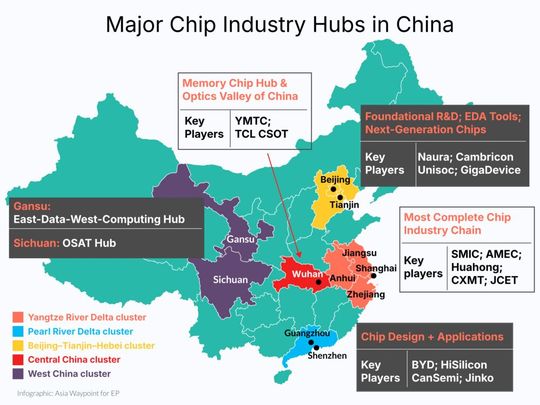
Which chip clusters are there in China? And which one focuses on which technology?
(Image: Asia Waypoint)
If you look at where the most investment is currently being made in the semiconductor industry, the most important chip clusters are Shanghai and the Yangtze River Delta with the provinces of Jiangsu and Zhejiang, followed by the capital Beijing and an amazing recent up-and-comer, the province of Hubei. Two other important regional clusters can be found in the Pearl River Delta and Sichuan/Gansu.
The three clusters in the Delta alone, i.e. Shanghai, Jiangsu and Zhejiang, together attract more than half of all new investment in the industry. The geographical concentration of semiconductor manufacturing in China becomes even clearer when you see that the five regions mentioned above attract more than 80 percent of all capital, even though China has a total of 21 provinces and cities at provincial level.
Differently Weighted Chip Focal Points
Shanghai and the Yangtze River Delta are traditionally the strongholds of the foundry business in China, and the largest manufacturers such as SMIC can be found here. Beijing and neighboring Tianjin have a strength in chip design and rely on the many graduates from their leading universities.
The Pearl River Delta, which in this context also includes Guangzhou and Shenzhen as well as their respective hinterlands, is known for fabless design and the outsourcing of manufacturing to specialized foundries. The other regional clusters, such as those in Sichuan province (including neighbouring Gansu) or the up-and-coming technology hotspots in Hubei and Anhui, are growing through even greater specialization in individual future technologies.
A vivid example of this is the highly ambitious Anhui with its focus on dynamic memory chips and its recently decided focus on the interlinking of artificial intelligence, semiconductor and quantum industries.
Overall, Beijing, Shanghai and Shenzhen are leading the way with their ecosystems for logic chips (SMIC, Huahong, Huawei), while Wuhan in Hubei and Hefei in Anhui excel in the production of memory chips (YMTC, CXMT). In the targeted development of clusters, China's central planners are applying a principle that applied to the entire population in the era of the great reformer Deng Xiaoping: "Let some get rich first." This time, this refers to a few regions and industrial clusters that will hopefully gradually bring technological upgrading and faster GDP growth to the whole country in a few years' time.
Important: A Look at the Five-Year Plans
Anyone who wants to be successful in business in China in the coming years or is even looking for a suitable location for production lines would be well advised to take a detailed look at the individual five-year plans. Shenzhen, for example, lists integrated circuits as a strategic industry in its plan and also mentions specific disruptive and asymmetric technologies. The aim here is to become a "first mover" and play a leading role in advanced semiconductors.
Date: 08.12.2025
Naturally, we always handle your personal data responsibly. Any personal data we receive from you is processed in accordance with applicable data protection legislation. For detailed information please see our privacy policy.
Consent to the use of data for promotional purposes
I hereby consent to Vogel Communications Group GmbH & Co. KG, Max-Planck-Str. 7-9, 97082 Würzburg including any affiliated companies according to §§ 15 et seq. AktG (hereafter: Vogel Communications Group) using my e-mail address to send editorial newsletters. A list of all affiliated companies can be found here
Newsletter content may include all products and services of any companies mentioned above, including for example specialist journals and books, events and fairs as well as event-related products and services, print and digital media offers and services such as additional (editorial) newsletters, raffles, lead campaigns, market research both online and offline, specialist webportals and e-learning offers. In case my personal telephone number has also been collected, it may be used for offers of aforementioned products, for services of the companies mentioned above, and market research purposes.
Additionally, my consent also includes the processing of my email address and telephone number for data matching for marketing purposes with select advertising partners such as LinkedIn, Google, and Meta. For this, Vogel Communications Group may transmit said data in hashed form to the advertising partners who then use said data to determine whether I am also a member of the mentioned advertising partner portals. Vogel Communications Group uses this feature for the purposes of re-targeting (up-selling, cross-selling, and customer loyalty), generating so-called look-alike audiences for acquisition of new customers, and as basis for exclusion for on-going advertising campaigns. Further information can be found in section “data matching for marketing purposes”.
In case I access protected data on Internet portals of Vogel Communications Group including any affiliated companies according to §§ 15 et seq. AktG, I need to provide further data in order to register for the access to such content. In return for this free access to editorial content, my data may be used in accordance with this consent for the purposes stated here. This does not apply to data matching for marketing purposes.
Right of revocation
I understand that I can revoke my consent at will. My revocation does not change the lawfulness of data processing that was conducted based on my consent leading up to my revocation. One option to declare my revocation is to use the contact form found at https://contact.vogel.de. In case I no longer wish to receive certain newsletters, I have subscribed to, I can also click on the unsubscribe link included at the end of a newsletter. Further information regarding my right of revocation and the implementation of it as well as the consequences of my revocation can be found in the data protection declaration, section editorial newsletter.
In its five-year plan, Zhejiang Province also reveals its ambition to soon achieve breakthroughs in the 3 to 7 nanometer range and is also focusing on special segments such as AI chips and those with the latest generation of RISC architectures.
Beijing is promoting several local clusters. There is the northern district of Haidian, which is sometimes referred to as the "Silicon Valley of China" and now wants to focus more on basic research into chip architectures, state-of-the-art semiconductors and EDA software. This is also where the Zhongguancun district is located, with its high density of high-tech companies, in the direct vicinity of some of the country's top universities.
And then there is the suburb of Yizhuang in southern Beijing, whose Beijing Economic Technological Development Area (BDA) with its chip industry, robotics and automation, autonomous driving and other high-tech industries has been growing by an average of eight percent per year for years. This is one of several Chinese hotspots for embodied intelligence ("embodied AI"), which the head office has also placed at the center of its efforts over the next five years.
In addition to the existing foundries, the focus in Shanghai has recently been very much on dovetailing the chip industry with AI. With the help of programs such as "Model-Driven Shanghai", for example, the development of vertical AI models is to be promoted, while at the same time research into high-quality AI chips is being driven forward.
For CEOs and strategy managers in Europe, the differentiated technology plans of these semiconductor regions provide important information for the search for new customers and sales markets, as well as concrete instructions for adapting their own corporate strategy to growth opportunities in China. (sb)



:quality(80)/p7i.vogel.de/wcms/f7/85/f785e961fa2a55ecf4380e1a204c79e3/0129432203v1.jpeg "This is the new Artis 300, which completes the Artis range as the third variant. It stands for TIG DC welding up to 300 amps and is designed as an XT variant for all common voltage levels worldwide. (Image:Fronius)")
:quality(80)/p7i.vogel.de/wcms/28/7c/287ccc5ac565d6e6041bebb1e3e073f0/0113143253v1.jpeg "In our China Market Insider, we regularly provide you with relevant information directly from China. (Image:© Eisenhans - stock.adobe.com)")
:quality(80)/p7i.vogel.de/wcms/da/b1/dab1af09c1f7fd43c841d8c8c60882d7/0129466462v1.jpeg "The yellow device is an auxiliary tool that Subaru needs in vehicle production. The production of such tools can now be accelerated using the high-speed T25 nozzle from Stratsys in combination with the F770-3D 3D printer. Read more here ... (Image:Subaru)")
:quality(80)/p7i.vogel.de/wcms/26/50/2650410753c0bdf9c55989b752891a4f/0129485561v1.jpeg "Northern German industrial companies' confidence in relations with the USA is waning. (Image:ChatGPT)")
:quality(80)/p7i.vogel.de/wcms/99/2e/992e57a54c4ddeaafc113de8e56f2b73/0129501004v1.jpeg "Sereact's AI-based control system can process new and unknown items without prior data collection. (Image:Sereact)")
:quality(80)/p7i.vogel.de/wcms/97/3a/973acc83133c28605f855d750523142e/0129492013v1.jpeg "During the opening, Agile One symbolically pressed the start button. (Image:Deutsche Telekom AG / Cindy Albrecht)")
:quality(80)/p7i.vogel.de/wcms/dd/4e/dd4e6ce73e0e700dcc0f0584813ef47f/0128875162v1.jpeg "Thanks to their high precision, robustness and integration capability, Micro-Epsilon's measurement technology solutions are not only suitable for new systems, but also ideal for retrofit applications. (Image:Micro-Epsilon Messtechnik GmbH & Co. KG)")
:quality(80)/p7i.vogel.de/wcms/17/61/1761a0165c23fe007d0a8e62d2a23121/0129467133v1.jpeg "The partnership between Dassault Systèmes and Nvidia aims to make the industry more effective with the help of AI and digital twins. (Picture: ©DC Studio - stock.adobe.com)")
:quality(80)/p7i.vogel.de/wcms/f8/2d/f82d45c2610205e2c0c188968022890d/more-liftoff-power-first-ariane-6-with-four-boosters-launched-4781x2691v1v1.jpeg "The Ariane 6 can be modularly adapted to any mission—either with two or four boosters and a variable payload fairing length. (Image:ESA-M. Pedoussaut)")
:quality(80)/p7i.vogel.de/wcms/9b/e7/9be7c2ceb897aa2bf1ab4eb2198b8b96/roboter-20hand1-1240x698v1v1.jpeg "What if you could 3D print a soft robot with predictable shape-shifting capabilities already built in? (Image:Picture: Harvard University)")
:quality(80)/p7i.vogel.de/wcms/a7/34/a73475e9638e032c32288f53006abab7/newsimage417867-2665x1500v1v1.jpeg "Combination of a model from a scanning electron microscope image (left) with a section of the underlying crystal structure of a studied MXene with precisely controlled surface terminations. (Image:B. Schröder/HZDR)")
:quality(80)/p7i.vogel.de/wcms/d2/1a/d21a9b3e1333f306ffd6421e84f9e3d0/semiconductor-20image-20courtesy-20of-20gelest-3000x1688v1.jpeg "In a new collaboration, IBM will test the performance of Gelest precursor materials for dry resist EUV lithography, generating results that aim to guide Gelest on materials research and speed innovation toward smaller devices. (Source: Gelest)")
:quality(80)/p7i.vogel.de/wcms/12/ce/12ce3b8d4062d9e433419e9ada594c34/adobestock-1669527454-marewa-4096x2304v1v1.jpeg "Symbol image (Image:Marewa - stock.adobe.com)")
:quality(80)/p7i.vogel.de/wcms/e8/1f/e81f2bd61d820a0cf982dd3831f273dd/0129511298v1.jpeg "In China, certain functions in new cars will once again be directly accessible via haptic input—without a screen. (Image:BYD)")
:quality(80)/p7i.vogel.de/wcms/0b/02/0b02abc1524e267ae66ad0609ce08b20/0129482073v1.jpeg "The Haval Jolion Pro competes in the compact SUV segment. (Image:GWM)")
:quality(80)/p7i.vogel.de/wcms/94/81/948196fc18c3feb4ec87165b218b5650/0129493778v1.jpeg "This is the Vector reconnaissance drone from the start-up Quantum Systems from Gilching near Munich. The specialists are so well received by investors that they can now look forward to an injection of 150 million euros to strengthen their position even further. (Image:Quantum Systems)")
:quality(80)/p7i.vogel.de/wcms/a0/36/a03679debcdda99158f4eaa0d6fbe43d/0129505643v1.jpeg "Arduino App Lab: The current release 0.4.0 brings a number of helpful new features. (Image:Arduino)")
:quality(80)/p7i.vogel.de/wcms/36/c8/36c8b329076027abf5def92031e3028e/0129508876v1.jpeg "Microsoft German headquarters in Munich: As part of the Munich Security Conference, 15 international companies along the entire electronics value chain have formed a tech alliance for digital sovereignty and common trust standards under the leadership of Microsoft and Ericsson. (Image:Microsoft)")
:quality(80)/p7i.vogel.de/wcms/d5/6e/d56e97cb8afab17e93794c1cca214228/0129419457v1.jpeg "China is investing heavily in its domestic semiconductor ecosystem. If you want to be part of it, you should know in advance where which cluster is located and which technology it is driving forward. (Image:Dall-E / AI-generated)")
:quality(80)/p7i.vogel.de/wcms/63/33/6333b367f8caefeba2c7af6318313d65/0129408600-667x375v1.jpeg "Christian Nietner is Innovation Center Lead for Quantum Computing at NTT Data DACH (Image:NTT Data)")
:fill(fff,0)/images.vogel.de/vogelonline/companyimg/76800/76895/65.jpg "FAULHABER_120mm.jpg ()")
:fill(fff,0)/p7i.vogel.de/companies/67/eb/67eba621ef6ea/logo2.png "logo2 (Wuxi InfiMotion)")
:quality(80):fill(efefef,0)/p7i.vogel.de/wcms/67/af/67af6debad886/skz-whitepaper-future-trends-coverbild.png "SKZ Whitepaper_Future Trends_Coverbild")
:quality(80)/p7i.vogel.de/wcms/d5/e2/d5e22c63ba60d609d973da20984f6828/0126218335v1.jpeg "The long-term impact of state-led initiatives to promote high-tech industries is continually demonstrated in China. (Symbolic image) (Image:Dall-E / AI-generated)")
:quality(80)/p7i.vogel.de/wcms/83/8a/838accb8f4f47d9e955b4c9685271f84/bdfb1e7a4e056eaa7899d26ac955addc-1918x1079v1.jpeg "bdfb1e7a4e056eaa7899d26ac955addc-1918x1079v1 (Source: 《AUTOMOBIL INDUSTRIE》China)")