Industry 4.0 significantly enhances the productivity and quality of traditional manufacturing and automation practices. Data connectivity is the key to success in this process.
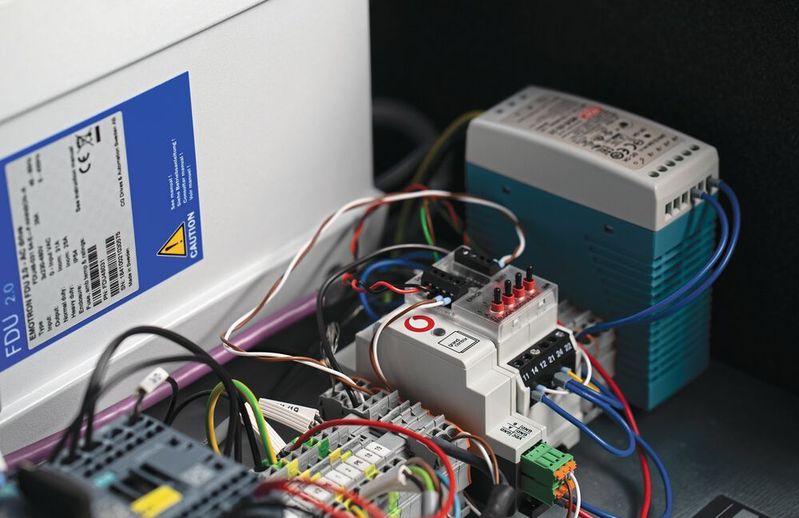
With Modbus Cloud Connect from Grandcentrix, all devices running Modbus RTU can connect with the cloud via cellular-based IoT.
(Image: Grandcentrix)
The first computers revolutionized factory automation at the end of the 1960s. They ushered in an era of computer-aided design (CAD), consistent manufacturing of complex components, increased automation through programmable logic controllers (PLCs), and higher productivity. This period is considered the third industrial revolution, following the impact of steam engines, and after machine tools, electrification, and the internal combustion engine boosted productivity.
The next phase of the revolution is now in full swing: Industry 4.0 is introducing automation of traditional manufacturing and automation practices on a larger scale. This involves widespread machine-to-machine communication (M2M), edge computing, and the transformative potential of artificial intelligence (AI) and machine learning (ML).
All of this is coordinated through the Industrial Internet of Things (IIoT). Its data connectivity, in turn, forms the foundation for Industry 4.0. Through wired and wireless/radio-based networks connecting machine tools, PLCs, sensors, distributed computers, industrial PCs (IPCs), and the cloud, every part of the factory can collect and process data and exchange information with every other part as well as the internet. The availability of this information source enables developers to revolutionize the manufacturing of all kinds of products—from cans to vehicles, screws to smartphones, and jigsaws to jet engines.
Bridging the Gap Between Development and Manufacturing
During Industry 3.0, development and manufacturing benefited from digital automation. However, there was no connection between the two, so they worked more in isolation from each other. Engineers took CAD outputs from the design office and used the information to manually program machine tools in the factory. Apart from being labor-intensive and error-prone, this separation between development and manufacturing prevented any possibility of refining a product design for easier, more cost-effective, and faster production.
Today, the IIoT bridges the gap between the IT networks used for development (Information Technology) and the OT networks used for factory automation (Operating Technology). Through M2M communication, development computers can communicate with machine tools to directly program them for part production. Conversely, machine tools can communicate with development computers to inform them about bottlenecks in the manufacturing process. This allows products to be redesigned for easier manufacturing without compromising functionality.
The free flow of information enables developers to design products that can be manufactured quickly and cost-effectively without compromising quality and minimizing waste. Additionally, machine tools can feed manufacturing information back to the design office to ensure that the next product iteration includes improvements to make processes even more efficient and increase productivity. A central computer can leverage all design and manufacturing data to determine the best method for producing future products that are durable, easy to repair, and easy to recycle at the end of their lifecycle.
Unite Wired and Wireless Connections
Industrial Ethernet is a proven networking technology for factory automation. It is robust and reliable and supports established industrial automation profiles such as Ethernet/IP, Profinet, and Modbus TCP. The wired technology will likely continue to form the backbone of the factory communication network in the coming years.
The downside of Industrial Ethernet is that expanding the infrastructure can be expensive and disruptive. Cabling and connections need to be housed within the building, and the associated electronics for managing the protocol must also be installed. Managers can justify this when adding new large machine tools or production lines—but it is a less practical solution when sensors need to be added to monitor machines and conditions, to track the movement of parts or assemblies in the factory, or to transmit design and manufacturing data to the cloud.
For these applications, wireless connections like Bluetooth LE, low-power Wi-Fi, and cellular-based IoT (NB-IoT and LTE-M) are more practical alternatives. The protocols are based on international standards and are continuously updated to introduce new features as IoT evolves. The sensors powered by these wireless techniques are cost-effective, compact, easy to install and configure, and can be powered by batteries for months or even years.
Date: 08.12.2025
Naturally, we always handle your personal data responsibly. Any personal data we receive from you is processed in accordance with applicable data protection legislation. For detailed information please see our privacy policy.
Consent to the use of data for promotional purposes
I hereby consent to Vogel Communications Group GmbH & Co. KG, Max-Planck-Str. 7-9, 97082 Würzburg including any affiliated companies according to §§ 15 et seq. AktG (hereafter: Vogel Communications Group) using my e-mail address to send editorial newsletters. A list of all affiliated companies can be found here
Newsletter content may include all products and services of any companies mentioned above, including for example specialist journals and books, events and fairs as well as event-related products and services, print and digital media offers and services such as additional (editorial) newsletters, raffles, lead campaigns, market research both online and offline, specialist webportals and e-learning offers. In case my personal telephone number has also been collected, it may be used for offers of aforementioned products, for services of the companies mentioned above, and market research purposes.
Additionally, my consent also includes the processing of my email address and telephone number for data matching for marketing purposes with select advertising partners such as LinkedIn, Google, and Meta. For this, Vogel Communications Group may transmit said data in hashed form to the advertising partners who then use said data to determine whether I am also a member of the mentioned advertising partner portals. Vogel Communications Group uses this feature for the purposes of re-targeting (up-selling, cross-selling, and customer loyalty), generating so-called look-alike audiences for acquisition of new customers, and as basis for exclusion for on-going advertising campaigns. Further information can be found in section “data matching for marketing purposes”.
In case I access protected data on Internet portals of Vogel Communications Group including any affiliated companies according to §§ 15 et seq. AktG, I need to provide further data in order to register for the access to such content. In return for this free access to editorial content, my data may be used in accordance with this consent for the purposes stated here. This does not apply to data matching for marketing purposes.
Right of revocation
I understand that I can revoke my consent at will. My revocation does not change the lawfulness of data processing that was conducted based on my consent leading up to my revocation. One option to declare my revocation is to use the contact form found at https://contact.vogel.de. In case I no longer wish to receive certain newsletters, I have subscribed to, I can also click on the unsubscribe link included at the end of a newsletter. Further information regarding my right of revocation and the implementation of it as well as the consequences of my revocation can be found in the data protection declaration, section editorial newsletter.
Bluetooth LE is suitable for mesh networks to ensure that hundreds of sensors can communicate from one end of the factory to the other. Low-power Wi-Fi can be used to power sensors with higher bandwidth needs (e.g., cameras) and is also useful as a location technique to keep track of assets. Cellular-based IoT provides a long-range communication protocol for gateways that collect information from sensor networks and transmit it to the cloud.
Close Monitoring With ML
To ensure productivity and quality, detailed process control is required. Wireless sensors and cameras can monitor machines and measure finished parts to detect minor deviations in the product and correct the process before tolerance is exceeded. Beyond the actual manufacturing process, many other factors can affect productivity and quality, so additional sensors can monitor aspects like vibrations, temperature, humidity, and air quality—all of which can negatively impact a manufacturing process.
However, continuous and large-scale manufacturing generates a massive stream of sensor data. Much of this data will not change—sending it to computers for analysis is time-consuming, costly, and energy-intensive. Instead, today's powerful wireless system-on-chip (SoC) and system-in-package (SiP) components from Nordic and other providers include powerful embedded processors and ML software that help detect significant deviations and forward only this information for further action.
Nordic's nRF52 and nRF53 series multiprotocol SoCs contain Arm Cortex-M4 (nRF52) and Arm Cortex-M33 processors (nRF53). They support Edge Impulse's TinyML—an optimized form of ML supported by compact, battery-operated sensors.
Avoid Externally Caused Problems With ML
ML also helps to avoid problems caused by external factors—such as increased humidity from employees arriving at the workplace, airflows from open windows and doors, and temperature fluctuations throughout the day and night. Machine settings can then be adjusted before these factors affect the process. Finally, specialized vibration and acoustic sensors can monitor machine tools to ensure they are in perfect condition. Unusual vibrations, temperature rises, or increased power consumption can be reported before a failure occurs, allowing for early maintenance and preventing unplanned and costly production downtime.
IIoT in Action
Nordic's multiprotocol and cellular-based IoT solutions are used worldwide for IIoT applications. The recently introduced low-power Wi-Fi series nRF70 is being integrated into asset tracking devices that will soon hit the market.
Modbus Cloud Connect from Grandcentrix enables all devices running the Modbus RTU industrial Ethernet protocol to wirelessly connect to the cloud using cellular-based IoT. This uses Nordic's low-power SiP nRF9160. Modbus RTU is a common industrial automation protocol for M2M communication that allows for the reporting of manufacturing data or maintenance issues to a central device or server.
Similarly, the IoT gateway Prylada from Tymiq uses the nRF9160 for LTE-M connectivity between the device and a cloud platform. The gateway offers numerous connection interfaces through which telemetry data from a variety of sensors is collected, including temperature, humidity, light, liquid leakage, air quality, and motion detection. It uses the Arm Cortex-M33 processor of the SiP to monitor the sensors and gather the relevant data.
TZero uses the nRF9160 to provide long-range wireless connectivity and computing power for its MachineMailbox tool for network connecting machines. According to TZero, the solution turns any product into a connected IIoT sensor/machine solution without configuration. MachineMailbox uses the Arm Cortex-M33 processor of the nRF9160 to manage and execute the complex proprietary algorithms needed by multiple sensors, as well as to send the data to the cloud.
The Atom from Atomation is designed for predictive maintenance and is equipped with Nordic's nRF52840 SoC. It features a range of sensors that monitor machine variables such as temperature, vibration, humidity, pressure, distance, tilt, and impact. The Atom utilizes the computing power of the Arm Cortex-M4 processor of the SoC to determine if the sensors detect abnormal values before transmitting the data.
The IIoT Will Usher in Industry 5.0
Both Industry 3.0 and 4.0 utilize digital data processing to increase productivity. The difference is that earlier computers helped humans make better decisions, while Industry 4.0 uses the same information (and much more) to optimize processes largely without human intervention.
Wireless technology reduces the costs of networking in Industry 4.0 and facilitates the reconfiguration of networks when manufacturing is modified and expanded. The long-term savings through better product design and improved manufacturing are significant, as productivity increases and product defects decrease.
Industry 4.0 still has some time to develop. However, the vision for Industry 5.0 is clear: sustainability. According to the EU, the next leap will "take the industry beyond efficiency and productivity as sole goals and reinforce the role and contribution of industry to society, whilst respecting the production limits of the planet." This is a commendable goal, but a great challenge. Yet, as with the challenges of Industry 4.0, the IIoT will help us in solving these.
About the author
Lorenzo Amicucci
(Image: Nordic Semiconductor)
Lorenzo Amicucci is a Business Development Manager at Nordic Semiconductor in Oslo, Norway. He supports Nordic's sales team in developing new solutions in collaboration with leading partners and customers from various industries. Before joining Nordic, he worked in the telecommunications industry, focusing on radio/microwave network equipment, and served leading customers providing critical radio infrastructure. Amicucci studied at universities in Italy, China, and Sweden, and holds a master's degree in electrical engineering from Politecnico di Milano, specializing in analog/RF IC design.



:quality(80)/p7i.vogel.de/wcms/94/81/948196fc18c3feb4ec87165b218b5650/0129493778v1.jpeg "This is the Vector reconnaissance drone from the start-up Quantum Systems from Gilching near Munich. The specialists are so well received by investors that they can now look forward to an injection of 150 million euros to strengthen their position even further. (Image:Quantum Systems)")
:quality(80)/p7i.vogel.de/wcms/da/b1/dab1af09c1f7fd43c841d8c8c60882d7/0129466462v1.jpeg "The yellow device is an auxiliary tool that Subaru needs in vehicle production. The production of such tools can now be accelerated using the high-speed T25 nozzle from Stratsys in combination with the F770-3D 3D printer. Read more here ... (Image:Subaru)")
:quality(80)/p7i.vogel.de/wcms/26/50/2650410753c0bdf9c55989b752891a4f/0129485561v1.jpeg "Northern German industrial companies' confidence in relations with the USA is waning. (Image:ChatGPT)")
:quality(80)/p7i.vogel.de/wcms/37/9f/379f62914fcef347331e271270e3f755/ad1i8940-4368x2456v1.jpeg "(Source: SIMTOS)")
:quality(80)/p7i.vogel.de/wcms/05/63/05633ca5deb577945793fd0f553356b3/0129493475v1.jpeg "Lapp continued to invest in production capacities and technologies worldwide in the 2025 financial year. (Image:Lapp)")
:quality(80)/p7i.vogel.de/wcms/97/3a/973acc83133c28605f855d750523142e/0129492013v1.jpeg "During the opening, Agile One symbolically pressed the start button. (Image:Deutsche Telekom AG / Cindy Albrecht)")
:quality(80)/p7i.vogel.de/wcms/dd/4e/dd4e6ce73e0e700dcc0f0584813ef47f/0128875162v1.jpeg "Thanks to their high precision, robustness and integration capability, Micro-Epsilon's measurement technology solutions are not only suitable for new systems, but also ideal for retrofit applications. (Image:Micro-Epsilon Messtechnik GmbH & Co. KG)")
:quality(80)/p7i.vogel.de/wcms/17/61/1761a0165c23fe007d0a8e62d2a23121/0129467133v1.jpeg "The partnership between Dassault Systèmes and Nvidia aims to make the industry more effective with the help of AI and digital twins. (Picture: ©DC Studio - stock.adobe.com)")
:quality(80)/p7i.vogel.de/wcms/9b/e7/9be7c2ceb897aa2bf1ab4eb2198b8b96/roboter-20hand1-1240x698v1v1.jpeg "What if you could 3D print a soft robot with predictable shape-shifting capabilities already built in? (Image:Picture: Harvard University)")
:quality(80)/p7i.vogel.de/wcms/a7/34/a73475e9638e032c32288f53006abab7/newsimage417867-2665x1500v1v1.jpeg "Combination of a model from a scanning electron microscope image (left) with a section of the underlying crystal structure of a studied MXene with precisely controlled surface terminations. (Image:B. Schröder/HZDR)")
:quality(80)/p7i.vogel.de/wcms/d2/1a/d21a9b3e1333f306ffd6421e84f9e3d0/semiconductor-20image-20courtesy-20of-20gelest-3000x1688v1.jpeg "In a new collaboration, IBM will test the performance of Gelest precursor materials for dry resist EUV lithography, generating results that aim to guide Gelest on materials research and speed innovation toward smaller devices. (Source: Gelest)")
:quality(80)/p7i.vogel.de/wcms/f5/c6/f5c6cefa374d48138dc702821d41c7c6/greenspeed-visual-home-1500x843v1v1.jpeg "The EU Green Speed project is laying the foundations for cleaner and more competitive production of lithium-ion batteries in Europe. (Image:greenSPEED Consortium / VIRTUAL VEHICLE)")
:quality(80)/p7i.vogel.de/wcms/b9/47/b9470dd7a30574d74b6d95d26e4e4ee8/0129473060v1.jpeg "UE Studios has presented the Self-Driving Urban E-Shuttle to the public for the first time. (Image:UE Studios)")
:quality(80)/p7i.vogel.de/wcms/d0/bb/d0bb569e57d4b98f28bfa4b9600b245e/0129453908v1.jpeg "Tobias Sühlmann is Head of Design at Porsche. (Image:McLaren)")
:quality(80)/p7i.vogel.de/wcms/eb/73/eb73c6f1dc08af55057cfc298c8ef72f/0128683789v1.jpeg "Alpina has been an independent brand since January. In the picture: the BMW Alpina Roadstar V8 from 2002. (Image:BMW)")
:quality(80)/p7i.vogel.de/wcms/b7/1d/b71d25d354a0800790b525ebacd45168/a260075-large-960x540v1v1.jpeg "With the AI-supported dryer control system, Audi is testing the first application from an IPAI cooperation in series production in the paint shop at the Neckarsulm site. (Image:Audi)")
:quality(80)/p7i.vogel.de/wcms/8d/ff/8dffe7518cc69b90ea89c7b37f7de781/0129470810v1.jpeg "Demo of the ChipStack AI Super Agent. (Image:Cadence)")
:quality(80)/p7i.vogel.de/wcms/35/a7/35a7cbca29eb719318324ca2e70c33c7/0129484567v1.jpeg "The above-ground part of the IceCube experiment and the graphic simulation of a measurement signal from the detectors in the ice. Researchers can measure cosmic neutrinos with the IceCube observatory. (Image:Stephan Richter, IceCube; photomontage: Beatrix von Puttkamer)")
:quality(80)/p7i.vogel.de/wcms/42/c0/42c09f523fbe58320ac017087fb678b4/0129455974v1.jpeg "Schematic representation of a microlaser with a surface grating structured with nanometer precision. The compact semiconductor laser generates a directed beam of light with a beam profile that is precisely tailored to the respective application. (Image:AG Reitzenstein/TU Berlin)")
:quality(80)/p7i.vogel.de/wcms/72/e8/72e82e7be7eb9c7f3fe6e7bd6442b95d/0129427931v1.jpeg "Strategic: EPC licenses eGaN technology to Renesas (Image:freely licensed)")
:fill(fff,0)/p7i.vogel.de/companies/69/88/69882c428938e/tmts2026-ticec-banner-en-2000px.png "tmts2026-ticec-banner-en-2000px (https://www.tmts.tw/en)")
:fill(fff,0)/p7i.vogel.de/companies/67/eb/67eba621ef6ea/logo2.png "logo2 (Wuxi InfiMotion)")
:quality(80)/p7i.vogel.de/wcms/22/4c/224c1d336b0c8a0f260f080d61121faa/0124368691v1.jpeg "The MachineMailbox from TZero uses the Arm Cortex-M33 processor of the SiP nRF9160 to manage and execute the complex proprietary algorithms needed by multiple sensors, as well as to send the data to the cloud.(Image: TZero)")
:quality(80)/p7i.vogel.de/wcms/74/fc/74fc4192b7626444054094c9f3eda8f8/0124368769v1.jpeg "Atomation uses the processing power of the Arm Cortex-M4 processor in the nRF52840 to determine if sensors detect abnormal values before transmitting the data.(Image: Atomation)")
:quality(80)/p7i.vogel.de/wcms/b1/a9/b1a9ca5823fedc8a2e847d4803d860b5/0124368682v1.jpeg "The IoT Gateway Prylada from Tymiq captures telemetry data from numerous sensors, including temperature, humidity, light, liquid leakage, air quality, and motion detection.(Image: TYMIQ)")
:quality(80)/p7i.vogel.de/wcms/d8/ef/d8ef4ae57917994599792cb7b907c9b2/0124368438v1.jpeg "Nordic's SiP nRF9160 is the most power-efficient cellular IoT solution on the market – extending battery life.(Image: Nordic)")

:quality(80)/p7i.vogel.de/wcms/57/03/57033deb409d3609592ddcb59d86ac69/0127248634v1.jpeg "The Industrial PI from Pilz is a versatile industrial PC: suitable for automation and drive technology. The Industrial PI can be used as an IIoT gateway or soft PLC. (Image:Pilz GmbH & Co. KG)")
:quality(80)/p7i.vogel.de/wcms/58/f2/58f220c93ab6a5fc7c8374849430a444/0128247466v1.jpeg "Space satellites: \"Setting up and providing NTN has never been so easy.\" (Image:AI-generated)")