Important foundations for the success of digital transformation are a clear strategy and the integration of modern technologies such as cloud computing, artificial intelligence, and IIoT. With regard to implementation, industrial transformation today focuses on application scenarios that combine automation and security solutions into an "all-in-one" package. This creates—in a very pragmatic way—greater continuity between safety and automation.
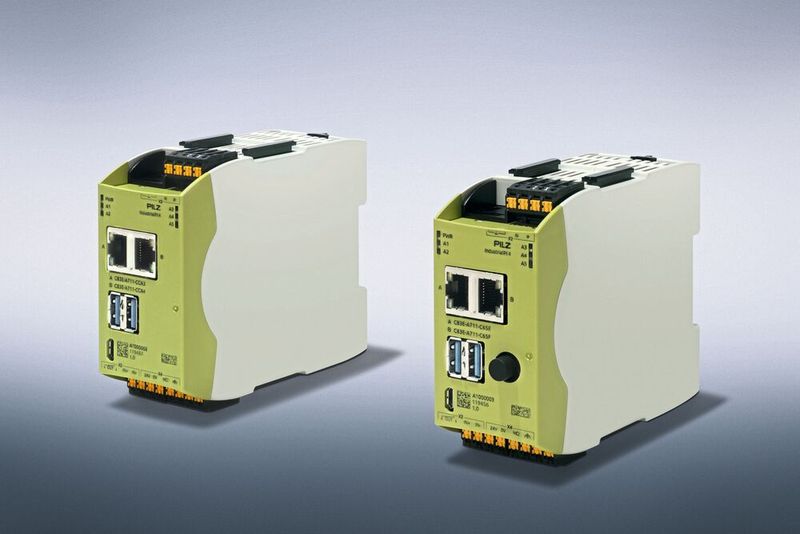
The Industrial PI from Pilz is a versatile industrial PC: suitable for automation and drive technology. The Industrial PI can be used as an IIoT gateway or soft PLC.
(Image: Pilz GmbH & Co. KG)
An easy-to-use solution for implementing Industry 4.0 concepts is industrial PCs, such as the IndustrialPI from Pilz. Designed as an open and modular industrial PC, it uses Linux as its operating system, a freely available open-source software. This industrial PC can be used either as a gateway in Industrial IoT (IIoT) environments or as a soft PLC in a wide range of applications.
Adaptable Industrial PCs Support
What can such adaptable industrial PCs achieve? Industrial PCs used as IIoT gateways provide intelligent diagnostic scenarios: always available in plain text and, above all, accessible regardless of location. This is because users should always keep an eye on their machines and systems to ensure that the production processes of decentralized systems run as smoothly as possible without major disruptions, or that commissioning can be carried out more quickly.
Gallery
The Pilz industrial PC can be easily integrated into existing system architectures. In the immediate vicinity of machines and systems, it collects process or operational data, for example, and transfers it directly, such as to a company cloud. And what do industrial PCs achieve as soft PLCs? When used as a soft PLC, the IndustrialPI also handles 'simple' automation tasks. One application: it controls machines and systems, such as gantry machines for sorting battery cells or case erectors in the packaging industry. There, it takes on tasks such as drive operations—whether pure control applications or synchronized axis movements in the drivetrain of machines. Such adaptable industrial PCs thus support users in implementing Industry 4.0 concepts individually—they adapt to the intended purpose.
Flexible connectivity as a critical factor
The IndustrialPI provides an industrial-grade solution for data exchange between the Internet of Things and cloud services. It features freely available open-source software and offers numerous input and output modules.
(Image: Pilz GmbH & Co. KG)
Another factor for the success of industrial transformation is connectivity, aiming for seamless communication in the field. The foundation for this is open and flexible IIoT architectures. Only dynamic solution approaches can ensure effective collaboration across numerous devices, installations, and applications. Here too, industrial PCs excel when they can be used as a gateway, data collector, and diagnostic unit, like the IndustrialPI. In the case of the Pilz industrial PC, this is possible in conjunction with the safe small control system PNOZmulti 2 and the automation system PSS 4000. This solution enables data exchange between the Internet of Things and cloud services.
In implementation, it is holistic automation solutions, including safety and security, that make modular and decentralized production plants flexibly extendable and quickly ready to operate. They also ensure that data communication is designed to be maximally flexible and reliable—with safety-oriented and standard communication.
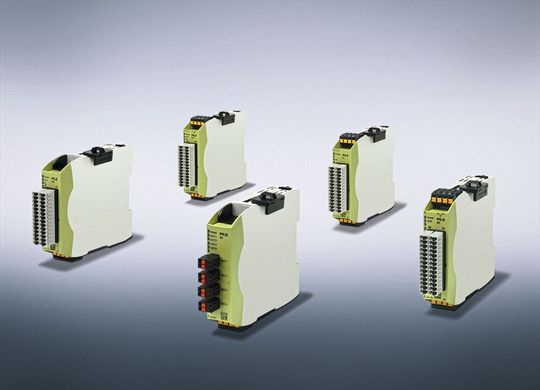
The communication system IO-Link Safety and the standard FSoE (Failsafe over EtherCAT) already play a key role in a connected world today: IO-Link Safety technology is crucial for meeting important user requirements. It enables seamless safe communication with every sensor and actuator in the field. For example, Pilz IO-Link Safety sensors provide important status information. They also offer a wider range of features for intelligent diagnostics: the devices can self-identify and self-parameterize. This helps optimize processes, making components easier to replace and reducing downtime due to repairs. Moreover, this technology can monitor applications smartly. For instance, IO-Link Safety evaluates data from safety light curtains: information such as signal quality can be used for predictive maintenance. Thus, IO-Link Safety fulfills the demand for flexible automation through safe and standardized point-to-point communication. Furthermore, achieving the highest level of safety up to PL e per EN ISO 13849-1 (SIL 3 according to IEC 61508/62061) and being fieldbus-independent are additional advantages for the user. The result is greater availability of machines in today's and tomorrow's industries.
Date: 08.12.2025
Naturally, we always handle your personal data responsibly. Any personal data we receive from you is processed in accordance with applicable data protection legislation. For detailed information please see our privacy policy.
Consent to the use of data for promotional purposes
I hereby consent to Vogel Communications Group GmbH & Co. KG, Max-Planck-Str. 7-9, 97082 Würzburg including any affiliated companies according to §§ 15 et seq. AktG (hereafter: Vogel Communications Group) using my e-mail address to send editorial newsletters. A list of all affiliated companies can be found here
Newsletter content may include all products and services of any companies mentioned above, including for example specialist journals and books, events and fairs as well as event-related products and services, print and digital media offers and services such as additional (editorial) newsletters, raffles, lead campaigns, market research both online and offline, specialist webportals and e-learning offers. In case my personal telephone number has also been collected, it may be used for offers of aforementioned products, for services of the companies mentioned above, and market research purposes.
Additionally, my consent also includes the processing of my email address and telephone number for data matching for marketing purposes with select advertising partners such as LinkedIn, Google, and Meta. For this, Vogel Communications Group may transmit said data in hashed form to the advertising partners who then use said data to determine whether I am also a member of the mentioned advertising partner portals. Vogel Communications Group uses this feature for the purposes of re-targeting (up-selling, cross-selling, and customer loyalty), generating so-called look-alike audiences for acquisition of new customers, and as basis for exclusion for on-going advertising campaigns. Further information can be found in section “data matching for marketing purposes”.
In case I access protected data on Internet portals of Vogel Communications Group including any affiliated companies according to §§ 15 et seq. AktG, I need to provide further data in order to register for the access to such content. In return for this free access to editorial content, my data may be used in accordance with this consent for the purposes stated here. This does not apply to data matching for marketing purposes.
Right of revocation
I understand that I can revoke my consent at will. My revocation does not change the lawfulness of data processing that was conducted based on my consent leading up to my revocation. One option to declare my revocation is to use the contact form found at https://contact.vogel.de. In case I no longer wish to receive certain newsletters, I have subscribed to, I can also click on the unsubscribe link included at the end of a newsletter. Further information regarding my right of revocation and the implementation of it as well as the consequences of my revocation can be found in the data protection declaration, section editorial newsletter.
Secure Transmission Down to the Last Sensor
When discussing industrial communication today, secure data transmission to the "last" sensor should be the focus, especially for devices in the field. FSoE is also another standard for communication in this context. The main advantages of FSoE for industrial applications lie in the use of the so-called Black Channel principle. Through this, safety-critical data can be transmitted across various networks, including Ethernet and wireless connections. This supports the Industry 4.0 requirements for vertically integrated, real-time communication within the automation pyramid in smart factories. High reliability and safety in critical applications are ensured through standardization according to IEC 61784-3 and certification to Safety Integrity Level (SIL) 3. This "innovative" secure connectivity helps optimize manufacturing processes.
FSoE Also Stands for More Flexibility
FSoE can do even more: the FSoE communication protocol offers users greater flexibility, as it enables the simultaneous transmission of both safety-related and non-safety-related process data over a single EtherCAT network—hat is, also via a single-cable solution. This helps seamlessly integrate safety concepts into machine designs while also securely incorporating safety-relevant system structures.
When configurable small controllers use the safe FSoE protocol for communication, the efficiency and safety of production systems can be increased: by integrating safety functions into an existing EtherCAT network, separate or redundant safety wiring becomes unnecessary. This simplifies system architecture and reduces complexity for the user. In addition, these simplifications lower installation and maintenance costs.
Single-cable solution at fieldbus level
Specifically, starting with version 11.3 of the software tool PNOZmulti Configurator, users can use PNOZmulti 2 as an FSoE MainInstance, as an FSoE SubInstance, and also as an EtherCAT Subdevice.
In combination with the base unit PNOZ m B1 or the EtherCAT FSoE communication module, a total of up to four MainInstance-to-MainInstance connections and up to 60 MainInstance-SubInstance connections are possible. De facto, this represents a "single-cable solution" at the fieldbus level.
Single-Cable Solution on Top
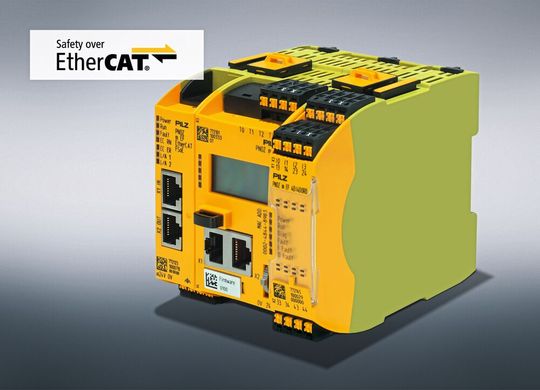
The configurable safe small controller PNOZmulti 2 from Pilz supports the open communication system EtherCAT in combination with the safe protocol Safety-over-EtherCAT FSoE (FailSafe over EtherCAT). This enables PNOZmulti 2 to transmit both control-relevant and safety-relevant information.
(Image: Pilz GmbH & Co. KG)
The safe small controller PNOZmulti 2, for example, supports EtherCAT in combination with the safe protocol Safety-over-EtherCAT FSoE (= Failsafe over EtherCAT). With it, users can transmit both control-related and safety-related information. Such a solution makes applications flexible and economical, as safety-relevant system structures can be integrated more easily. The PNOZmulti 2 single-cable solution also enables safety-relevant networking of infrastructures—for instance, with safe radar sensors like PSENradar and safe drive technology PMC, both from Pilz. When PNOZmulti 2 functions as an FSoE MainInstance, a comprehensive safe drive solution—"Safe Motion"—becomes possible. FSoE-capable actuators and sensors can then be easily integrated into the network.
Holistic automation solutions, including safety for a digitized industrial world, must enable flexible expansion and quick commissioning of modular and decentralized production plants, as well as reliable and flexibly designed communication in the field. These are important aspects of a successful transformation that ensures availability.
Pilz keeps connectivity in focus
At Pilz, the topic of connectivity has gained significant importance over the past years. Products and solutions in the portfolio aim to enhance network security, improve availability, and make infrastructures future-proof in the long term.
The Pilz devices communicate with each other. For example, the automation provider developed its own fieldbus with SafetyNET p. The goal was to enable fieldbus communication over Ethernet in real-time while simultaneously providing safety (machine safety) data for communication. SafetyNET p is the only safe, Ethernet-based fieldbus system that has supported Publisher/Subscriber technology (Pub/Sub) from the very beginning.
This knowledge about Pub/Sub in connection with the requirements of functionally safe fieldbus protocols is currently paving the way for Safety over OPC UA. For instance, Pilz has been significantly driving the development of this communication technology since 2018 as part of the IO-Link Safety Consortium: Pilz led—in addition to the Marketing Working Group—the Technical Working Group, which developed the specifications for this protocol technology, including the execution of tests and certifications.
The automation company Pilz offers its global customers and their applications the appropriate connectivity for various industries and sectors: For customers in the European automotive industry, the Profinet / Profisafe protocol. In other industries and sectors in Europe and Asia, it’s EtherCAT and FSoE, while in the USA, it’s Ethernet/IP.
Since connectivity between controllers and decentralized data collectors in the field is also highly relevant, Pilz sees OPC UA (FX) as another important topic. Currently, Pilz is focusing not only on connectivity via the IO-Link Safety communication protocol but also on fieldbus connectivity through Pilz safety controllers.
Secure and Compliant Authentication in Laboratories



:quality(80)/p7i.vogel.de/wcms/eb/2b/eb2bd1b8487afe577b37363cd02f16ff/0113143253v1.jpeg "In our China Market Insider, we regularly provide you with relevant information straight from China. (Image:© Eisenhans - stock.adobe.com)")
:quality(80)/p7i.vogel.de/wcms/dd/b8/ddb8edc98c49b384734ab2432b297eb5/adobestock-1913662309--irene-stock-adobe-com-ki-generiertv1.jpeg "Rotary joints are used in grippers and swivel mechanisms to allow assemblies to rotate or swivel smoothly relative to one another, even under very high loads (illustrative image). (Source: Irene - stock.adobe.com / KI-generiert)")
:quality(80)/p7i.vogel.de/wcms/d1/ef/d1ef6b6f7d4543f7999980bacccaf22b/0133499261v1.jpeg "As the growing imbalance in trade relations with China continues to widen, the EU Chamber of Commerce foresees a day when trade with China will have to be seriously reevaluated ... (Image: AI-generated)")
:quality(80)/p7i.vogel.de/wcms/fe/1f/fe1fa5ee713f94deaba963dc24c3abc5/0133299273v1.jpeg "The Flexistar enables highly flexible production of laser-welded tubes thanks to its tool-free clamping system. (Image:Because Technology, LLC)")
:quality(80)/p7i.vogel.de/wcms/60/ef/60ef4f07e4829b2c2929befc0f353c58/0133511729v1.jpeg "Humanoid robots can match human performance in certain tasks. (Image:Gemini / AI-generated)")
:quality(80)/p7i.vogel.de/wcms/2e/99/2e99726b522e4b35b690e25eb6a42643/0133463991v1.jpeg "Robotics: In AMR applications, connection technology must reliably transmit power, signals, and data despite vibration and shock loads—in very confined spaces and in a way that allows for regular maintenance. (Image:Hyperever)")
:quality(80)/p7i.vogel.de/wcms/d0/18/d01801e3d5dbd7bc9d0b4f60408b630c/0133468429v1.jpeg "Quality requirements for film packaging are on the rise. At the same time, many companies are turning to recyclable film materials, which, however, have their own challenges. Fraunhofer researchers have therefore developed a fast system that detects problems in real time. (Image:Fraunhofer IKTS)")
:quality(80)/p7i.vogel.de/wcms/b1/06/b106cf44923ce39565c3264982fd20eb/0133414574v1.jpeg "Robots Build Robots: At the new Ubtech factory, automated systems even handle parts of the material supply and logistics for the production of humanoid robots. (Image:Ubtech)")
:quality(80)/p7i.vogel.de/wcms/c0/52/c052f405eb55fc3d08c4837e77206fc0/adobestock-2021845957--aucartstudio-stock-adobe-com-ki-generiertv1.jpeg "An innovation from China to combat extreme summer heat: A novel coating lowers temperatures. (Source: © AucArtStudio – stock.adobe.com_AI-generated)")
:quality(80)/p7i.vogel.de/wcms/66/a7/66a7b78159caeacce57136529688799f/0133503398v1.jpeg "Sunlight Makes Stone! These stone blocks weren't made the traditional way. Instead, they were additively manufactured from sand using a laser. In the future, however, the laser is set to be replaced by concentrated sunlight—if the startup Addisol is successful... (Image:Addisol / F. Fiedler)")
:quality(80)/p7i.vogel.de/wcms/72/b9/72b995c2c8d812c5e2115cbef31e035a/0133462727v1.jpeg "Eggl manufactures center hoods that are precisely tailored to each cooking island—whether standard size or custom shape. They are made entirely of stainless steel and are individually customized in terms of size and filter arrangement. (Image:SPI)")
:quality(80)/p7i.vogel.de/wcms/13/5d/135dfae6229ceaf5c55467a43e8f7257/adobestock-1879961393--ardi-stock-adobe-com-ki-generiertv1.jpeg "Annoying chatterboxes or awkward silences in response to questions—a moderator should specifically prepare for difficult situations in order to navigate them effectively. (Image:ardi - stock.adobe.com_AI-generated)")
:quality(80)/p7i.vogel.de/wcms/aa/a2/aaa2c6dd2daa24b485cddbf9297590c0/0133467318v1.jpeg "Battery Monitoring: Battery monitoring using electrochemical impedance spectroscopy offers several advantages. (Image:TI)")
:quality(80)/p7i.vogel.de/wcms/39/b2/39b21bf03be1683831862239a369987c/0133469638v1.jpeg "Data from autonomous vehicles and robots operating autonomously is in high demand, and Ruqi wants to capitalize on this. (Image:Ruqi Mobility)")
:quality(80)/p7i.vogel.de/wcms/8a/bb/8abbb6217220595edc1549ac9b84f307/0133429906v1.jpeg "The IAA in Hanover showcased the ambitions of Chinese commercial vehicle manufacturers in Europe. (Image:Wehner - VCG)")
:quality(80)/p7i.vogel.de/wcms/0c/53/0c5313ef91c14b6df0d0996efc33c8ad/jpg03568-bearbeitetv1.jpeg "The category winners of the 2027 German Car of the Year award. (Source: GCOTY)")
:quality(80)/p7i.vogel.de/wcms/48/15/4815da27c45973ca629a99b375ac3aef/0133509585v1.jpeg "Ventuno Q RoadTest: Designed to help the Element14 community gain practical insights from real-world tests using the Ventuno Q. (Image:Farnell/Element14)")
:quality(80)/p7i.vogel.de/wcms/17/2b/172bd132f9febdfcbcedba292ad0504d/aufmacherv1.jpeg "Micro-Epsilon offers a wide range of IO-Link-compatible sensors. (Source: Micro-Epsilon Messtechnik GmbH & Co. KG)")
:quality(80)/p7i.vogel.de/wcms/ca/b4/cab46fd26d19d6a2febca032048200b6/0133471827v1.jpeg "Photonics SDK for C and Python: Computational operations are now abstracted as standard mathematical functions. (Image:Q.ANT)")
:quality(80)/p7i.vogel.de/wcms/92/b2/92b2ed5299cde450c0764f4f64468395/0133505895v1.jpeg "The \"Iris 100\" test system for high-precision volume production of microLEDs uses a spectrometer and a high-resolution camera. (Image:Teradyne)")
:fill(fff,0)/images.vogel.de/vogelonline/companyimg/76800/76895/65.jpg "FAULHABER_120mm.jpg ()")
:fill(fff,0)/p7i.vogel.de/companies/69/de/69de1b7403b0d/simtos-logo.jpeg "simtos-logo (SIMTOS)")
:quality(80)/p7i.vogel.de/wcms/bc/d6/bcd6571670322153e3c1585c2cb8efb0/0127248640v1.jpeg "The Industrial PI from Pilz is a versatile industrial PC: suitable for automation and drive technology. The Industrial PI can be used as an IIoT gateway or soft PLC.(Image: Pilz GmbH & Co. KG)")
:quality(80)/p7i.vogel.de/wcms/22/ac/22acac0e7b293d54c224a236bf28b948/0126923764v1.jpeg "As a soft PLC, the IndustrialPI also handles 'simple' automation tasks, e.g., for carton erectors in the packaging industry.(Image: sema Systemtechnik GmbH)")
:quality(80)/p7i.vogel.de/wcms/36/e7/36e75898ac75b600751f0e65901a9765/0126924130v1.jpeg "Dr.-Ing. Manuel Schön, Product Management Software and Technology, Pilz GmbH & Co. KG.(Image: Pilz GmbH & Co. KG)")
:quality(80):fill(efefef,0)/p7i.vogel.de/wcms/67/ac/67acb931a438c/elatec-wp-gmp.png "Elatec WP GMP")
:quality(80)/p7i.vogel.de/wcms/f1/e0/f1e0762012ba63607bd0ee537ef4db7a/bild1-phoenix-20contact-00167373-full-b5000v1.jpeg "The driverless transport systems (DTS) or automated guided vehicles (AGVs) used in intralogistics must meet one essential requirement: they should operate safely, quickly, and interoperably within the existing infrastructure. (Image: Phoenix Contact)")
:quality(80)/p7i.vogel.de/wcms/66/08/660805a7af69a79b12c4d76fccc5b56b/0129347606v1.jpeg "Can real-time applications for motion or robotics, for example, be operated with virtual controllers in the data center? (Image:AI-generated)")