The immense computational demand of modern AI applications is not only advancing the development of GPUs but also forcing the storage industry to rethink its architecture. New form factors, extreme packing densities, and unconventional cooling concepts are becoming the standard.
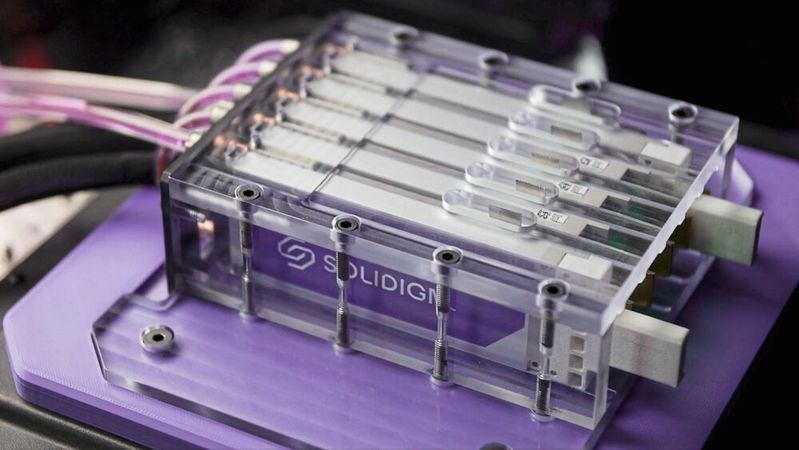
Cold-plate cooling in detail: For completely fanless server environments, Solidigm has developed a liquid-cooled SSD design that dissipates the extreme heat of densely packed AI storage systems via direct contact (direct-to-chip).
(Image: Solidigm)
Anyone planning the construction of AI data centers or high-performance edge infrastructures today quickly encounters hard physical limits. Space requirements, thermal load, and, above all, the available electrical power massively limit expansion. In this context, the hardware design of storage media plays an unexpectedly central role, as Scott Shadley, Director of Leadership Narrative & Evangelist at storage manufacturer Solidigm, emphasized in mid-June at the "Technology Live" storage event by A3 Communication in Munich. Solidigm is the spin-off of Intel's storage division, acquired by SK Hynix in 2021 to form its own U.S. subsidiary.
New Key Currencies: Energy Efficiency and Quality of Service
Historically, the price per storage capacity was the most important metric in procurement. Those days are over in high-performance computing. "It used to be dollars per gigabyte. Nobody really cares about that anymore," explains Shadley. "Today, everything is primarily dictated by a power consumption figure."
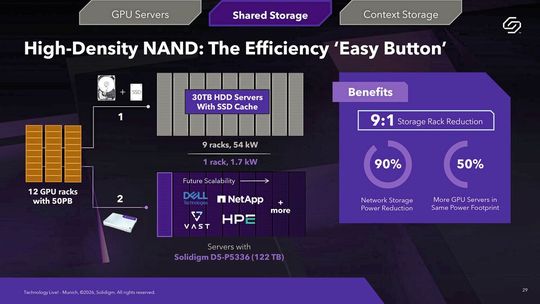
In automation and AI infrastructures, the available power at the site limits the number of usable compute accelerators (GPUs). Every watt saved on storage can potentially be allocated to additional computing power. The solution lies in high-density solid-state drives (SSDs) with capacities of up to 122 terabytes. Solidigm calculates that a conventional storage cluster consisting of nine racks with a power consumption of 54 kW can be compressed into a single rack requiring only 1.7 kW by using high-density SSDs.
Dense SSDs save space and power: A single rack with 122 TB SSDs replaces nine conventional HDD racks at a fraction of the energy consumption.
(Image: Solidigm)
In addition to power consumption, performance evaluation is also undergoing a fundamental shift. Previously, manufacturers boasted about maximum IOPS (Input/Output Operations Per Second) values. However, this is no longer the key metric for AI architectures. Today, predictability, known as Quality of Service (QoS), is crucial. SSDs must guarantee that data is delivered with extremely high reliability (99.999 percent) within an exact, minimal time frame. If data arrives in irregular waves, the GPU waits for the dataset. This immensely expensive "idle time" of the processors must be avoided at all costs through a smooth, continuous data stream.
"Disposable Data" and the End of Wear Concerns
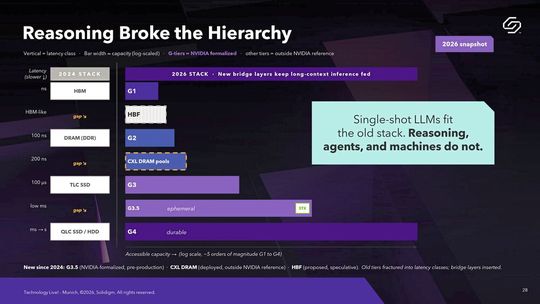
This necessity for a fast, continuous data stream disrupts the traditional storage pyramid. The industry is currently defining an entirely new intermediate layer in the server rack—often referred to as the "G3.5 layer." This is not about traditional, persistent long-term storage. This SSD layer is solely designed to rapidly read and write massive data blocks for AI inference (such as the KV cache of large language models). Since persistence is secondary here, this is referred to as ephemeral storage or "throwaway data." If something is lost, the system simply rebuilds the cache.
The new storage hierarchy: Complex AI workloads are breaking traditional architectural concepts and forcing the introduction of new intermediary layers (like the G3.5 level) for fast, volatile storage.
(Image: Solidigm)
When looking at such continuous write workloads on flash storage, hardware developers immediately think of lifespan due to limited write cycles. However, the industry provides a surprising insight: even though cost-effective QLC NAND (Quad-Level Cell) is used for these hyper-density storage solutions, flash wear has become mathematically irrelevant. Shadley calculates that drives with 122 terabytes cannot simply be "written to death" within a typical server lifecycle of five years. Today's interfaces cannot deliver data fast enough to overwrite all cells to their limit within this timeframe.
The End of Old Form Factors and the Challenge of Signal Integrity
To meet these enormous packing densities and the associated thermal requirements at the circuit board level, the mechanics of SSDs must change radically. Familiar standards are obsolete. "The U.2 form factor was derived from a 2.5-inch hard drive enclosure," Shadley recalls. "This is the last hard drive-based SSD product that still exists today."
Date: 08.12.2025
Naturally, we always handle your personal data responsibly. Any personal data we receive from you is processed in accordance with applicable data protection legislation. For detailed information please see our privacy policy.
Consent to the use of data for promotional purposes
I hereby consent to Vogel Communications Group GmbH & Co. KG, Max-Planck-Str. 7-9, 97082 Würzburg including any affiliated companies according to §§ 15 et seq. AktG (hereafter: Vogel Communications Group) using my e-mail address to send editorial newsletters. A list of all affiliated companies can be found here
Newsletter content may include all products and services of any companies mentioned above, including for example specialist journals and books, events and fairs as well as event-related products and services, print and digital media offers and services such as additional (editorial) newsletters, raffles, lead campaigns, market research both online and offline, specialist webportals and e-learning offers. In case my personal telephone number has also been collected, it may be used for offers of aforementioned products, for services of the companies mentioned above, and market research purposes.
Additionally, my consent also includes the processing of my email address and telephone number for data matching for marketing purposes with select advertising partners such as LinkedIn, Google, and Meta. For this, Vogel Communications Group may transmit said data in hashed form to the advertising partners who then use said data to determine whether I am also a member of the mentioned advertising partner portals. Vogel Communications Group uses this feature for the purposes of re-targeting (up-selling, cross-selling, and customer loyalty), generating so-called look-alike audiences for acquisition of new customers, and as basis for exclusion for on-going advertising campaigns. Further information can be found in section “data matching for marketing purposes”.
In case I access protected data on Internet portals of Vogel Communications Group including any affiliated companies according to §§ 15 et seq. AktG, I need to provide further data in order to register for the access to such content. In return for this free access to editorial content, my data may be used in accordance with this consent for the purposes stated here. This does not apply to data matching for marketing purposes.
Right of revocation
I understand that I can revoke my consent at will. My revocation does not change the lawfulness of data processing that was conducted based on my consent leading up to my revocation. One option to declare my revocation is to use the contact form found at https://contact.vogel.de. In case I no longer wish to receive certain newsletters, I have subscribed to, I can also click on the unsubscribe link included at the end of a newsletter. Further information regarding my right of revocation and the implementation of it as well as the consequences of my revocation can be found in the data protection declaration, section editorial newsletter.
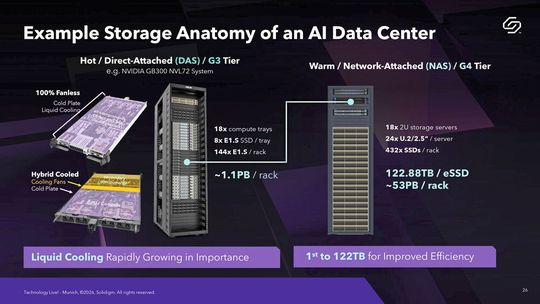
Storage architecture for AI: A typical division into extremely fast, liquid-cooled storage layers (hot/DAS) at the compute node and network-connected, high-density storage racks (warm/NAS).
(Image: Solidigm)
Future designs are exclusively oriented towards the requirements of flash technology. The industry is therefore shifting to dedicated form factors like E1.S and E3.S. These provide developers with more space on the board for components and are flatter, enabling more efficient cooling and higher packing density in servers.
Another technical driver for this shift is signal integrity at increasing data rates. The upcoming generations of the PCI-Express standard allow no compromises with physical connectors. "When we move specifically to PCIe Gen 6 and Gen 7, we will need an edge connector due to signal integrity, not a physical standard connector. That's why U.2 will gradually disappear with PCIe Gen 6," says Shadley.
Cooling Concepts at the Limit: Immersion Cooling in Practice
One of the greatest challenges remains thermal management. Traditional air cooling in server rooms results in deafening noise from massively high-speed fans and reaches its physical limits. Additionally, traditional air cooling with chiller systems wastes enormous amounts of water compared to liquid cooling.
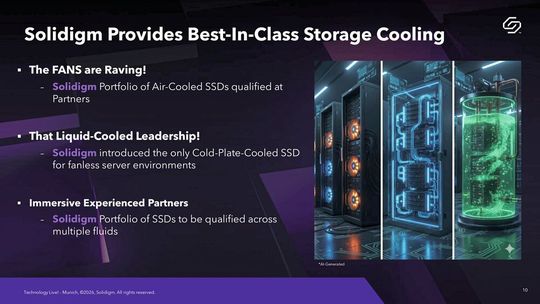
Cooling concepts at the limit: Beyond traditional air cooling, SSDs are increasingly being designed for cold-plate systems and complete immersion cooling in non-conductive liquids.
(Image: Solidigm)
The industry is therefore moving towards cold-plate and liquid cooling. Since storage drives typically need to remain hot-pluggable, meaning replaceable during operation, this requires special designs. For fanless server environments, liquid-cooled SSD solutions have already been developed that can be directly connected to cooling circuits.
The next logical step is "immersion cooling," the complete submersion of electronics in non-conductive liquids (e.g., special oils). While semiconductor components can easily withstand this immersion today, the challenges for engineers often lie in unexpected details.
Shadley shared a piece of wisdom from everyday lab work: "One of the most interesting things we encountered in the immersion cooling environment had nothing to do with the components or the functional aspects of the drive. It was actually about keeping the label on the drive. Apparently, this liquid dissolves the adhesive very effectively." The unconventional but pragmatic solution from the hardware developers: clear nail polish was used to secure the labeling, preventing the labels from peeling off in the cooling bath.
Soon Water-Cooled for Edge IT?
These profound architectural changes are by no means limited to the massive data centers of hyperscalers. Compact, flash-optimized form factors and fanless or liquid-based cooling concepts are precisely the building blocks needed for rugged edge-inferencing environments. When AI models are calculated directly at telecommunications towers, in industrial manufacturing, or in connected automation systems in the future, compact design, maximum energy efficiency, and reliability under challenging climatic conditions will be crucial. The days of the hard drive enclosure are thus numbered even in industrial hardware.



:quality(80)/p7i.vogel.de/wcms/ed/78/ed786ed6b280ff6c692908f01f715e3d/0113143253v1.jpeg "In our China Market Insider, we regularly provide you with relevant information straight from China. (Image:© Eisenhans - stock.adobe.com)")
:quality(80)/p7i.vogel.de/wcms/68/a5/68a5ce0896756c1dcf48dbeceefafbd3/0132300990v1.jpeg "Christoph Geigges is President and CEO of Walter AG. Headquartered in Tübingen (Germany), the company is one of the world’s leading suppliers of precision tools for metalworking. Under Geigges’ leadership, this long-established company is increasingly transforming itself from a tool manufacturer into an engineering partner that supports the entire manufacturing process. (Image: Walter AG)")
:quality(80)/p7i.vogel.de/wcms/3e/7c/3e7c26f44c68545fc7318597b6b65903/0133649650v1.jpeg "The flexible Heller circular storage system can store and process pallets measuring both 630 millimeters by 630 millimeters and 800 millimeters by 800 millimeters—even in mixed-mode operation. This makes the entire production line particularly flexible. (Image:Brighter)")
:quality(80)/p7i.vogel.de/wcms/16/29/162983885950ec1df27ab441bfe88613/0133132549v1.jpeg "Bernd Hermeler is the CEO of Cemecon AG. He studied mechanical engineering at RWTH Aachen University (Germany)—the very university from which the company emerged as a spin-off 40 years ago. Today, Hermeler is responsible for the global strategy of the coating specialist, which, with branches in Europe, the U.S., China, Japan, and India, is considered the global technology leader in the coating of cutting tools. (Image: Cemecon AG)")
:quality(80)/p7i.vogel.de/wcms/4b/7c/4b7c11f510878f154012d04c18a7c3cc/0133798118v1.jpeg "RobCo Becomes a Unicorn: The Munich-based robotics company has reached a valuation of more than one billion U.S. dollars and is driving the next generation of autonomous industrial robotics with Alfie. (Image:RobCo)")
:quality(80)/p7i.vogel.de/wcms/c8/a9/c8a96d5841d508c9e9c609c64168cbaa/0133758997v1.jpeg "Hospital Robotics: Neura Robotics' autonomous healthcare platform is designed to independently transport empty hospital beds between wards and floors. (Image:Neura Robotics)")
:quality(80)/p7i.vogel.de/wcms/88/dc/88dc38a1a0b5e016192ab83b0850fbd0/0133514708v1.jpeg "Scalable data sovereignty is the foundation for the transition from computationally intensive AI processing and growing data streams to sustainable, energy-efficient storage systems. (Image:Gemini / AI-generated)")
:quality(80)/p7i.vogel.de/wcms/1c/ef/1cef66e13c5cc02c5731fefcc99c00d2/0133697754v1.jpeg "Embodied AI in Industry: FMC³ Robotics combines AI-based perception and adaptation with traditional robot control to prepare robots for use in industrial manufacturing. (Image:FMC³/processed by AI)")
:quality(80)/p7i.vogel.de/wcms/a7/8a/a78a582a42a96aaaff38bd6b8f97a015/vishal-lal-mit-kernuhrv1.jpeg "It's ticking: Researchers have stabilized the first atomic clock. (Source: PTB)")
:quality(80)/p7i.vogel.de/wcms/36/f9/36f96a206fc408c9a632ce849de1f7fa/newsimage428299v1.jpeg "Polystyrene is used in protective packaging for televisions and electronic devices, in decorative moldings and baseboards for interior home construction, and even in Petri dishes. (Source: Hereon/Marcel Schwickerath)")
:quality(80)/p7i.vogel.de/wcms/90/30/90300137452b00d22f95113eff065ac3/fliehkraftkupplungen-und-bremsen-montage-centrifugal-clutches-and-brakes-assembly-1v1.jpeg "Installation: Centrifugal clutches should always be precisely matched to the machine. (Source: Amsbeck Machine Technology)")
:quality(80)/p7i.vogel.de/wcms/93/84/9384230e840a99a2015fdd3e0af11e2b/newsimage428236v1.jpeg "The crutch replicates the natural, biomechanical movement pattern of the human body. (Source: Leon Kast)")
:quality(80)/p7i.vogel.de/wcms/50/23/5023ffaefac8f9a47286b368143b88eb/0133801078v1.jpeg "Life isn't exactly a walk in the park for Porsche right now. And now Porsche management is saying that next year will be even worse. Read here to find out why that's supposed to be the case... (Image: Porsche)")
:quality(80)/p7i.vogel.de/wcms/2f/ab/2fabf62cdd2f57cb279e00931c91c869/0133794991v1.jpeg "The Atto 2 SUV is one of BYD's most popular plug-in hybrids. (Image:BYD)")
:quality(80)/p7i.vogel.de/wcms/e9/6e/e96e34d467ca1017f2a689275ae07302/0133815122v1.jpeg "Porsche CEO Leiters has shared new information about the company's model plans. (Image:Porsche)")
:quality(80)/p7i.vogel.de/wcms/0a/50/0a50938be0b598b36efc4e5457ed56dd/forvia-siege-zen-massage-16-9-06v1.jpeg "Seat with massage function by Forvia. (Source: Forvia)")
:quality(80)/p7i.vogel.de/wcms/4d/eb/4debf44ac7c0349544c70033bb9a182c/0133750488v1.jpeg "AI-enabled hardware: is a prerequisite for successful AI projects. (Image:Tung Lam)")
:quality(80)/p7i.vogel.de/wcms/36/f0/36f0472d20227013871aa790f4d48ac6/0133726018v1.jpeg "Ion beams can ablate, coat, or smooth surfaces down to the atomic level. Such processes are used, among other things, in optical chips, precision optics, and superconducting materials. (Image:AI-generated)")
:quality(80)/p7i.vogel.de/wcms/1f/47/1f47da6ee12c38a745eb478a04157a65/0133726100v1.jpeg "The schematic diagram shows the structure of a 3D NAND memory device with memory cells stacked on top of one another and vertical connections for high storage density. (Image:Dall-E / AI-generated)")
:quality(80)/p7i.vogel.de/wcms/b6/06/b6060e0b986e103e442b3971b6c0724c/0133731535v1.jpeg "Rendering of the planned Terafab facility in Texas (presumably generated using AI). Elon Musk does not seem to be making progress with his plans to operate his own semiconductor manufacturing facility. The SpaceX CEO has confirmed that he is currently in talks with TSMC regarding a stake in the Terafab project. (Image:SpaceX)")
:fill(fff,0)/images.vogel.de/vogelonline/companyimg/76800/76895/65.jpg "FAULHABER_120mm.jpg ()")
:fill(fff,0)/p7i.vogel.de/companies/69/88/69882c428938e/tmts2026-ticec-banner-en-2000px.png "tmts2026-ticec-banner-en-2000px (https://www.tmts.tw/en)")
:quality(80)/p7i.vogel.de/wcms/01/45/014504297c8d56cad7555305d2fb9001/0132060894v1.jpeg "(Image: Solidigm)")
:quality(80)/p7i.vogel.de/wcms/07/8a/078a53877e34da16d06736549a659f58/0132061009v1.jpeg "New storage hierarchies for AI: With the introduction of the intermediary layer \"G3.5\" (STX Storage), the storage architecture moves even closer to the computing cores to consistently supply GPUs with data through BlueField DPUs with minimal latency.(Image: Solidigm)")
:quality(80)/p7i.vogel.de/wcms/3e/30/3e30fbdf1179567a4006669c7adf1867/0132061011v1.jpeg "Cold-plate cooling in detail: For completely fanless server environments, Solidigm has developed a liquid-cooled SSD design that dissipates the extreme heat of densely packed AI storage systems via direct contact (direct-to-chip).(Image: Solidigm)")
:quality(80)/p7i.vogel.de/wcms/bc/55/bc559c48a8374fda3d3f48ed0b4c31aa/0132060883v1.jpeg "Volumetric data growth: AI infrastructures require a rethink as the data volume grows three-dimensionally due to multimodal sensors and complex inference models.(Image: Solidigm)")
:quality(80)/p7i.vogel.de/wcms/7b/73/7b736ec0a4a0f7298b65edadc633bb97/0129365186v1.jpeg "Old form factor, new technologies: Ahmed Shihab, Chief Product Officer at Western Digital, shows the physical drive, which is designed to hold up to 140 TB, at Innovation Day. (Image:Western Digital)")
:quality(80)/p7i.vogel.de/wcms/d6/61/d661801f679db7b71de6cbf76c38de64/0132929603v1.jpeg "Thermal management in the data center: Air cooling is no longer sufficient for AI applications, but liquid cooling is not universally applicable. (Image:Dall-E / AI-generated)")