While traditional server racks have so far managed with 40 to 100 kilowatts, artificial intelligence is increasing power requirements to previously unimaginable levels. The vision is: one megawatt per rack. However, to ensure that this figure is not just a marketing figure, fundamental problems with the power supply need to be solved.
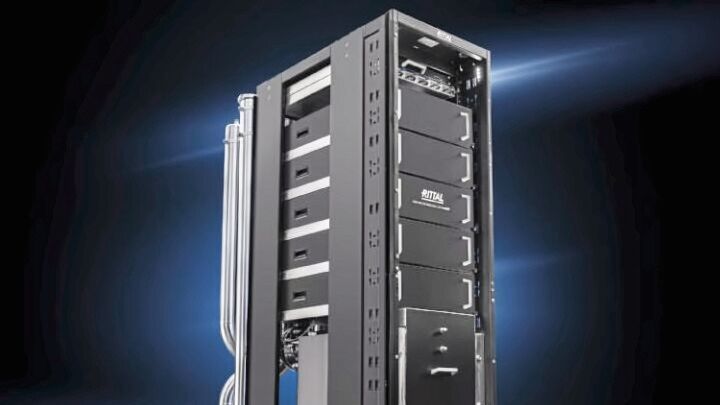
The modular bayed solution provides a cooling capacity of over 1 megawatt, ideal for the high power density of AI applications thanks to direct liquid cooling.
(Image: Rittal GmbH & Co. KG)
Traditionally, power is supplied to the data center via alternating current, which is fed into the racks and broken down by power supply units for each individual server board. However, this architecture means that the energy is converted several times: from high voltage AC to low voltage AC, then to 48 volts DC and finally directly to the supply voltage of the chips. Each stage generates losses. Even efficient power supply units rarely achieve more than 90 percent; standard devices often achieve 80 to 85 percent. This sounds high at first glance, but in a rack with a 100 kilowatt load, ten percent loss already means ten kilowatts that are converted exclusively into heat. With a target value of one megawatt per rack, the same efficiency would mean over 100 kilowatts of waste heat from the power supply units alone. As much as the entire energy requirement of a small company.
A new Approach
Infineon is working with partners such as Nvidia on a power architecture that radically reduces the number of converter stages. Instead of carrying alternating current to the rack, direct current of up to 800 volts is to be supplied directly to the cabinets. Only there is a targeted conversion to the required operating voltages carried out. This centralization of power distribution not only reduces the amount of cabling and space required, but above all the losses. Fewer conversion stages mean greater efficiency.
Infineon is launching power supply units and backup modules with a significantly higher power density on the market. While small power supply units with a few kilowatts per server or per blade were previously common, central power supply units with 12 kilowatts and more are now taking center stage. Combined with the latest semiconductor technology based on silicon carbide and gallium nitride, efficiency is increasing noticeably. Instead of 80 percent, values in excess of 95 percent will be possible in the future. The difference sounds small, but on the scale of entire data centers, it makes the difference between manageable operation and an energy guzzler that is no longer economically viable.
Semiconductors in Transition
The breakthrough for the 800-volt DC power supply in the rack is based on decisive advances in power semiconductors. Classic silicon transistors quickly reach their limits at high voltages and currents: On-resistance increases, switching losses increase and thermal stresses further degrade performance. Wide-bandgap semiconductors such as silicon carbide (SiC) and gallium nitride (GaN) fundamentally change the picture. Their larger bandgap not only allows higher reverse voltages, but also a significantly lower specific on-state resistance (R_DS(on)) and considerably lower switching losses. SiC MOSFETs can operate reliably in the 800 V range without massive heat losses. GaN components go one step further by enabling extremely high switching frequencies. This significantly reduces the size of passive components such as coils and capacitors and makes the power modules more compact and efficient overall.
This technological basis enables modern power supply units and DC/DC converters to achieve efficiencies of over 95%, whereas previous silicon solutions usually remained at 80-90%. The lower losses and better thermal stability make cooling and operational management much easier. Without wide bandgap materials, efficient 800 V DC architectures would be almost impossible to implement in the rack.
Infineon is also using this semiconductor expertise to lead the way in the next generation of battery backup units (BBUs). The roadmap ranges from modular 4 kW solutions to the world's first 12 kW BBU, which achieves a power density up to 400 percent higher than the industry standard. These backup modules not only offer a particularly efficient and scalable power supply for AI server racks, but also reliably protect sensitive hardware from voltage peaks and current anomalies.
Cooling is also Crucial
With SiC- and GaN-based solutions, Infineon is creating the basis for power up to 800 volts to be fed directly into the rack, where it is available with minimal losses. However, even if the losses are drastically reduced by wide bandgap semiconductors, cooling remains a decisive factor. This is because every percent of waste heat adds up to enormous amounts of energy for megawatt outputs. This is where providers such as Rittal come into play, using direct liquid cooling systems to ensure that the thermal load is reliably dissipated - only the combination of an efficient power supply and modern cooling technology makes the 1 MW server rack truly realistic.
Date: 08.12.2025
Naturally, we always handle your personal data responsibly. Any personal data we receive from you is processed in accordance with applicable data protection legislation. For detailed information please see our privacy policy.
Consent to the use of data for promotional purposes
I hereby consent to Vogel Communications Group GmbH & Co. KG, Max-Planck-Str. 7-9, 97082 Würzburg including any affiliated companies according to §§ 15 et seq. AktG (hereafter: Vogel Communications Group) using my e-mail address to send editorial newsletters. A list of all affiliated companies can be found here
Newsletter content may include all products and services of any companies mentioned above, including for example specialist journals and books, events and fairs as well as event-related products and services, print and digital media offers and services such as additional (editorial) newsletters, raffles, lead campaigns, market research both online and offline, specialist webportals and e-learning offers. In case my personal telephone number has also been collected, it may be used for offers of aforementioned products, for services of the companies mentioned above, and market research purposes.
Additionally, my consent also includes the processing of my email address and telephone number for data matching for marketing purposes with select advertising partners such as LinkedIn, Google, and Meta. For this, Vogel Communications Group may transmit said data in hashed form to the advertising partners who then use said data to determine whether I am also a member of the mentioned advertising partner portals. Vogel Communications Group uses this feature for the purposes of re-targeting (up-selling, cross-selling, and customer loyalty), generating so-called look-alike audiences for acquisition of new customers, and as basis for exclusion for on-going advertising campaigns. Further information can be found in section “data matching for marketing purposes”.
In case I access protected data on Internet portals of Vogel Communications Group including any affiliated companies according to §§ 15 et seq. AktG, I need to provide further data in order to register for the access to such content. In return for this free access to editorial content, my data may be used in accordance with this consent for the purposes stated here. This does not apply to data matching for marketing purposes.
Right of revocation
I understand that I can revoke my consent at will. My revocation does not change the lawfulness of data processing that was conducted based on my consent leading up to my revocation. One option to declare my revocation is to use the contact form found at https://contact.vogel.de. In case I no longer wish to receive certain newsletters, I have subscribed to, I can also click on the unsubscribe link included at the end of a newsletter. Further information regarding my right of revocation and the implementation of it as well as the consequences of my revocation can be found in the data protection declaration, section editorial newsletter.
One megawatt per server rack is therefore not just a question of cooling, but above all a question of electrical efficiency. Every kilowatt hour that is not lost in heat can be used directly for computing power. If the power supply is rethought, with high-voltage direct current right into the rack and high-density power modules directly at the chips, then the megawatt rack moves from a vision to reality. (mr)



:quality(80)/p7i.vogel.de/wcms/2c/b5/2cb58b0c53a4a7d9c3032427e9a31861/0132623548v1.jpeg "Quality inspection in detail: Roundness measurement of a workpiece using Accretech Rondcom. (Image:Accretech)")
:quality(80)/p7i.vogel.de/wcms/58/bf/58bf72e72e3066a7f7990d33c757675b/0132650629v1.jpeg "The winding determines what defines the electric motor. In the image: Short winding on small motors. (Image:Faulhaber)")
:quality(80)/p7i.vogel.de/wcms/ef/08/ef08922ce5a15207a9775d5065527250/0132599857v1.jpeg "What you see here is the innovative WAAM system called Arctitan from Gefertec. With it, high-quality titanium components can finally be additively manufactured under consistent process conditions, as the manufacturer promises. (Image: Gefertec)")
:quality(80)/p7i.vogel.de/wcms/66/fa/66fa3238dd2624ae644a3ba871438757/0113143253v1.jpeg "In our China Market Insider, we regularly provide you with relevant information directly from China. (Image:© Eisenhans - stock.adobe.com)")
:quality(80)/p7i.vogel.de/wcms/00/4c/004c97f265026bc126720f24d0b0d68c/0132664223v1.jpeg "Physical AI can intervene directly in manufacturing, delivering significant added value. (Image:Shutterstock)")
:quality(80)/p7i.vogel.de/wcms/da/dc/dadcf29e66cec822e5fbac3144df7dce/0132579697v1.jpeg "The \"childhood\" of robots: Structured training environments provide the crucial practical data that AI models need for reliable autonomy. (Image:Gemini / AI-generated)")
:quality(80)/p7i.vogel.de/wcms/e3/a4/e3a44159531a41ac69f308a3b356fa9e/image1v1.jpeg "The dynamic guidance system LARS projects information directly onto the warehouse floor using laser projection. (Image:Fraunhofer IML)")
:quality(80)/p7i.vogel.de/wcms/2f/2a/2f2ac048a0e03f535795d2b3e05c44c1/0132582608v1.jpeg "If the future storage and material flow structure of a plant site needs to be planned, the digital planning twin can demonstrate whether the structure works even under peak loads or with a changed product mix. (Image:AI-generated)")
:quality(80)/p7i.vogel.de/wcms/14/b7/14b722e669a9aa9810c1a77b4fa5e8af/0132649760v1.jpeg "The new version of the sensor system is based on reusable patches and integrates a portable computer that enables AI-supported analysis of the collected data. (Image:Basel Adams / AI-generated)")
:quality(80)/p7i.vogel.de/wcms/7c/78/7c78b1a79249627ecac8a6cdd9ff0db8/0132675504v1.jpeg "Here at Fraunhofer IWM, an additively manufactured metal part is cyclically loaded in a test fixture after its highly stressed surface zones have been mechanically post-processed. Now, it is also known how to identify these areas before production. (Image:Fraunhofer IWM)")
:quality(80)/p7i.vogel.de/wcms/f5/e6/f5e67d094c9ff528802907f2986c175f/0132631344v1.jpeg "Graphite electrodes for batteries consist of natural and synthetic graphite. Both materials will be in increasingly high demand in the future. That’s why projects, such as those by International Graphite and Westwater, are already in the starting blocks to seize the opportunity... (Image: International Graphite)")
:quality(80)/p7i.vogel.de/wcms/84/2b/842b528802ab7fb92be95e089d9f5777/csm-wabenstruktur-2026-07-20-jm-855955b94dv1.png "Bionically inspired honeycomb structures with gradually arranged fiber angles made from regenerated cellulose fibers. These lightweight structures could contribute to more sustainable safety components in the future. (Source: © HSB - AG Biologische Werkstoffe)")
:quality(80)/p7i.vogel.de/wcms/e5/2b/e52b30828b2c61228b8795d807520d68/0132607603v1.jpeg "In Project LEIA, various companies like Airbus are working on a hybrid-electric onboard network architecture for short- and medium-haul aircraft. (Image: Airbus)")
:quality(80)/p7i.vogel.de/wcms/21/b2/21b24e92c458fd3a019289cf920fb2a0/b4acb47fcace0508fa403dfaef9628968fa3f650v1.jpeg "The muscle car from Dodge is back on offer in Germany. The Charger is available with a combustion engine and as the electric Daytona variant. (Image:Stellantis/Dodge)")
:quality(80)/p7i.vogel.de/wcms/3d/6f/3d6f237bda1ed959f4926789b8dcac11/0132622329v1.jpeg "The battery manufacturer CATL has announced a cell that can charge so quickly that the driver can remain standing next to the van after plugging in the cable. (Image:Volkswagen Commercial Vehicles)")
:quality(80)/p7i.vogel.de/wcms/9d/27/9d27974b77965320deca4effe62fe450/org-blobs-user-response-file-output-b2334db5-a0dc-4492-9c6d-1c655264bc22-file-1785911165790-jpgv1.jpeg "A debate is ongoing in China about whether cars have become disposable items. (Image:KI-generiert)")
:quality(80)/p7i.vogel.de/wcms/92/f1/92f1243318173802ec4ac8ed6a36dc2a/0132637902v1.jpeg "Depending on the solid electrolyte used, material systems, cell concepts, and production processes for solid-state batteries differ significantly. (Image:freely licensed)")
:quality(80)/p7i.vogel.de/wcms/62/2d/622d79199f67c7721eca0b81dd350779/0132577934v1.jpeg "The executives at Globalfoundries are planning for additional funds from the CHIPS Act. (Image:Globalfoundries)")
:quality(80)/p7i.vogel.de/wcms/c7/22/c72290be02701591268e4419220766d0/0132589361v1.jpeg "A Twinscan NXT:1950i lithography machine from ASML. According to Chinese media reports, the Chinese company Shanghai Yuliansheng plans to deliver six self-developed DUV lithography machines by the end of 2026, which are said to be technologically comparable to the system from the Dutch equipment manufacturer introduced in 2008. (Image:ASML)")
:quality(80)/p7i.vogel.de/wcms/70/21/7021d732ad7b441d0436592046a25432/0132610698v1.jpeg "Kimi K3 can fundamentally be self-hosted. However, due to its size, it is not a model for just any company: even in a compressed form, extensive storage and computing resources are required. (Image:Moonshot AI)")
:quality(80)/p7i.vogel.de/wcms/50/20/5020c38203e8b7eb2dd84b43ce9ea28f/0131765852v1.jpeg "Power supply solutions for data centers are booming, making SiC applications highly sought after. (Image:Dall-E / AI-generated)")
:quality(80)/p7i.vogel.de/wcms/e9/51/e9519f6f6e2aedcf896e1306e37d7642/0130872105v1.jpeg "Figure 1: Principle of a sidecar solution for supplying power to AI data centers. (Image:TI)")