At this year's IZB in Wolfsburg, Germany, suppliers showcased new ideas and products. VW hopes these innovations will bring cost-effective solutions to help compete with rivals from China and the USA.
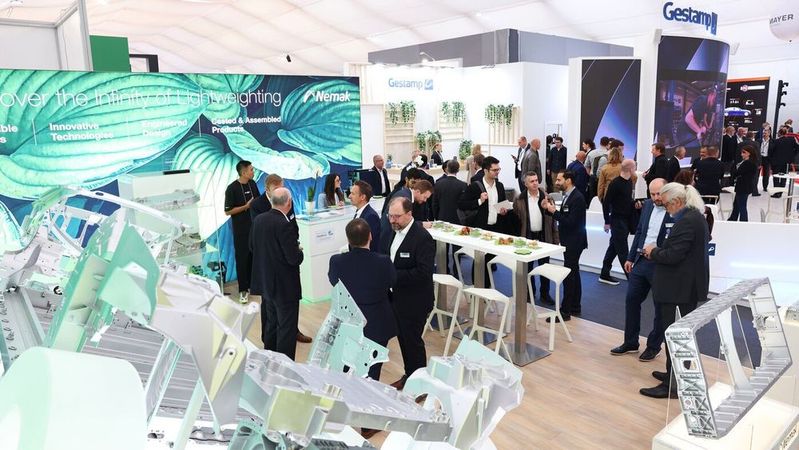
At the International Suppliers Fair (IZB) in Wolfsburg, suppliers presented their new ideas.
(Bild: Author Union Mobilität/Wolfsburg AG)
"Innovations at Low Costs with High Quality—Volkswagen is looking to its suppliers to make the impossible possible. 'We can’t do it without you,' said VW Purchasing Chief Dirk Große-Loheide at the International Suppliers Fair (IZB) in Wolfsburg. VW doesn't manufacture 60 to 70 percent of a car’s components itself, instead sourcing them from suppliers—a figure that reaches up to 80 percent for other automakers. But VW must reduce costs if it’s to compete with Chinese manufacturers and Tesla, the pioneer of electric vehicles.
Simultaneously, the automaker needs continuous innovation, as competitors are advancing technologically, with some, like Tesla in vehicle software and BYD from China in battery systems, already ahead. To address this, VW regularly hosts the IZB in Wolfsburg, the world’s largest showcase of this kind.
VW CEO Schäfer Promises Enhanced Gigacasting
Among the 843 exhibitors from 33 countries vying for VW contracts, many are engaging in this cost and innovation challenge. In car body production, Tesla’s Gigacasting method has demonstrated how billions can be saved in manufacturing by casting large sections of the car frame in one piece, instead of welding together dozens of small parts. For instance, Tesla’s bodywork for the front, rear, and battery housing is made from large aluminum casts, replacing the traditional multi-part steel construction.
VW intends not only to adopt but also improve upon this concept. 'Casting large vehicle parts in one piece is great—we’re going to do it too,' said VW brand chief Thomas Schäfer during the VIP tour at IZB. However, VW aims to address Gigacasting’s drawbacks: cast parts are difficult to repair and don’t absorb crash energy effectively, instead directing impacts toward the car’s interior. Schäfer assured that VW would resolve these issues while ensuring reparability. Reports at IZB suggested that the upcoming VW ID 2, an electric model in the Polo class, will feature large cast parts, such as for its battery housing."
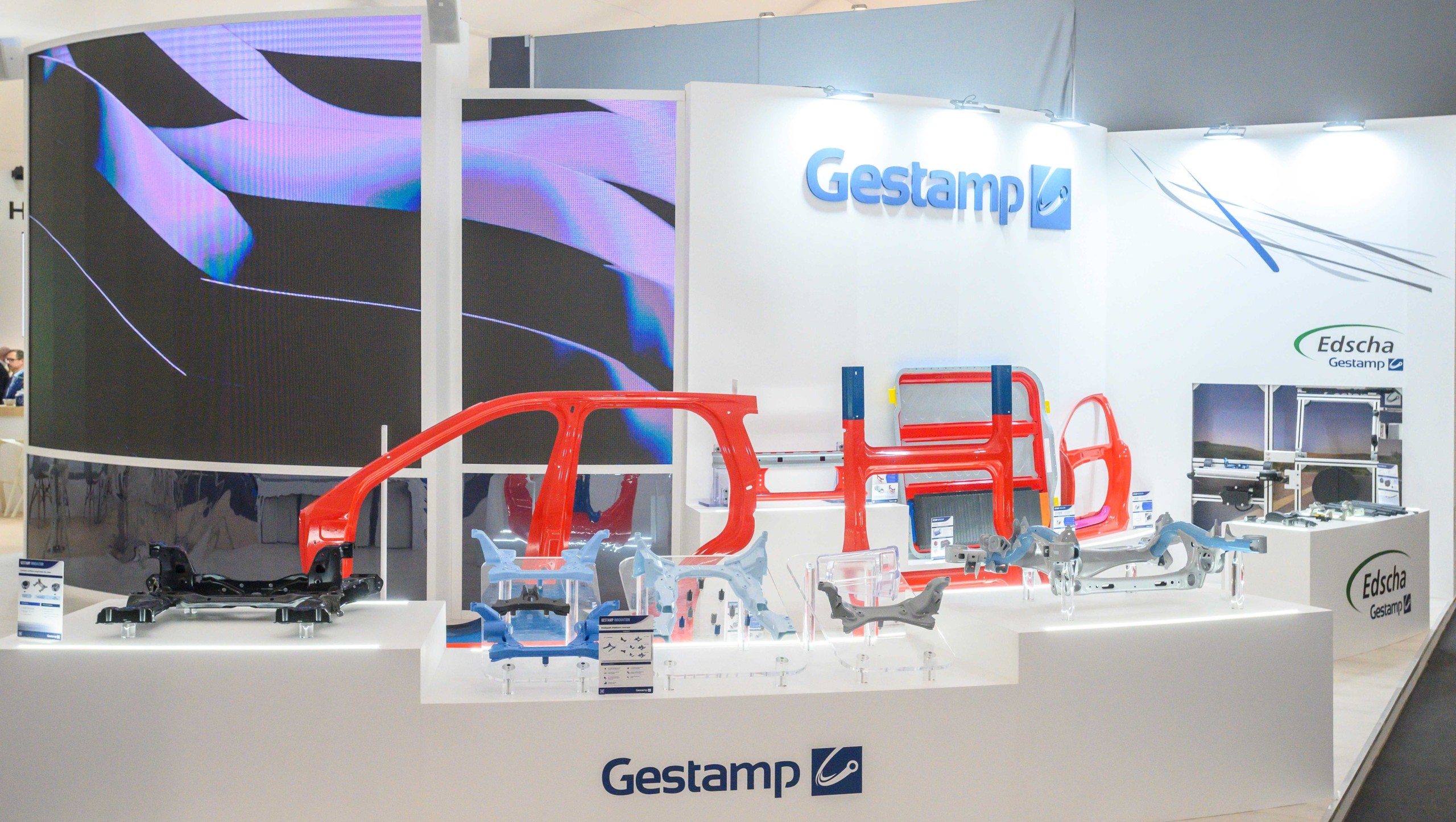
Bad news for traditional metal processors like the Spanish company Gestamp? Not necessarily, according to Ulf Sudowe, responsible for chassis production at Gestamp. His solution to producing car bodies more affordably in the future is “Gigastamping instead of Gigacasting.” Sudowe explains that “we can form 12 to 16 parts in one step,” allowing for larger car body components like side panels or door frames to be made in a single piece. This approach reduces costs, energy consumption, and weight. Additionally, the stamped parts are optimized for crash safety and weight, and are highly recyclable since, as Sudowe puts it, “you should be familiar with your scrap.”
Another advantage of Gigastamping is that “automakers can continue using their existing machines.” In contrast, Gigacasting would require presses to be replaced by massive casting machines, a costly investment. Gestamp operates 115 production sites globally, including 11 in China, where there is significant interest in this approach.
Display Integration in the Windshield
The Korean automotive supplier Hyundai Mobis also showcased cost-saving innovations without sacrificing tech advancements. Recognizing the high cost of multiple screens in vehicles, CEO Axel Maschka notes that “installing two or three screens, or even one large screen, can cost well over 100 euros (approx. 108 USD).” Hyundai Mobis, in collaboration with German optics specialist Zeiss, has developed a system that turns the lower portion of the windshield into a display.
Cubos Technologies has specialized in bidirectional charging, with their Solar-Link system allowing an electric vehicle to serve as a power storage unit for existing solar installations. When the sun shines, the vehicle charges; at night or during a power outage, the car battery can supply power to the house.
American supplier Gentex has developed an innovative interior feature: an electronic sun visor. Made from dimmable glass, the visor provides protection from glare without obstructing the driver’s view of oncoming traffic or road signs. This continuously dimmable glass shields drivers from sunlight and bright reflections. "Modern LED headlights are more dazzling for oncoming traffic than traditional headlights," says Craig Piersma, Gentex’s marketing director. Similarly, low sun angles can cause significant glare. This innovation reduces glare without overly limiting visibility, thus enhancing safety. With a unique twist, the glass sun visor can transform into a mirror with the push of a button.
Integrated Battery Systems
Dräxlmaier showcased a comprehensive approach to EV battery systems at the Wolfsburg event, covering everything from control electronics and charging systems to battery modules. Their approach starts with optimal use of available space and efficient heat distribution. Maximum charging current is also a crucial factor, impacting charging speed for the end customer.
In addition to performance and safety, sustainability and seamless battery integration are key criteria. Dräxlmaier is committed to minimizing the carbon footprint across the product lifecycle. "With over a decade of experience in high-voltage battery systems, Dräxlmaier can adopt a holistic approach, focusing equally on the battery, control electronics, and charging system," said Christoph Mahler, Head of Key Account VW.
Date: 08.12.2025
Naturally, we always handle your personal data responsibly. Any personal data we receive from you is processed in accordance with applicable data protection legislation. For detailed information please see our privacy policy.
Consent to the use of data for promotional purposes
I hereby consent to Vogel Communications Group GmbH & Co. KG, Max-Planck-Str. 7-9, 97082 Würzburg including any affiliated companies according to §§ 15 et seq. AktG (hereafter: Vogel Communications Group) using my e-mail address to send editorial newsletters. A list of all affiliated companies can be found here
Newsletter content may include all products and services of any companies mentioned above, including for example specialist journals and books, events and fairs as well as event-related products and services, print and digital media offers and services such as additional (editorial) newsletters, raffles, lead campaigns, market research both online and offline, specialist webportals and e-learning offers. In case my personal telephone number has also been collected, it may be used for offers of aforementioned products, for services of the companies mentioned above, and market research purposes.
Additionally, my consent also includes the processing of my email address and telephone number for data matching for marketing purposes with select advertising partners such as LinkedIn, Google, and Meta. For this, Vogel Communications Group may transmit said data in hashed form to the advertising partners who then use said data to determine whether I am also a member of the mentioned advertising partner portals. Vogel Communications Group uses this feature for the purposes of re-targeting (up-selling, cross-selling, and customer loyalty), generating so-called look-alike audiences for acquisition of new customers, and as basis for exclusion for on-going advertising campaigns. Further information can be found in section “data matching for marketing purposes”.
In case I access protected data on Internet portals of Vogel Communications Group including any affiliated companies according to §§ 15 et seq. AktG, I need to provide further data in order to register for the access to such content. In return for this free access to editorial content, my data may be used in accordance with this consent for the purposes stated here. This does not apply to data matching for marketing purposes.
Right of revocation
I understand that I can revoke my consent at will. My revocation does not change the lawfulness of data processing that was conducted based on my consent leading up to my revocation. One option to declare my revocation is to use the contact form found at https://contact.vogel.de. In case I no longer wish to receive certain newsletters, I have subscribed to, I can also click on the unsubscribe link included at the end of a newsletter. Further information regarding my right of revocation and the implementation of it as well as the consequences of my revocation can be found in the data protection declaration, section editorial newsletter.
A New Competitor for Continental from China
Chinese supplier Desay SV presented extensive electronics offerings, aiming to establish a foothold in Europe. Originating from Siemens VDO’s former Chinese division, Desay has become a leader in screens and assistance systems in the Chinese market. Yong "Edgar" Yang, the new European head, highlighted their domain controllers for automated driving (Level 2+), already mass-produced in China, and noted, "We deliver the most Nvidia chipsets worldwide in the automotive market."
Desay’s display technology is now entering the European market, with initial production orders secured and plans for a facility in Spain. ADAS systems are expected to follow later. "We aim to build trust with our flagship product, the displays," says the Europe CEO.
Automated Cost Analysis for ECUs
To reduce costs, it’s essential to monitor competitors’ products. Saarland/Germany-based SME K-Lens, along with Polarix, has automated the cost analysis of populated circuit boards. Their "EE-Scanner" produces a list of all components, including details like manufacturer, package, and part number within minutes. This allows users to calculate both component and processing costs, explained CEO Stefan Beinkämpen.
Using an advanced optical system, the scanner creates images of components from various angles, not just top-down, allowing it to function as a quality assurance system. K-Lens developed the technology in partnership with Polarix Partners.



:quality(80)/p7i.vogel.de/wcms/c3/6f/c36f031df46d22615d941d077d32313c/0129800025v1.jpeg "The laser-assisted process is intended to make wafer cutting significantly more productive. (Image:Trumpf)")
:quality(80)/p7i.vogel.de/wcms/ef/1e/ef1e248f58a3697ec1384f6849762d5a/0129842086v1.jpeg "Bodo will soon be hitting it off smart! Signing the memorandum of understanding in Las Vegas: Steffen Haack, Member of the Board of Bosch Rexroth, and Yoshimoto Matsuda, Managing Director of Precision Machinery & Robot Company, Kawasaki Heavy Industries. Here's what it's all about ... (Image:Bosch Rexroth)")
:quality(80)/p7i.vogel.de/wcms/40/b3/40b38efc9eae25e69d644512a2dc4b7c/0129806862v1.jpeg "This is one of the new MDA power clamping nuts from Jakob Antriebstechnik from various angles. It is described as particularly durable and powerful. Here are a few specific data ... (Image:Jakob Drive Technology)")
:quality(80)/p7i.vogel.de/wcms/f5/61/f561ad7c72ed41fd7a67ad9c481cb15d/0129799343v1.jpeg "Engine-generator units (MGU) from Steyr Motors are at work in the Leopard 2 main battle tank and the Leguan bridge vehicle (pictured). An extended contract is now to secure at least 500 more systems of this type for the Bundeswehr ... (Image:German Armed Forces)")
:quality(80)/p7i.vogel.de/wcms/9c/ac/9cac6246660e746c5a3989399ac4d250/0128561645v1.jpeg "Artificial intelligence can drive efficiency in smart factories through centralized data management and predictive maintenance. (Picture: ©Fardived - stock.adobe.com)")
:quality(80)/p7i.vogel.de/wcms/6b/e2/6be235b5ad8a442ccd9d164b0b300d8b/0129763992v1.jpeg "As early as 2020, the Zimmer Group announced that it would convert its production to be sustainably CO2-neutral. (Image:Zimmer Group)")
:quality(80)/p7i.vogel.de/wcms/d4/ba/d4bab9481e66f8570f40eb8ef2a90198/0129795613v1.jpeg "A camera inspection during removal ensures that the components are placed correctly in the KLTs. (Image:Yaskawa Europe)")
:quality(80)/p7i.vogel.de/wcms/cb/56/cb56e42b01638b618e8d1b9b38f32faa/0129810132v1.jpeg "From summer 2026, \"AEON\" will support people at the BMW plant in Leipzig. (Image:diephotodesigner.de/BMW)")
:quality(80)/p7i.vogel.de/wcms/76/81/7681b6450512b2cce1e453cd3d732543/0129479309v1.jpeg "Symbolic image: Model-based design combines virtual system models with real machines and systems in order to simulate, validate and coordinate functions, control and software early on in the development process. (Image:Dall-E / AI-generated)")
:quality(80)/p7i.vogel.de/wcms/5c/0f/5c0fee074c4b6c8e8c0993f3217c2f5a/0129773718v1.jpeg "The General Fusion demonstration reactor. (Image:General Fusion)")
:quality(80)/p7i.vogel.de/wcms/b5/5e/b55ed9355e0395ec0caf111d6af6b494/adobestock-495980372--c2-a9-20natali-mis-20-e2-80-93-20stock-adobe-com-6720x3778v1v1.jpeg "Which engineering skills will be in vogue in 2026? (Image:natali_mis - stock.adobe.com)")
:quality(80)/p7i.vogel.de/wcms/bf/a5/bfa5d882e93f159ce93e933742272b00/nord-vibn-cmyk-2196x1235v1v1.jpeg "With digital twins for virtual commissioning, Nord supports customers in ensuring that systems are available more quickly, even with complex drive systems. (Image:Nord Drivesystems)")
:quality(80)/p7i.vogel.de/wcms/81/24/8124e33f53ec73fa99374f407cc11b61/0129727992-541x304v1v1.jpeg "The development of control elements and HMI systems for commercial vehicles can lead to interactions. (Image:Preh / AI-generated)")
:quality(80)/p7i.vogel.de/wcms/87/f6/87f6edf2c7f287df294328c0b002617d/0129467191v1.jpeg "Jörg Grotendorst has been advising the management of HTEC in Belgrade, Serbia, since April 2025. (Image:HTEC)")
:quality(80)/p7i.vogel.de/wcms/d5/76/d5764e7ca6787e7a924fcc26c3de6793/l9-outdoor01-11358x6389v1v1.jpeg "According to the manufacturer, the new Li L9 is no longer a car, but embodies artificial intelligence. (Image:Li car)")
:quality(80)/p7i.vogel.de/wcms/90/d8/90d81390b6739724628a4ed225ab7752/l9-outdoor03-800x450v1v1.jpeg "The L9 Livis model from Li Auto has both steer-by-wire and brake-by-wire. (Image:Li car)")
:quality(80)/p7i.vogel.de/wcms/84/cc/84cc506003388ecffaab464677c7afa6/0129843694v1.jpeg "Launched last year, ASML's TWINSCAN XT:260 is an i-line scanner with a throughput of 270 wafers per hour. With a focus on the increased demands of AI chips, ASML wants to shift its focus away from pure front-end tools for chip production in the next ten to fifteen years with packaging and bonding technologies. (Image:ASML)")
:quality(80)/p7i.vogel.de/wcms/8f/48/8f48b0ed0d6c5c4f299b1310a7b577e9/0129830738v1.jpeg "Data centers in orbit are indeed dreams of the future, while data centers under water are already being tested. (Image:Dall-E / AI-generated)")
:quality(80)/p7i.vogel.de/wcms/36/ec/36ec46b311c3fb2cf9759ba4843047c5/0129831604v1.jpeg "Keysight and Ericsson enable validation of pre-6G interoperability with real network infrastructure and devices. (Image:Keysight)")
:quality(80)/p7i.vogel.de/wcms/c5/7a/c57ab05221defbbcaf6bddc346d21464/0129752421v1.jpeg "(Image:concept electronic GmbH)")
:fill(fff,0)/images.vogel.de/vogelonline/companyimg/76800/76895/65.jpg "FAULHABER_120mm.jpg ()")
:fill(fff,0)/p7i.vogel.de/companies/67/eb/67eba621ef6ea/logo2.png "logo2 (Wuxi InfiMotion)")
:quality(80)/p7i.vogel.de/wcms/63/30/6330cfbbedf32b0e2be89e609bd967cd/0118199939v1.jpeg "SDVs represent a profound change in the automotive industry, promising a new level of safety, efficiency, and user comfort. (Image:Royalty-free)")
:quality(80)/p7i.vogel.de/wcms/81/dc/81dc15b9a33b940e8112db1ed7203beb/0109116706-799x266.jpeg "BMW provides a glimpse into the \"New Class\" (Picture: BMWBMW)")
:quality(80)/p7i.vogel.de/wcms/22/e7/22e7cf0857f827770c2b2a5257e7fa6c/0113143253v1.jpeg "In our China Market Insider, we regularly provide you with relevant information directly from China. (Image:© Eisenhans - stock.adobe.com)")
:quality(80)/p7i.vogel.de/wcms/13/3e/133ed96ff025a412440b4c60b6acee25/0127068689v1.jpeg "Ulf Sudowe is General R&D Director Chassis at Gestamp. (Image:Henning Scheffen)")