Automated sales environments, kiosk terminals and micromarkets place high demands on computing power and reliability. A major challenge for edge servers, AI-enabled platforms and energy-efficient embedded boards.
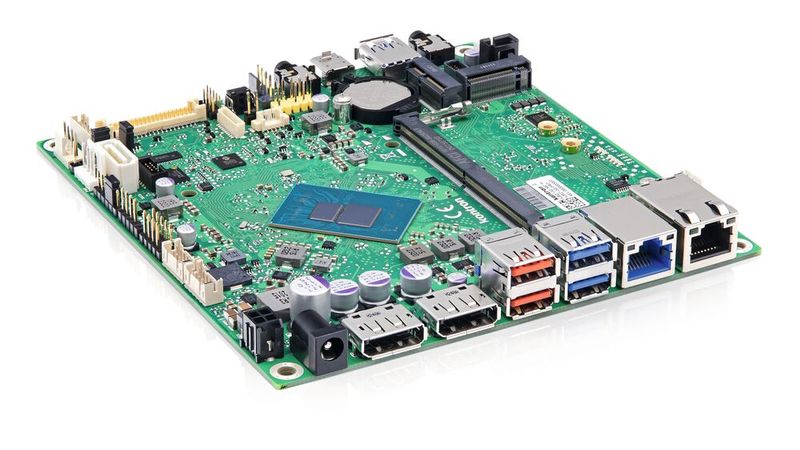
Mini-STX K3921-N: The motherboard masters Intel's Core i3 and N-Series processors and can connect multiple monitors with Full HD.
(Image: Kontron)
The hardware used in sales environments and terminals must simultaneously capture sensor data, perform image analyses, process transactions and communicate with cloud platforms under conditions that are almost impossible for conventional IT systems to manage. Continuous load, changing temperatures and continuous operation require industrial platforms that are optimized for edge scenarios. The edge server plays a central role, coordinating all local processes and synchronizing data with the company infrastructure.
Kontron's µATX Motherboard Forms the Technical Backbone
Platforms such as the K3881-C µATX motherboard with Intel's Xeon E 2400 or Xeon 6300 processors form the technical backbone here. Several redundant network interfaces ensure communication between peripherals and the cloud, while the integrated Intel C266 chipset provides high data bandwidths. 5G support enables synchronous data transmission even if wired connections fail.
All data streams come together at this level: Video streams from the surveillance cameras, log files from the checkout system, sensor data from the shelves and control commands for digital signage or energy management. To ensure that analysis processes are not impaired by latency times, the majority of processing takes place locally. The systems analyze in real time, prioritize according to defined rules and only transfer relevant information to the cloud. This reduces data volumes, lowers latencies and enables autonomous operation in the event of network disruptions.
Edge systems in this class are designed for continuous operation with availability in the carrier-grade range. Values of up to 99.9999 percent mean downtimes of just a few minutes or seconds per year. This high availability is achieved through redundant network interfaces, robust power supplies and fail-safe firmware. On-premises cloud systems, also known as fogs, can also serve as a local backup layer if the connection to the central cloud is interrupted.
Video Analysis And Access Control
Monitoring unmanned environments requires systems that capture high-resolution image data in real time and analyze it with the help of AI. The K3841 micro ATX motherboard is designed for such applications. It supports up to three LAN and six USB ports, which allows the simultaneous operation of multiple cameras. The platform uses 12th to 14th generation Intel Core processors and can be expanded with dedicated AI accelerators.
This architecture allows video analysis and access control to be carried out independently of central servers. Event detection, motion analysis and biometric authentication are carried out directly at the point of data capture. The system also offers options for redundant storage connections and failover operation to ensure uninterrupted recording even in the event of partial infrastructure failures.
For operation in harsh environments, motherboards in this class are prepared for temperature fluctuations, dust and vibrations. Durable components, validated voltage regulators and coated circuit boards ensure consistent performance, even in cold or high humidity environments. Manufacturers guarantee long-term availability over several years and extended support to offer integrators reliable product cycles.
Computing at the Point of Interaction
Space-saving and energy-efficient solutions are required for compact kiosk systems or self-checkout terminals. The K3931-N mini-ITX platform is designed for 24/7 continuous operation and supports a variety of serial and USB interfaces for peripheral devices such as scanners, payment systems or printers. All variants can be operated without a fan, which reduces maintenance costs and increases reliability.
The computing power goes beyond reactive user interfaces, real-time transaction processing and parallel tasks such as ticket printing or payment reconciliation and thus offers expansion possibilities in the future. The integration of LVDS or eDP enables the direct connection of embedded displays without additional adapters. Firmware and BIOS options are designed for long-term product cycles, simplifying migration and spare parts strategy.
The K3931-N also offers the ccTALK interface for payment transactions. This allows POS systems and cash processing modules to be connected directly without the need for proprietary additional hardware. Regular security updates ensure protection against tampering, and the energy requirement remains so low that fanless POS terminals with permanent availability can also be implemented.
Date: 08.12.2025
Naturally, we always handle your personal data responsibly. Any personal data we receive from you is processed in accordance with applicable data protection legislation. For detailed information please see our privacy policy.
Consent to the use of data for promotional purposes
I hereby consent to Vogel Communications Group GmbH & Co. KG, Max-Planck-Str. 7-9, 97082 Würzburg including any affiliated companies according to §§ 15 et seq. AktG (hereafter: Vogel Communications Group) using my e-mail address to send editorial newsletters. A list of all affiliated companies can be found here
Newsletter content may include all products and services of any companies mentioned above, including for example specialist journals and books, events and fairs as well as event-related products and services, print and digital media offers and services such as additional (editorial) newsletters, raffles, lead campaigns, market research both online and offline, specialist webportals and e-learning offers. In case my personal telephone number has also been collected, it may be used for offers of aforementioned products, for services of the companies mentioned above, and market research purposes.
Additionally, my consent also includes the processing of my email address and telephone number for data matching for marketing purposes with select advertising partners such as LinkedIn, Google, and Meta. For this, Vogel Communications Group may transmit said data in hashed form to the advertising partners who then use said data to determine whether I am also a member of the mentioned advertising partner portals. Vogel Communications Group uses this feature for the purposes of re-targeting (up-selling, cross-selling, and customer loyalty), generating so-called look-alike audiences for acquisition of new customers, and as basis for exclusion for on-going advertising campaigns. Further information can be found in section “data matching for marketing purposes”.
In case I access protected data on Internet portals of Vogel Communications Group including any affiliated companies according to §§ 15 et seq. AktG, I need to provide further data in order to register for the access to such content. In return for this free access to editorial content, my data may be used in accordance with this consent for the purposes stated here. This does not apply to data matching for marketing purposes.
Right of revocation
I understand that I can revoke my consent at will. My revocation does not change the lawfulness of data processing that was conducted based on my consent leading up to my revocation. One option to declare my revocation is to use the contact form found at https://contact.vogel.de. In case I no longer wish to receive certain newsletters, I have subscribed to, I can also click on the unsubscribe link included at the end of a newsletter. Further information regarding my right of revocation and the implementation of it as well as the consequences of my revocation can be found in the data protection declaration, section editorial newsletter.
Digital Signage And Control Systems
The K3921-N mini STX motherboard is designed to control multiple displays or interactive information systems. It supports Intel Core i3 and N-Series processors, offers USB-C and DisplayPort interfaces as well as the option of dual-display operation in Full HD. The fanless design reduces noise and improves energy efficiency. Due to its low height, the board can be installed directly behind screens or in compact cases, such as the Smartcase S501.
In combination with edge servers, these systems can process dynamic content, exchange advertising data on a time-dependent basis or evaluate sensor information to adjust brightness and energy consumption. They therefore form the lowest level of a multi-level edge architecture that remains scalable all the way to the cloud.
Standardized Hardware Basis
The integration of different systems requires homogeneous platforms with compatible BIOS configurations, board support packages and APIs. A uniform hardware basis reduces complexity and increases serviceability. Temperature, voltage, CPU load and network status can be permanently monitored using monitoring tools. Watchdog timers ensure automatic restarts in the event of malfunctions, while remote management functions such as Intel Active Management Technology enable remote maintenance and software updates. This combination of industrial-grade hardware and remote management creates an infrastructure that can be operated and maintained without physical intervention. For applications with increased security requirements, additional protection mechanisms such as TPM modules or Secure Boot can be implemented.
Another advantage of standardization is the scalability across different applications. Systems for video surveillance, digital signage or checkout can be equipped with identical components, which considerably simplifies maintenance, spare parts management and certification. This leads to lower total cost of ownership and accelerates rollouts for series projects.
Integration of IoT And Robotics
In addition to stationary devices, smart robots and intelligent shelves are increasingly coming into focus. They record stock levels, identify shortages and report replenishment requirements in real time. Linking this data with sales and checkout systems enables precise control of the flow of goods. Studies forecast annual growth of around 23% for in-store robotics between 2024 and 2030.
IoT-capable motherboards with multiple networks, serial bus protocols and expandable sensors are required for technical implementation. RFID readers, motion sensors and cameras can be integrated via standardized interfaces. The result is an adaptive edge infrastructure that combines sensor data, video analysis and process control in a local system.
Hybrid Cloud And Future Technologies
Future-proof architectures combine local edge systems with central cloud platforms. This hybrid cloud structure enables workloads to be distributed as required: time-critical processes run locally, data-intensive analyses centrally. In its Hype Cycle for Retail Technologies 2024, Gartner names several key technologies that will be incorporated into such infrastructures in the future, including AI-optimized video analysis, sensor fusion and adaptive controls.
Edge systems serve as a bridge layer between the physical components and the cloud services. They handle real-time processing, data selection and synchronization. This architecture minimizes latency times, reduces costs and also allows use in network-critical environments.
Technical Continuity in the Life Cycle
The long-term availability of components is crucial when planning such systems. Industrial platforms such as the boards described here are designed for product lifetimes of up to seven years and offer extended manufacturer support. This means that projects can be operated stably over the entire life cycle without the need for new validations due to discontinuations or hardware changes. The combination of robust mechanics, standardized interfaces, long-term availability of components and remote maintenance results in an infrastructure that is designed for continuous load, real-time processing and high security requirements.
Robust Hardware Architectures Are Required
The digitalization of distributed systems requires robust hardware architectures that combine continuous operation, real-time processing and security. Edge servers, AI-capable platforms and energy-efficient embedded boards form the basis for autonomous processes at decentralized locations. Standardization, remote management and long-term availability create a technical basis that can be used in a wide variety of scenarios, from retail, logistics and manufacturing to safety-critical infrastructures. (mk)
Thomas Stanik is Senior Sales & Business Development Manager at Kontron.



:quality(80)/p7i.vogel.de/wcms/72/a0/72a0ffc94f0929c8b193b4bc40638d72/0129755066v1.jpeg "Tens of billions less! After Ford and General Motors, Stellantis is now also feeling the painful consequences of Donald Trump's decision to change its electric car strategy ... (Image:Stellantis)")
:quality(80)/p7i.vogel.de/wcms/7f/fd/7ffd32863352c40f562f4245e4766e61/0129745849v1.jpeg "After US President Donald Trump once again resorted to his favorite weapon, tariffs, concerns rose in the EU that the so-called tariff deal could become invalid. But it looks as if the sea remains relatively calm ... (Image:F. Schneidler)")
:quality(80)/p7i.vogel.de/wcms/53/69/5369bed136061188d873441dfefd6d6e/0129245111v1.jpeg "The company revised the factory layout even though construction work had already begun. (Image:Efeso Management Consultants)")
:quality(80)/p7i.vogel.de/wcms/d2/d7/d2d79e3fb84663cb7e918c88f123989b/0129733908v1.jpeg "Mineral decision! This is how lithium is mined. There is a lot of it in Chile, Australia, Bolivia and also in Zimbabwe. However, the latter country has now announced that the export of all minerals, including lithium concentrate, will be stopped. Read more about the reasons here ... (Image:Largbatt)")
:quality(80)/p7i.vogel.de/wcms/d9/bd/d9bd1bfa7d02f586e092f06c61ee3d9a/0129464423v1.jpeg "This is what the Black Soldier Fly (BSF) looks like. The first impression is of a common two-winged insect. But appearances are deceptive, because its larvae are true protein reactors, whose industriousness is now to be exploited for food ... (Image:Fly Friends)")
:quality(80)/p7i.vogel.de/wcms/13/4d/134dee0c2b8af6b4f28937ca5b586e0d/0129499541v1.jpeg "The industry now needs to build a flexible, powerful and sovereign infrastructure that can exploit the full potential of artificial intelligence while guaranteeing control over data and processes. (Picture: ©Gorodenkoff - stock.adobe.com)")
:quality(80)/p7i.vogel.de/wcms/c6/71/c671ce338f12be49d39d1b04b40a54f7/0129697443v1.jpeg "Claas is working on making its combine harvesters fit for refurbishment. (Image:Claas)")
:quality(80)/p7i.vogel.de/wcms/f2/4b/f24b8f1c3070e7f13e4f0ffd7854e75a/0129653538v1.jpeg "The production of the BMW iX3 is to be taken as far as possible in terms of sustainability. This is also ensured by the climate-friendly Blueprint recycled steel from Thyssenkrupp Steel ... (Image:BMW)")
:quality(80)/p7i.vogel.de/wcms/f5/7e/f57ef535ee35e7b3b7ff15a8a63cef10/eds-keyvisual-8000x4496v1.jpeg "(Source: European Defence Supply)")
:quality(80)/p7i.vogel.de/wcms/af/a3/afa312176d956068af20491957eef642/newsimage418262-3100x1745v1v1.jpeg "The autonomous shuttle of the Aula AI project during a demonstration of sensor data with artificial fog. (Image:University of Magdeburg)")
:quality(80)/p7i.vogel.de/wcms/84/2d/842d51915fa4fe69c72da5cc4ba52ed1/newsimage418103-3408x1917v1v1.jpeg "3 Printing can also be sustainable—if recyclable ink is used. (Image:Hereon/Steffen Niemann)")
:quality(80)/p7i.vogel.de/wcms/b0/78/b078e07634ffd4d5ee6b73af42cc7c55/newsimage418259-1000x563v1v1.jpeg "Magnesium during forming. (Image:TU Bergakademie Freiberg)")
:quality(80)/p7i.vogel.de/wcms/c7/5e/c75e5942cd1d7e6bce973391af6dafe8/0129757614v1.jpeg "Pony.ai is cooperating with Moore Threads to bring Level 4 autonomous driving to the roads in China more quickly. (Image:Pony.ai)")
:quality(80)/p7i.vogel.de/wcms/a8/9f/a89ff7a3e28a19c03a22fd16cf3404b4/0129761837v1.jpeg "KD and Hitachi High-Tech have concluded a distribution agreement. (Image:KD)")
:quality(80)/p7i.vogel.de/wcms/29/b5/29b536a22d9b5ac80387b02620cce554/20260212-sue-60-6000x3372v1v1.jpeg "The People Mover at its world premiere. The large polycarbonate windshield is clearly visible. One of several materials contributed by Covestro. (Image:UE | STUDIOS)")
:quality(80)/p7i.vogel.de/wcms/a0/3e/a03e71cec3a956df095607a0b176a7b0/0129584071v1.jpeg "Andreas Mindt will be Head of Design at the Volkswagen Group from March. (Image:Volkswagen AG)")
:quality(80)/p7i.vogel.de/wcms/eb/4e/eb4e449562174ec95a5b3d30fb0137a2/0129648135v1.jpeg "The III-V germanium PV module with an efficiency of 34.2% is currently the most efficient solar module in the world. (Image:Jacob Forster)")
:quality(80)/p7i.vogel.de/wcms/92/c2/92c23fd5d95286c8c8c634314f6b22f8/0129722027v1.jpeg "The Meta Group has signed a five-year contract for GPU and CPU deliveries to expand its AI capacities. The agreement covers the delivery of up to 6 gigawatts of GPU computing power with a total value of around USD 60 billion. (Image:freely licensed)")
:quality(80)/p7i.vogel.de/wcms/01/77/017742db7d5eb5964c297bb8917df701/0129696639v1.jpeg "Mini-STX K3921-N: The motherboard masters Intel's Core i3 and N-Series processors and can connect multiple monitors with Full HD. (Image:Kontron)")
:quality(80)/p7i.vogel.de/wcms/17/21/1721b98b7580a86c7790f607395878a1/0129697493v1.jpeg "Universal: Motors are used everywhere. (Image:Microchip Technology)")
:fill(fff,0)/images.vogel.de/vogelonline/companyimg/76800/76895/65.jpg "FAULHABER_120mm.jpg ()")
:fill(fff,0)/p7i.vogel.de/companies/67/eb/67eba621ef6ea/logo2.png "logo2 (Wuxi InfiMotion)")
:quality(80):fill(efefef,0)/p7i.vogel.de/wcms/67/09/67094781dd403/dossier-additive-manufacturing.png "Dossier Additive Manufacturing")
:quality(80)/p7i.vogel.de/wcms/c7/bb/c7bbf9d2e343a8b935b82f5e240e0203/0126516806v1.jpeg "Containerization and cloud computing enable a flexible and scalable IT infrastructure. Through APIs and edge computing, distributed systems can be centrally controlled, secure, and used in real time. (Image:gridscale)")
:quality(80)/p7i.vogel.de/wcms/b9/0c/b90cc85f64dcb5e00768e429f72225a8/0129191183v1.jpeg "Car manufacturers rely on a software platform that allows them to manage software updates as well as the condition and status of the vehicle. (Image:Sibros)")