The Greek pipe manufacturer Corinth Pipeworks S.A. (CPW) and Europe's largest heavy plate rolling mill, Dillinger, headquartered in Saarland (Germany), are pioneering the construction of high-pressure gas pipelines for up to 100% pure hydrogen.
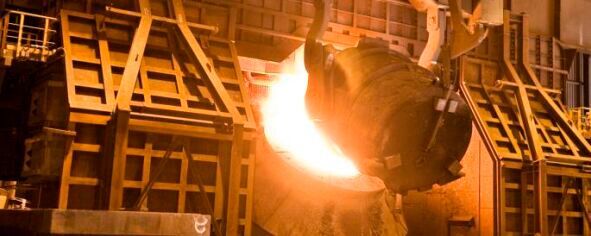
The converter at Dillinger is filled with pig iron.
(Image: Dillinger)
Hydrogen is considered the energy carrier of the future: versatile, producible from renewable energies, and highly efficient as a fuel and for energy storage. Its key role in decarbonizing industry and thereby enabling the energy transition is acknowledged by the European Union through its Hydrogen Strategy. The aim of this strategy is to achieve European domestic production of about 11 million short tons of green hydrogen by 2030, as well as to import another 11 million short tons. A prerequisite for this is the availability of the corresponding infrastructure in the form of a Europe-wide hydrogen transport network. This European Hydrogen Backbone (EHB) is expected to consist of around 70 percent retrofitting existing natural gas pipelines and 30 percent new construction of hydrogen pipelines. The Greek pipe manufacturer Corinth Pipeworks S.A. (CPW) and Europe's largest heavy plate rolling mill Dillinger, headquartered in Saarland, are pioneers in advancing the construction of high-pressure gas pipelines for up to 100 percent pure hydrogen. A prime example of this is their successful collaboration on the first European pipelines certified for pure hydrogen in Poland and Italy.
Corinth Pipeworks is a leading Tier-1 supplier of steel pipes that meet the highest standards of the oil and gas industry worldwide. More than 90 percent of the projects involve gas transport pipelines for natural gas, hydrogen, and carbon capture and storage technologies. A leading role in research and development for pipelines in the energy sector completes the portfolio. Based in Thisvi (Thebes) near the city of Corinth, which gave it its name, the company relies on the principle of one-stop shopping. It delivers all welded products for hydrogen pipelines from a single source—from manufacturing and certification in its own state-of-the-art hydrogen laboratory to delivery. Founded in Corinth in 1969, the company opened its new production facility in Thisvi in 2000, with 1.4 million square feet, of which ten production plants are housed under cover: including four pipe mills producing pipes with diameters ranging from 2.5 to 100 inches, two plants for external pipe coating, one for internal pipe coating, a concrete coating plant, and a double jointing facility for pipelines. The annual production capacity amounts to up to 1.1 million short tons. Since 2016, the company has been part of Cenergy Holdings SA. Aktien-Gesellschaft der Dillinger Hüttenwerke (Dillinger) is a global leader in the production of high-quality heavy plates. These high-tech plates are used in technically demanding projects in the fields of steel construction, offshore and onshore, wind power, line pipe, pressure vessel, and mechanical engineering. From pig iron and steel production, two rolling mills, to trading, flame-cutting, and processing operations, Dillinger also offers everything from a single source. Corinth Pipeworks and Dillinger share a long-standing, trustworthy collaboration.
Pioneer With Its Own Hydrogen Laboratory
In 2020, Corinth Pipeworks established an Emerging Fuels Team to define and drive a strategy for the forward-looking development of pipe technology. This team consists of three experts, each with more than two decades of experience at the company: Athanassios Tazedakis, Senior Operations Director, metallurgical engineer, and Ph.D. in welding engineering; Nikolaos Voudouris, Head of Research and Development, chemical engineer, and Ph.D. in materials science; and Efthymios Dourdounis, Head of Quality Assurance, chemical engineer, and Ph.D. in metallurgical engineering. At that time, there was no European standardization program for hydrogen pipelines, so Corinth Pipeworks began developing the necessary protocols for the qualification program based on the ASME B31.12 Option B code from the USA. Corinth Pipeworks integrated the requirements of the code into a standardized testing and certification process according to ASME B31.12 Option B for plates and welds of pipes designed for the transport of hydrogen-natural gas mixtures or pure gaseous hydrogen without design limitations. In addition to the mentioned qualification, the company created its own testing environment. Today, CPW is the only pipe manufacturer in the world to have a state-of-the-art hydrogen testing laboratory to test and certify pipes for pure hydrogen under static or increasing loads and high pressures up to 4,400 psi in accordance with the ASME B31.12 code and other relevant standards regarding toughness, ductility, and the associated toughness reduction due to hydrogen embrittlement. This knowledge of hydrogen-specific phenomena allows Corinth Pipeworks to deliver end products with the necessary safety levels and provide deeper insights into design requirements for network operators. Today, this expertise in steel grades, thicknesses, and pipeline technology represents a decisive competitive advantage in ensuring proven safety and design of products for even the most demanding projects. A guarantee of this reliable product safety for the pipe manufacturer is strategic collaborations with top-tier steel mills, with Dillinger among the leaders. "The fact that the steel behaves as we predicted based on our experiences with the company and our finite element (FEM) analysis for the specific product is extremely important," explains Athanassios Tazedakis, highlighting the significance of this established collaboration.
Date: 08.12.2025
Naturally, we always handle your personal data responsibly. Any personal data we receive from you is processed in accordance with applicable data protection legislation. For detailed information please see our privacy policy.
Consent to the use of data for promotional purposes
I hereby consent to Vogel Communications Group GmbH & Co. KG, Max-Planck-Str. 7-9, 97082 Würzburg including any affiliated companies according to §§ 15 et seq. AktG (hereafter: Vogel Communications Group) using my e-mail address to send editorial newsletters. A list of all affiliated companies can be found here
Newsletter content may include all products and services of any companies mentioned above, including for example specialist journals and books, events and fairs as well as event-related products and services, print and digital media offers and services such as additional (editorial) newsletters, raffles, lead campaigns, market research both online and offline, specialist webportals and e-learning offers. In case my personal telephone number has also been collected, it may be used for offers of aforementioned products, for services of the companies mentioned above, and market research purposes.
Additionally, my consent also includes the processing of my email address and telephone number for data matching for marketing purposes with select advertising partners such as LinkedIn, Google, and Meta. For this, Vogel Communications Group may transmit said data in hashed form to the advertising partners who then use said data to determine whether I am also a member of the mentioned advertising partner portals. Vogel Communications Group uses this feature for the purposes of re-targeting (up-selling, cross-selling, and customer loyalty), generating so-called look-alike audiences for acquisition of new customers, and as basis for exclusion for on-going advertising campaigns. Further information can be found in section “data matching for marketing purposes”.
In case I access protected data on Internet portals of Vogel Communications Group including any affiliated companies according to §§ 15 et seq. AktG, I need to provide further data in order to register for the access to such content. In return for this free access to editorial content, my data may be used in accordance with this consent for the purposes stated here. This does not apply to data matching for marketing purposes.
Right of revocation
I understand that I can revoke my consent at will. My revocation does not change the lawfulness of data processing that was conducted based on my consent leading up to my revocation. One option to declare my revocation is to use the contact form found at https://contact.vogel.de. In case I no longer wish to receive certain newsletters, I have subscribed to, I can also click on the unsubscribe link included at the end of a newsletter. Further information regarding my right of revocation and the implementation of it as well as the consequences of my revocation can be found in the data protection declaration, section editorial newsletter.
High-Pressure Gas Pipeline for Poland
The Polish gas network operator GAZ-System Poland SA has long been part of Corinth Pipeworks' customer base. In 2021, the Greek pipe manufacturer received a request from GAZ-System for an 50 miles high-pressure gas pipeline. This pipeline was initially intended to transport natural gas but was designed to be hydrogen-compatible in the future, to become part of the European hydrogen backbone. The standardized testing and certification by Corinth Pipeworks' hydrogen laboratory fully convinced GAZ-System, prompting the gas network operator to integrate the requirements of the ASME B31.12 code into its own specifications for the planned high-pressure gas pipeline. The commissioned 50 miles pipeline from Gustorzyn to Wronow is part of a larger high-pressure gas pipeline. The longitudinally welded pipeline (LSAW) has a diameter of 40 inches and a wall thickness of 0.9 inches. It was coated externally with a three-layer polyethylene coating for corrosion protection and internally with an epoxy coating. The operating pressure of the pipeline, 1,160 psi, corresponds to the typical pressure for transmission pipelines in Europe. Efthymios Dourdounis emphasizes, "However, it was tested by us at a much higher pressure than required for operation and withstands a pressure of up to 2,900 psi." Athanassios Tazedakis adds, "To meet and exceed the associated requirements, we must be very careful and conservative in selecting our partners." The choice of base material supplier fell on Dillinger Hüttenwerke, which supplied 12,000 short tons of L485ME grade heavy plate for this section. "This is the highest-strength steel grade that can be qualified for hydrogen applications under ASME B31.12," explains Efthymios Dourdounis, adding, "More common grades are L415, L450, or L485. However, the L485ME grade specified by GAZ-System permits reduced wall thickness due to its high mechanical properties and high yield strength, requiring less steel for the same design pressure."
Tailor-Made Heavy Plates for Hydrogen Pipes
The basis for choosing Dillinger as the supplier was the extensive database of information on steel properties and requirements that Corinth Pipeworks demanded of the steel, as well as Dillinger's proven capabilities in the past. According to Nikolaos Voudouris, a decisive factor for the pipe manufacturer is that the plates can be shaped in such a way that they meet the challenging specifications for hydrogen pipelines. "We have strict requirements regarding the chemical composition and mechanical properties of the steel, which we must guarantee to ensure the high quality of the pipes." For this, it is extremely important that the pipe plate behaves predictably during shaping so that the preparation for welding can be carried out correctly. In the preceding FEM analysis, it is determined in detail how all forming steps and the plates must be used for the specific pipe designs. "We do not produce standard pipes; every project is designed by us from scratch. We receive designs from customers for a very specific application with requirements specified down to the last detail." Therefore, the steel supplier must design the steel to meet these customer requirements while simultaneously adhering to all restrictions imposed by standards. The hydrogen standard is in addition to all other standards for a pipeline. "With Dillinger, we know that the plates indeed meet our expectations and predictions: high purity due to low phosphorus and sulfur content, a good microstructure with low carbon content, low hardness, good ductility, and easy weldability."
In Close Collaboration for Certified Safety
Dillinger is also favored for its high delivery reliability, the availability of the desired grade and thickness combinations, as well as the mechanical properties of the plates. Athanassios Tazedakis adds, "Hydrogen embrittlement is one of the greatest challenges we have to overcome—especially with high-strength steels! It is a critical factor for us when selecting Dillinger’s high-strength material! This is the only way we can ensure that what is promised is delivered, not only by Dillinger but also by us." Nikolaos Voudouris emphasizes, "However, our relationship with Dillinger is not just based on the quality of the material but on the entire package: we receive very high-quality documentation on the steel. Everything is at the highest level—the metallurgical expertise, the responsiveness to quickly adapt to requirements, and the communication. We speak the same language." This is why frequent discussions are held to keep each other updated and to align agendas for these technically demanding projects.
The high-pressure gas pipeline delivered for GAZ-System has been in operation since 2023 and is one of the first in Europe certified for the transport of pure hydrogen. The first hydrogen pipeline of this kind was also delivered by Corinth Pipeworks—for the Italian transmission network operator SNAM S.p.A. (Società Nazionale Metanodotti). To date, it includes more than 370 miles of hydrogen-certified pipes from the Greek pipe manufacturer, including high-strength steel of grade L450 from the Saarland-based steel producer. "The collaboration with Dillinger means double support for us," says Athanassios Tazedakis. "Dillinger supplies products for pipelines intended to deliver large quantities of hydrogen and manufactures this product, thanks to immense investments in its production facilities, with low CO₂ emissions, as hydrogen is used in the production process. Our philosophies and mentalities therefore align well. That’s why Dillinger is at the very top of our list."
Next Milestones for Onshore And Offshore Pipelines in Sight
The demanding applications with hydrogen herald a new era in Europe from the expert’s perspective, where challenges must be tackled together, as success is very important for both companies. The retrofitting of existing pipelines requires significant economic sacrifices from gas network operators: they must inspect the entire pipeline length and, in the case of existing damages or suspicious sections that are not critical for natural gas, reduce the pressure in the pipeline for hydrogen transport. However, a hydrogen transport pipeline is only profitable with large flow volumes, which is why a high demand for new pipelines is expected. At the same time, Corinth Pipelines is once again a pioneer in many projects aimed at formulating the currently missing standards for offshore pipelines. "The qualification of these pipelines for hydrogen transport at sea must be based on strict initial testing and material validations. This is something we, as well as Dillinger, must be prepared for!" Corinth Pipelines and Dillinger are ready as partners for the future hydrogen market: "We have ready solutions, have already supplied the market with state-of-the-art products, and have the determination for further improvements and deeper collaboration!"



:quality(80)/p7i.vogel.de/wcms/a0/47/a04725ef9bd09fb6c9341a1bea1b5d93/0130443083v1.jpeg "Here, a type of plastic pallet is produced by thermoforming (vacuum forming or deep drawing) at the corresponding division of New England Plastics in the USA. This division, which specializes in so-called liners, is now part of Ringmetall ... (Image:New England Plastics)")
:quality(80)/p7i.vogel.de/wcms/e3/42/e342b3c593ea92d56604d3be969e9c9a/0130437231v1.jpeg "Daimler Truck will be building even more trucks at its Czech plant in Cheb in the future. This is because it is now being expanded for strategic cost-saving reasons ... (Image:Daimler Truck)")
:quality(80)/p7i.vogel.de/wcms/23/99/23992bf2dcdc432c9b7209c34a4a7c48/0129733089v1.jpeg "Stork relies on the modular Neoswiss turning system from Iscar to shorten the set-up times for its sliding headstock lathes and work more productively. (Image:Iscar)")
:quality(80)/p7i.vogel.de/wcms/7d/e2/7de2923434b2f1a78ba5482d8d335269/0113143253v1.jpeg "In our China Market Insider we regularly provide you with relevant information directly from China. (Image:© Eisenhans - stock.adobe.com)")
:quality(80)/p7i.vogel.de/wcms/b7/36/b736dfebc16c42d6901d0d0e1f390493/3d-druck-20factory-20--20ki-20generiert-1920x1079v1.png "(Source: AI-generated)")
:quality(80)/p7i.vogel.de/wcms/79/b2/79b21aad663f4a7bd4472afc1c1afc62/0130433994v1.jpeg "Mission Joyride: The free-flying robot (shown here in the rendering) will relieve the ISS crew of logistics tasks from 2027 with its two mechanical arms. (Image:Icarus Robotics)")
:quality(80)/p7i.vogel.de/wcms/6b/45/6b4546fa6ebf305c3660326909363f32/0130437089v1.jpeg "Industrial AI in action: Rockwell Automation presents practical solutions for self-controlling production systems at the Hannover Messe. (Image:Rainer Jensen, Deutsche Messe)")
:quality(80)/p7i.vogel.de/wcms/78/e9/78e9188c25a8a94e67c34c9bf8ffe495/visual-agile-20robots-20and-20google-20deepmind-20partner-20to-20bring-20intelligence-20to-20robotics-2500x1406v1v1.jpeg "Together, the partners are developing adaptable, intelligent robots for a wide range of applications (Image:Agile Robots SE)")
:quality(80)/p7i.vogel.de/wcms/59/a2/59a2b11f0aa1b700eff02addd5de8703/adobestock-1788280853--c2-a9-20satria-20-e2-80-93-20stock-adobe-com-5081x2860v1v1.jpeg "Quantum computers require extreme cooling to temperatures close to absolute zero in order to keep qubits stable. (Image:satria - stock.adobe.com)")
:quality(80)/p7i.vogel.de/wcms/62/5f/625f41e87ebfef156a98c8e6393e32fd/0130211654v1.jpeg "Axial flux motors have some advantages over radial flux motor—but their production is currently still expensive. (Image:RWTH Aachen University)")
:quality(80)/p7i.vogel.de/wcms/f6/ae/f6aec4f6241b36ed5e3a990ac9176b42/0130429460v1.jpeg "Verne, Pony.ai and Uber want to launch a robotaxi service in Europe. (Image:Verne)")
:quality(80)/p7i.vogel.de/wcms/d7/88/d788699f2974708a332baa4e7a62fa9e/0130438967v1.jpeg "Skoda is withdrawing from China. The brand has produced well over three million vehicles there. (Image:Skoda car)")
:quality(80)/p7i.vogel.de/wcms/b0/43/b043b86899837532aad62d63368a917a/0130371361v1.jpeg "Skoda leaves the chinese market.
(Image:Skoda)")
:quality(80)/p7i.vogel.de/wcms/c3/c4/c3c4ce270b083eeac55654148611f064/0130237945v1.jpeg "China is not giving up on hydrogen, but is intensifying its efforts. (Image:freely licensed from Pixabay)")
:quality(80)/p7i.vogel.de/wcms/ee/09/ee09acbd6dc896df25affaa9e871e6e5/0130440053v1.jpeg "IMS chip module for simple system integration into an ion mobility spectrometer. (Image:Fraunhofer IPMS)")
:quality(80)/p7i.vogel.de/wcms/10/6c/106cd22de5f68a0f74639d654827228c/0130345302v1.jpeg "Made in India: According to the India Electronics and Semiconductor Association (IESA), the country should be able to produce between 75 and 80 million chips by the beginning of 2027, once the plants currently under construction become operational. (Image:Pixabay (Montage: Sebastian Gerstl))")
:quality(80)/p7i.vogel.de/wcms/a5/ed/a5ed6fda029d362732a293d6b19d74c4/0130444216v1.jpeg "Thirteen executives from the Chinese chip industry have drawn up a plan to achieve an 80% self-sufficiency rate for semiconductors by 2030. (Image:Maxim_Kazmin - stock.adobe.com)")
:quality(80)/p7i.vogel.de/wcms/31/a6/31a646018b34d8e0a44bfc8bf17837f6/0130361632v1.jpeg "For many companies, PFAS are considered indispensable in electronics production. (Image:freely licensed)")
:fill(fff,0)/images.vogel.de/vogelonline/companyimg/76800/76895/65.jpg "FAULHABER_120mm.jpg ()")
:quality(80)/p7i.vogel.de/wcms/e8/ca/e8ca5f5d150514d45de60b3a254add23/0122391441v1.jpeg "The Estadio Santiago Bernabéu of Real Madrid is both a myth and a magnet. (Image:Real Madrid)")
:quality(80)/p7i.vogel.de/wcms/b3/cf/b3cfd128d242a2f1189781525ce817ef/0125802529v1.jpeg "Additive manufacturing can pave the way for hydrogen technology. According to researchers at RWTH Aachen, this works in several ways. For example, through special structures for electrolyzers created by powder bed-based laser beam melting. (Image:RWTH Aachen DAP)")
:quality(80)/p7i.vogel.de/wcms/5e/47/5e47efbcf1fcb05112b89b96157fb024/0123946657v1.jpeg "With its 75 meters in length and a production volume of 122,000 tons per year, the preservation line KON 47/3-HD is a powerhouse. (Image:Rösler)")