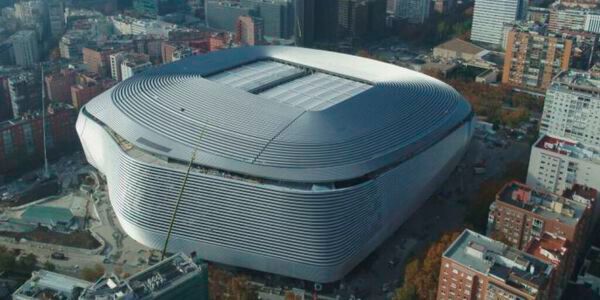
A high-strength premium steel for lightweight steel structures from Dillinger enables the challenging roof construction of the Estadio Santiago Bernabéu, the stadium of Real Madrid.
The Estadio Santiago Bernabéu of Real Madrid is both a myth and a magnet.
(Image: Real Madrid)
The Estadio Santiago Bernabéu is both a myth and a magnet. As the home of Real Madrid, one of the most successful football clubs in the world, the arena, which opened in 1947, is regularly the venue for legendary encounters. After several renovations and expansions over the past decades, the most exciting match for the football temple began in 2019—its transformation into a multifunctional arena unparalleled worldwide. For Real Madrid, only the best solution was good enough for the implementation of the ambitious redesign. This applied to the companies involved in the construction as well as the materials used. Exemplifying this is S690QL1 from Dillinger, a high-strength premium steel for lightweight steel constructions, which, in unprecedented quantities for such a project, made the challenging roof structure of the Estadio Santiago Bernabéu possible.
The new, spectacular stadium design is a joint draft by the Hamburg architectural firm of Gerkan, Marg and Partner (gmp), the Spanish project partners L35 Arquitectos, Ribas & Ribas Arquitectos, and the engineering firms schlaich bergermann partner (sbp) and Ines Consulting Engineers. Besides the sculptural shell made of diagonally curved stainless steel slats with varying degrees of transparency, the retractable pitch, and a 360-degree LED screen on the inner roof edge, the floating-appearing roof structure with a fully retractable inner roof is one of the defining design elements of the new Bernabéu Stadium. The Spanish steel construction company Horta Coslada was commissioned with the construction of three of these outstanding design elements. With four plants in Spain and a total production area of 390,000 square meters, Horta Coslada is the largest steel construction company in Spain, specializing in complex large-scale projects like bridges, stadiums, infrastructure, and skyscrapers. The company's references, founded in 1963, include Terminal 4 of Madrid Airport (21,000 tons of steel), the Cité de la Musique in Paris (3,500 tons of steel), the NATO headquarters in Brussels (6,000 tons of steel), and stadium constructions like Atlético Madrid's Estadio Wanda Metropolitano (5,700 tons of steel) or Olympique Marseille's Stade Vélodrome (5,800 tons of steel).
Large deployment in the Bernabéu stadium
For about 15 years, Horta Coslada has also been using steel from Dillinger: exemplified by the Cepsa Tower in Madrid, the tallest skyscraper in Spain at 249.5 meters (approx. 818,6 ft), and the Pont de l'Assut de l'Or in Valencia. For the roof of the Bernabéu Stadium, Horta Coslada processed a total of 13,000 tons of steel, including 3,100 tons of the higher strength S690QL1 steel from Dillinger in plate thicknesses from 10 to 120 millimeters (approx. 0,4 to 4,7 inches). This higher strength enables lighter and slimmer constructions that would otherwise not be feasible from an engineering perspective. The lighter weight of the components also allows for larger parts and opens up entirely new architectural possibilities. At the same time, the cost and time required for welding volume are significantly reduced. As a premium manufacturer, Dillinger offers a very wide range of higher strength grades. This includes such special products as S690 according to standards up to the largest plate thicknesses. While the use of this steel is common in crane construction, it is rather atypical in steel construction and, if at all, only used in small tonnages. According to Alejandro Otero Gutiérrez, CEO of Horta Coslada, such a large amount of S690, as processed for the roof of the Bernabéu Stadium, has never before been used in steel construction in Europe. The QL1 class, also ordered by Horta Coslada for thinner sheets, is a particularly demanding steel due to its highest toughness class, meeting the highest safety levels.
Date: 08.12.2025
Naturally, we always handle your personal data responsibly. Any personal data we receive from you is processed in accordance with applicable data protection legislation. For detailed information please see our privacy policy.
Consent to the use of data for promotional purposes
I hereby consent to Vogel Communications Group GmbH & Co. KG, Max-Planck-Str. 7-9, 97082 Würzburg including any affiliated companies according to §§ 15 et seq. AktG (hereafter: Vogel Communications Group) using my e-mail address to send editorial newsletters. A list of all affiliated companies can be found here
Newsletter content may include all products and services of any companies mentioned above, including for example specialist journals and books, events and fairs as well as event-related products and services, print and digital media offers and services such as additional (editorial) newsletters, raffles, lead campaigns, market research both online and offline, specialist webportals and e-learning offers. In case my personal telephone number has also been collected, it may be used for offers of aforementioned products, for services of the companies mentioned above, and market research purposes.
Additionally, my consent also includes the processing of my email address and telephone number for data matching for marketing purposes with select advertising partners such as LinkedIn, Google, and Meta. For this, Vogel Communications Group may transmit said data in hashed form to the advertising partners who then use said data to determine whether I am also a member of the mentioned advertising partner portals. Vogel Communications Group uses this feature for the purposes of re-targeting (up-selling, cross-selling, and customer loyalty), generating so-called look-alike audiences for acquisition of new customers, and as basis for exclusion for on-going advertising campaigns. Further information can be found in section “data matching for marketing purposes”.
In case I access protected data on Internet portals of Vogel Communications Group including any affiliated companies according to §§ 15 et seq. AktG, I need to provide further data in order to register for the access to such content. In return for this free access to editorial content, my data may be used in accordance with this consent for the purposes stated here. This does not apply to data matching for marketing purposes.
Right of revocation
I understand that I can revoke my consent at will. My revocation does not change the lawfulness of data processing that was conducted based on my consent leading up to my revocation. One option to declare my revocation is to use the contact form found at https://contact.vogel.de. In case I no longer wish to receive certain newsletters, I have subscribed to, I can also click on the unsubscribe link included at the end of a newsletter. Further information regarding my right of revocation and the implementation of it as well as the consequences of my revocation can be found in the data protection declaration, section editorial newsletter.
Construction of the new roof structure without access to the interior
The football temple in the heart of Madrid has a long history. Real Madrid's declared goal with the current renovation was to give the legendary Estadio Santiago Bernabéu a completely new face and make it the best stadium in the world. With four new tiers of stands, a shopping center, hotel, interactive club museum, retractable high-tech roof, and retractable pitch, the home of the Spanish record champions heralds the start of a new generation of multifunctional arenas.
As a global reference in sports and architecture, the state-of-the-art arena is to offer not only a venue for emotions but also maximum comfort, safety, and cutting-edge technology. The Bernabéu Stadium is located directly on the main traffic artery in the densely populated center of Madrid. A particular challenge for all companies involved in the renovation was Real Madrid's original stipulation to carry out the entire stadium renovation during ongoing games and without any access to the interior. The general contractor appointed by Real Madrid, Fomento de Construcciones y Contratas (FCC), and Horta Coslada jointly developed a construction strategy to assemble the enormous trusses required for the roof structure outside the stadium. A core component of this strategy was a temporary platform six meters high in front of the western stadium entrance, where all the components of the roof trusses were pre-assembled. With this construction, spectators could have entered and left the stadium as if passing under a bridge. Although the matches were canceled due to the Covid-19 pandemic that started a few months later, this construction strategy was nevertheless maintained.
Four trusses for the entire roof load
Comparable demanding requirements had already been successfully implemented by Horta Coslada for the stadiums of Atlético Madrid and Olympique Marseille, which recommended the company as the first steel construction choice for the Bernabéu Stadium. In 2019, the experienced steel construction company was therefore commissioned by FCC to build the new roof of the Bernabéu Stadium. The engineers' original plan for the main roof was based on the lightweight spoke wheel principle: an inner tension ring connected to an outer compression ring via 44 radial cables, meant to rest on steel cantilevers of the existing bowl. This lightweight cable construction was abandoned by FCC and replaced with a more conventional system of four steel trusses supporting the entire stadium roof. The main trusses are the north and south spans, each six meters wide and high with a span of 176 meters (approx. 577 ft). These key roof elements played a crucial role in the entire assembly: during construction, they allowed the pre-assembly of other roof components on the platform outside the stadium. Both main trusses were fully constructed in a truss design using the higher-strength S690 steel and each weighs almost 1,500 tons. They rest on only four points, or columns, two of which were newly built. "This construction was only possible with the steel grade S690, a lightweight steel with a very high yield strength," explains Alejandro Otero Gutiérrez. He adds, "The weight savings only achievable through this were crucial for the success of the entire construction: compared to other solutions, we were able to save about 40 percent of steel by using this steel!" About a third of the entire Bernabéu Stadium roof structure was made from S690 by Dillinger.
"With other steel grades, the roof would have weighed about 20,000 tons. With the S690, we only needed about 12,000 tons of steel," says Otero Gutiérrez. For the other two girders, the east and south trusses with a span of 138 meters, the steel grades S690 and S460 were combined in roughly equal proportions.
Challenging manufacturing, assembly, and installation
prefabrication of all individual parts took place at Horta Coslada's plant in Madrid. Over 100,000 parts were cut and drilled there before being welded into transportable elements of beams and diagonals in the prescribed geometry. For transport to the construction site with elements up to 18 meters long, each beam had to be divided into 40 parts. To ensure that all bolts would fit correctly on-site, a complete trial assembly of all components was conducted in Horta Coslada's production halls. The entire truss structure over the stadium is completely bolted, without a single weld seam. A total of 336,500 bolts were required. After pre-assembly on the platform outside the stadium, the north and south trusses were lifted with a 600-ton crawler crane and bolted together step by step in the air from the four corners. The pre-assembled components of the two other trusses were then lifted in pairs, bolted, and – supported by the main trusses—pushed to the opposite side on wheels using electric motors. Using the higher-strength S690 steel not only reduced the tonnage of the roof but also the
number of required components and the number of trucks needed for transport to the construction site. "We saved about 300 trucks," Otero Gutiérrez specifies this advantage. Given the stadium's location in the heart of Madrid, this meant not only a significant reduction in traffic load on the busy access road but also a substantial decrease in the environmental impact from CO2.
Resounding victory in the new super stadium
Looking back, the steel constructor states: "I can only say that it was one of the most challenging projects in our company's history—because of the construction method, the logistics, the extremely tight schedule, and the steel grade." In his view, the steel grade was probably one of the biggest challenges. "I know of only two companies in Europe that can produce this steel in this thickness. Dillinger is known in Europe as probably the best supplier of such thick and high-quality steels." His company has successfully completed many projects with Dillinger. The high capacity and reliability of the steel manufacturer also argued for collaboration with the Saarland supplier given the tight schedule. "This was a unique project with high public attention. That's why we decided to work only with the best partners we can have. That's why Dillinger was also the partner of choice for us."



:quality(80)/p7i.vogel.de/wcms/68/a5/68a5ce0896756c1dcf48dbeceefafbd3/0132300990v1.jpeg "Christoph Geigges is President and CEO of Walter AG. Headquartered in Tübingen (Germany), the company is one of the world’s leading suppliers of precision tools for metalworking. Under Geigges’ leadership, this long-established company is increasingly transforming itself from a tool manufacturer into an engineering partner that supports the entire manufacturing process. (Image: Walter AG)")
:quality(80)/p7i.vogel.de/wcms/3e/7c/3e7c26f44c68545fc7318597b6b65903/0133649650v1.jpeg "The flexible Heller circular storage system can store and process pallets measuring both 630 millimeters by 630 millimeters and 800 millimeters by 800 millimeters—even in mixed-mode operation. This makes the entire production line particularly flexible. (Image:Brighter)")
:quality(80)/p7i.vogel.de/wcms/16/29/162983885950ec1df27ab441bfe88613/0133132549v1.jpeg "Bernd Hermeler is the CEO of Cemecon AG. He studied mechanical engineering at RWTH Aachen University (Germany)—the very university from which the company emerged as a spin-off 40 years ago. Today, Hermeler is responsible for the global strategy of the coating specialist, which, with branches in Europe, the U.S., China, Japan, and India, is considered the global technology leader in the coating of cutting tools. (Image: Cemecon AG)")
:quality(80)/p7i.vogel.de/wcms/af/81/af81b53cb4926dcadc20ba369a29d412/0132695968v1.jpeg "International venture capital is increasingly flowing into the machining industry. Here are the players that entrepreneurs and CEOs should keep an eye on right now. (Image: ©NDABCREATIVITY - stock.adobe.com)")
:quality(80)/p7i.vogel.de/wcms/88/dc/88dc38a1a0b5e016192ab83b0850fbd0/0133514708v1.jpeg "Scalable data sovereignty is the foundation for the transition from computationally intensive AI processing and growing data streams to sustainable, energy-efficient storage systems. (Image:Gemini / AI-generated)")
:quality(80)/p7i.vogel.de/wcms/1c/ef/1cef66e13c5cc02c5731fefcc99c00d2/0133697754v1.jpeg "Embodied AI in Industry: FMC³ Robotics combines AI-based perception and adaptation with traditional robot control to prepare robots for use in industrial manufacturing. (Image:FMC³/processed by AI)")
:quality(80)/p7i.vogel.de/wcms/db/ca/dbcae78eb8853b53fe122832fe3b2cba/0132914918v1.jpeg "Robotics in Flexible Manufacturing: As connectivity increases, so do the requirements for functional safety. (Image: Delta Electronics)")
:quality(80)/p7i.vogel.de/wcms/ea/18/ea18e84aed24bbe1c91937f30c2f7301/image1v1.jpeg "Kassow Robots' new product portfolio now includes seven 7-axis cobots. (Image: Kassow Robots (Image:)")
:quality(80)/p7i.vogel.de/wcms/90/30/90300137452b00d22f95113eff065ac3/fliehkraftkupplungen-und-bremsen-montage-centrifugal-clutches-and-brakes-assembly-1v1.jpeg "Installation: Centrifugal clutches should always be precisely matched to the machine. (Source: Amsbeck Machine Technology)")
:quality(80)/p7i.vogel.de/wcms/93/84/9384230e840a99a2015fdd3e0af11e2b/newsimage428236v1.jpeg "The crutch replicates the natural, biomechanical movement pattern of the human body. (Source: Leon Kast)")
:quality(80)/p7i.vogel.de/wcms/5b/a2/5ba21b3e5fcdd91f6bfe806f745ea723/isc-physioink-bild-3v1.jpeg "In the PhysioINK project, Fraunhofer researchers are developing bio-printing inks from the most common tissue proteins. Under the microscope, the living tissue cells (fibroblasts) are visible in the printed lattice structure: blue represents the cell nucleus, and green represents the cytoskeleton. (Source: Tobias Weigel/Fraunhofer ISC)")
:quality(80)/p7i.vogel.de/wcms/9c/16/9c16e4aa02594fe4bf82ead736562b07/directhop1-scaledv1.jpeg "Light as a feather, but without feathers: The University of Washington's robot, which weighs just one gram, uses a bionic direct-drive system to catapult itself into the air with centimeter-level precision. (Source: Mark Stone/University of Washington)")
:quality(80)/p7i.vogel.de/wcms/0a/50/0a50938be0b598b36efc4e5457ed56dd/forvia-siege-zen-massage-16-9-06v1.jpeg "Seat with massage function by Forvia. (Source: Forvia)")
:quality(80)/p7i.vogel.de/wcms/99/61/9961719acb89bc87fdecb1bba140481c/0133725593v1.jpeg "Ultrason (PSU, PESU, PPSU) is suitable for E&E components used in electric mobility or AI infrastructure, such as connectors for fiber-optic cables. (Image:BASF)")
:quality(80)/p7i.vogel.de/wcms/42/9b/429badd88cd4a74edb6491d10310349c/wayve-london-05v1.jpeg "Wayve is developing an AI software stack for automated driving. It appears that the Volkswagen Group has now opted for this technology. (Source: Wayve)")
:quality(80)/p7i.vogel.de/wcms/14/9f/149f934f87e5418748fa41a611586a4f/rawdon-gloverv1.jpeg "Rowdon Glover, Managing Director of Jaguar: “We are willing to accept polarization.” (Image:JLR)")
:quality(80)/p7i.vogel.de/wcms/36/f0/36f0472d20227013871aa790f4d48ac6/0133726018v1.jpeg "Ion beams can ablate, coat, or smooth surfaces down to the atomic level. Such processes are used, among other things, in optical chips, precision optics, and superconducting materials. (Image:AI-generated)")
:quality(80)/p7i.vogel.de/wcms/1f/47/1f47da6ee12c38a745eb478a04157a65/0133726100v1.jpeg "The schematic diagram shows the structure of a 3D NAND memory device with memory cells stacked on top of one another and vertical connections for high storage density. (Image:Dall-E / AI-generated)")
:quality(80)/p7i.vogel.de/wcms/70/59/7059db055d4eeb8dea752651a071f360/geralt-handshake-4608297v1.jpeg "The deal between Schneider Electric and PTC is intended to create end-to-end data flows for the industry. (Source: )")
:quality(80)/p7i.vogel.de/wcms/67/3d/673d8f6f14bd030b53b61800a0aeb06d/0133548286v1.jpeg "Overview: If even a single critical component is missing, the entire production process can come to a standstill. Proactive procurement is intended to mitigate such bottlenecks early on. (Image:Dall-E / AI-generated)")
:fill(fff,0)/images.vogel.de/vogelonline/companyimg/76800/76895/65.jpg "FAULHABER_120mm.jpg ()")
:quality(80)/p7i.vogel.de/wcms/18/47/1847f131e3afda201d1dbb98ad0ecb04/0132826776v1.jpeg "Image 1: Difender armored steels from Dillinger stand out with top scores in ballistic testing and cold bending. Defense companies therefore readily choose them. They can be found, for example, in the armored vehicles Fuchs and GTK Boxer of the German Armed Forces. (Image: Dillinger)")
:quality(80)/p7i.vogel.de/wcms/5c/c3/5cc38d3e9f835e048f1d38663237c9ef/0127265829v1.jpeg "The converter at Dillinger is filled with pig iron. (Image:Dillinger)")