A groundbreaking advancement in 6G technology is on the horizon as scientists unveil a new terahertz polarization multiplexer, poised to transform high-speed wireless communications. This device, tested successfully in the sub-terahertz J-band, promises to double data capacity while minimizing loss.
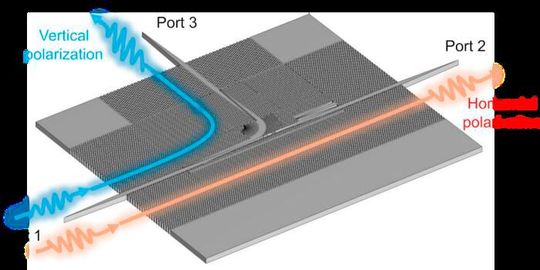
Operation schematic of the proposed all-silicon terahertz integrated polarization (de)multiplexer.
(Source: Dr Weijie Gao/ Osaka University)
The introduction of a new polarization multiplexer for terahertz communications by a team of scientists marks a significant advancement in the field of wireless technology. Terahertz communications, operating at frequencies much higher than those used in current networks, offer the potential for dramatically higher data transmission rates. This technological leap can lead to a substantial increase in bandwidth availability, which is critical for supporting the rapid growth of data-heavy applications and connectivity demands in areas such as streaming services, Internet of Things (IoT), and virtual reality (VR). One of the primary challenges in harnessing terahertz frequencies has been the efficient management and utilization of the spectrum. The polarization multiplexer addresses this challenge by allowing multiple data streams to be transmitted simultaneously over the same frequency, but with different polarization states. This multiplexing technique effectively doubles the data capacity of a transmission channel without requiring additional spectrum. This breakthrough could significantly accelerate the development and deployment of 6G networks, providing the infrastructure necessary for the next generation of digital services and connectivity. By increasing the efficiency of data transmission at terahertz frequencies, this innovation not only paves the way for ultra-fast wireless communications but also ensures more reliable and higher-quality connections that could transform various sectors including telecommunications, healthcare, and transportation.
The team has developed the first ultra-wideband integrated terahertz polarization (de)multiplexer implemented on a substrateless silicon base which they have successfully tested in the sub-terahertz J-band (220-330 GHz) for 6G communications and beyond.
The University of Adelaide’s Professor Withawat Withayachumnankul from the School of Electrical and Mechanical Engineering led the team which also includes former PhD student at the University of Adelaide, Dr Weijie Gao, who is now a postdoctoral researcher working alongside Professor Masayuki Fujita at Osaka University.
“Our proposed polarization multiplexer will allow multiple data streams to be transmitted simultaneously over the same frequency band, effectively doubling the data capacity,” said Professor Withayachumnankul. “This large relative bandwidth is a record for any integrated multiplexers found in any frequency range. If it were to be scaled to the center frequency of the optical communications bands, such a bandwidth could cover all the optical communications bands.”
A multiplexer makes it possible for several input signals to share one device or resource — such as the data of several phone calls being carried on a single wire.
The new device that the team has developed can double the communication capacity under the same bandwidth with lower data loss than existing devices. It is made using standard fabrication processes enabling cost-effective large-scale production.
This innovation not only enhances the efficiency of terahertz communication systems but also paves the way for more robust and reliable high-speed wireless networks.
Dr Weijie Gao, University of Adelaide,
According to Gao, the polarization multiplexer is a key enabler in realizing the full potential of terahertz communications, driving forward advancements in various fields such as high-definition video streaming, augmented reality, and next-generation mobile networks such as 6G. The groundbreaking challenges addressed in the team’s work, which they have published in the journal Laser & Photonic Reviews, significantly advance the practicality of photonics-enabled terahertz technologies.
“By overcoming key technical barriers, this innovation is poised to catalyze a surge of interest and research activity in the field,” said Professor Fujita who is a co-author of the paper. “We anticipate that within the next one to two years, researchers will begin to explore new applications and refine the technology.”
Over the following three-to-five years, the team expects to see significant advancements in high-speed communications, leading to commercial prototypes and early-stage products.
“Within a decade, we foresee widespread adoption and integration of these terahertz technologies across various industries, revolutionizing fields such as telecommunications, imaging, radar, and the internet of things,” said Professor Withayachumnankul.
Date: 08.12.2025
Naturally, we always handle your personal data responsibly. Any personal data we receive from you is processed in accordance with applicable data protection legislation. For detailed information please see our privacy policy.
Consent to the use of data for promotional purposes
I hereby consent to Vogel Communications Group GmbH & Co. KG, Max-Planck-Str. 7-9, 97082 Würzburg including any affiliated companies according to §§ 15 et seq. AktG (hereafter: Vogel Communications Group) using my e-mail address to send editorial newsletters. A list of all affiliated companies can be found here
Newsletter content may include all products and services of any companies mentioned above, including for example specialist journals and books, events and fairs as well as event-related products and services, print and digital media offers and services such as additional (editorial) newsletters, raffles, lead campaigns, market research both online and offline, specialist webportals and e-learning offers. In case my personal telephone number has also been collected, it may be used for offers of aforementioned products, for services of the companies mentioned above, and market research purposes.
Additionally, my consent also includes the processing of my email address and telephone number for data matching for marketing purposes with select advertising partners such as LinkedIn, Google, and Meta. For this, Vogel Communications Group may transmit said data in hashed form to the advertising partners who then use said data to determine whether I am also a member of the mentioned advertising partner portals. Vogel Communications Group uses this feature for the purposes of re-targeting (up-selling, cross-selling, and customer loyalty), generating so-called look-alike audiences for acquisition of new customers, and as basis for exclusion for on-going advertising campaigns. Further information can be found in section “data matching for marketing purposes”.
In case I access protected data on Internet portals of Vogel Communications Group including any affiliated companies according to §§ 15 et seq. AktG, I need to provide further data in order to register for the access to such content. In return for this free access to editorial content, my data may be used in accordance with this consent for the purposes stated here. This does not apply to data matching for marketing purposes.
Right of revocation
I understand that I can revoke my consent at will. My revocation does not change the lawfulness of data processing that was conducted based on my consent leading up to my revocation. One option to declare my revocation is to use the contact form found at https://contact.vogel.de. In case I no longer wish to receive certain newsletters, I have subscribed to, I can also click on the unsubscribe link included at the end of a newsletter. Further information regarding my right of revocation and the implementation of it as well as the consequences of my revocation can be found in the data protection declaration, section editorial newsletter.
This latest polarization multiplexer can be seamlessly integrated with the team’s earlier beamforming devices on the same platform to achieve advanced communications functions.
This article first appeared on our sister website www.lab-worldwide.com



:quality(80)/p7i.vogel.de/wcms/4b/7f/4b7feb398114331dff3d8b6c5e8dc06a/0133877511v1.jpeg "Brandt GmbH designs, manufactures, and services molds and tools for plastic injection molding, metal die casting, and the processing of LSR (liquid silicone rubber). (Image:Brandt)")
:quality(80)/p7i.vogel.de/wcms/db/23/db2332f08461bb166442018b9644b613/0133890143v1.jpeg "The International Monetary Fund (IMF) has revised some of its earlier forecasts for global economic growth upward. Germany, for example, is expected to grow more strongly in 2026 than previously thought. But the IMF has also taken a look at how things are shaping up in the rest of the world... (Image: AI-generated)")
:quality(80)/p7i.vogel.de/wcms/3b/53/3b53eec6903a838b98425d19f21d25ee/0132416085v1.jpeg "Complex progressive dies serve as the basis for stamped and formed parts—such as the copper outer conductors for sensor elements shown here. They are equipped with bending and embossing dies manufactured on the Kern Micro HD. (Image:Quittenbaum, LLC)")
:quality(80)/p7i.vogel.de/wcms/14/43/1443db59695f7eed2a338d16d03a6257/26-09-30-st-ber-ab-hunger-games-bild-1v1.jpeg "For “The Hunger Games: On Stage,” drive systems lift and move grandstand sections with a dynamic load of up to 26 metric tons—each section can accommodate up to 112 spectators. (Source: Troubadour at the Canary Wharf Theatre)")
:quality(80)/p7i.vogel.de/wcms/b7/95/b795d5fb82459f8a526e880f0698dffa/1-maxon-mind-covershot-landscapev1.jpeg "Claude Jaquemet demonstrates the Maxon Mind demo system. (Source: Maxon)")
:quality(80)/p7i.vogel.de/wcms/be/66/be661616d5250d4c3814a25688f3904b/0133917202v1.jpeg "Neuron AI combines 3D vision, touch, hearing, proprioception, and language—along with memory—into a Perception-Language-Action (PLA) model. Robots can grasp objects they cannot see. (Image:Neura)")
:quality(80)/p7i.vogel.de/wcms/c7/12/c712b688dba2262fa3906e3a4c1d2f7d/humanoide-robotikv1.jpeg "“Find a job that the humanoid can actually do, and understand your processes”—that’s the advice robotics expert Sebastian Prinz gives companies so they can benefit from the technology in the long term. (Source: Fraunhofer IEM / Janosch Gruschczyk)")
:quality(80)/p7i.vogel.de/wcms/05/bc/05bcc7390d30da9c23a829f7e96247e3/koch-glserdepalettierung-nahrungsmittelv1.jpeg "Opportunities for automation using robots can be found in all areas of manufacturing, such as in the palletizing of products. (Image:Koch Industrial Systems, LLC)")
:quality(80)/p7i.vogel.de/wcms/96/89/9689197f666e4aa9bc4a1f395c25d3ef/0133739635v1.jpeg "The 2026 Nobel Prize in Medicine laureates: Karl Deisseroth, Peter Hegemann, and Georg Nagel. (Image:Nobel Prize Outreach)")
:quality(80)/p7i.vogel.de/wcms/8a/c8/8ac8eb7fc2b70f4b72771548e2e2e520/epfl-motor-3v1.jpeg "FiberMotor has a diameter of 1 to 3 mm and consists of two concentric hollow fibers. Each fiber is wrapped in tightly insulated copper wire electrodes that are only slightly thicker than a human hair. (Source: EPFL)")
:quality(80)/p7i.vogel.de/wcms/a7/8a/a78a582a42a96aaaff38bd6b8f97a015/vishal-lal-mit-kernuhrv1.jpeg "It's ticking: Researchers have stabilized the first atomic clock. (Source: PTB)")
:quality(80)/p7i.vogel.de/wcms/36/f9/36f96a206fc408c9a632ce849de1f7fa/newsimage428299v1.jpeg "Polystyrene is used in protective packaging for televisions and electronic devices, in decorative moldings and baseboards for interior home construction, and even in Petri dishes. (Source: Hereon/Marcel Schwickerath)")
:quality(80)/p7i.vogel.de/wcms/c0/30/c030f79acad01285bcf98d3e634708e1/0133914206v1.jpeg "The Li 6 combines a platform developed specifically for electric vehicles with 800-V architecture and 5C fast-charging technology. The suspension and handling have been adapted to European roads and driving habits. (Image:LI Auto)")
:quality(80)/p7i.vogel.de/wcms/23/fa/23fa8e88a49a99e13e819c188c8a22de/0133950806v1.jpeg "In Shenyang, China, BMW has begun mass production of its Gen6 high-voltage batteries for the New Class. (Image:BMW)")
:quality(80)/p7i.vogel.de/wcms/64/bf/64bf3942deb5fa1fd3488d9f61bad2e9/0133911824v1.jpeg "The return of the \"Duck\" was certainly one of the most exciting topics at the 2026 Paris Motor Show. (Image:sp-x)")
:quality(80)/p7i.vogel.de/wcms/0e/0f/0e0fbf3c457f4b983ff9c2cc20de513c/708953-ef6f61c0616f461c9a42f6a0f403a3f8-c8ba35-original-1791536261v1.jpeg "In early October, Xpeng announced the successful production trial of its G9L model at Magna in Graz. (Image:Xpeng)")
:quality(80)/p7i.vogel.de/wcms/8a/d1/8ad1fd2d80399dd663a55b44b0953707/0133918510v1.jpeg "Multiple wireless standards on a single platform: Qualcomm's Dragonwing FWA Gen 6 Elite combines 5G Advanced, satellite communications, and Wi-Fi 8 with on-device AI processing for wireless broadband connectivity. (Image:Qualcomm)")
:quality(80)/p7i.vogel.de/wcms/8c/27/8c27323a09724f906aacf549d7cdaf3a/0133923995v1.jpeg "Keysight is working with research institutes to simplify the testing of next-generation semiconductor devices. (Image:Keysight)")
:quality(80)/p7i.vogel.de/wcms/78/92/7892504a95318acd1cd009ce614a33ab/0133939086v1.jpeg "Vishay's nine optical sensors combine an infrared emitter with a PIN photodiode. They enable bidirectional data transmission at speeds of up to 6 Mbit/s, for example in battery management systems for electric vehicles. (Image: Vishay)")
:quality(80)/p7i.vogel.de/wcms/50/81/50811ef8ab18d0626aa6d86dac2c46b4/0133922867v1.jpeg "Encapsulation materials are becoming increasingly important in electronics manufacturing. Particularly in highly integrated chip packages, the requirements for reliability, thermomechanical stability, and processability are rising. (Image:Sumitomo Bakelite)")
:fill(fff,0)/images.vogel.de/vogelonline/companyimg/76800/76895/65.jpg "FAULHABER_120mm.jpg ()")
:quality(80)/p7i.vogel.de/wcms/08/ef/08efd9707cae69418f38d5a0a3806657/0128777205v2v1.jpeg "Anritsu and the Finnish research center VTT have achieved a significant breakthrough and validated a complete wireless system in the D-band under realistic conditions for the first time. (Image:Image: Anritsu)")
:quality(80)/p7i.vogel.de/wcms/8a/d1/8ad1fd2d80399dd663a55b44b0953707/0133918510v1.jpeg "Multiple wireless standards on a single platform: Qualcomm's Dragonwing FWA Gen 6 Elite combines 5G Advanced, satellite communications, and Wi-Fi 8 with on-device AI processing for wireless broadband connectivity. (Image:Qualcomm)")