Time Synchronization in Measurement TechnologyFrom NTP to PTP and the Growing Role of Time-Based Measurements
A guest post by
Peter Plazotta* | Translated by AI
8 min Reading Time
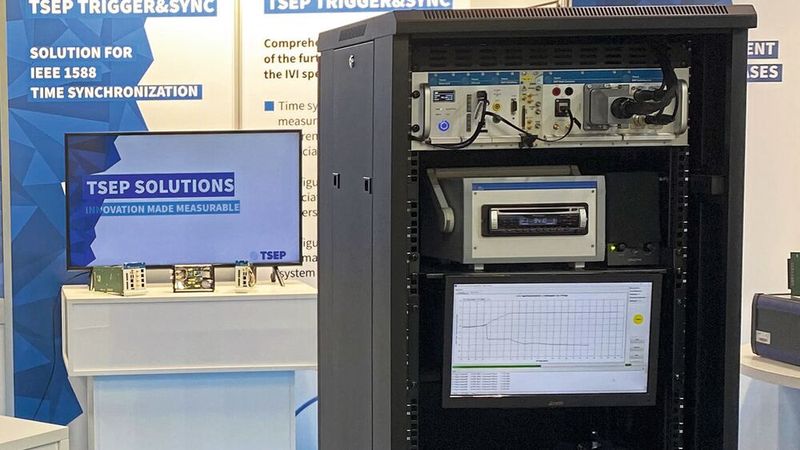
Classic, star-shaped measurement systems reach their temporal limits with distributed topologies. Protocols like IEEE 1588 or "White Rabbit" allow distributed measurement data to be synchronized down to the picosecond range today. A precision that is essential for building digital twins and training AI models.
Time synchronization in measurement technology: Protocols like IEEE 1588 or "White Rabbit" allow distributed measurement data to be synchronized down to the picosecond range today.
(Image: TSEP)
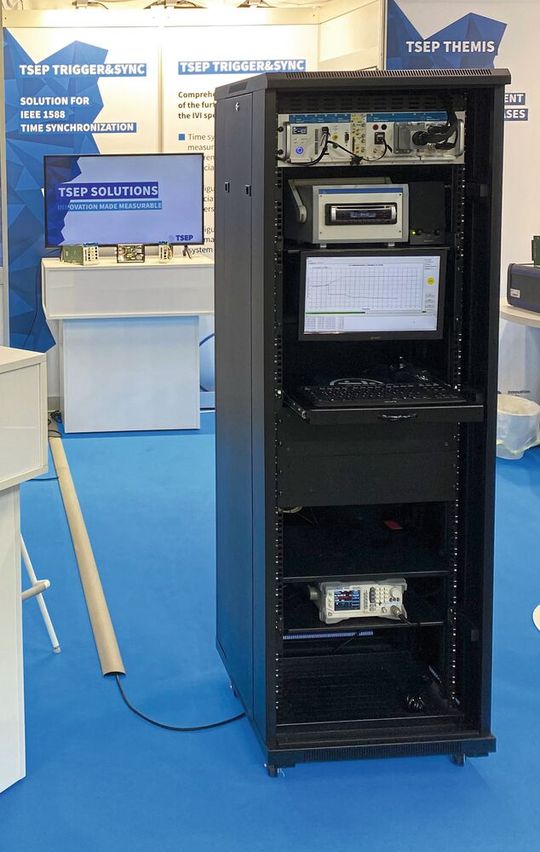
Classical test and measurement systems were typically centralized and star-shaped in the past. A central control computer directed the measurement process, managed the measuring instruments as well as the test object (Device Under Test, DUT), and executed the individual test steps. A real temporal connection between the spatially distributed measurement points was rarely present in these architectures. To sequence individual test steps, simple trigger lines were used, which, however, did not have to meet strict time-related requirements (Figure 1).
This fundamental structure proved itself over decades. However, as early as 1990, the T&M industry recognized the growing need for decentralized systems with precise temporal references. While GPS-based systems offering high accuracy were already available at that time, they were simply too expensive for widespread T&M applications. The goal was therefore to achieve the required time synchronization using the existing network infrastructure.
From the NTP Standard to the Precision Time Protocol (IEEE 1588)
Image 1: A classic centralized measurement setup.
(Image: TSEP)
The initial spark occurred in the early 1990s when Hewlett-Packard formed a working group led by John C. Eidson. The goal was to develop a concept for significantly improving the previously used Network Time Protocol (NTP). The results, published in 2000, generated such great interest in the measurement technology industry that it was quickly decided to establish a dedicated IEEE standard for this new type of hardware-based time synchronization.
In 2002, the Precision Time Protocol (PTP) was finally adopted as IEEE 1588-2002. For the first time, this standard enabled synchronization accuracies in the sub-microsecond range over standard networks. As technical requirements rapidly increased, the protocol was extensively updated in 2008 (IEEE 1588-2008). The most recent revision, IEEE 1588-2019 (PTP v2.1), introduced significant improvements for modern industrial and measurement networks:
Significant increase in time synchronization and accuracy.
Scalability: From localized subsystems to distributed large-scale facilities.
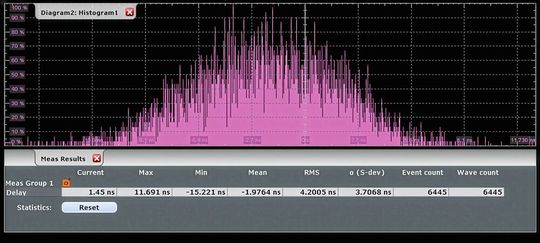
With the implementation of the IEEE-1588-2019 standard, the foundation was laid to reliably determine the exact timing of a measurement in distributed systems. In a standard Ethernet network, PTP enables typical accuracies of ±20 nanoseconds. Modern, hardware-optimized systems even achieve performance in the single-digit nanosecond range (Image 2).
Initial Use Cases: From Power Plants to Particle Accelerators
The first practical use cases for this highly precise time synchronization were found in large industries, such as nuclear power plants. Here, all decentrally collected measurement data was tagged with PTP timestamps, centrally stored in a database, and then correlated and analyzed offline based on their timestamps.
Even more extreme synchronization requirements were posed by CERN for the Large Hadron Collider (LHC). The accelerator ring has a circumference of nearly 27 kilometers (approx. 16.8 miles). Considering physical limits, a signal needs up to 135 µs for this distance with an idealized signal propagation time of 5 ns per meter of cable. The measurement errors resulting from spatial latencies via standard PTP were unacceptable for particle physics.
White Rabbit: PTP in the Picosecond Range
To overcome this physical limit, CERN independently extended the IEEE 1588 standard. The results were published as the so-called White Rabbit standard under the CERN Open Hardware License. Today, White Rabbit is not only used in the control of the LHC but also in other large-scale scientific projects such as the KM3NeT neutrino telescope in the Mediterranean or the FAIR particle accelerator at the GSI Helmholtz Center for Heavy Ion Research in Darmstadt. The key advantage: the synchronization accuracy of the White Rabbit implementation is in the range of ±200 picoseconds. This makes the system approximately 100 times more accurate than the classical IEEE 1588 protocol over standard Ethernet.
Where Nanoseconds are Crucial
The establishment of the PTP standard has created entirely new possibilities for testing and measurement technology today. Fundamentally, four central scenarios can be identified that rely on highly precise, time-based measurement data acquisition:
Date: 08.12.2025
Naturally, we always handle your personal data responsibly. Any personal data we receive from you is processed in accordance with applicable data protection legislation. For detailed information please see our privacy policy.
Consent to the use of data for promotional purposes
I hereby consent to Vogel Communications Group GmbH & Co. KG, Max-Planck-Str. 7-9, 97082 Würzburg including any affiliated companies according to §§ 15 et seq. AktG (hereafter: Vogel Communications Group) using my e-mail address to send editorial newsletters. A list of all affiliated companies can be found here
Newsletter content may include all products and services of any companies mentioned above, including for example specialist journals and books, events and fairs as well as event-related products and services, print and digital media offers and services such as additional (editorial) newsletters, raffles, lead campaigns, market research both online and offline, specialist webportals and e-learning offers. In case my personal telephone number has also been collected, it may be used for offers of aforementioned products, for services of the companies mentioned above, and market research purposes.
Additionally, my consent also includes the processing of my email address and telephone number for data matching for marketing purposes with select advertising partners such as LinkedIn, Google, and Meta. For this, Vogel Communications Group may transmit said data in hashed form to the advertising partners who then use said data to determine whether I am also a member of the mentioned advertising partner portals. Vogel Communications Group uses this feature for the purposes of re-targeting (up-selling, cross-selling, and customer loyalty), generating so-called look-alike audiences for acquisition of new customers, and as basis for exclusion for on-going advertising campaigns. Further information can be found in section “data matching for marketing purposes”.
In case I access protected data on Internet portals of Vogel Communications Group including any affiliated companies according to §§ 15 et seq. AktG, I need to provide further data in order to register for the access to such content. In return for this free access to editorial content, my data may be used in accordance with this consent for the purposes stated here. This does not apply to data matching for marketing purposes.
Right of revocation
I understand that I can revoke my consent at will. My revocation does not change the lawfulness of data processing that was conducted based on my consent leading up to my revocation. One option to declare my revocation is to use the contact form found at https://contact.vogel.de. In case I no longer wish to receive certain newsletters, I have subscribed to, I can also click on the unsubscribe link included at the end of a newsletter. Further information regarding my right of revocation and the implementation of it as well as the consequences of my revocation can be found in the data protection declaration, section editorial newsletter.
Generation of data for digital twins and hardware-in-the-loop simulations (HiL),
Database for training AI models,
Distributed measurements over large spatial distances and
Time-synchronous triggering of actuators and test sequences.
A particularly significant role in modern T&M systems is played by the Digital Twin. This concept, coined in the early 2000s by Michael Grieves and John Vickers, describes the virtual representation of a real process. The key to a functioning Digital Twin is the data and information connection between the physical and virtual worlds.
In measurement technology, this means: The real collected data must be tagged with extremely precise timestamps (correlated) to make it usable. Only when the temporal causality of all sensor signals is absolutely deterministically recorded does the subsequent simulation model behave exactly like its physical counterpart.
Practical Example: Engine Test Benches and Welding Robots
A classic application can be found in modern engine test benches in the automotive sector. Here, thousands of measurements from various sensors (pressure, temperature, torque, or CAN bus signals) are recorded per second. If all these distributed measurements are provided with a synchronous timestamp via PTP, a highly precise, behavior-accurate simulation model (the Digital Twin of the engine) can be generated. Based on this model, developers can drastically reduce the number of time- and cost-intensive tests on the real test bench and instead conduct virtual tests at their desks.
Another concrete example is the optimization of welding processes in automotive production, as realized in collaboration with research institutions. Distributed measurement systems simultaneously record parameters such as voltage, current, electrode distance, wire feed, and temperature during welding. The correlated temporal analysis of this raw data precisely reveals how, for example, a minimal voltage drop with a delay of fractions of a second impacts the welding temperature.
From Simulation to AI Model
If the principle of the deterministic digital twin is consistently pursued, it inevitably leads to the use of artificial intelligence. Machine learning algorithms and AI models require clean, time-correlated datasets for their training. These are the so-called ground truth data.
The welding example mentioned above illustrates this potential: By feeding a AI model with timestamped process data from hundreds of thousands of real welding processes, including their qualitative evaluation, the AI learns the perfect process parameters. These trained models can then be directly applied to the controllers of industrial robots to monitor the welding process in the production line in real time, adaptively regulate it, and thus maximize quality.
The Software is Meant to Master Complexity
As the use cases show, the configuration effort for time-based, distributed measurement systems is significantly higher than for classic, centralized architectures. To operate these systems efficiently, a high level of automation at the software level is essential.
The first hurdle for the test engineer already lies in the fundamental topology: When using a time-based system, the hierarchy of clock distribution must be defined. Who functions as the "Grandmaster Clock"? How is the time signal physically and logically distributed through switches and routers to the "Slave Clocks" of the individual measurement nodes?
Additionally, PTP systems exhibit a physical peculiarity: they require a certain settling time after startup. The software must therefore ensure that all internal clocks are fully synchronized before the actual measurement sequence begins. During operation, it is also essential to ensure that all recorded data is seamlessly correlated with the corresponding timestamps and stored without errors.
Continuous Monitoring of Clock Quality
Image 3: Quality control in time-based measurements. The user interface of the TSEP Herakles.Testbench not only enables configuration but also visualizes the stability and quality of the ongoing clock synchronization.
(Image: TSEP)
To generate reliable simulation or AI data, the quality of synchronization must never be blindly assumed. Modern measurement software must continuously monitor and evaluate the quality of time synchronization (sync status, offset, jitter) in the background (Figure 3). This is the only way to ensure that temporary network overloads or synchronization losses do not unnoticedly distort the measurement data. In case of an error, the system must stop the measurement or mark the corresponding data packets as invalid.
Visual Support for the Test Engineer
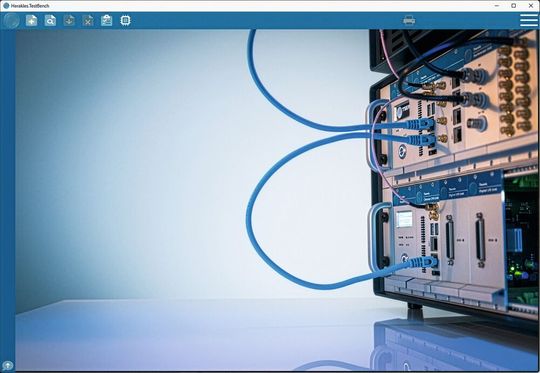
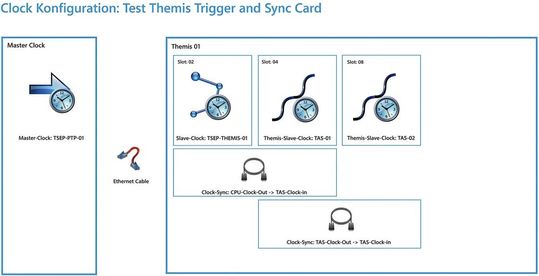
Image 4: Through the GUI of the TSEP Herakles.Testbench, parameters, measurements, and the hierarchy of time synchronization can be centrally defined before the software automatically configures the subcomponents.
(Image: TSEP)
It is obvious that test engineers must be relieved of handling these profound network and time parameters through software support. Instead of cryptic command lines or complex configuration files, a graphical visualization (GUI) of the entire system topology is indispensable today.
A modern T&M software interface (as shown in Figure 4) enables the user to intuitively define the distribution of clocks, the topology of network nodes, as well as the physical measurement variables and their parameters in one place. In the background, the software handles the heavy lifting: it automatically configures the corresponding components, loads the required calibration data, aligns the parameters, and monitors the settling phase of the clocks. Only when the system confirms the lock status of all clocks does the software give the green light for precise data acquisition.
Latencies and Calibration as Pitfalls of Physics
Even if the network is synchronized to the picosecond range via PTP or White Rabbit, another challenge awaits at the hardware level: analog physics. In time-based measurements, signal propagation times in cables and the internal processing times of sensors (until a measurement value is ready at the output) play a crucial role.
Here too, the test engineer relies on the support of the system software. The signal delay of the sensors can often be obtained from manufacturer datasheets or determined empirically and stored as a fixed offset in the system. It becomes more complex with the wiring: if sensors or external measurement devices are connected via long cables (e.g., coaxial or trigger cables), the exact propagation times of the electrical signals must be determined.
Modern systems largely automate this step. For precise determination of cable propagation times, D-DMTD algorithms (Digital Dual Mixer Time Difference) are used, for example, which detect phase shifts in the sub-nanosecond range. These measured propagation times, combined with the internal latencies of the measurement cards (which must be provided by the system manufacturer), are then automatically calculated by the software as correction factors into the timestamps of the measurement data.
A Conclusion
Time-based test and measurement systems open the door to entirely new application fields. They form the fundamental backbone for creating highly precise digital twins, hardware-related simulations (HiL), and generating reliable data for training AI models.
Although the underlying network architecture and synchronization (via IEEE 1588 or White Rabbit) are technologically far more complex than in traditional centralized measurement setups, modern software frameworks make the handling just as comfortable for the test engineer today. These frameworks graphically visualize and largely automate complex tasks such as clock distribution, network monitoring, and latency calibration.
Currently, the T&M market is still heavily dominated by classic architectures. However, as the industry increasingly demands deterministic, distributed data for AI and simulation purposes, the seamless integration of time-based measurement functions will become a decisive criterion in the selection of future-proof test and measurement systems.
*Peter Plazotta is the CEO and founder of Technical Software Engineering Plazo



:quality(80)/p7i.vogel.de/wcms/17/b8/17b8af0cb725e0e1d3e8d72458bab260/siemens-meet-at-the-machinev1.jpeg "“Meet at the Machine” is Siemens’ new initiative, which aims to bring together machine builders, software, and automation technologies to accelerate innovation in the machine tool industry and help manufacturers become productive more quickly. (Source: Siemens)")
:quality(80)/p7i.vogel.de/wcms/8e/7e/8e7e0cda4c68699bcc48283a38739769/0133316747v1.jpeg "A little-known hidden champion! When people think of laser cutting, the first thing that comes to mind is the power of the laser beam—and it is impressive to see the sparks flying. But Air Liquide—an exhibitor at Euroblech, by the way—wants to make it clear that the process gas is also key to success. (Image:AI-generated)")
:quality(80)/p7i.vogel.de/wcms/20/fa/20fa35e0af203c3464f7e7fdbb57a685/0133281172v1.jpeg "Since 2003, Etzinger AG has been developing and manufacturing high-quality coffee grinders, pepper mills, and grinding mechanisms for professional and home use. (Image:Etzinger)")
:quality(80)/p7i.vogel.de/wcms/69/91/6991413943488b4a2f6fde9dcd88c5b0/0133256686v1.jpeg "The CMA-patented pendulum mount can compensate for radial tolerances of up to one millimeter. (Image:Schwiening)")
:quality(80)/p7i.vogel.de/wcms/38/79/38799bfbbccd938b64c67068cfa68780/0133329362v1.jpeg "What exactly enables machines to act on their own? (Image:Shutterstock)")
:quality(80)/p7i.vogel.de/wcms/1b/9f/1b9fc9f113fc66212e2c0e17a3edaf9f/org-blobs-user-response-file-output-f317796f-57b7-483f-9403-5d9ac8a816f5-plugin-output-call-kdigtepb7be7us8xvbota0mh-1672x940v1.png "According to Barclays data, Europe leads the global trade in actuator components. With a 34 percent share, the region ranks ahead of China, which has a 26.3 percent share. (Source: Statista | CC BY-ND 4.0, AI-generated)")
:quality(80)/p7i.vogel.de/wcms/f5/4c/f54c9fc59ccb0604ab9219188469a45f/image1v1.jpeg "Christopher Savoia, Global Head of the UR+ Ecosystem at Universal Robots, presents the new SP7 Smart Panel on a UR17g-1300 robot during the unveiling of Gen 7—UR’s 7th-generation robot platform—at IMTS in Chicago on September 14, 2026. (Image:Image: Teradyne Robotics)")
:quality(80)/p7i.vogel.de/wcms/bd/4e/bd4ef09ab0f84932ea76ca0330ffe789/0133329802v1.jpeg "The robotics boom and its consequences: According to a study, a significant portion of value creation occurs in the electronics industry. (Image:Fraunhofer IPA)")
:quality(80)/p7i.vogel.de/wcms/87/87/87870cf2b30aaef7b8a06212a4ef2c14/0133403885v1.jpeg "A digital twin and a real component demonstrate how closely simulation and manufacturing are converging. Stampack Xpress 2026.1 virtually models forming behavior and supports the validation of process and tool design. (Image:Stampack)")
:quality(80)/p7i.vogel.de/wcms/59/2a/592a7f2d0964e9e6846cae331f5daa3a/0133266065v1.jpeg "Perforated metal sheets are particularly well-suited for balcony railings, as they combine stability, privacy, and design versatility. (Image:Ripo Factory)")
:quality(80)/p7i.vogel.de/wcms/45/64/45642ff0fe0a6bec251b77739131d83b/abb-ferrari-hypersail-16-9-three-quarter-front-viewv1.jpeg "The Ferrari Hypersail is a 100-foot monohull wing-in-plane yacht powered entirely by renewable energy. (Source: ABB / Ferrari Hypersail)")
:quality(80)/p7i.vogel.de/wcms/3e/0e/3e0e3ea22e48410ceada53b02ffccb59/0133358454v1.jpeg "BYD top executive Stella Li plans to offer megawatt flash charging for commercial vehicles as well. (Image:VDA/IAA Transportation 2026)")
:quality(80)/p7i.vogel.de/wcms/e2/7d/e27de60472809cc58ac0d321066c9679/l1051833v1.jpeg "Geely has acquired a stake of just over 26 percent in Renault do Brasil. Geely models for the South American market are now also being produced at the Ayrton Senna plant in São José dos Pinhais. (Image:Renault)")
:quality(80)/p7i.vogel.de/wcms/1e/c1/1ec1495eb283200f4b7cb55de0c4dff7/20260917-110436643v1.jpeg "Ceremonial launch of Mercedes-Benz GLA production in Rastatt; among those in attendance was plant manager Marco Zwick (second from the right). (Source: Thomas Günnel – Automotive Industry)")
:quality(80)/p7i.vogel.de/wcms/76/f3/76f310eed0caebc79ff91195c29de08d/visual-siwa-treatment-optimizerv1.jpeg "A Mireo train from Siemens Mobility was used in the “Automated Train” project for a fully automated delivery and return trip on the open rail network. (Source: Siemens Mobility)")
:quality(80)/p7i.vogel.de/wcms/4c/53/4c534208d09a9b1ce597938715e7fc19/0133288763v1.jpeg "Logic Folding: In its latest Kirin 9050 Pro, Huawei uses hybrid bonding to distribute the computing units across two silicon layers in order to increase the effective transistor density without resorting to finer manufacturing processes. (Image:Huawei)")
:quality(80)/p7i.vogel.de/wcms/56/d1/56d131e0b5bd05ef47411e92ad740cb4/0133351029v1.jpeg "Researchers at DTU have developed a nanolaser in a semiconductor membrane. The structure concentrates charge carriers and the light field into a small area (shaded in blue). If data is transmitted on microchips using light instead of electrical signals, transmission speeds can be increased and energy losses reduced. (Image:Yi Yu, DTU)")
:quality(80)/p7i.vogel.de/wcms/5e/55/5e55101ddc6338f755fcf3244db1367f/0133331863v1.jpeg "For data center projects, it is becoming increasingly important to also obtain the consent of the affected community. (Image:Dall-E / AI-generated)")
:quality(80)/p7i.vogel.de/wcms/8d/f9/8df95d3f58408673986b3d643e6b63ba/0133252773v1.jpeg "TXC targets high-speed optical links in AI data centers with 312.5 MHz oscillators, among other solutions. As data rates increase, requirements for jitter and frequency stability become more demanding as well. (Bild: TXC)")
:quality(80)/p7i.vogel.de/wcms/2d/46/2d4652baa2a877fe8732f4446f35b406/0127093746v1.jpeg "MEMS oscillators: As a quartz-free alternative, MEMS oscillators offer several advantages that make them ideal for future miniaturized applications. (Image:SiTime)")
:quality(80)/p7i.vogel.de/wcms/dd/cf/ddcf3cc7aee9449d8122ac7c9d19a268/0131288690v1.jpeg "0131288690v1 (Image:KiCad)")