The Fraunhofer Institute for Laser Technology ILT in Aachen (Germany) is breaking new ground: instead of milling forming tools from solid material, it applies wear-resistant functional layers close to the final contour onto inexpensive construction steel using extreme high-speed laser cladding (EHLA).
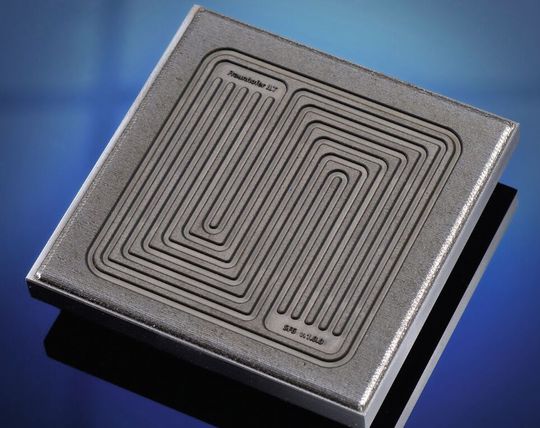
Demonstrator for EHLA technology: 3D printing and a final processing by conventional milling characterize this tool, allowing bipolar plates to be economically, quickly, and sustainably manufactured in the future at short intervals.
(Image: Fraunhofer ILT)
The mass production of bipolar plates for fuel cells occurs in seconds. To protect the forming tools used from wear, they are milled from high-quality metal alloys. In the National Action Plan for Fuel Cell Production (H2GO), the Fraunhofer Institute for Laser Technology ILT in Aachen is taking new approaches: Instead of milling the tools from solid material, it uses extreme high-speed laser material deposition (EHLA) to apply wear-resistant functional layers near the final contour on cost-effective structural steel. This significantly reduces the costs, construction time, and wear of the tools. Additionally, the EHLA process can be used to repair damaged and worn tools, thus making a substantial contribution to the circular economy.
"We are pursuing a completely new approach," reports Dora Maischner, project manager at Fraunhofer ILT. "Previously, forming tools for bipolar plates were milled from high-quality tool steel in lengthy processes. We apply a wear-resistant functional layer near the final contour on a cost-effective material." The researcher is working on a subproject of R2HP (Ready to Hydrogen Production), which is part of the large-scale research project H2GO – National Action Plan for Fuel Cell Production, involving 18 Fraunhofer Society institutes nationwide. In this project, Fraunhofer ILT is developing the new process for manufacturing bipolar half-plates, in collaboration with the nearby Fraunhofer Institute for Production Technology IPT and the Fraunhofer Institute for Machine Tools and Forming Technology IWU in Chemnitz (Germany). The aim is to increase the service life of the highly stressed and precisely structured forming tools, while simultaneously reducing their costs and construction times—and furthermore, to establish an efficient repair procedure for damaged or worn tools. The key to this is the Extreme High-Speed Laser Material Deposition (EHLA) developed at Fraunhofer ILT.
Revolutionary approach to tool production
Modern ELHA-3D systems achieve speeds of more than 30 meters per minute. Using digital process chains, wear-resistant functional layers can be quickly and efficiently applied using the additive process. Additionally, the three-dimensional material build-up can be controlled so precisely that the highly wear-resistant layer welded onto cost-effective structural steel comes very close to the intended final contour. Instead of milling from solid material in a lengthy, tool-intensive process as before, the forming tool only needs to be finished selectively. The new EHLA-based process chain thus also minimizes costs, as only a thin functional layer of high-quality material needs to be applied. At the same time, the near-final contour material application and the consequently minimized mechanical processing effort reduce the construction time and tool costs for milling heads that are heavily stressed by the high-strength material.
The unique aspect of the EHLA process is that the powder melts in the laser beam above the workpiece, depositing in liquid form on its surface. "In the EHLA process, the powder absorbs most of the laser energy before it hits the workpiece," explains Viktor Glushych, group leader for coating LMD and heat treatment at Fraunhofer ILT. The patented process significantly accelerates the deposition process compared to conventional laser cladding processes, minimizes thermal stress on the components, and moreover creates more homogeneous microstructures in the metal layers. This, in turn, has a positive effect on wear resistance.
Wear resistance increased
In the ongoing research project, high-speed steel 1.3343 and the martensitic stainless steel alloy Ferro55 are used as coating materials, distinguished by their high hardness and wear resistance. Maischner notes, "1.3343 achieves a hardness of about 830 HV0.5 and Ferro55 about 820 HV0.5, putting them in the range of the usual tool steel 1.2379, which is used both hardened and unhardened." The wear protection can be applied with a coating speed of 30 meters per minute. A layer thickness of approximately 1.2 millimeters is achieved per layer. Through multilayer application, the required layer thickness, one millimeter in the current task, can be adjusted. The digital control ensures a precise and selective material build-up, allowing for the production of robust wear protection layers. According to the team's findings, the structure of these layers is more important for wear protection than the hardness of the material. "The wear resistance largely depends on the material's microstructure," says Glushych. "EHLA creates extremely fine-grained microstructures, which improve the mechanical properties and significantly reduce abrasion. The fine-grained structure gives the layers high resistance to wear, even under heavy loads."
The moment of truth comes in the sliding wear test
To precisely assess wear resistance, the ILT uses a sliding friction wear test from TU Clausthal, which simulates realistic wear scenarios for the application case. The apparatus presses a pin onto a counterplate under defined force and moves it back and forth. Subsequently, it is possible to measure very accurately how much material is worn away. The current results indicate significant advantages of the EHLA-coated test specimens compared to conventional materials.
Date: 08.12.2025
Naturally, we always handle your personal data responsibly. Any personal data we receive from you is processed in accordance with applicable data protection legislation. For detailed information please see our privacy policy.
Consent to the use of data for promotional purposes
I hereby consent to Vogel Communications Group GmbH & Co. KG, Max-Planck-Str. 7-9, 97082 Würzburg including any affiliated companies according to §§ 15 et seq. AktG (hereafter: Vogel Communications Group) using my e-mail address to send editorial newsletters. A list of all affiliated companies can be found here
Newsletter content may include all products and services of any companies mentioned above, including for example specialist journals and books, events and fairs as well as event-related products and services, print and digital media offers and services such as additional (editorial) newsletters, raffles, lead campaigns, market research both online and offline, specialist webportals and e-learning offers. In case my personal telephone number has also been collected, it may be used for offers of aforementioned products, for services of the companies mentioned above, and market research purposes.
Additionally, my consent also includes the processing of my email address and telephone number for data matching for marketing purposes with select advertising partners such as LinkedIn, Google, and Meta. For this, Vogel Communications Group may transmit said data in hashed form to the advertising partners who then use said data to determine whether I am also a member of the mentioned advertising partner portals. Vogel Communications Group uses this feature for the purposes of re-targeting (up-selling, cross-selling, and customer loyalty), generating so-called look-alike audiences for acquisition of new customers, and as basis for exclusion for on-going advertising campaigns. Further information can be found in section “data matching for marketing purposes”.
In case I access protected data on Internet portals of Vogel Communications Group including any affiliated companies according to §§ 15 et seq. AktG, I need to provide further data in order to register for the access to such content. In return for this free access to editorial content, my data may be used in accordance with this consent for the purposes stated here. This does not apply to data matching for marketing purposes.
Right of revocation
I understand that I can revoke my consent at will. My revocation does not change the lawfulness of data processing that was conducted based on my consent leading up to my revocation. One option to declare my revocation is to use the contact form found at https://contact.vogel.de. In case I no longer wish to receive certain newsletters, I have subscribed to, I can also click on the unsubscribe link included at the end of a newsletter. Further information regarding my right of revocation and the implementation of it as well as the consequences of my revocation can be found in the data protection declaration, section editorial newsletter.
To practically demonstrate the new EHLA-based process chain, the team set up a demonstrator where simple structural steel (St37) was coated near-final contour with high-speed steel 1.3343 using the EHLA process. For finishing, both conventional milling and structuring with ultrashort pulse lasers are used at ILT. Due to the high tool wear in mechanical finishing of high-hardness materials, the contactless laser process is of great industrial interest. "The project's aim is to prove that the entire process chain from coating to structuring the bipolar plates is already supported by close-to-production methods," explains Maischner. The researchers aim to test the durability and wear resistance of different forming tools by the end of this year on a test stand at Fraunhofer IPT. They focus on production-like forming processes, where a bipolar plate needs to be stamped per second—as required for efficient industrial production. "The method allows us to realistically test the service life of EHLA-coated tools," explains Maischner.
Re-use: tools with multiple lives
Another focus is on the efficient manufacturing and reuse of the tools. "We are already in contact with companies that manufacture tools for bipolar plates and have received very positive feedback," explains Glushych. The ability to build functional layers near the final contour with EHLA's typical process speeds, thereby significantly shortening the previously time-consuming machining with high removal volumes, generates interest. Additionally, the option to refurbish worn tools using the same EHLA process is met with positive feedback. Instead of having to melt down tools at the end of their service life, the defective or worn contours can be rebuilt using EHLA, according to the digitally stored blueprint, and then mechanically finished.
This new process chain can pave the way for repeated reuse; such cyclic processes are in demand because they prevent the downgrading of high-quality alloys and also eliminate the energy-intensive melting of worn-out tools and numerous transport routes. Once the tool wears down, users can refinish the layer on-site to a defined, digitally stored contour and re-coat it using EHLA. "This approach conserves resources and allows for long-term use of the tools," emphasizes the Fraunhofer researcher.
Coating reduces fine dust pollution
Successes in the passenger car sector may encourage further potential users to venture into this new form of tool construction. EHLA has proven to be an effective method for wear protection coating: with brake discs, the thin, firmly adhering EHLA protective layers significantly reduced abrasion. This advantage benefits not only car owners but also contributes to a significant reduction in fine dust. This know-how provides the ideal foundation to advance the mass production of ultra-thin bipolar plates for commercial vehicles.



:quality(80)/p7i.vogel.de/wcms/9d/2b/9d2b802f800e5caf17b2831e74228cd3/screenshot-202026-03-03-20103822-609x343v1v1.png "Visual comparison: on the left, a clean, burr-free cut edge; on the right, typical burr formation with oxidation discoloration. This illustrates how strongly parameter control and gas management influence the quality of the result. (CO₂ laser, oxygen cutting gas, sheet thickness approx. 15 mm). (Image:Picture: Rime)")
:quality(80)/p7i.vogel.de/wcms/dd/08/dd086510d9ae7b50181f6070e4463b44/0129363730v1.jpeg "Typical application for ionizing devices: Wrapping films. (Picture: ©Adobe Stock/SMC)")
:quality(80)/p7i.vogel.de/wcms/35/57/3557c819943c53acec41a0ccba87da4f/0130049064v1.jpeg "Researchers at the Fraunhofer IWU in Chemnitz have long known that many typical sheet metal parts can be manufactured more cost-effectively using hollow embossing rollers. Now there is news to report ... (Image:Fraunhofer IWU)")
:quality(80)/p7i.vogel.de/wcms/59/02/590246e3b3f415c65edbee377c14ca77/26-06-pi-fraunhofer-iws-41450-direktplattieren-pic-01-7771x4369v1v1.jpeg "The Fraunhofer IWS has developed the new \"direct laser cladding\" process, which creates a functional layer directly on the base body by applying a strip-shaped metal to rotationally symmetrical components in a spiral and bonding it locally by laser. (Image:Christoph Wilsnack/Fraunhofer IWS)")
:quality(80)/p7i.vogel.de/wcms/78/e9/78e9188c25a8a94e67c34c9bf8ffe495/visual-agile-20robots-20and-20google-20deepmind-20partner-20to-20bring-20intelligence-20to-20robotics-2500x1406v1v1.jpeg "Together, the partners are developing adaptable, intelligent robots for a wide range of applications (Image:Agile Robots SE)")
:quality(80)/p7i.vogel.de/wcms/e7/66/e7669ecf0260ae8fc54c214e34e4902a/0130316817v1.jpeg "Siemens and Palo Alto Networks offer tested cybersecurity solution for industrial 5G. (Image:Siemens)")
:quality(80)/p7i.vogel.de/wcms/9f/55/9f55324832c4f426958031375124d9de/siemens-20ubtech-20hmnd-1920x1079v1v1.png "Ready for the factory floor: While Ubtech is planning mass production, Siemens is already testing humanoids in real factory applications in Erlangen. (Image:Siemens)")
:quality(80)/p7i.vogel.de/wcms/11/36/113695ed260e29c8c2d9d39dc5f9d869/0130213768v1.jpeg "AI can work cheaply in China and deliver the results rapidly all over the world. (Image:Dall-E / AI-generated)")
:quality(80)/p7i.vogel.de/wcms/62/5f/625f41e87ebfef156a98c8e6393e32fd/0130211654v1.jpeg "Axial flux motors have some advantages over radial flux motor—but their production is currently still expensive. (Image:RWTH Aachen University)")
:quality(80)/p7i.vogel.de/wcms/77/9b/779b0685d010dfe45c9c2cb1cfecd467/0128886425v1.jpeg "The BlueEye is the first \"real\" hyperspectral camera for the UV range and covers the wavelength range from 220 to 380nm. (Image:Inno-spec GmbH)")
:quality(80)/p7i.vogel.de/wcms/e4/51/e451d52ce0182fb0aaa46a5774f832ef/26-04-pi-fraunhofer-iws-21160-bioslide-pic-01-4128x2321v1v1.jpeg "With the BioSlide research project, the Fraunhofer IWS is investigating how sliding systems can be designed to be more sustainable and energy-efficient. New materials can be tested in a particularly application-oriented manner on this plain bearing test stand. (Image:Fraunhofer IWS)")
![Thanks to advanced 3D printing technology, a more efficient use of resources should contribute to lower-emission aviation—this is the goal of ['skai]-lab. (Image:Oleksandr Pashchenko - stock.adobe.com / AI-generated)](https://cdn1.vogel.de/nghHNSbySccfOjG3n1qCA-FVOjQ=/288x162/smart/filters:format(jpg):quality(80)/p7i.vogel.de/wcms/62/64/626424c97a16e69f871bf216c9629c2a/adobestock-1927043193--c2-a9-20oleksandr-20pashchenko-20-e2-80-93-20stock-adobe-com-ki-generiertv1v1.jpeg "Thanks to advanced 3D printing technology, a more efficient use of resources should contribute to lower-emission aviation—this is the goal of ['skai]-lab. (Image:Oleksandr Pashchenko - stock.adobe.com / AI-generated)")
:quality(80)/p7i.vogel.de/wcms/b0/43/b043b86899837532aad62d63368a917a/0130371361v1.jpeg "Skoda leaves the chinese market.
(Image:Skoda)")
:quality(80)/p7i.vogel.de/wcms/c3/c4/c3c4ce270b083eeac55654148611f064/0130237945v1.jpeg "China is not giving up on hydrogen, but is intensifying its efforts. (Image:freely licensed from Pixabay)")
:quality(80)/p7i.vogel.de/wcms/4e/c0/4ec0bd19390b169edfa23677373dcdf1/0130260089v1.jpeg "Renewable fuels can supply European road traffic, according to a study. (Image:Aral)")
:quality(80)/p7i.vogel.de/wcms/6f/c9/6fc9050301d745cad25585c6780f8f51/0130197341v1.jpeg "Production facilities are a worthwhile target and are therefore at risk. (Image:ABB Robotics)")
:quality(80)/p7i.vogel.de/wcms/4d/dd/4dddf438e91f394c04a095dbfd109d1c/0130236430v1.jpeg "Measurement modules: The 720301 module in combination with the SL2000 enables RMS and power calculations, among other things. (Image:Yokogawa)")
:quality(80)/p7i.vogel.de/wcms/61/fc/61fcf95f5cca15494ad18343901ae585/0130317237v1.jpeg "With the AGI CPU, Arm says it is taking a \"historic step\": With the processor aimed at AI in data centers, the company is presenting itself for the first time as a provider of its own chips, not just as a pure IP licensor. (Image:Arm)")
:quality(80)/p7i.vogel.de/wcms/82/90/8290dfe3595b6c6b33726ae8b76172c7/0130319587v1.jpeg "The concept image illustrates how the pattern of tiny protrusions and depressions created on the substrate (MgO, bottom) controls the arrangement of atoms in the superconducting material (YBCO, top). At the interface between the two layers, an electronic structure enables superconductivity to occur at higher temperatures than previously possible. (Image:Chalmers University of Technology / Riccardo Arpaia)")
:fill(fff,0)/images.vogel.de/vogelonline/companyimg/76800/76895/65.jpg "FAULHABER_120mm.jpg ()")
:quality(80)/p7i.vogel.de/wcms/59/02/590246e3b3f415c65edbee377c14ca77/26-06-pi-fraunhofer-iws-41450-direktplattieren-pic-01-7771x4369v1v1.jpeg "The Fraunhofer IWS has developed the new \"direct laser cladding\" process, which creates a functional layer directly on the base body by applying a strip-shaped metal to rotationally symmetrical components in a spiral and bonding it locally by laser. (Image:Christoph Wilsnack/Fraunhofer IWS)")
:quality(80)/p7i.vogel.de/wcms/f6/a1/f6a1ab3f4221c2a1ba19b47076ce20f6/0128777874v1.jpeg "Aerospace is among the beneficiaries of the current advancements in metallic 3D printing. Small production quantities and the high complexity of lightweight, high-performance components are already strengths of additive manufacturing today. (Image:Fraunhofer ILT)")