For the efficient and precise processing of huge steel sheets in a challenging project environment, a leading US steel producer relies on a preservation line from Rösler.
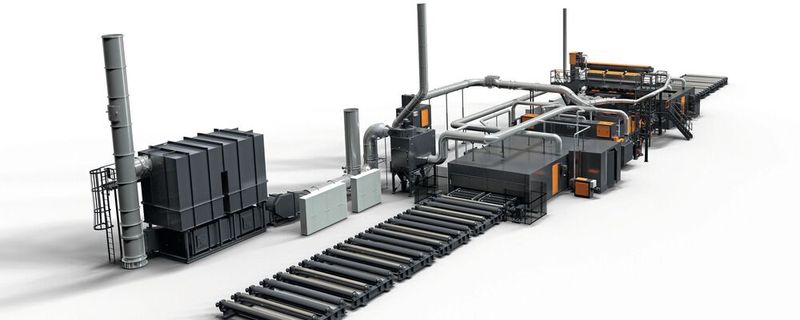
With its 75 meters in length and a production volume of 122,000 tons per year, the preservation line KON 47/3-HD is a powerhouse.
(Image: Rösler)
In the middle of a greenfield site in an industrial park in the USA, one of the largest steel producers in North America has erected a gigantic rolling mill for steel sheets.
This sets new standards in terms of the size of the rolled and processed sheets there and is one of the most powerful steel plants in the North American region. In addition to particularly thick and large-format, freshly rolled steel sheets, the company offers surface treatment of the rolled products as an additional service to its major customers in the oil and offshore industry, which is becoming increasingly important in the industry. This is specifically implemented with a preservation line of the type KON 47/3-HD in rolling mill design by Rösler Oberflächentechnik GmbH.
Gigantic Steel Sheets Require the Highest Precision and Maximum Power
With a length of around 75 meters (approx. 246 ft), an abrasive throughput of 3.7 tons per minute, and a production volume of 122,000 tons per year, the preservation line designed and manufactured by Rösler Oberflächentechnik GmbH for the American steel producer is a real powerhouse. It has to be, as the sheets processed here are of enormous dimensions. Depending on the rolling thickness of the slab, i.e., the raw steel block, they can be up to 4,300 millimeters wide (approx. 169 inches), 18,000 millimeters long (approx. 708 inches), and a maximum of 203 millimeters thick (approx. 7.9 inches). "That was precisely the challenge for us: to be able to blast such large and heavy plates with a maximum weight of over 45 tons, an extremely robust plant is needed, which is extremely powerful but at the same time works precisely and reliably achieves the required purity level of 2.5 SA. Combined with a fairly tight schedule, this was an exciting and ambitious project for us," says Marcus Witter, Global Sales Expert at Rösler.
Preservation Line Offers Additional Value
The location of the Rösler plant at the end of the process chain already indicates its special status within the rolling mill: the Rösler preservation line does not offer standard processing, but an optional additional service that is gaining importance for more and more intermediaries and end customers. The customer has the choice between a freshly rolled sheet or an already blasted and/or coated sheet. “Depending on what happens with the sheet, this can be a very attractive added value. For example, if sheets have long shipping routes and may experience initial corrosion spots. In this case, it makes sense to blast and apply corrosion protection before shipping. At the same time, the customer saves one or two process steps in their own production, as they can directly cut and weld the sheet without having to remove the weldable primer beforehand,” explains Marcus Witter, Global Sales Expert at Rösler. The plant uses solvent-based primers, as are also required in the shipbuilding and offshore sectors. Solvent-based paints are also sometimes used in traditional steel construction. Due to the increasing demands on environmental protection, Rösler preservation lines are also capable of processing water-based paints.
Efficiency and Cost-Effectiveness
The heart of the Rösler preservation line is a roller conveyor blasting machine. Preceding it are a blow-off unit that prevents the introduction of contamination, as well as a preheater. This preheater has a maximum operating temperature of 260 degrees celsius (approx. 500 °F) and is very efficiently heated with two gas burners in recirculation mode. Here, the sheets are heated to the optimal operating temperature for subsequent coating. They then pass over a short intermediate roller conveyor into the blasting machine, which is equipped with ten Gamma 400G turbines, each with 30 kilowatts. The turbines can be selectively and automatically switched off depending on the sheet width. This increases efficiency, reduces wear, and thus lowers operating costs.
Specifically for automatic sheet width detection, the system was equipped with an improved abrasive return and distribution system to ensure consistent abrasive distribution with optimal cleaning performance even with the selective shutdown of individual turbines. To withstand the weight of 7 tons per running meter and an abrasive throughput of 3.7 tons per minute even under full load and continuous operation, the blasting chamber is entirely made of 8 mm (approx. 0.3 inches) manganese steel and additionally equipped with replaceable manganese steel plates with a thickness of 8 mm (approx. 0.3 inches).
After blasting, the sheet is automatically cleaned using an integrated cleaning station, so it is free of abrasive and dust when transported to the automatic painting system. There, the two-component paint is applied using the airless process. Sensors detect the sheet size and width as well as the sheet's transport speed, thereby minimizing unnecessary overspray, which means the dispersion of paint in the air, and ensuring more efficiency and lower paint consumption. In the final state, the painted sheet must have a dry film thickness of 15 to 25 µm.
Once the sheet is painted, it goes into the paint dryer heated to around 60 degrees celsius (approx. 140 °F). The sheet passes through this on a special chain conveyor to ensure that the paint on the underside of the sheet is not damaged and no visible defects occur. A thermal afterburner ensures that the solvent-laden exhaust air from the painting system and the dryer is cleaned, and that the plant's emission limits are safely met.
Date: 08.12.2025
Naturally, we always handle your personal data responsibly. Any personal data we receive from you is processed in accordance with applicable data protection legislation. For detailed information please see our privacy policy.
Consent to the use of data for promotional purposes
I hereby consent to Vogel Communications Group GmbH & Co. KG, Max-Planck-Str. 7-9, 97082 Würzburg including any affiliated companies according to §§ 15 et seq. AktG (hereafter: Vogel Communications Group) using my e-mail address to send editorial newsletters. A list of all affiliated companies can be found here
Newsletter content may include all products and services of any companies mentioned above, including for example specialist journals and books, events and fairs as well as event-related products and services, print and digital media offers and services such as additional (editorial) newsletters, raffles, lead campaigns, market research both online and offline, specialist webportals and e-learning offers. In case my personal telephone number has also been collected, it may be used for offers of aforementioned products, for services of the companies mentioned above, and market research purposes.
Additionally, my consent also includes the processing of my email address and telephone number for data matching for marketing purposes with select advertising partners such as LinkedIn, Google, and Meta. For this, Vogel Communications Group may transmit said data in hashed form to the advertising partners who then use said data to determine whether I am also a member of the mentioned advertising partner portals. Vogel Communications Group uses this feature for the purposes of re-targeting (up-selling, cross-selling, and customer loyalty), generating so-called look-alike audiences for acquisition of new customers, and as basis for exclusion for on-going advertising campaigns. Further information can be found in section “data matching for marketing purposes”.
In case I access protected data on Internet portals of Vogel Communications Group including any affiliated companies according to §§ 15 et seq. AktG, I need to provide further data in order to register for the access to such content. In return for this free access to editorial content, my data may be used in accordance with this consent for the purposes stated here. This does not apply to data matching for marketing purposes.
Right of revocation
I understand that I can revoke my consent at will. My revocation does not change the lawfulness of data processing that was conducted based on my consent leading up to my revocation. One option to declare my revocation is to use the contact form found at https://contact.vogel.de. In case I no longer wish to receive certain newsletters, I have subscribed to, I can also click on the unsubscribe link included at the end of a newsletter. Further information regarding my right of revocation and the implementation of it as well as the consequences of my revocation can be found in the data protection declaration, section editorial newsletter.
Successful Commissioning Despite Challenging Assembly Conditions and Time Pressure
Since the end of 2023, the Rösler preservation line has been in operation, running reliably and continuously. The installation of the preservation line was a real challenge due to the tight schedule for the construction of the entire rolling mill. While the preservation line was already being set up, construction work on the hall continued at full speed to complete the roof, exterior walls, and other necessary installations. "This made the installation of the system a real challenge, but we wanted to support our client in meeting their tight schedule. This was only possible through direct daily communication between the project teams on both sides, which from our view went very pleasantly and constructively and ultimately led to mutual success," says Marcus Witter from Rösler.
Future-Proof Authentication with Universal RFID Readers



:quality(80)/p7i.vogel.de/wcms/a0/47/a04725ef9bd09fb6c9341a1bea1b5d93/0130443083v1.jpeg "Here, a type of plastic pallet is produced by thermoforming (vacuum forming or deep drawing) at the corresponding division of New England Plastics in the USA. This division, which specializes in so-called liners, is now part of Ringmetall ... (Image:New England Plastics)")
:quality(80)/p7i.vogel.de/wcms/e3/42/e342b3c593ea92d56604d3be969e9c9a/0130437231v1.jpeg "Daimler Truck will be building even more trucks at its Czech plant in Cheb in the future. This is because it is now being expanded for strategic cost-saving reasons ... (Image:Daimler Truck)")
:quality(80)/p7i.vogel.de/wcms/23/99/23992bf2dcdc432c9b7209c34a4a7c48/0129733089v1.jpeg "Stork relies on the modular Neoswiss turning system from Iscar to shorten the set-up times for its sliding headstock lathes and work more productively. (Image:Iscar)")
:quality(80)/p7i.vogel.de/wcms/7d/e2/7de2923434b2f1a78ba5482d8d335269/0113143253v1.jpeg "In our China Market Insider we regularly provide you with relevant information directly from China. (Image:© Eisenhans - stock.adobe.com)")
:quality(80)/p7i.vogel.de/wcms/b7/36/b736dfebc16c42d6901d0d0e1f390493/3d-druck-20factory-20--20ki-20generiert-1920x1079v1.png "(Source: AI-generated)")
:quality(80)/p7i.vogel.de/wcms/79/b2/79b21aad663f4a7bd4472afc1c1afc62/0130433994v1.jpeg "Mission Joyride: The free-flying robot (shown here in the rendering) will relieve the ISS crew of logistics tasks from 2027 with its two mechanical arms. (Image:Icarus Robotics)")
:quality(80)/p7i.vogel.de/wcms/6b/45/6b4546fa6ebf305c3660326909363f32/0130437089v1.jpeg "Industrial AI in action: Rockwell Automation presents practical solutions for self-controlling production systems at the Hannover Messe. (Image:Rainer Jensen, Deutsche Messe)")
:quality(80)/p7i.vogel.de/wcms/78/e9/78e9188c25a8a94e67c34c9bf8ffe495/visual-agile-20robots-20and-20google-20deepmind-20partner-20to-20bring-20intelligence-20to-20robotics-2500x1406v1v1.jpeg "Together, the partners are developing adaptable, intelligent robots for a wide range of applications (Image:Agile Robots SE)")
:quality(80)/p7i.vogel.de/wcms/59/a2/59a2b11f0aa1b700eff02addd5de8703/adobestock-1788280853--c2-a9-20satria-20-e2-80-93-20stock-adobe-com-5081x2860v1v1.jpeg "Quantum computers require extreme cooling to temperatures close to absolute zero in order to keep qubits stable. (Image:satria - stock.adobe.com)")
:quality(80)/p7i.vogel.de/wcms/62/5f/625f41e87ebfef156a98c8e6393e32fd/0130211654v1.jpeg "Axial flux motors have some advantages over radial flux motor—but their production is currently still expensive. (Image:RWTH Aachen University)")
:quality(80)/p7i.vogel.de/wcms/f6/ae/f6aec4f6241b36ed5e3a990ac9176b42/0130429460v1.jpeg "Verne, Pony.ai and Uber want to launch a robotaxi service in Europe. (Image:Verne)")
:quality(80)/p7i.vogel.de/wcms/d7/88/d788699f2974708a332baa4e7a62fa9e/0130438967v1.jpeg "Skoda is withdrawing from China. The brand has produced well over three million vehicles there. (Image:Skoda car)")
:quality(80)/p7i.vogel.de/wcms/b0/43/b043b86899837532aad62d63368a917a/0130371361v1.jpeg "Skoda leaves the chinese market.
(Image:Skoda)")
:quality(80)/p7i.vogel.de/wcms/c3/c4/c3c4ce270b083eeac55654148611f064/0130237945v1.jpeg "China is not giving up on hydrogen, but is intensifying its efforts. (Image:freely licensed from Pixabay)")
:quality(80)/p7i.vogel.de/wcms/ee/09/ee09acbd6dc896df25affaa9e871e6e5/0130440053v1.jpeg "IMS chip module for simple system integration into an ion mobility spectrometer. (Image:Fraunhofer IPMS)")
:quality(80)/p7i.vogel.de/wcms/10/6c/106cd22de5f68a0f74639d654827228c/0130345302v1.jpeg "Made in India: According to the India Electronics and Semiconductor Association (IESA), the country should be able to produce between 75 and 80 million chips by the beginning of 2027, once the plants currently under construction become operational. (Image:Pixabay (Montage: Sebastian Gerstl))")
:quality(80)/p7i.vogel.de/wcms/a5/ed/a5ed6fda029d362732a293d6b19d74c4/0130444216v1.jpeg "Thirteen executives from the Chinese chip industry have drawn up a plan to achieve an 80% self-sufficiency rate for semiconductors by 2030. (Image:Maxim_Kazmin - stock.adobe.com)")
:quality(80)/p7i.vogel.de/wcms/31/a6/31a646018b34d8e0a44bfc8bf17837f6/0130361632v1.jpeg "For many companies, PFAS are considered indispensable in electronics production. (Image:freely licensed)")
:fill(fff,0)/images.vogel.de/vogelonline/companyimg/76800/76895/65.jpg "FAULHABER_120mm.jpg ()")
:quality(80):fill(efefef,0)/p7i.vogel.de/wcms/67/ae/67ae0b9ac31f8/elatec-wp-universal-reader.png "Elatec WP Universal Reader")
:quality(80)/p7i.vogel.de/wcms/3d/be/3dbe9894ebc1d78bba79212ee492af23/0128343810v1.jpeg "Premium steel with a sustainability effect! Wambandwerk 2 of Thyssenkrupp Steel Europe has now reached a record level of 250 million tons of hot-rolled steel. Read more here ... (Image:Thyssenkrupp Steel Europe)")
:quality(80)/p7i.vogel.de/wcms/74/66/7466d7d16e5b6a7da5315dcacee0bb53/0124314062v1.jpeg "The spray system realized for Tawesco is designed for blanks with a maximum width of 1700 millimeters and a maximum length of 2500 millimeters. The thickness can be up to 6 millimeters, with a weight up to 120 kilograms. The spray chamber of the Eckardt system is equipped with 17 spray nozzles each, above and below, for each type of oil, applying at intervals of 100 millimeters. (Image:Eckardt Systems)")