Manufacturers and suppliers are working on higher energy densities for battery systems. New packing concepts and solid-state batteries should increase the range. The first series applications have been announced.
This year, BMW and Mercedes launched their first models on the new "Neue Klasse" and "MMA" platforms. Initial test drives by relevant automotive media showed that both models are very efficient: The saloon (CLA) beats the SUV (iX3) in terms of energy consumption: The WLTP values are between 13 and 15 kWh/100 km and from 15 to 17 kWh/100 km (~21 to 24 kWh/62 miles and ~24 to 27 kWh/62 miles). Nevertheless, both manufacturers continue to rely on very high battery capacities.
Apparently, the innovation cycles for lithium battery systems have recently become longer. Nevertheless, research into increasing the energy density of modules and packs is continuing in many areas. Various approaches to this have recently been published.
Electrodes Without Housing in Battery Pack
The US company 24M Technologies has developed a process in which sealed electrodes are packed directly into thin polymer films and integrated directly into the battery pack. According to the company, the so-called ETOP (Electrode-to-Pack) approach increases the proportion of energy-storing electrodes to 80 percent of the pack volume - compared to 30 to 60 percent with conventional methods.
According to 24M, a 75 kWh NMC battery could be extended to over 100 kWh with the same pack size. In the case of the CLA, this would mean around 150 km (~93 miles) more range. There would also be new design freedom for customized battery shapes. "We have currently produced ETOP prototypes on a semi-automated production line," explains Naoki Ota, CEO of 24M Technologies. The technology can be licensed immediately and can be integrated into existing production processes with minimal investment.
ETOP Series Launch in 2027 or 2028
According to 24M, it will deliver the first commercial prototypes to a well-known OEM in the coming months. The company did not provide any details about the customer. "We are currently working with car manufacturers on the development and evaluation of the technology." The exact schedule depends on the OEMs' internal approval and qualification processes. "However, we expect the first series production launches from 2027 and wider availability on the market after 2028."
ETOP production is no more expensive than existing approaches. Although setting up an ETOP production line requires a certain investment, this is significantly lower than with conventional cell-to-pack approaches, as 24M explains.
"ETOP also significantly reduces material costs, as many components such as individual cell housings or busbars are no longer required," emphasizes Ota. In addition, the architecture enables a significantly higher energy density and more flexibility in production.
Integrated Inverter
The engineers at Stellantis are also fine-tuning the mechanical structure: "IBIS" (Intelligent Battery Integrated System) integrates the inverter and the on-board charger directly into the battery. Previously, both components were installed separately in the underbody.
According to Stellantis, the initial measurement data from a prototype shows a ten percent higher energy efficiency and 15 percent more charging power: 175 kW instead of 150 kW in the E-3008 series model. The integration of the power electronics reduces the vehicle weight by 40 kilograms (~88 pounds), as the Group reports. In addition, the volume in the underbody has been increased by 17 liters (~4.5 gallons).
Stellantis cites easier maintenance as a further advantage. If a battery cell fails, it is "skipped" while driving - the electric car continues to drive without any noticeable loss of performance. In the workshop, the defective cell can be replaced more quickly than before. Individual cell modules can be replaced with new ones, extending the service life of the vehicle by several years. The first vehicles with IBIS are expected to come onto the market in a good five years.
Europe Needs a Unique Selling Point
It is doubtful whether iteratively improved systems, which will not be available until the end of the decade, will strengthen the competitiveness of local manufacturers. Jozsef Bugovics, Partner at Pava Partners, demands in a guest article for "Automobil Industrie": "The European automotive industry needs independent and superior battery technology in order to return to the top of the world and to be able to compete with inexpensive Chinese e-cars." According to Bugovics, the market leadership in lithium-ion batteries has already changed hands three times: from Japanese companies to Korean and currently to Chinese companies. "The fourth change is on the horizon."
Date: 08.12.2025
Naturally, we always handle your personal data responsibly. Any personal data we receive from you is processed in accordance with applicable data protection legislation. For detailed information please see our privacy policy.
Consent to the use of data for promotional purposes
I hereby consent to Vogel Communications Group GmbH & Co. KG, Max-Planck-Str. 7-9, 97082 Würzburg including any affiliated companies according to §§ 15 et seq. AktG (hereafter: Vogel Communications Group) using my e-mail address to send editorial newsletters. A list of all affiliated companies can be found here
Newsletter content may include all products and services of any companies mentioned above, including for example specialist journals and books, events and fairs as well as event-related products and services, print and digital media offers and services such as additional (editorial) newsletters, raffles, lead campaigns, market research both online and offline, specialist webportals and e-learning offers. In case my personal telephone number has also been collected, it may be used for offers of aforementioned products, for services of the companies mentioned above, and market research purposes.
Additionally, my consent also includes the processing of my email address and telephone number for data matching for marketing purposes with select advertising partners such as LinkedIn, Google, and Meta. For this, Vogel Communications Group may transmit said data in hashed form to the advertising partners who then use said data to determine whether I am also a member of the mentioned advertising partner portals. Vogel Communications Group uses this feature for the purposes of re-targeting (up-selling, cross-selling, and customer loyalty), generating so-called look-alike audiences for acquisition of new customers, and as basis for exclusion for on-going advertising campaigns. Further information can be found in section “data matching for marketing purposes”.
In case I access protected data on Internet portals of Vogel Communications Group including any affiliated companies according to §§ 15 et seq. AktG, I need to provide further data in order to register for the access to such content. In return for this free access to editorial content, my data may be used in accordance with this consent for the purposes stated here. This does not apply to data matching for marketing purposes.
Right of revocation
I understand that I can revoke my consent at will. My revocation does not change the lawfulness of data processing that was conducted based on my consent leading up to my revocation. One option to declare my revocation is to use the contact form found at https://contact.vogel.de. In case I no longer wish to receive certain newsletters, I have subscribed to, I can also click on the unsubscribe link included at the end of a newsletter. Further information regarding my right of revocation and the implementation of it as well as the consequences of my revocation can be found in the data protection declaration, section editorial newsletter.
He sees pure silicon anodes, which were developed in Europe, as a mature product suitable for mass production. This could expand Li-ion battery technology with an inexpensive and powerful variant. "The savings in raw materials alone are well over ten euros per kilowatt hour due to the elimination of graphite and other materials," says Bugovics. He also sees potential in the combination of LFP cathodes and silicon anodes. "It now achieves volumetric performance values that previously only optimized NCM cells could achieve."
Solid-State Batteries in China Ahead of Market Launch
Looking a little further into the future of battery systems, solid-state batteries are on the horizon. In China, the supplier EVE Energy has opened a plant for series production, reports Gasgoo. 500,000 batteries per year are to be produced there as soon as construction is completed at the end of 2026. The supplier is now producing "Longquan No. 2" - a solid-state battery with an energy density of 300 Wh/kg and 700 Wh/l, intended for air cabs and humanoid robots, among other things. The company plans to produce solid-state batteries with 60 Ah from the end of 2025 and 100 Ah from the end of 2026.
Almost all major Chinese battery manufacturers are working on the new technology. Farasis Energy, sponsored by Mercedes-Benz, is building a pilot plant for the production of sulphide-based solid-state cells. The car brand GAC Aion has announced that it will be mass-producing its first models with solid-state batteries from 2026.
In the fall, the Chinese Academy of Sciences announced a breakthrough: researchers have developed a self-adaptive intermediate phase that maintains close contact between the anode and solid electrolyte without external pressure. The method could enable batteries with energy densities of over 500 Wh/kg, as reported by the Xinhua news agency.
BMW and Mercedes Extend Tests
BMW and Mercedes are also driving development forward. Samsung SDI will use sulphide-based solid-state electrolytes from Solid Power to produce cells for the Bavarians. In May 2025, the partners already tested these new solid fuel cells in a i7 prototype on the road.
Mercedes demonstrated the potential with a modified EQS at the end of August: 1,205 kilometers (~750 miles) from Stuttgart to Malmö - without stopping to charge. According to Mercedes, the usable energy content of the battery increased by 25 percent. The lithium-metal cells come from Factorial Energy. "Our goal is to bring innovations like this into series production by the end of the decade," says Markus Schäfer, Board Member for Development.



:quality(80)/p7i.vogel.de/wcms/60/eb/60ebe43de41f833157b476b2e1641811/0130090160v1.jpeg "The Surface Control Automotive measuring system from Micro-Epsilon automatically detects dents, scratches and other surface defects on body shells. (Image:Micro-Epsilon)")
:quality(80)/p7i.vogel.de/wcms/26/8a/268aba929d72bd089234bd512aab9b08/0130487474v1.jpeg "The works meeting at Volkswagen is over! Here is a brief overview of the most important aspects ... (Image:VW)")
:quality(80)/p7i.vogel.de/wcms/50/63/5063e5b91e7897c13b882440c7f106d4/0128575929v1.jpeg "How is Edge AI changing the industry? Local data processing meets distributed intelligence to promote sustainability and efficiency. (Picture: ©tippapatt - stock.adobe.com)")
:quality(80)/p7i.vogel.de/wcms/a0/47/a04725ef9bd09fb6c9341a1bea1b5d93/0130443083v1.jpeg "Here, a type of plastic pallet is produced by thermoforming (vacuum forming or deep drawing) at the corresponding division of New England Plastics in the USA. This division, which specializes in so-called liners, is now part of Ringmetall ... (Image:New England Plastics)")
:quality(80)/p7i.vogel.de/wcms/29/d8/29d83fa92093c7f247429e060be46c7b/0130378625v1.jpeg "Secures and monitors circuits directly in the field: Turck's IP67 TBIF fuse with IO-Link (Image:Turck GmbH)")
:quality(80)/p7i.vogel.de/wcms/d3/3d/d33d26b35aa1e64f5c41d19d22c5c5dc/0130496518v1.jpeg "(Image:Speedbot)")
:quality(80)/p7i.vogel.de/wcms/f0/ca/f0caaaa9fc2347a5221760a94f92e831/0129880873v1.jpeg "Human-machine collaboration takes on a new quality. This is because the automation task is formulated in natural language and the AI takes over its implementation directly in the project. This allows users to implement Codesys projects more quickly. (Image:Codesys)")
:quality(80)/p7i.vogel.de/wcms/b7/36/b736dfebc16c42d6901d0d0e1f390493/3d-druck-20factory-20--20ki-20generiert-1920x1079v1.png "(Source: AI-generated)")
:quality(80)/p7i.vogel.de/wcms/79/b2/79b21aad663f4a7bd4472afc1c1afc62/0130433994v1.jpeg "Mission Joyride: The free-flying robot (shown here in the rendering) will relieve the ISS crew of logistics tasks from 2027 with its two mechanical arms. (Image:Icarus Robotics)")
:quality(80)/p7i.vogel.de/wcms/59/a2/59a2b11f0aa1b700eff02addd5de8703/adobestock-1788280853--c2-a9-20satria-20-e2-80-93-20stock-adobe-com-5081x2860v1v1.jpeg "Quantum computers require extreme cooling to temperatures close to absolute zero in order to keep qubits stable. (Image:satria - stock.adobe.com)")
:quality(80)/p7i.vogel.de/wcms/49/38/493876a248943456b7e4a6db6edfc454/0130230765v1.jpeg "Safe and reliable in aircraft construction: light-curing adhesive bond combined with universal fastening elements. (Source: Delo)")
:quality(80)/p7i.vogel.de/wcms/26/e1/26e1c8d1f56a588b078196508a069155/0130500702v1.jpeg "Hyundai plans a large truck for North America (Image:Hyundai)")
:quality(80)/p7i.vogel.de/wcms/61/eb/61eb2c9fe2ec3295593bd63ebc610f59/0130504331v1.jpeg "Headquarters of the Chinese truck start-up Zeron. (Image:Jiangsu 01 Automobile Technology/Screen shot)")
:quality(80)/p7i.vogel.de/wcms/c2/57/c257d627beec10e94252cde72830adf6/0130472803v1.jpeg "With the Twingo E-Tech, Renault is now launching a purely electrically powered new edition of the Twingo small car (Image:Renault)")
:quality(80)/p7i.vogel.de/wcms/c1/43/c143c24b62e51b848b2586b52bcd20e2/0130468443v1.jpeg "Jörg Burzer, Head of Development at Mercedes Benz Group AG (Image:Mercedes)")
:quality(80)/p7i.vogel.de/wcms/89/f2/89f2b2de703956abfb30ea456d77a463/0130471595v1.jpeg "The joint venture between TDK and Nippon Chemical Industrial focuses on the development of ceramic materials for electronic components. (Image:TDK Corporation)")
:quality(80)/p7i.vogel.de/wcms/e4/a0/e4a0da27805e96aa8976f04add4b3bec/0130458429v1.jpeg "Fit for extreme conditions: This illustration shows a photonic chip whose components have been bonded with high stability using the new connection technology. (Image:NIST)")
:quality(80)/p7i.vogel.de/wcms/9b/84/9b845ee38e4fb3c8ea07d1735d9e36fd/0130451629v1.jpeg "The windshield as a projection screen: a high-precision and low-latency system architecture is required for implementation. This requires the seamless integration of different technologies. (Image:Harman)")
:quality(80)/p7i.vogel.de/wcms/86/e0/86e09ea9c278d112c55b995b843abfee/0130494578v1.jpeg "PV system on the roof of the Elbfabrik, a Fraunhofer IFF research factory. A sensor system can detect faults in large-scale PV systems at an early stage. (Image:Fraunhofer IFF/Anne Bornkessel)")
:fill(fff,0)/images.vogel.de/vogelonline/companyimg/76800/76895/65.jpg "FAULHABER_120mm.jpg ()")
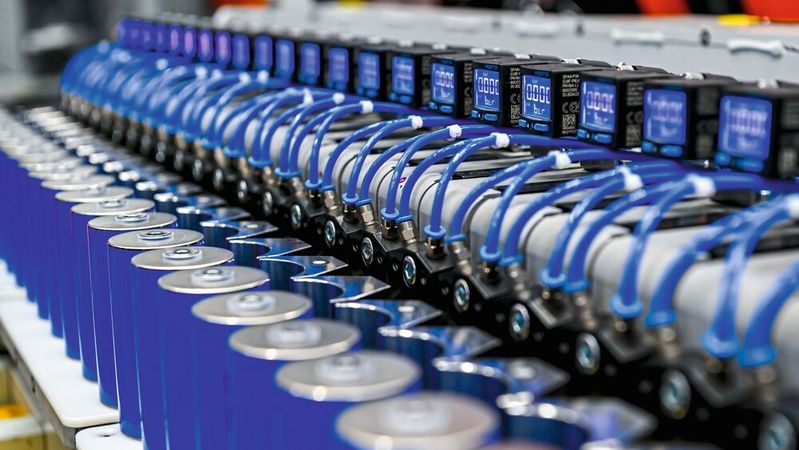
:quality(80)/p7i.vogel.de/wcms/fb/c5/fbc5a1d3151a05241d0b5afc0f017759/0129596854v1.jpeg "The prospects for European cell production have been poor for some time. The reasons for this are high production costs, technical difficulties in ramping up production and overcapacity on the market. (Image:McKinsey)")
:quality(80)/p7i.vogel.de/wcms/6f/a4/6fa443ed1e0db0d4683188545438cc70/0127127874v1.jpeg "EVE Energy is one of the Chinese manufacturers heavily investing in solid-state batteries. (Image:EVE Energy)")