After the Bigster comes the Hipster: With the new concept car, Dacia shows what affordable mobility in rural areas could look like: inexpensive, lightweight, electric—and no frills.
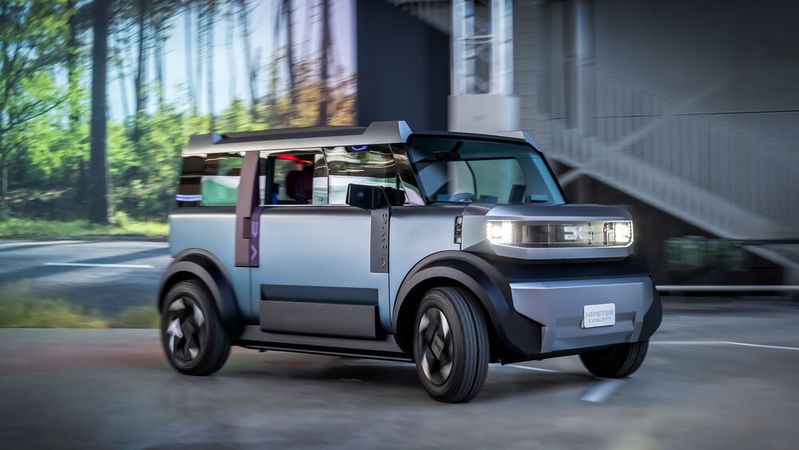
Dacia has unveiled a box-shaped concept car. The Hipster is set to receive an L7e license.
(Image: Dacia)
Life in the countryside can be quite exhausting. When the bus stops in the village only once a day, the nearest supermarket is miles away, and doctors are only found in the district town, mobility becomes essential. However, many older people with a modest pension can barely afford their own car. Or they are simply overwhelmed by the technology of modern vehicles.
The automotive industry provides few answers to the question of affordable individual mobility. According to Dacia, new cars in Europe have become 77 percent more expensive on average since 2010. Even small cars now cost so much due to the numerous legally mandated electronic driving aids that they exceed the budget of many people.
Competition for Stellantis Minis
Affordable small electric vehicles like the Opel Rocks from the Stellantis group, the Citroën Ami, or the Fiat Topolino offered as two-seaters are more of stopgap solutions. As shopping aids for the city, the barely 8 feet-long and approximately $10,600 e-cars may suffice. But crawling along country roads at 28 mph while trucks loom behind is not everyone's cup of tea.
Now Dacia wants to tackle the issue. Renault's Romanian budget brand has developed a concept study for an electric car. The French call their little 10 feet-long vehicle "Hipster," and it is described as "the newly reinvented car for everyone."
Whether everyone will like it remains to be seen. Somehow, the Hipster looks like a rolling box, with wheels at the edges and minimal overhang. It offers space for four and can even transport a refrigerator in the rear when the back seat is folded down.
The highlight: The vehicle is set to receive an L7e classification. For this, it must weigh a maximum of 1,000 pounds without the battery but can reach a speed of 50 mph. Apart from ABS, such a vehicle, legally considered a heavy road quad, does not require expensive driver assistance systems. To ensure buyers still feel secure, chief designer David Durand gave the Hipster a rugged off-road vehicle look. The boxy design also has practical advantages, the designer explains. "It's the same idea found in the original Mini: nothing utilizes space better than a cube."
Sneaker Look And Bluetooth Speakers
The Hipster actually surprises with a generous sense of space and excellent all-round visibility. The front part of the roof is made of glass, which, for example, makes it easier to see traffic lights. Instead of sitting on thick cushions, you sit on a thin mesh fabric. The material resembles sneakers and is extremely lightweight, just like the straps on the doors that replace the usual handles. And in the cockpit, you only find what is truly necessary for driving: controls for the fan, lights, indicators, and sliding windows. If you want to listen to the radio via a mobile Bluetooth speaker or navigate, you need to connect your smartphone using a special mount.
While the space in the front might resemble that of a Smart Fortwo, the rear is naturally tight. However, as an emergency solution for shorter distances, the rear seat is certainly sufficient. And when the backrests are folded down, the Hipster turns into a mini truck.
How much the car will ultimately cost if it goes into production is something the French don’t want to reveal. The fact is: with the Spring, Dacia already has a highly successful small electric car in its lineup. The 12 feet-long four-seater starts at $18,000 and is one of the cheapest and best-selling electric cars in Europe. An L7e vehicle like the Hipster is likely to be significantly cheaper, especially since the Romanians are only planning a small battery for about 50 miles of range.
Charging At A Household Socket
Whether in the countryside or the city, this would be completely sufficient for normal daily use. According to a mobility study by the Federal Ministry of Transport, 57 percent of people living in rural areas rely on their car daily, more than in cities and metropolitan regions. At the same time, charging infrastructure is particularly lacking in these areas. However, the Hipster doesn't require a wallbox or fast charger: it can be charged using a standard household socket. Nowhere is electricity cheaper than at home, which also saves costs.
While politicians argue about expanding public transportation and society debates car-sharing and micro-mobility concepts, rural areas risk being forgotten. According to the study "Rural Mobility 2024," 77 percent of Germans currently live in and around large cities with over 100,000 inhabitants—an upward trend. On the other hand, 44 percent would prefer to move to the countryside. Intelligent vehicle concepts like the Hipster could at least help keep people affordably mobile in those areas.
Date: 08.12.2025
Naturally, we always handle your personal data responsibly. Any personal data we receive from you is processed in accordance with applicable data protection legislation. For detailed information please see our privacy policy.
Consent to the use of data for promotional purposes
I hereby consent to Vogel Communications Group GmbH & Co. KG, Max-Planck-Str. 7-9, 97082 Würzburg including any affiliated companies according to §§ 15 et seq. AktG (hereafter: Vogel Communications Group) using my e-mail address to send editorial newsletters. A list of all affiliated companies can be found here
Newsletter content may include all products and services of any companies mentioned above, including for example specialist journals and books, events and fairs as well as event-related products and services, print and digital media offers and services such as additional (editorial) newsletters, raffles, lead campaigns, market research both online and offline, specialist webportals and e-learning offers. In case my personal telephone number has also been collected, it may be used for offers of aforementioned products, for services of the companies mentioned above, and market research purposes.
Additionally, my consent also includes the processing of my email address and telephone number for data matching for marketing purposes with select advertising partners such as LinkedIn, Google, and Meta. For this, Vogel Communications Group may transmit said data in hashed form to the advertising partners who then use said data to determine whether I am also a member of the mentioned advertising partner portals. Vogel Communications Group uses this feature for the purposes of re-targeting (up-selling, cross-selling, and customer loyalty), generating so-called look-alike audiences for acquisition of new customers, and as basis for exclusion for on-going advertising campaigns. Further information can be found in section “data matching for marketing purposes”.
In case I access protected data on Internet portals of Vogel Communications Group including any affiliated companies according to §§ 15 et seq. AktG, I need to provide further data in order to register for the access to such content. In return for this free access to editorial content, my data may be used in accordance with this consent for the purposes stated here. This does not apply to data matching for marketing purposes.
Right of revocation
I understand that I can revoke my consent at will. My revocation does not change the lawfulness of data processing that was conducted based on my consent leading up to my revocation. One option to declare my revocation is to use the contact form found at https://contact.vogel.de. In case I no longer wish to receive certain newsletters, I have subscribed to, I can also click on the unsubscribe link included at the end of a newsletter. Further information regarding my right of revocation and the implementation of it as well as the consequences of my revocation can be found in the data protection declaration, section editorial newsletter.



:quality(80)/p7i.vogel.de/wcms/9c/c1/9cc103887017ef58ccef3918281eb6c2/screenshot-202025-12-19-20150025-457x257v1v1.png "Various parts as produced by Kleiner in Pforzheim. (Image:Image: Kleiner)")
:quality(80)/p7i.vogel.de/wcms/34/52/3452bdfb14441ee0832ae2cbddfad975/0128849606v1.jpeg "Signing of the partnership in Chicago: Dr. Daniel Castro (center), Dean of Purdue Polytechnic, Sebastian Seitz (left), CEO of Eplan, and Jochen Trautman (right), CEO of Rittal Automation Systems (front row). (Image:Eplan)")
:quality(80)/p7i.vogel.de/wcms/19/dd/19dda8e146c3ed1f0d3739d913734734/0128815410v1.jpeg "Finished products are held by Thyssenkrupp Materials Processing Europe. The Essen-based company will in the future source large quantities of non-prime steel (second choice) from the Swedish manufacturer Stegra. (Image:Thyssenkrupp Materials Services)")
:quality(80)/p7i.vogel.de/wcms/c6/4e/c64e217a9fff02fa80dfe81621f9c4b5/swd-technologien-stator-segmentierung-04-500x281v1v1.jpeg "Stator segmentation. (Image:SWD)")
:quality(80)/p7i.vogel.de/wcms/a4/d5/a4d50ff81ccd24c8247d64f12bec7fdf/0113143253v1.jpeg "In our China Market Insider, we regularly provide you with relevant information directly from China. (Image:© Eisenhans - stock.adobe.com)")
:quality(80)/p7i.vogel.de/wcms/76/74/76741895df02ffd13e8844aee3572155/0128805929v1.jpeg "The KMP 1500P is used in the Krone plant in Werlte to minimize forklift traffic. (Image:Kuka)")
:quality(80)/p7i.vogel.de/wcms/1e/7a/1e7a774e63ca0ef438faf9d04dced5fa/0128774222v1.jpeg "LG Electronics aims to bring robotics into homes with LG Cloid. The machine is designed to handle everyday household tasks, such as cooking or doing laundry. (Image:LG Electronics)")
:quality(80)/p7i.vogel.de/wcms/ad/da/adda2b0237d0167d79524dc8845649b8/0128720455v1.jpeg "Pepsico is digitizing selected production facilities and warehouses in the USA using Digital Twin Composer. (Image:Pepsico)")
:quality(80)/p7i.vogel.de/wcms/77/f4/77f40a3ea0c8f9f18d72a42336e57104/0128775363v1.jpeg "Shunts with aluminum connectors are a perfect match for aluminum cables, which have long been the standard when it comes to weight reduction in mobile applications. (Image:Wickeder)")
:quality(80)/p7i.vogel.de/wcms/fa/65/fa653385df43d7b47543882ab3a89b79/0128816209v1.jpeg "Images on displays can now be touched. (Image: ©Lush Diaries - stock.adobe.com / AI-generated)")
:quality(80)/p7i.vogel.de/wcms/e5/00/e500dd46cc77693709f8600b20f233fb/0127794630v1.jpeg "Rolls-Royce has optimized an engine component using a seamless digital process with Siemens' help. (Image:Siemens)")
:quality(80)/p7i.vogel.de/wcms/c7/20/c7202bea5eafd354796ef4bbe1e69954/0128850938v1.jpeg "Not least thanks to the support of Leybold, test tracks for the Hyperloop to transport people and goods could be successfully planned and implemented. Speeds of up to 621 miles per hour (1000 km/h) are possible in the vacuum tunnel. (Image:Leybold)")
:quality(80)/p7i.vogel.de/wcms/02/3c/023c94dfee7083f51d9821a4e8dd7085/0128898758v1.jpeg "An empty factory as a symbolic image for the next failed battery factory. (Image:freely licensed)")
:quality(80)/p7i.vogel.de/wcms/47/8e/478e8d86c55178db8084e7a585499d59/iaa-20mobility-202025-jf-1-14603-7921x4455v1v1.jpeg "At the IAA 2025, companies from China were represented in large numbers, including many highly regarded startups. (Image:Image: IAA Mobility/Messe München)")
:quality(80)/p7i.vogel.de/wcms/a9/d1/a9d1deb0858e24c2e5f237c0b1b02763/0128892744v1.jpeg "Autonomous vehicles can massively improve the quality of public transportation, according to a study commissioned by DB Regio. (Image:Deutsche Bahn)")
:quality(80)/p7i.vogel.de/wcms/3d/d5/3dd50e300bf8af537882d9a31d3268b8/0128891096v1.jpeg "Wolfspeed has produced a single-crystal 300-mm silicon carbide wafer. (Image:Wolfspeed)")
:quality(80)/p7i.vogel.de/wcms/2e/be/2ebe7a3fd5bc91773110a9b66e3e95cf/86592347v1.jpeg "Quantum computers exploit quantum mechanical effects such as superposition and entanglement to deliver enormous computing power. (Image:public domain)")
:quality(80)/p7i.vogel.de/wcms/0b/9b/0b9b8b3adce7884d20b74abc1d6bfa90/0126467542v1.jpeg "The Cheongju campus of SK Hynix. The memory manufacturer is investing the equivalent of $13 billion in expanding its high-end chip packaging facilities in South Korea. The new plants are expected to begin operations by the end of 2027. (Image:SK Hynix)")
:quality(80)/p7i.vogel.de/wcms/b5/0f/b50fdf6e9de3851c1659b521a856f35a/0128794769v1.jpeg "An NPU is an economical, energy-efficient solution designed for efficient AI inference and neural network calculations in embedded systems. (Image:Yuichiro Chino / MathWorks)")
:fill(fff,0)/images.vogel.de/vogelonline/companyimg/76800/76895/65.jpg "FAULHABER_120mm.jpg ()")
:fill(fff,0)/p7i.vogel.de/companies/67/eb/67eba621ef6ea/logo2.png "logo2 (Wuxi InfiMotion)")
:quality(80)/p7i.vogel.de/wcms/79/7a/797a00ab73fcc38e433751445898f27b/0127169781v1.jpeg "Inside, the Hipster surprises with a spacious feel and excellent all-around visibility.(Image: Dacia)")
:quality(80)/p7i.vogel.de/wcms/58/00/580082bd3848fed86def12588dc5c26f/0127169791v1.jpeg "How much the car will ultimately cost if it goes into production, the French do not want to say.(Image: Dacia)")
:quality(80)/p7i.vogel.de/wcms/1f/54/1f54f4805c45c23f862793ac93d0ff80/0127163041v1.jpeg "The boxy concept car is smaller than it looks at first glance and is set to receive an L7e license.(Image: Dacia)")
:quality(80)/p7i.vogel.de/wcms/70/a5/70a57023f54355c5eec6f90ffc45094f/0127163031v1.jpeg "When the backrests are folded down, the Hipster becomes a mini truck.(Image: Dacia)")
:quality(80)/p7i.vogel.de/wcms/9b/c2/9bc2880ace08a4241f6c9c5019e6d30c/0126754328v1.jpeg "At the IAA Mobility 2025, the Chinese brand Linktour Automotive introduced itself to a wide audience and announced its entry into the European market. (Image:Stefanie Eckardt)")
:quality(80)/p7i.vogel.de/wcms/d5/52/d55266362c63b1c618f64931529cb009/0126787309v1.jpeg "For the new Micra, Nissan collaborates closely with Renault. (Image:Nissan)")