Cobots play a key role in automation. Many medium-sized companies often shy away from embracing new technology because they feel overwhelmed by the complex safety aspects of collaborative robots. However, with flexible designs, Cobots can be easily and above all safely integrated into existing production.
Cobots cannot simply be parked on the production line. They need a periphery tailored to them. And above all, all safety requirements to protect employees must be met.
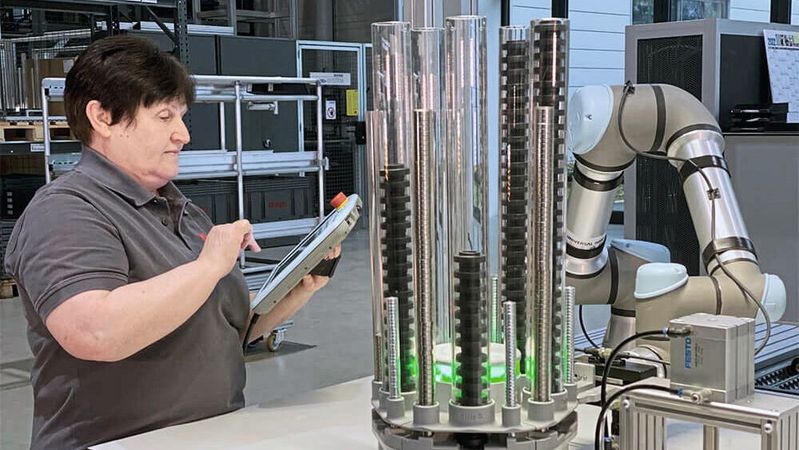
(Image: Item)
Cobots are currently the hype in automation. According to the International Federation of Robotics (IFR), 55,000 models were sold worldwide in 2023, which corresponds to growth of 31 percent. Cobots now make up 10 percent of all robots sold globally. And they also show where robotics is headed. Cobots have partly already incorporated all future technologies, including artificial intelligence (AI), thus simplifying implementation. They prove that a balance between high-tech and easy operation is possible, that an employee without special knowledge can benefit from AI: artificial intelligence without headaches.
Versatile in use
Hannes Fröhlich, product manager for robotics at Item Industrietechnik GmbH in Solingen, Germany, sees the cobot as an ideal entry point into automation: "Manufacturers are focusing on plug-and-play and easy handling. The user doesn't have to be a robotics expert to use the technology." Moreover, the models can be flexibly used at various points in the production line: "If, for example, increased quantities need to be produced, the user can bring in one or more cobots, instead of expanding the assembly line with another station and an industrial robot," says Fröhlich.
Despite all their intelligence, cobots cannot simply be left on the production line. They need a periphery tailored to them. And above all, all safety requirements must be met. Item recognised this years ago and expanded their modular system to accommodate cobots. The kit consists of around 4,500 components. The aluminium profiles can be screwed together with a flexible connection technology to create individual constructions.
On their website, Item currently shows 120 sample solutions, which are continuously supplemented by more. These are to show potential customers what is possible with the modular system. Nineteen suggestions on robotics alone are listed there. These include, for example, mobile robot islands for cobots with central cable routing, compact robot columns with levellable floor mounting or partially enclosed cabins for cobot use. Most solutions can be ordered directly or serve as a source of inspiration. Many sample solutions can be individually redesigned and adapted to the requirements in production with the help of Item's comfortable engineering tool.
Safe cable management in every solution
With all solutions from the modular system, the issue of safety is top of the agenda. This starts with the individual building blocks. A preload in the flanks of the profiles ensures stability and a strong hold, even under high loads that can occur in robotic applications. The mobile constructions are equipped with steering or lifting rollers and can thus be easily moved from one location to another. Since the transport is not strenuous work, the employer is also on the safe side with regard to occupational safety regulations. Item also has a safe cable management in mind.
"Most of the solutions are designed in such a way that there is always a way to optimally guide the cables," says Hannes Fröhlich. The profiles are equipped with intelligent cable management that simultaneously protects the lines. The cable channel is accessible from the outside, so the cable management can be changed or adapted at any time.
The developers at Item have made sure that all cables can be routed from the supply level to the cobot without being kinked or pinched. The cables run through dense brush strips, preventing dust and dirt from penetrating. The cobot is connected to the construction via mounting plates. The user can choose between the plates for the different models of the manufacturers. "We also support the plug-and-play principle here," emphasizes Hannes Fröhlich. "The user does not have to worry about a milled plate with threaded holes, but simply orders it." There are also universal mounting plates with exclusive hole patterns for individual processing.
Load testing ensures tipping safety.
The construction with a cobot literally stands or falls with tipping security. In addition to the setup area and the center of gravity properties of the overall solution, the weight of the robot, the load capacity, the travel speed, and the range are crucial for a secure stand. Item has dealt intensively with this complex topic. A calculation aid, which can be downloaded as a PDF on the website, allows the customer to check their system with the given figures. "For the calculation, the customer does not need a completed mechanical engineering degree; basic knowledge of classical mechanics is sufficient," emphasizes Hannes Fröhlich. "However, if the customer chooses to use a sample solution, they can also delegate the test to us."
Date: 08.12.2025
Naturally, we always handle your personal data responsibly. Any personal data we receive from you is processed in accordance with applicable data protection legislation. For detailed information please see our privacy policy.
Consent to the use of data for promotional purposes
I hereby consent to Vogel Communications Group GmbH & Co. KG, Max-Planck-Str. 7-9, 97082 Würzburg including any affiliated companies according to §§ 15 et seq. AktG (hereafter: Vogel Communications Group) using my e-mail address to send editorial newsletters. A list of all affiliated companies can be found here
Newsletter content may include all products and services of any companies mentioned above, including for example specialist journals and books, events and fairs as well as event-related products and services, print and digital media offers and services such as additional (editorial) newsletters, raffles, lead campaigns, market research both online and offline, specialist webportals and e-learning offers. In case my personal telephone number has also been collected, it may be used for offers of aforementioned products, for services of the companies mentioned above, and market research purposes.
Additionally, my consent also includes the processing of my email address and telephone number for data matching for marketing purposes with select advertising partners such as LinkedIn, Google, and Meta. For this, Vogel Communications Group may transmit said data in hashed form to the advertising partners who then use said data to determine whether I am also a member of the mentioned advertising partner portals. Vogel Communications Group uses this feature for the purposes of re-targeting (up-selling, cross-selling, and customer loyalty), generating so-called look-alike audiences for acquisition of new customers, and as basis for exclusion for on-going advertising campaigns. Further information can be found in section “data matching for marketing purposes”.
In case I access protected data on Internet portals of Vogel Communications Group including any affiliated companies according to §§ 15 et seq. AktG, I need to provide further data in order to register for the access to such content. In return for this free access to editorial content, my data may be used in accordance with this consent for the purposes stated here. This does not apply to data matching for marketing purposes.
Right of revocation
I understand that I can revoke my consent at will. My revocation does not change the lawfulness of data processing that was conducted based on my consent leading up to my revocation. One option to declare my revocation is to use the contact form found at https://contact.vogel.de. In case I no longer wish to receive certain newsletters, I have subscribed to, I can also click on the unsubscribe link included at the end of a newsletter. Further information regarding my right of revocation and the implementation of it as well as the consequences of my revocation can be found in the data protection declaration, section editorial newsletter.
In terms of tipping safety, Item plays it safe and always considers the worst-case scenario. In this extreme case, the robot moves at maximum speed and maximum load with an extended arm, while the employee presses the emergency stop button at the critical point. If the construction withstands the forces occurring in this test, then nothing can happen even in industrial use under the most severe loads.
Enclosure allows for higher travel speed
If the cobot stands freely on a construction and no further protective measures such as safety sensors are used, for safety reasons it may only move at the so-called collaborative speed, which is 0.25 m/s. However, this is only a guideline. Depending on the travel height and the workpiece hanging on the gripper, further safety measures may have to be taken. In order to ensure an efficient process, the solution can, for example, be supplemented with an area sensor that is attached to the construction near the ground. If an employee approaches the cobot, the sensor sends a signal to the control in time and the cobot switches to the collaborative mode.
Those who do not want to do without speed in principle are well served with a partial or complete housing of the cobot. This variant is implemented in some sample solutions, but can also be installed on request at a later date. The cobot can run fast permanently behind the large, impact-resistant windows of the housing. The employee is well protected from the robot and still has a good insight into the process.
Additional controls are simply clicked into the integrated cable channel. If necessary, all cables run safely and protected within the profile frames. Special connection sets serve as cable passage between the vertical and horizontal profiles and ensure a kink-free transition of the lines.
Whether an enclosure makes sense depends on the process. "If the cobot operates collaboratively all the time, I don't necessarily need an enclosure," says Hannes Fröhlich. "The same applies if the employee works with the machine and, for example, has to regularly replenish materials and therefore constantly open and close the door."
Safe solutions
When planning a solution, many aspects need to be considered. Therefore, Item provides a guide on their website that the customer can use as a guide. This enables potential dangers to be identified in advance and suitable protective measures to be taken. "We want the customer to not only have a safe solution that suits him," emphasizes the product manager. "He should also be sure that he is on the right track to advance automation in his company."



:quality(80)/p7i.vogel.de/wcms/a0/47/a04725ef9bd09fb6c9341a1bea1b5d93/0130443083v1.jpeg "Here, a type of plastic pallet is produced by thermoforming (vacuum forming or deep drawing) at the corresponding division of New England Plastics in the USA. This division, which specializes in so-called liners, is now part of Ringmetall ... (Image:New England Plastics)")
:quality(80)/p7i.vogel.de/wcms/e3/42/e342b3c593ea92d56604d3be969e9c9a/0130437231v1.jpeg "Daimler Truck will be building even more trucks at its Czech plant in Cheb in the future. This is because it is now being expanded for strategic cost-saving reasons ... (Image:Daimler Truck)")
:quality(80)/p7i.vogel.de/wcms/23/99/23992bf2dcdc432c9b7209c34a4a7c48/0129733089v1.jpeg "Stork relies on the modular Neoswiss turning system from Iscar to shorten the set-up times for its sliding headstock lathes and work more productively. (Image:Iscar)")
:quality(80)/p7i.vogel.de/wcms/7d/e2/7de2923434b2f1a78ba5482d8d335269/0113143253v1.jpeg "In our China Market Insider we regularly provide you with relevant information directly from China. (Image:© Eisenhans - stock.adobe.com)")
:quality(80)/p7i.vogel.de/wcms/b7/36/b736dfebc16c42d6901d0d0e1f390493/3d-druck-20factory-20--20ki-20generiert-1920x1079v1.png "(Source: AI-generated)")
:quality(80)/p7i.vogel.de/wcms/79/b2/79b21aad663f4a7bd4472afc1c1afc62/0130433994v1.jpeg "Mission Joyride: The free-flying robot (shown here in the rendering) will relieve the ISS crew of logistics tasks from 2027 with its two mechanical arms. (Image:Icarus Robotics)")
:quality(80)/p7i.vogel.de/wcms/6b/45/6b4546fa6ebf305c3660326909363f32/0130437089v1.jpeg "Industrial AI in action: Rockwell Automation presents practical solutions for self-controlling production systems at the Hannover Messe. (Image:Rainer Jensen, Deutsche Messe)")
:quality(80)/p7i.vogel.de/wcms/78/e9/78e9188c25a8a94e67c34c9bf8ffe495/visual-agile-20robots-20and-20google-20deepmind-20partner-20to-20bring-20intelligence-20to-20robotics-2500x1406v1v1.jpeg "Together, the partners are developing adaptable, intelligent robots for a wide range of applications (Image:Agile Robots SE)")
:quality(80)/p7i.vogel.de/wcms/59/a2/59a2b11f0aa1b700eff02addd5de8703/adobestock-1788280853--c2-a9-20satria-20-e2-80-93-20stock-adobe-com-5081x2860v1v1.jpeg "Quantum computers require extreme cooling to temperatures close to absolute zero in order to keep qubits stable. (Image:satria - stock.adobe.com)")
:quality(80)/p7i.vogel.de/wcms/62/5f/625f41e87ebfef156a98c8e6393e32fd/0130211654v1.jpeg "Axial flux motors have some advantages over radial flux motor—but their production is currently still expensive. (Image:RWTH Aachen University)")
:quality(80)/p7i.vogel.de/wcms/f6/ae/f6aec4f6241b36ed5e3a990ac9176b42/0130429460v1.jpeg "Verne, Pony.ai and Uber want to launch a robotaxi service in Europe. (Image:Verne)")
:quality(80)/p7i.vogel.de/wcms/d7/88/d788699f2974708a332baa4e7a62fa9e/0130438967v1.jpeg "Skoda is withdrawing from China. The brand has produced well over three million vehicles there. (Image:Skoda car)")
:quality(80)/p7i.vogel.de/wcms/b0/43/b043b86899837532aad62d63368a917a/0130371361v1.jpeg "Skoda leaves the chinese market.
(Image:Skoda)")
:quality(80)/p7i.vogel.de/wcms/c3/c4/c3c4ce270b083eeac55654148611f064/0130237945v1.jpeg "China is not giving up on hydrogen, but is intensifying its efforts. (Image:freely licensed from Pixabay)")
:quality(80)/p7i.vogel.de/wcms/ee/09/ee09acbd6dc896df25affaa9e871e6e5/0130440053v1.jpeg "IMS chip module for simple system integration into an ion mobility spectrometer. (Image:Fraunhofer IPMS)")
:quality(80)/p7i.vogel.de/wcms/10/6c/106cd22de5f68a0f74639d654827228c/0130345302v1.jpeg "Made in India: According to the India Electronics and Semiconductor Association (IESA), the country should be able to produce between 75 and 80 million chips by the beginning of 2027, once the plants currently under construction become operational. (Image:Pixabay (Montage: Sebastian Gerstl))")
:quality(80)/p7i.vogel.de/wcms/a5/ed/a5ed6fda029d362732a293d6b19d74c4/0130444216v1.jpeg "Thirteen executives from the Chinese chip industry have drawn up a plan to achieve an 80% self-sufficiency rate for semiconductors by 2030. (Image:Maxim_Kazmin - stock.adobe.com)")
:quality(80)/p7i.vogel.de/wcms/31/a6/31a646018b34d8e0a44bfc8bf17837f6/0130361632v1.jpeg "For many companies, PFAS are considered indispensable in electronics production. (Image:freely licensed)")
:fill(fff,0)/images.vogel.de/vogelonline/companyimg/76800/76895/65.jpg "FAULHABER_120mm.jpg ()")
:quality(80)/p7i.vogel.de/wcms/e1/b5/e1b500419942e1c50b87431590a8c479/0119043958v1.jpeg "When an enclosure makes sense is determined by the process. \"If the cobot is always moving collaboratively, I don't necessarily need an enclosure,\" says Hannes Fröhlich, product manager for robotics at item.(Image: Item)")
:quality(80)/p7i.vogel.de/wcms/ad/50/ad5087bcce7bcb3d241994dc72c74d09/0119043973v1.jpeg "Behind the large, impact-resistant windows of the partially enclosed cobot cabin, the cobot can move quickly continuously. The worker is well protected from the robot and still has a good view of the process.(Image: Item)")
:quality(80)/p7i.vogel.de/wcms/03/30/0330589f01fac9adbe1784614adc4e88/0119043962v1.jpeg "Decisive for a secure stand are not only the installation surface and the center of gravity characteristics of the overall solution, the weight of the robot, the load capacity, the traversing speed and the range. When considering tipping safety, Item looks at the extreme case and checks whether the construction can withstand the forces occurring.(Image: Item)")
:quality(80)/p7i.vogel.de/wcms/95/66/956607eb6e0f7b6bc08ea4ead120ccb0/0119043970v1.jpeg "As an efficient protective measure, a surface sensor that is mounted on the construction near the ground is suitable. When an employee approaches the cobot, the sensor sends a signal to the control in time and the cobot switches to collaborative mode.(Image: Image:)")
:quality(80)/p7i.vogel.de/wcms/63/e3/63e30c347948c42342c23ef9148ec1ff/0128208922v1.jpeg "In total, more than 40 cobots from the E-series and the new generation of Universal Robots are in productive use at Junior Kühlkörper. (Image:Junior Kühlkörper)")
:quality(80)/p7i.vogel.de/wcms/b6/ca/b6cadb68a36d4250032126430ddd34e4/0126599764v1.jpeg "The market offers a wide variety of cobots: the range includes single- or multi-axis cobots with payloads of up to 20 kg, reach up to 1,500 mm, and varying speeds, as well as mobile solutions. (Image:Beckhoff)")