Cobots are lightweight industrial robots that can collaborate with humans—without protective barriers. But how do they differ from conventional industrial robots? What tasks are they suitable for, and what safety aspects are important in practice?
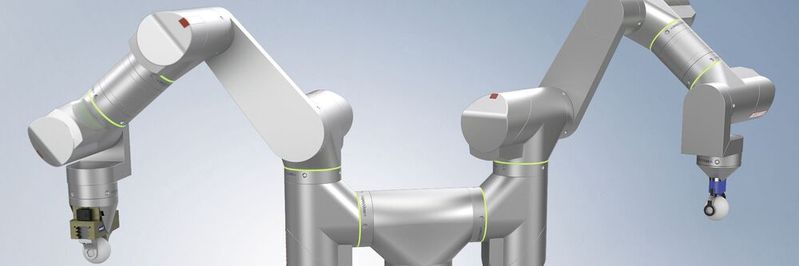
The market offers a wide variety of cobots: the range includes single- or multi-axis cobots with payloads of up to 44 pounds, reach up to 59 inches, and varying speeds, as well as mobile solutions.
(Image: Beckhoff)
The term Cobot is a combination of the English words "Collaborative" and "Robot," meaning collaborative robot. Cobots are designed to work alongside humans and therefore do not require a protective enclosure for the shared workspace. When humans and robots share a workspace without protective barriers, this is referred to as human-robot collaboration (HRC)—a highly sought-after type of cooperation. Since around 2010, there has been significant hype around Cobots, with a correspondingly growing number of suppliers entering the market.
Cobots owe their popularity and success mainly to one key feature: they allow SMEs, in particular, to quickly adopt automation with comparatively low investment costs.
What Tasks Does A Cobot Perform?
Cobots perform a variety of tasks in human-robot collaboration (HRC) and are mostly used in areas or processes that cannot be fully automated and therefore require additional personnel involvement.
Cobots relieve humans from repetitive, monotonous tasks that can become exhausting over time. They lift heavy or complex components and help improve workplace ergonomics by supporting individuals in tasks such as heavy assembly work or overhead activities. Moreover, they take on tasks that can be risky for humans, such as safely handling sharp, hot, or pointed workpieces, or dealing with potentially hazardous substances and materials, for example, during gluing, welding, painting, etc. However, this is essentially just a fraction of the potential Cobots offer.
Some examples of common applications for cobots in industry:
Palletizing
Measuring, inspecting, testing
Packaging and order picking
Pressing and fastening
Painting
Assembling, equipping, positioning
Applying, gluing, sealing
Welding
Deburring, polishing
When Was the Birth of the Cobot?
The first Cobots were developed in 1996 by U.S. professors James Edward Colgate and Michael A. Peshkin from Northwestern University in the state of Illinois. This was part of a research project funded by the General Motors Foundation, which primarily aimed to make robots safer for direct interaction with workers. The first Cobot in Germany was likely developed in 2004 by the Augsburg-based robotics manufacturer Kuka, in collaboration with the German Aerospace Center. Finally, the Danish start-up Universal Robots achieved a breakthrough for lightweight robots in 2008.
What Differentiates Cobots from Traditional Industrial Robots?
There are essentially five key criteria that differentiate a cobot from a conventional industrial robot:
Human-Machine Interaction: Cobots are specifically designed for HRC and operate in the immediate vicinity of humans. They were purposefully developed to work collaboratively with people. Cobots operate in a collaborative work environment and assist individuals with various tasks. In contrast, traditional industrial robots are typically true powerhouses carrying out very fast movements depending on the application, which is why they must be secured with protective fences, light barriers, pressure mats, etc., to prevent accidents. Additionally, special safety functions in the robot controls ensure that the robot stays within its designated range of action. Thus, there is a clear separation between the working areas of traditional robots and Cobots.
Relief in risky or demanding tasks: Another key difference has already been mentioned above. Cobots perform tasks that can be risky for humans, such as handling sharp-edged workpieces or hazardous substances. Thus, cobots significantly reduce the risk of accidents for humans.
Safety through “intelligent” interaction: Cobots are designed to work closely with humans. To enhance HRC, Cobots are equipped with advanced sensors that ensure the robot stops at the slightest touch from a human. Since a Cobot does not pose any immediate danger to humans, protective fences or other separating measures are not necessary.
Simple Programming: Cobots make things easy for humans in every respect. They are particularly simple to program. While traditional robots require specialized programming skills, configuring a Cobot is usually very straightforward, especially since some models are capable of learning independently. For example, the robotic arm can first be guided by a human to teach a movement sequence, and the Cobot then automatically replicates the action.
Flexibly Deployable: Traditional industrial robots are stationary installations and can only be relocated to another work area with significant effort. Cobots, on the other hand, are more mobile as they are easier to move and can therefore be easily used in other areas of a production line when needed. Some Cobots are even so lightweight that they can be moved by just one person. Additionally, most Cobots can be mounted on any surface—horizontally, vertically, or even on a ceiling.
What Components Are Required to Commission A Cobot?
Each application for a cobot is fundamentally different from another, so the range of additional components for cobots is extensive. When it comes to,
lifting, lowering, or transporting components, various gripper concepts are commonly used, which can be mechanical, magnetic, or pneumatic, for instance.
A mechanical gripper is considered a classic solution, allowing a cobot to handle a wide variety of components or workpieces made from different materials with great flexibility. The range of mechanical grippers specifically designed for cobots is very extensive in this regard.
Magnetic solutions also transport parts from A to B. In this case, the workpieces are lifted using a magnet. However, such solutions can only be used with ferromagnetic components.
Additionally, it is possible to pneumatically suction parts, similar to a vacuum cleaner. For this purpose, a type of hose or nozzle is attached to the robot arm, which uses suction power to lift parts. To release a part, the suction power is reduced, allowing it to detach from the robot arm.
When workpieces need to be processed by a Cobot, specific tools are required on the robotic arm. These tools are referred to as end effectors. This is not about handling a component but rather processing it. The range of end effectors is as diverse as the applications they are designed for: from tools for grinding or deburring to specialized nozzles for applying adhesives or painting components, and even specialized torches for welding—just to name a few examples.
What Safety Aspects Should Be Considered When Using Cobots?
The special feature of human-robot collaboration (HRC) is that cobots can work in close proximity to or directly with humans. A key requirement for this is that collaborative robots must not pose a danger and must not injure people.
To completely avoid contact, cobots are equipped with technologies such as laser scanners, various vision systems, or sensor solutions based on ultrasound or radar technologies, to name just a few examples.
If contact between humans and cobots cannot be avoided, power and force limitations must ensure that the robot poses no danger to humans.
Which Safety Standards Are Important for Cobots?
Robot manufacturers must include the intended workplace of cobots in their risk assessment. The basis for this risk assessment, in addition to the Machinery Directive, includes the standard EN ISO 10218, parts 1 and 2, and specifically ISO TS 15066.
The harmonized European standards EN ISO 10218-1/-2 regulate the safety of industrial robots. These include, for example, six-axis articulated robots, SCARA robots, and gantry robots, with the standards generally applying to system solutions with at least three freely programmable axes. The revision of the standards relevant to industrial robots also addressed the then-emerging application field of collaborative robots.
Date: 08.12.2025
Naturally, we always handle your personal data responsibly. Any personal data we receive from you is processed in accordance with applicable data protection legislation. For detailed information please see our privacy policy.
Consent to the use of data for promotional purposes
I hereby consent to Vogel Communications Group GmbH & Co. KG, Max-Planck-Str. 7-9, 97082 Würzburg including any affiliated companies according to §§ 15 et seq. AktG (hereafter: Vogel Communications Group) using my e-mail address to send editorial newsletters. A list of all affiliated companies can be found here
Newsletter content may include all products and services of any companies mentioned above, including for example specialist journals and books, events and fairs as well as event-related products and services, print and digital media offers and services such as additional (editorial) newsletters, raffles, lead campaigns, market research both online and offline, specialist webportals and e-learning offers. In case my personal telephone number has also been collected, it may be used for offers of aforementioned products, for services of the companies mentioned above, and market research purposes.
Additionally, my consent also includes the processing of my email address and telephone number for data matching for marketing purposes with select advertising partners such as LinkedIn, Google, and Meta. For this, Vogel Communications Group may transmit said data in hashed form to the advertising partners who then use said data to determine whether I am also a member of the mentioned advertising partner portals. Vogel Communications Group uses this feature for the purposes of re-targeting (up-selling, cross-selling, and customer loyalty), generating so-called look-alike audiences for acquisition of new customers, and as basis for exclusion for on-going advertising campaigns. Further information can be found in section “data matching for marketing purposes”.
In case I access protected data on Internet portals of Vogel Communications Group including any affiliated companies according to §§ 15 et seq. AktG, I need to provide further data in order to register for the access to such content. In return for this free access to editorial content, my data may be used in accordance with this consent for the purposes stated here. This does not apply to data matching for marketing purposes.
Right of revocation
I understand that I can revoke my consent at will. My revocation does not change the lawfulness of data processing that was conducted based on my consent leading up to my revocation. One option to declare my revocation is to use the contact form found at https://contact.vogel.de. In case I no longer wish to receive certain newsletters, I have subscribed to, I can also click on the unsubscribe link included at the end of a newsletter. Further information regarding my right of revocation and the implementation of it as well as the consequences of my revocation can be found in the data protection declaration, section editorial newsletter.
Why Did Biomechanical Limits Become Relevant for Cobots?
For this reason, ISO TS 15066 was added as a supplement to the previously mentioned standards, focusing on the use of robots in collaborative operation.
Since direct contact between a person and a Cobot is also taken into account, so-called biomechanical limit values first had to be determined. For this purpose, the DGUV (German Social Accident Insurance) and the BGHM (Wood and Metal Trade Association), with support from the IFA (Institute for Occupational Safety and Health) and the Fraunhofer IFF (Institute for Factory Operation and Automation), conducted investigations as part of various research projects. The biomechanical limit values determined through these studies, which must not be exceeded during contact between a Cobot and a human, were eventually incorporated into ISO TS 15066.
The standard distinguishes between four types of safety measures for collaborative operation:
Monitored stop: The robot stops immediately when an employee enters the shared workspace.
Hand guiding: The robot's movements are controlled by an employee using sensors. This operation is usually confirmed by the employee via an additional switch.
Speed and distance monitoring: Accidental contact between humans and the cobot is avoided through the use of various safety or sensor systems (laser scanners, light barriers, camera systems, etc.). If such a non-separating safety device is triggered, the cobot's movement must stop immediately.
Power and force limitation: The contact forces between humans and cobots are limited to a safe level by defining maximum force and pressure values. ISO TS 15066 specifies the pain thresholds for various body regions, such as the head, hand, arm, and leg, in Appendix A using biomechanical limits.
This question is not easy to answer, as the market offers a wide range of solutions and continues to grow. The spectrum ranges from single- or multi-axis Cobots with a payload of less than 2.2 pounds to robots capable of handling payloads of up to 44 pounds. Similarly, the range of reach is diverse, starting at approximately 19.7 inches and extending to nearly 59 inches. There is also significant variation in terms of speed and weight, with technical specifications ranging, for example, from speeds of 2.8 to 78.7 inches per second and weights from 18 to around 2,200 pounds.
Manufacturers of Cobots
ABB
Aubo Robotics
Beckhoff
Bosch Rexroth
Doosan Robotics
Fanuc
Franka Emika
Fruitcore Robotics
F & P Personal Robotics
Hahn Robotics
Hanwha
Igus
Kassow Robots
Kawasaki
Kinova
Kuka
Mabi
Mitsubishi
Omron
Pilz
Rethink Robotics
Stäubli
Techman
TM Robotics
Universal Robots
Yamaha
Yaskawa
The list is an excerpt without any claim to completeness.



:quality(80)/p7i.vogel.de/wcms/2c/b5/2cb58b0c53a4a7d9c3032427e9a31861/0132623548v1.jpeg "Quality inspection in detail: Roundness measurement of a workpiece using Accretech Rondcom. (Image:Accretech)")
:quality(80)/p7i.vogel.de/wcms/58/bf/58bf72e72e3066a7f7990d33c757675b/0132650629v1.jpeg "The winding determines what defines the electric motor. In the image: Short winding on small motors. (Image:Faulhaber)")
:quality(80)/p7i.vogel.de/wcms/ef/08/ef08922ce5a15207a9775d5065527250/0132599857v1.jpeg "What you see here is the innovative WAAM system called Arctitan from Gefertec. With it, high-quality titanium components can finally be additively manufactured under consistent process conditions, as the manufacturer promises. (Image: Gefertec)")
:quality(80)/p7i.vogel.de/wcms/66/fa/66fa3238dd2624ae644a3ba871438757/0113143253v1.jpeg "In our China Market Insider, we regularly provide you with relevant information directly from China. (Image:© Eisenhans - stock.adobe.com)")
:quality(80)/p7i.vogel.de/wcms/00/4c/004c97f265026bc126720f24d0b0d68c/0132664223v1.jpeg "Physical AI can intervene directly in manufacturing, delivering significant added value. (Image:Shutterstock)")
:quality(80)/p7i.vogel.de/wcms/da/dc/dadcf29e66cec822e5fbac3144df7dce/0132579697v1.jpeg "The \"childhood\" of robots: Structured training environments provide the crucial practical data that AI models need for reliable autonomy. (Image:Gemini / AI-generated)")
:quality(80)/p7i.vogel.de/wcms/e3/a4/e3a44159531a41ac69f308a3b356fa9e/image1v1.jpeg "The dynamic guidance system LARS projects information directly onto the warehouse floor using laser projection. (Image:Fraunhofer IML)")
:quality(80)/p7i.vogel.de/wcms/2f/2a/2f2ac048a0e03f535795d2b3e05c44c1/0132582608v1.jpeg "If the future storage and material flow structure of a plant site needs to be planned, the digital planning twin can demonstrate whether the structure works even under peak loads or with a changed product mix. (Image:AI-generated)")
:quality(80)/p7i.vogel.de/wcms/14/b7/14b722e669a9aa9810c1a77b4fa5e8af/0132649760v1.jpeg "The new version of the sensor system is based on reusable patches and integrates a portable computer that enables AI-supported analysis of the collected data. (Image:Basel Adams / AI-generated)")
:quality(80)/p7i.vogel.de/wcms/7c/78/7c78b1a79249627ecac8a6cdd9ff0db8/0132675504v1.jpeg "Here at Fraunhofer IWM, an additively manufactured metal part is cyclically loaded in a test fixture after its highly stressed surface zones have been mechanically post-processed. Now, it is also known how to identify these areas before production. (Image:Fraunhofer IWM)")
:quality(80)/p7i.vogel.de/wcms/f5/e6/f5e67d094c9ff528802907f2986c175f/0132631344v1.jpeg "Graphite electrodes for batteries consist of natural and synthetic graphite. Both materials will be in increasingly high demand in the future. That’s why projects, such as those by International Graphite and Westwater, are already in the starting blocks to seize the opportunity... (Image: International Graphite)")
:quality(80)/p7i.vogel.de/wcms/84/2b/842b528802ab7fb92be95e089d9f5777/csm-wabenstruktur-2026-07-20-jm-855955b94dv1.png "Bionically inspired honeycomb structures with gradually arranged fiber angles made from regenerated cellulose fibers. These lightweight structures could contribute to more sustainable safety components in the future. (Source: © HSB - AG Biologische Werkstoffe)")
:quality(80)/p7i.vogel.de/wcms/21/b2/21b24e92c458fd3a019289cf920fb2a0/b4acb47fcace0508fa403dfaef9628968fa3f650v1.jpeg "The muscle car from Dodge is back on offer in Germany. The Charger is available with a combustion engine and as the electric Daytona variant. (Image:Stellantis/Dodge)")
:quality(80)/p7i.vogel.de/wcms/3d/6f/3d6f237bda1ed959f4926789b8dcac11/0132622329v1.jpeg "The battery manufacturer CATL has announced a cell that can charge so quickly that the driver can remain standing next to the van after plugging in the cable. (Image:Volkswagen Commercial Vehicles)")
:quality(80)/p7i.vogel.de/wcms/9d/27/9d27974b77965320deca4effe62fe450/org-blobs-user-response-file-output-b2334db5-a0dc-4492-9c6d-1c655264bc22-file-1785911165790-jpgv1.jpeg "A debate is ongoing in China about whether cars have become disposable items. (Image:KI-generiert)")
:quality(80)/p7i.vogel.de/wcms/29/17/2917f4bf1a9f7a53da609a0af5e217c4/p90648237-highres-high-voltage-batteryv1.jpeg "The tax exemption for batteries in China is being abolished. Only battery cell manufacturers will continue to be exempt from taxes. (Image:BMW)")
:quality(80)/p7i.vogel.de/wcms/92/f1/92f1243318173802ec4ac8ed6a36dc2a/0132637902v1.jpeg "Depending on the solid electrolyte used, material systems, cell concepts, and production processes for solid-state batteries differ significantly. (Image:freely licensed)")
:quality(80)/p7i.vogel.de/wcms/62/2d/622d79199f67c7721eca0b81dd350779/0132577934v1.jpeg "The executives at Globalfoundries are planning for additional funds from the CHIPS Act. (Image:Globalfoundries)")
:quality(80)/p7i.vogel.de/wcms/c7/22/c72290be02701591268e4419220766d0/0132589361v1.jpeg "A Twinscan NXT:1950i lithography machine from ASML. According to Chinese media reports, the Chinese company Shanghai Yuliansheng plans to deliver six self-developed DUV lithography machines by the end of 2026, which are said to be technologically comparable to the system from the Dutch equipment manufacturer introduced in 2008. (Image:ASML)")
:quality(80)/p7i.vogel.de/wcms/70/21/7021d732ad7b441d0436592046a25432/0132610698v1.jpeg "Kimi K3 can fundamentally be self-hosted. However, due to its size, it is not a model for just any company: even in a compressed form, extensive storage and computing resources are required. (Image:Moonshot AI)")
:fill(fff,0)/p7i.vogel.de/companies/69/88/69882c428938e/tmts2026-ticec-banner-en-2000px.png "tmts2026-ticec-banner-en-2000px (https://www.tmts.tw/en)")
:quality(80)/p7i.vogel.de/wcms/6e/36/6e361c6a25aafe0c993978134cbb61fa/0123135870v1.jpeg "Frequency converters can be used in numerous applications—from simple speed control to encoderless torque regulation and dynamic positioning operations. (Image:SEW Eurodrive)")
:quality(80)/p7i.vogel.de/wcms/66/2d/662dce5c2dc45696bc98faf2917a2c50/0124271041v1.jpeg "A completely finished switch cabinet has, among other things, a distributor, circuit breakers. contactors and connector and coupling blocks. (Image:Friedrich Lütze GmbH)")
:quality(80)/p7i.vogel.de/wcms/16/d5/16d5e4cd9b61b912644949d57aa2957f/yamaha-20picture-202v1.jpeg "The seventh axis on the cobot increases flexibility in production and logistics. (Image: Yamaha Robotics)")
:quality(80)/p7i.vogel.de/wcms/b3/62/b36228b3eb1dccb322a577206acf2bbb/0131982120v1.jpeg "Researcher Federico Masiero receives a package whose weight the robot has already transmitted to the exoskeleton. (Image: Andreas Schmitz / TUM)")