From
Editorial team | Translated by AI
8 min Reading Time
Control cabinets are much more than simple enclosures that house electronics. Depending on the application, requirements, and location of use, there are significant differences. But what do these differences look like exactly? Which materials are preferred for control cabinets? And which standards and guidelines should be considered when designing and specifically configuring control cabinets?
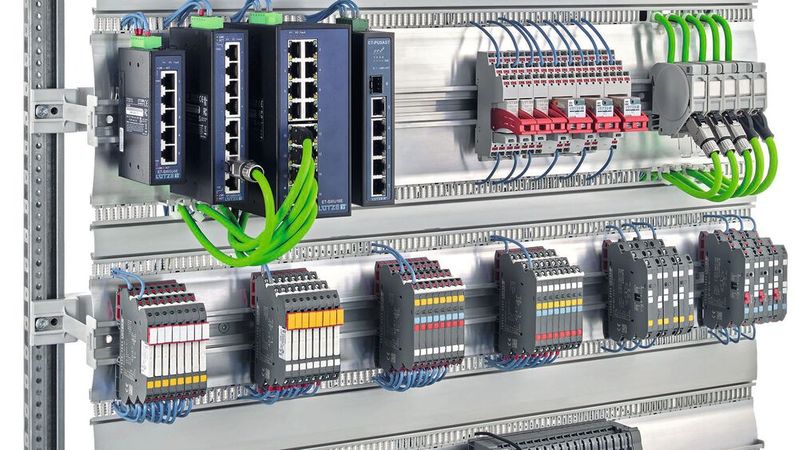
A completely finished switch cabinet has, among other things, a distributor, circuit breakers. contactors and connector and coupling blocks.
(Image: Friedrich Lütze GmbH)
An enclosure is a housing for the central storage and wiring of electrical and electronic components that are used to control machines, systems and processes. The control cabinet ensures that the components are arranged in an organized manner and are always protected from external influences.
What specific functions does an electrical enclosure have?
An enclosure housing should protect the electronics inside from dirt (e.g. dust), moisture, external influences and overheating (e.g. due to cooling). Enclosures that are used in outdoor areas are used to protect against dust, ice, snow, rain and vandalism, for example. In order to protect the sometimes sensitive electronics from very high or very low temperatures, some enclosures are air-conditioned, i.e. either heated, cooled and/or ventilated, due to the specific ambient conditions.
In addition, control cabinets should protect the environment in which they are installed from electromagnetic emissions, fires and people from accidentally touching dangerous and live components.
Where are control cabinets used?
Switch cabinets are indispensable components of all industrial, building services, telecommunications, energy and infrastructure systems. In automation, they are used to control and monitor machines and systems. In energy technology, they enable the distribution and monitoring of electrical energy in wind turbines, photovoltaic systems, other power plants for electricity and heat production and in substations. Control cabinets are also indispensable in building technology for controlling and monitoring lighting, heating and air conditioning systems, for example.
In telecommunications and network technology, control cabinets are used for signal distribution and as central nodes for the organization and control of different communication systems. By protecting routers, servers and fiber optic components from environmental influences, for example, they ensure a secure and reliable communication infrastructure at all times. Areas of application include broadband and fiber optic networks, mobile radio infrastructure, satellite communication as well as data centers and IT infrastructures.
Last but not least, control cabinets ensure the efficiency and safety of traffic control systems.
Which materials are most commonly found in enclosures?
The most common and therefore most frequently used control cabinets in industry are made of powder-coated sheet steel, usually in the color RAL7035 (light grey). For particularly demanding and harsh environments as well as outdoor applications, sheet steel enclosures with special coatings such as galvanization are recommended. There are also solutions made of stainless steel, which are particularly corrosion-resistant and therefore ideal for damp and aggressive environments, such as in the chemical or food industry and in shipping on the high seas, where the enclosures usually come into frequent contact with water and salt water or similar liquids.
Other frequently used materials are aluminum and plastic. Aluminum is both lightweight and corrosion-resistant and therefore offers a good mix of weight and strength. In addition, aluminum control cabinets have good heat dissipation. Plastic control cabinets are also particularly light and corrosion-resistant. Another advantage is that these enclosures are non-conductive and therefore provide good insulation against electrical currents. However, plastic switch cabinets can only be used in environments with comparatively low mechanical stress, unless they are particularly reinforced in terms of their design.
What are the main components of an electrical enclosure?
In its simplest form, a control cabinet consists only of terminals arranged in series. However, a completely finished control cabinet is far more complex. Here are the main components:
The housing is to a certain extent the outer frame of an enclosure, the materials of which can vary depending on the location and application, as explained above. The enclosure also integrates a door for easy access to the inside of the enclosure.
The distribution board is the central element of an electrical enclosure in which the cables and electrical lines are connected.
The circuit breaker (also RCD or residual current circuit breaker) is an important safety element, as it switches off the power supply in the event of an overload or short circuit.
The power contactors are used to protect the electrical system against overload or voltage peaks.
The connector and coupling blocks make it easy to wire and disconnect cables as required.
Date: 08.12.2025
Naturally, we always handle your personal data responsibly. Any personal data we receive from you is processed in accordance with applicable data protection legislation. For detailed information please see our privacy policy.
Consent to the use of data for promotional purposes
I hereby consent to Vogel Communications Group GmbH & Co. KG, Max-Planck-Str. 7-9, 97082 Würzburg including any affiliated companies according to §§ 15 et seq. AktG (hereafter: Vogel Communications Group) using my e-mail address to send editorial newsletters. A list of all affiliated companies can be found here
Newsletter content may include all products and services of any companies mentioned above, including for example specialist journals and books, events and fairs as well as event-related products and services, print and digital media offers and services such as additional (editorial) newsletters, raffles, lead campaigns, market research both online and offline, specialist webportals and e-learning offers. In case my personal telephone number has also been collected, it may be used for offers of aforementioned products, for services of the companies mentioned above, and market research purposes.
Additionally, my consent also includes the processing of my email address and telephone number for data matching for marketing purposes with select advertising partners such as LinkedIn, Google, and Meta. For this, Vogel Communications Group may transmit said data in hashed form to the advertising partners who then use said data to determine whether I am also a member of the mentioned advertising partner portals. Vogel Communications Group uses this feature for the purposes of re-targeting (up-selling, cross-selling, and customer loyalty), generating so-called look-alike audiences for acquisition of new customers, and as basis for exclusion for on-going advertising campaigns. Further information can be found in section “data matching for marketing purposes”.
In case I access protected data on Internet portals of Vogel Communications Group including any affiliated companies according to §§ 15 et seq. AktG, I need to provide further data in order to register for the access to such content. In return for this free access to editorial content, my data may be used in accordance with this consent for the purposes stated here. This does not apply to data matching for marketing purposes.
Right of revocation
I understand that I can revoke my consent at will. My revocation does not change the lawfulness of data processing that was conducted based on my consent leading up to my revocation. One option to declare my revocation is to use the contact form found at https://contact.vogel.de. In case I no longer wish to receive certain newsletters, I have subscribed to, I can also click on the unsubscribe link included at the end of a newsletter. Further information regarding my right of revocation and the implementation of it as well as the consequences of my revocation can be found in the data protection declaration, section editorial newsletter.
The monitoring and transmission devices are used to monitor and transmit data and measured values from a control cabinet.
Additional cooling, heating, ventilation or desiccant may also be required to protect the electronics from overheating or very cold temperatures as well as humidity and condensation. Some enclosures are also equipped with lighting to make it easier to work on the electronic components when there is little natural ambient light.
What are the differences between control cabinets in various industrial sectors?
The requirements, materials and functions of enclosures can vary considerably depending on the industry. Here are some key differences:
In automation, modular control cabinets that can be expanded at any time are usually used to control and monitor machines, production lines and robots, which sometimes integrate very complex automation systems and are often equipped with network interfaces for a wide range of Industry 4.0 applications. The control cabinet materials are usually made of powder-coated sheet steel or stainless steel for harsher environments.
The energy technology sector is usually characterized by large enclosures in order to create sufficient capacity for circuit breakers and transformers, for example, when controlling and monitoring energy distribution networks. The solutions are usually made of galvanized sheet steel or stainless steel for weatherproof outdoor use.
In building technology, compact control cabinets are in demand for controlling and monitoring lighting, ventilation, security systems and access control, for example, which can also be easily integrated into existing building structures in terms of their aesthetics.
In telecommunications and network technology, you will find distribution cabinets and outdoor enclosures as well as server and network cabinets. There are also compact plastic enclosures and customized solutions.
The food and chemical industry places special demands on enclosures in terms of corrosion resistance to aggressive cleaning agents and chemicals, whereby a hygienic enclosure design with smooth stainless steel surfaces for easy cleaning plays a decisive role.
In the transport sector, such as railroad technology, control cabinets with vibration-resistant designs are valued for controlling traction systems, braking systems and emergency power supplies, among other things; these solutions are usually made of stainless steel or aluminum and are ATEX-certified for use in potentially explosive atmospheres.
How is the interior of an enclosure protected from environmental influences?
In the explanations of the main components of enclosures, the topics of materials, climate control and ventilation to protect the electrical and electronic components have already been addressed. But how can the interior of an enclosure be additionally sealed off from potentially harmful environmental influences in order to ensure the longevity and functionality of the components installed in the enclosure? Here are some tried and tested measures:
High-quality seals, e.g. made of polyurethane, on the enclosure doors prevent dust, water and similar liquid media as well as foreign bodies from entering the enclosure. In this context, the IP54 or IP65 protection classes define the degree of enclosure protection against moisture and solids.
Design-related measures such as double walls and additional insulation, even in parts of the enclosure, protect against temperature fluctuations and minimize possible cold bridges that may promote condensation inside. In combination with rubber seals, for example, pull-out elements can also be sealed, making them easily accessible and yet protected.
Standard-compliant tests, e.g. in accordance with IEC 62208 and IEC 61439, are used to test switch cabinets for their resistance to environmental influences, e.g. salt spray tests or simulations of extreme temperatures and climatic fluctuations.
What common safety measures are included in electrical enclosures?
Switch cabinets should contain some essential safety measures to minimize the risks to the components inside and, above all, to people.
First and foremost, this includes access protection, such as a special tool or a key to prevent the cabinet from being opened without authorization. Basic protection against electric shocks is also required, which can be achieved, for example, by covering components with dangerous voltages to prevent accidental contact with cables or wires.
However, high voltages can be dangerous not only in the enclosure, but also on the enclosure itself. An electrical enclosure should therefore be earthed in order to create equipotential bonding, e.g. in the event of loose wiring, etc. Appropriate devices for surge and lightning protection also prevent damage due to voltage peaks caused by lightning strikes or mains faults.
In areas with a particular risk of explosion, special types of protection such as "Ex d" (flameproof encapsulation) or "Ex e" (increased safety) are required for enclosures, which prevent the ingress of flammable substances and isolate possible ignition sources.
Various sensors also ensure continuous temperature monitoring so that fans or emergency cooling systems, for example, can be activated if critical temperatures are exceeded.
To ensure that all protective measures function properly, especially in safety-critical areas, regular inspections and maintenance ultimately serve to increase the safety of enclosures.
Which standards and directives are particularly important for enclosures?
Against this background, control cabinets must comply with common standards such as IEC 60204-1 (electrical equipment of machines) and IEC 61439 (low-voltage switchgear and controlgear assemblies), which regulate the design, construction and commissioning. In addition, the VDE guidelines for electrical systems and CE marking must be taken into account. Finally, here is a summary of some of the most important standards, regulations and certifications:
European standards and directives
IEC 61439: Safety of low-voltage switchgear and controlgear assemblies
IEC 60439-1: Design of enclosures, including materials, construction, performance characteristics and test methods
EN 60204-1: Safety of electrical, electronic and programmable electronic control systems
DIN EN 62208: Standard for empty enclosures of low-voltage switchgear and controlgear assemblies
EMC Directive: Requirements for electromagnetic compatibility in order to minimize interference from electrical devices.
Standards for North America
UL 508A: Certification for industrial control cabinets that guarantees electrical safety in the USA
NFPA 79: Electrical equipment in industrial machinery for the US market
NFPA 496 and UL 1203: Standards for enclosures in hazardous areas
CSA C22.2: Canadian standards for enclosures, including specific requirements for explosion-proof enclosures



:quality(80)/p7i.vogel.de/wcms/2c/b5/2cb58b0c53a4a7d9c3032427e9a31861/0132623548v1.jpeg "Quality inspection in detail: Roundness measurement of a workpiece using Accretech Rondcom. (Image:Accretech)")
:quality(80)/p7i.vogel.de/wcms/58/bf/58bf72e72e3066a7f7990d33c757675b/0132650629v1.jpeg "The winding determines what defines the electric motor. In the image: Short winding on small motors. (Image:Faulhaber)")
:quality(80)/p7i.vogel.de/wcms/ef/08/ef08922ce5a15207a9775d5065527250/0132599857v1.jpeg "What you see here is the innovative WAAM system called Arctitan from Gefertec. With it, high-quality titanium components can finally be additively manufactured under consistent process conditions, as the manufacturer promises. (Image: Gefertec)")
:quality(80)/p7i.vogel.de/wcms/66/fa/66fa3238dd2624ae644a3ba871438757/0113143253v1.jpeg "In our China Market Insider, we regularly provide you with relevant information directly from China. (Image:© Eisenhans - stock.adobe.com)")
:quality(80)/p7i.vogel.de/wcms/00/4c/004c97f265026bc126720f24d0b0d68c/0132664223v1.jpeg "Physical AI can intervene directly in manufacturing, delivering significant added value. (Image:Shutterstock)")
:quality(80)/p7i.vogel.de/wcms/da/dc/dadcf29e66cec822e5fbac3144df7dce/0132579697v1.jpeg "The \"childhood\" of robots: Structured training environments provide the crucial practical data that AI models need for reliable autonomy. (Image:Gemini / AI-generated)")
:quality(80)/p7i.vogel.de/wcms/e3/a4/e3a44159531a41ac69f308a3b356fa9e/image1v1.jpeg "The dynamic guidance system LARS projects information directly onto the warehouse floor using laser projection. (Image:Fraunhofer IML)")
:quality(80)/p7i.vogel.de/wcms/2f/2a/2f2ac048a0e03f535795d2b3e05c44c1/0132582608v1.jpeg "If the future storage and material flow structure of a plant site needs to be planned, the digital planning twin can demonstrate whether the structure works even under peak loads or with a changed product mix. (Image:AI-generated)")
:quality(80)/p7i.vogel.de/wcms/14/b7/14b722e669a9aa9810c1a77b4fa5e8af/0132649760v1.jpeg "The new version of the sensor system is based on reusable patches and integrates a portable computer that enables AI-supported analysis of the collected data. (Image:Basel Adams / AI-generated)")
:quality(80)/p7i.vogel.de/wcms/7c/78/7c78b1a79249627ecac8a6cdd9ff0db8/0132675504v1.jpeg "Here at Fraunhofer IWM, an additively manufactured metal part is cyclically loaded in a test fixture after its highly stressed surface zones have been mechanically post-processed. Now, it is also known how to identify these areas before production. (Image:Fraunhofer IWM)")
:quality(80)/p7i.vogel.de/wcms/f5/e6/f5e67d094c9ff528802907f2986c175f/0132631344v1.jpeg "Graphite electrodes for batteries consist of natural and synthetic graphite. Both materials will be in increasingly high demand in the future. That’s why projects, such as those by International Graphite and Westwater, are already in the starting blocks to seize the opportunity... (Image: International Graphite)")
:quality(80)/p7i.vogel.de/wcms/84/2b/842b528802ab7fb92be95e089d9f5777/csm-wabenstruktur-2026-07-20-jm-855955b94dv1.png "Bionically inspired honeycomb structures with gradually arranged fiber angles made from regenerated cellulose fibers. These lightweight structures could contribute to more sustainable safety components in the future. (Source: © HSB - AG Biologische Werkstoffe)")
:quality(80)/p7i.vogel.de/wcms/e5/2b/e52b30828b2c61228b8795d807520d68/0132607603v1.jpeg "In Project LEIA, various companies like Airbus are working on a hybrid-electric onboard network architecture for short- and medium-haul aircraft. (Image: Airbus)")
:quality(80)/p7i.vogel.de/wcms/21/b2/21b24e92c458fd3a019289cf920fb2a0/b4acb47fcace0508fa403dfaef9628968fa3f650v1.jpeg "The muscle car from Dodge is back on offer in Germany. The Charger is available with a combustion engine and as the electric Daytona variant. (Image:Stellantis/Dodge)")
:quality(80)/p7i.vogel.de/wcms/3d/6f/3d6f237bda1ed959f4926789b8dcac11/0132622329v1.jpeg "The battery manufacturer CATL has announced a cell that can charge so quickly that the driver can remain standing next to the van after plugging in the cable. (Image:Volkswagen Commercial Vehicles)")
:quality(80)/p7i.vogel.de/wcms/9d/27/9d27974b77965320deca4effe62fe450/org-blobs-user-response-file-output-b2334db5-a0dc-4492-9c6d-1c655264bc22-file-1785911165790-jpgv1.jpeg "A debate is ongoing in China about whether cars have become disposable items. (Image:KI-generiert)")
:quality(80)/p7i.vogel.de/wcms/92/f1/92f1243318173802ec4ac8ed6a36dc2a/0132637902v1.jpeg "Depending on the solid electrolyte used, material systems, cell concepts, and production processes for solid-state batteries differ significantly. (Image:freely licensed)")
:quality(80)/p7i.vogel.de/wcms/62/2d/622d79199f67c7721eca0b81dd350779/0132577934v1.jpeg "The executives at Globalfoundries are planning for additional funds from the CHIPS Act. (Image:Globalfoundries)")
:quality(80)/p7i.vogel.de/wcms/c7/22/c72290be02701591268e4419220766d0/0132589361v1.jpeg "A Twinscan NXT:1950i lithography machine from ASML. According to Chinese media reports, the Chinese company Shanghai Yuliansheng plans to deliver six self-developed DUV lithography machines by the end of 2026, which are said to be technologically comparable to the system from the Dutch equipment manufacturer introduced in 2008. (Image:ASML)")
:quality(80)/p7i.vogel.de/wcms/70/21/7021d732ad7b441d0436592046a25432/0132610698v1.jpeg "Kimi K3 can fundamentally be self-hosted. However, due to its size, it is not a model for just any company: even in a compressed form, extensive storage and computing resources are required. (Image:Moonshot AI)")
:quality(80)/p7i.vogel.de/wcms/08/72/0872dd2dd119a54824c41e0e580e45a8/0129576591v1.jpeg "The Rose enclosure systems can be customized on request. (Image:Rose Systemtechnik GmbH)")
:quality(80)/p7i.vogel.de/wcms/f8/76/f8761c4d42f22012d01a5abe7751e28c/0132211217v1.jpeg "Control cabinets are far from being obsolete in machinery and plant engineering. (Image:AI-generated)")