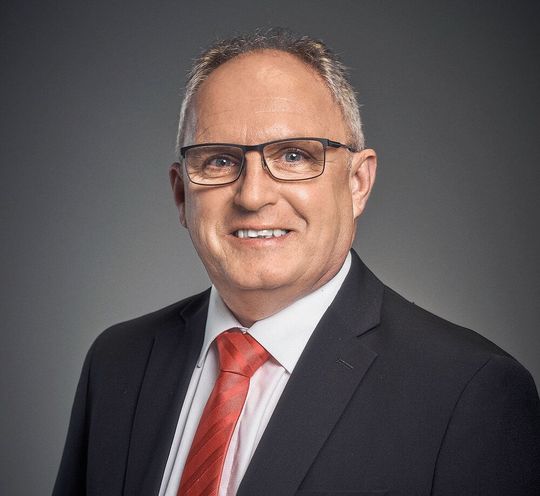
At this year's Smart Automation in Linz (Austria), Rittal introduced the VX ESS, a standard enclosure that can be equipped with battery modules. Helmut Ritter, Product and Industry Manager at Rittal Austria, explained to us what this is all about and how much potential this product holds.
Helmut Ritter from Rittal Austria: "The challenge was ultimately to develop cost-effective cabinets."
(Image: Hans Schubert)
The energy storage cabinets VX ESS are based on the freestanding cabinet of the VX series. How did the idea even come about to use an enclosure for battery storage for batteries?
The idea of developing energy storage cabinets arose from the growing demand for sustainable energy storage, particularly for electricity from renewable sources. The energy storage market, originally driven by photovoltaic systems, urgently needed a solution to efficiently store surplus electricity. In Europe, the industry initially held a strong market leadership in this sector, but it declined with the shift of battery module production to the Far East. In Europe, storage systems from the Far East were then assembled into cabinets that were individually designed—bent here, styled with colors there. Over time, the cost of storage systems continued to drop, but the designed cabinets did not—making them too expensive in relation to the product. Such a designer control cabinet is no longer attractive. The challenge was ultimately to develop cost-effective cabinets.
How did Rittal come to develop the energy storage cabinet?
Rittal has taken on this challenge and turned the designer cabinet into a standard cabinet—which is Rittal's strength. To achieve this, we surveyed all battery storage manufacturers about the size and weight of their batteries. The goal was to design a flexible standard cabinet that can accommodate over 80 percent of the storage modules available on the market. The framework is a standard VX cabinet, but the interior has been designed to be so flexible that it is height-adjustable, laterally adjustable, and depth-adjustable. We can accommodate up to 1,500 kilograms of battery modules. Using the rail system, an average of 16 modules can theoretically fit into the cabinet. This concept is now being made available to our customers worldwide because battery or module suppliers from the Far East do not ship cabinets with their products.
Are there no cabinets there?
No, that's neither logistically nor financially feasible. Additionally, the IEC 62208 is a European standard for enclosures, defining requirements such as impact resistance, temperature durability, and material properties. This presents a hurdle for manufacturers from the Far East, which is why they no longer ship enclosures. At Rittal, we have the ability in every subsidiary, at every location, and in every warehouse to deliver the cabinet directly to the customer, allowing them to install their battery elements. This significantly shortens the supply chain. Our systems are available worldwide.
Can it also be arranged like a regular control cabinet?
The Rittal energy storage cabinet is based on the proven VX-25 modular system, providing the option to expand the system as needed. So yes, the cabinets can be interconnected. Sometimes, these control cabinets need to be modified on-site, and thanks to their stability, they can easily be transported with a forklift or lifted using mounting eyelets. This is especially useful when the cabinets need to be positioned in hard-to-reach locations.
Are there differences compared to a conventional control cabinet?
No, the energy storage cabinet was developed to be based on a standard system that uses just nine components. The cabinet frame is available in two widths and depths—600 and 800 millimeters (approx. 24 and 30 inches)—resulting in 600 × 600 (approx. 24 × 24), 800 × 800 (approx. 30 × 30), and 600 × 800 (approx. 24 × 30)configurations. The height is always 2,000 millimeters (approx. 80 inches). The interior is then built upon this base, with a door and a rear panel added. That is the entire system.
Do I need additional ventilation if the cabinet is full?
Fundamentally, the energy storage cabinet, as a standard cabinet with standard interior, is individually expandable. The VX cabinet is designed as a passively ventilated standard enclosure, and it’s important to note: an efficient battery storage system should emit as little heat as possible, as heat emission indicates energy loss. Storage manufacturers naturally focus on minimizing losses so that their systems require as little cooling as possible. Otherwise, they would need to supply external energy or utilize their own, which would be counterproductive.
How do you assess the potential for these cabinets, especially in Europe?
The potential for energy storage cabinets in Europe is immense, particularly in connection with the rising demand for e-mobility and the use of renewable energies. The necessity to store energy temporarily for efficient distribution to charging stations or industrial applications calls for innovative storage solutions, as the grids are often too weak. The expansion of charging stations along highways with hyperchargers and their integration into private households and industries make energy storage cabinets an essential part of the future energy infrastructure, as there is nothing more to gain from the energy generated.
Date: 08.12.2025
Naturally, we always handle your personal data responsibly. Any personal data we receive from you is processed in accordance with applicable data protection legislation. For detailed information please see our privacy policy.
Consent to the use of data for promotional purposes
I hereby consent to Vogel Communications Group GmbH & Co. KG, Max-Planck-Str. 7-9, 97082 Würzburg including any affiliated companies according to §§ 15 et seq. AktG (hereafter: Vogel Communications Group) using my e-mail address to send editorial newsletters. A list of all affiliated companies can be found here
Newsletter content may include all products and services of any companies mentioned above, including for example specialist journals and books, events and fairs as well as event-related products and services, print and digital media offers and services such as additional (editorial) newsletters, raffles, lead campaigns, market research both online and offline, specialist webportals and e-learning offers. In case my personal telephone number has also been collected, it may be used for offers of aforementioned products, for services of the companies mentioned above, and market research purposes.
Additionally, my consent also includes the processing of my email address and telephone number for data matching for marketing purposes with select advertising partners such as LinkedIn, Google, and Meta. For this, Vogel Communications Group may transmit said data in hashed form to the advertising partners who then use said data to determine whether I am also a member of the mentioned advertising partner portals. Vogel Communications Group uses this feature for the purposes of re-targeting (up-selling, cross-selling, and customer loyalty), generating so-called look-alike audiences for acquisition of new customers, and as basis for exclusion for on-going advertising campaigns. Further information can be found in section “data matching for marketing purposes”.
In case I access protected data on Internet portals of Vogel Communications Group including any affiliated companies according to §§ 15 et seq. AktG, I need to provide further data in order to register for the access to such content. In return for this free access to editorial content, my data may be used in accordance with this consent for the purposes stated here. This does not apply to data matching for marketing purposes.
Right of revocation
I understand that I can revoke my consent at will. My revocation does not change the lawfulness of data processing that was conducted based on my consent leading up to my revocation. One option to declare my revocation is to use the contact form found at https://contact.vogel.de. In case I no longer wish to receive certain newsletters, I have subscribed to, I can also click on the unsubscribe link included at the end of a newsletter. Further information regarding my right of revocation and the implementation of it as well as the consequences of my revocation can be found in the data protection declaration, section editorial newsletter.
You showcased the energy storage cabinet at the Hannover Messe (German trade fair) and now at the Smart Automation (Austrian trade fair). Have you received any feedback on the product yet?
Yes, we have already received initial feedback and concrete project inquiries in collaboration with leading battery manufacturers and innovative start-ups. Over a year and a half ago, we reached out to battery manufacturers and storage suppliers to present our systems. As a result, several concrete projects are already underway. Companies such as Kite Rise Technologies from Graz and Salzstrom from Vienna, which focus on sodium-ion technology and saltwater batteries respectively, now include the Rittal energy storage cabinet as a standard component for their systems. They assemble the energy storage system using the standard cabinets and their battery systems from the available components.
Are there already companies in the industry or mechanical engineering sector using such storage systems?
Yes, especially industrial companies that rely on renewable energies and, for example, already use photovoltaics. An industrial company that produces from Monday to Friday has to sell its solar power at the lowest price on Saturday and Sunday—that’s almost a third of the year. These companies are now turning to energy storage: they purchase the storage module and already know where to buy control cabinets. The prices for energy storage systems are therefore continuing to decrease, making the investment in storage increasingly attractive for many companies. And this is the path we at Rittal must also follow with our energy storage cabinets.
The person handling control cabinet work in a company is not necessarily responsible for installing battery storage systems. Does this product target a new audience?
The target group is complex, as the use of energy storage systems varies across companies and industries. Whether it's technical departments, maintenance managers, energy officers, or CEOs—finding the right contact person can be challenging. That’s why Rittal places great emphasis on providing comprehensive information at trade fairs and events to make the product accessible to the widest possible audience. In personal discussions, it then becomes clear who the right contact person is. From my experience, the right person is always involved by the second meeting.
A look into the future: Is an ecosystem with storage providers planned, perhaps with "certified partners"?
That is not planned. Rittal focuses on treating every battery manufacturer as an equal partner: through an open approach to collaborating with as many battery producers as possible. Because only with many partners can we receive the necessary feedback to help us with further development.
Eng. Helmut Ritter
The electrical engineering graduate has worked for many years at an energy provider and has now been with Rittal GmbH in Vienna for nearly three years as Product Manager for Energy & Power Solutions.
5 Key Tips for Selecting Your Next Laser Cutting Machine
Facing rising demands and labor shortages, manufacturers must choose smarter laser systems. This guide helps you make informed decisions for flatbed and tube cutters—balancing cost, capacity, and future automation needs. Learn more about:
(Image: aai)
How to size your laser cutter for current and future production needs
Choosing the appropriate laser power for your material mix and thickness
Key differences between entry-level and high-performance cutting systems
When to consider tube laser cutting and how to evaluate its ROI
Why automation readiness is essential for operational efficiency in 2025



:quality(80)/p7i.vogel.de/wcms/de/45/de450b818441760d51de9d8d1895e8b3/0131815699v1.jpeg "HAM's carbide and PCD tools feature mirror-smooth surfaces and defined cutting edge preparations, even in catalog items, ensuring optimal chip removal. They are therefore perfect for minimal quantity lubrication. (Image:HAM)")
:quality(80)/p7i.vogel.de/wcms/6d/95/6d956e9b146a47bc6e731d42f48635ef/0131573143v1v1.jpeg "Can be done! The EU states have voted and are evidently of the opinion that the planned US tariff deal should be implemented ... (Image: F. Schneidler)")
:quality(80)/p7i.vogel.de/wcms/57/3e/573e5f8be45ba0d96122888a75ee68c0/0132000673v1.jpeg "EU Economic Affairs Commissioner Valdis Dombrovskis, speaking in the context of a reform of corporate tax rules, promises: “Our proposals for tax simplification include changes that will make life easier for businesses.” Read more here ... (Image:EU)")
:quality(80)/p7i.vogel.de/wcms/5b/99/5b99952e2dabf8632a55cfb60394c123/0131999764v1.jpeg "Billions are at stake! The preliminary proceedings for a project involving the construction of several cruise ships (stock photo) to be built by Meyer Werft and MSC are well underway ... (Image:Meyer Shipyard)")
:quality(80)/p7i.vogel.de/wcms/49/54/495466c2d41b13c5c3da89d985429692/adobestock-2071878125v1.jpeg "Until now, workers had to painstakingly inspect power lines by hand, a tough and dangerous job. The robotic snake takes over the riskiest climbing tasks for them. (Source: © Kingdola – stock.adobe.com/AI-generated)")
:quality(80)/p7i.vogel.de/wcms/04/f9/04f98d448f0b24db6ab7286148771e88/0132016788v1v1.jpeg "Humanoid robots are considered the automation of the future, where competencies from different disciplines come together. The Automatica 2027 trade fair, organized by Messe München (Germany), will therefore highlight this topic on a grand scale ... (Image: Image)")
:quality(80)/p7i.vogel.de/wcms/d1/71/d1718d8308b51d2e5c13e9772eb98841/thailand-20fastpass-main-20-282-29-3723x2094v1.jpeg "(Source: The Thailand Board of Investment (BOI))")
:quality(80)/p7i.vogel.de/wcms/12/c6/12c6bb1b6dbcdd48fd89da058cf5c80e/0131939666v1.jpeg "Libra is expected to process more than 256 corrected logical qubits and enable approximately one million reliable logical quantum operations. As part of an expanded collaboration with AWS, the system is expected to be available in the cloud via Amazon Braket starting in 2028. (Image:QuEra)")
:quality(80)/p7i.vogel.de/wcms/03/c2/03c2c967f78f3530377c100f88c4dd45/0132009221v1.jpeg "At Fraunhofer IAP, they have managed to achieve strong adhesive bonds virtually at the push of a button. Adhesive capsules are the secret... (Image: Fraunhofer IAP)")
:quality(80)/p7i.vogel.de/wcms/2e/3e/2e3e7b223f8074157a0892f8c37d8905/bild1-pgn-plus-anwendungsbild-07-04-2018v1.jpeg "Thanks to a digital solution for material selection, Schunk was able to identify new emission-reducing approaches and reduce the CO2 output of products. (Source: Schunk)")
:quality(80)/p7i.vogel.de/wcms/59/a1/59a13912afd2a517786fdf39b7ea588d/e7748318ea51436399aeab5985ffc9d6de9318ddv1v1.jpeg "The new process significantly reduces lead times and costs while expanding access to high-performance composite materials in new markets, including Advanced Air Mobility (AAM) and the defense industry. (Image:Greene Tweed)")
:quality(80)/p7i.vogel.de/wcms/e3/45/e34566a2ac2d4671f4f10db122da321e/newsimage423114v1.jpeg "Evonik is developing catalysts and adsorbents for the purification of pyrolysis oil to enable its use as a raw material in petrochemical processes. (Image: Evonik Industries AG)")
:quality(80)/p7i.vogel.de/wcms/19/82/19824ce92e1494103c20cbbd41fd7621/ee-20arrow-202-20--20copyright-202026-20artlist-20ltd-v1.jpeg "The E/E architectures of vehicles are currently being fundamentally redesigned. New or young automakers have enormous advantages in this process. (Image: 2026 Artlist Ltd)")
:quality(80)/p7i.vogel.de/wcms/07/a8/07a8130cbaa5ca065192eaa3132b7d31/0131974935v1.jpeg "In Hamburg (Germany), Bosch eBike Systems showcased new systems for e-bikes, such as the Hub Line hub motor. On the uneven harbor grounds with a decent breeze, the new systems were put through their paces. (Image: Stefanie Eckardt)")
:quality(80)/p7i.vogel.de/wcms/ef/d5/efd51deadaa11d27c590d660fd866d2c/0131935878v1.jpeg "The Deepal S05 PHEV has a system output of 190 kW/258 hp. (Image: Changan)")
:quality(80)/p7i.vogel.de/wcms/85/ab/85ab7d81f5802ad89ab406a36707cdc7/original-5650-polestar-260125-gfxii-dscf3929-v001-1-11483x6458v1v1.jpeg "Starting from the 2027 model year, Polestar will no longer be allowed to sell cars in the USA. (Image: Polestar)")
:quality(80)/p7i.vogel.de/wcms/fb/7a/fb7a7e5fb00d1aa0ea14ae80b5aee985/0132016773v1.jpeg "With the validation of the laser amplifier on an ion trap quantum computer from \"NeQxt,\" in collaboration with Fraunhofer IZM in Berlin, a building block for Europe's technological sovereignty in quantum computing is being established. (Image: \"NeQxt\")")
:quality(80)/p7i.vogel.de/wcms/cb/ff/cbfffaca40b8bb65e465e17dc7688c54/0131954057v1v1.jpeg "Excerpt from the existing editor extensions of the Open VSX Registry: The focus of development environments is increasingly shifting from local tools to external infrastructures. However, this has noticeable impacts on development processes themselves. (Image: Open VSX Registry)")
:quality(80)/p7i.vogel.de/wcms/cd/f3/cdf3648d8783d6ffdb387f68f406a135/0132008979v2v1.jpeg "OpenAI CEO Sam Altman (left) and Broadcom CEO Hock Tan (right) at the joint presentation of the jointly developed AI chip. (Image: OpenAI)")
:quality(80)/p7i.vogel.de/wcms/7e/da/7eda3e3c5b4046c7399e6bac74390828/0132004704v1.jpeg "Qualcomm is going on the AI offensive: With the Dragonfly C1000 CPU, the company aims to position itself as a strong provider of processors for AI workloads in data centers. At the same time, it plans to expand its China business by partnering with TikTok parent company Bytedance to produce ASICs for AI inference that do not fall under US trade restrictions. Additionally, the AI software startup Modular Technologies was acquired for $3.9 billion. (Image:Qualcomm)")
:fill(fff,0)/images.vogel.de/vogelonline/companyimg/76800/76895/65.jpg "FAULHABER_120mm.jpg ()")
:fill(fff,0)/p7i.vogel.de/companies/69/88/69882c428938e/tmts2026-ticec-banner-en-2000px.png "tmts2026-ticec-banner-en-2000px (https://www.tmts.tw/en)")
:fill(fff,0)/p7i.vogel.de/companies/69/de/69de1b7403b0d/simtos-logo.jpeg "simtos-logo (SIMTOS)")
:quality(80):fill(efefef,0)/p7i.vogel.de/wcms/67/ae/67ae0b9ac31f8/elatec-wp-universal-reader.png "Elatec WP Universal Reader")
:quality(80)/p7i.vogel.de/wcms/c7/c0/c7c0504abca9345d454f05fdf6561888/0126211340v1.jpeg "The modular bayed solution provides a cooling capacity of over 1 megawatt, ideal for the high power density of AI applications thanks to direct liquid cooling. (Image:Rittal GmbH & Co. KG)")
:quality(80)/p7i.vogel.de/wcms/f7/46/f7463fce73cce957a98c976326b0a916/0126791869v1.jpeg "Generously spacious: The new BMW plant in Debrecen. 2,000 new jobs have been created there. (Image:BMW Group)")