A Combi-Norm-Classic casing from Bopla, with customer-specific electronics and software from Kundisch, serves as the protective shell for a Condition Monitoring System for energy chains. The electronics had to be extremely responsive in order to capture, evaluate, and respond to sensor signals that sometimes last only a few milliseconds.
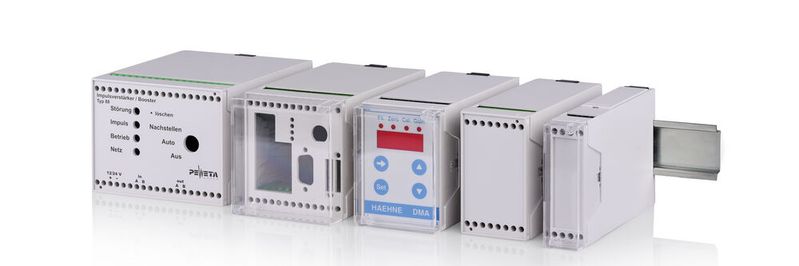
The functional DIN rail casings of the Combi-Norm-Classic series offer maximum installation space for circuit boards.
(Image: Bopla)
In the digital working world of Industry 4.0, where everything is interconnected, predictive maintenance and upkeep play a crucial role. In this world, even purely mechanical products such as energy chains must be able to provide information about their condition. Specifically for this purpose, Tsubaki Kabelschlepp offers a Condition Monitoring System (CMS) for its energy chains. With its help, users always have a view of the condition of their energy guides. If permissible wear limits or the thrust and tensile forces occurring over long travel distances are exceeded, the system triggers an alarm and stops the process. In this way, the lifespan of an energy chain system can be fully utilized. Premature replacement is prevented, and the facilities are well protected against damage and unplanned failures. This saves operators time and money.
Condition sensors measure the degree of wear
The functionality of the CMS is as simple as it is effective: Condition sensors in the guide channel or in the drag chain bracket measure the degree of wear of the glide shoes as well as the push and pull forces on the carriers of energy chains with precise percentage accuracy. Since every machine is different, users can program the system for various use cases and set the thresholds individually. Free switching outputs for connection to one's own machine and plant control systems are also available. Thus, the CMS is particularly suitable for process-critical machines and facilities where high availability must be ensured. This includes, for example, production lines or cranes in steel mills or bulk material plants.
Everything from a single source: casing, development, manufacturing
During the development of the CMS, the provider of energy chains had a knowledgeable partner at their side - Bopla Gehäusesysteme GmbH from Bünde in East Westphalia. "At first glance, you think of Bopla as a housing solutions provider, but not as a software or electronics development firm. But we can do that too," says Thorsten Penassa, Head of System Integration. The energy chain expert from the Sauerland region was also pleasantly surprised to find a provider in the specialists from Bünde who could offer everything from housing, through electronics and software development, to assembly including device testing and delivery in retail-ready packaging.
The Combi-Norm-Classic casing system
Combi-Norm-Classic is a functionally designed enclosure system for mounting on DIN EN 60715 TH 35 mounting rails. The cuboid design of the light gray ABS enclosures offers an optimally usable interior space in a compact design.
Screw terminals specifically tailored to the housing support two different installation situations for circuit boards: horizontally inserted and mounted parallel to the housing front. For horizontal circuit boards, there is also a plug-in solution for particularly quick replacement of defective devices in the event of service. To support the circuit board, the STL adapter CNA 100 must then be mounted.
To protect sensitive control elements, the front of the casing can be covered with a transparent protective hood. This can be folded up or down as desired, or completely removed.
Combi-Norm-Classic is also suitable for direct wall mounting. For this purpose, the DIN rail adapter is simply turned 180°.
High demands on the hardware and software
At the time of initial contact, there was only a rough specification sheet. It was only in the course of discussions that concrete specifications for the hardware and software emerged. The device had to be easily installable by the customer in the control cabinet and intuitively operable, and it had to function flawlessly even under harsh environmental conditions. At the same time, the user interface should be customizable, and the housing design should reflect the corporate identity of Tsubaki Kabelschlepp. The requirements for the electronics were particularly high. It had to be extremely responsive to capture, evaluate, and respond to sensor signals that sometimes lasted only a few milliseconds.
As we had no previous experience in this field, it was a great advantage for us that Bopla was able to offer us complete advice on the hardware and software and summarized all the requirements for the housing, membrane keypad and electronics in a specification sheet
Daniel Berger
DIN rail casing meets DIN EN 60715 TH 35
Bopla suggested a Combi-Norm-Classic housing as the protective shell for the CMS. The light gray DIN rail housings of this series are 75 millimeters deep, 109.5 millimeters high, and available in five different widths (22.5 mm, 45 mm, 55 mm, 70 mm, 100 mm). They meet the DIN EN 60715 TH 35, offer a customizable operating interface, can be easily installed in conventional control cabinets thanks to comprehensive accessories, and otherwise possess all the features desired by the energy chain expert. "At the beginning of the project, we had selected a narrow version of the housing. However, during the consultation with Bopla, our requirements for the hardware increased once again. Fortunately, these could easily be fulfilled by the larger Combi-Norm-Classic housing CN 100 AK," recalls Daniel Berger from product management.
Electronics and software development by specialists
After resolving the questions regarding the suitable housing, the required connections, and the arrangement of the membrane keyboard, display, and labeling, the sister company Kundisch GmbH & Co. KG was entrusted with the development lead up to the sampling. The company from Villingen-Schwenningen specializes in the development and manufacturing of high-quality, individual membrane keyboards and touch systems, including the required electronics and software, and works on its own as well as custom solutions for clients, such as the CMS for the energy chain expert from Sauerland, in cooperation with the Bünde-based company. "Such a device, or the required electronics and software, did not yet exist on the market in this form," says Gero Jantzen, Head of Electronics at Kundisch, who, along with his team, initially developed a prototype of the tension and compression force measuring device, which the energy chain expert then used for initial tests. Required changes to the hardware and software were incorporated into the specification document and the further development of the device.
Date: 08.12.2025
Naturally, we always handle your personal data responsibly. Any personal data we receive from you is processed in accordance with applicable data protection legislation. For detailed information please see our privacy policy.
Consent to the use of data for promotional purposes
I hereby consent to Vogel Communications Group GmbH & Co. KG, Max-Planck-Str. 7-9, 97082 Würzburg including any affiliated companies according to §§ 15 et seq. AktG (hereafter: Vogel Communications Group) using my e-mail address to send editorial newsletters. A list of all affiliated companies can be found here
Newsletter content may include all products and services of any companies mentioned above, including for example specialist journals and books, events and fairs as well as event-related products and services, print and digital media offers and services such as additional (editorial) newsletters, raffles, lead campaigns, market research both online and offline, specialist webportals and e-learning offers. In case my personal telephone number has also been collected, it may be used for offers of aforementioned products, for services of the companies mentioned above, and market research purposes.
Additionally, my consent also includes the processing of my email address and telephone number for data matching for marketing purposes with select advertising partners such as LinkedIn, Google, and Meta. For this, Vogel Communications Group may transmit said data in hashed form to the advertising partners who then use said data to determine whether I am also a member of the mentioned advertising partner portals. Vogel Communications Group uses this feature for the purposes of re-targeting (up-selling, cross-selling, and customer loyalty), generating so-called look-alike audiences for acquisition of new customers, and as basis for exclusion for on-going advertising campaigns. Further information can be found in section “data matching for marketing purposes”.
In case I access protected data on Internet portals of Vogel Communications Group including any affiliated companies according to §§ 15 et seq. AktG, I need to provide further data in order to register for the access to such content. In return for this free access to editorial content, my data may be used in accordance with this consent for the purposes stated here. This does not apply to data matching for marketing purposes.
Right of revocation
I understand that I can revoke my consent at will. My revocation does not change the lawfulness of data processing that was conducted based on my consent leading up to my revocation. One option to declare my revocation is to use the contact form found at https://contact.vogel.de. In case I no longer wish to receive certain newsletters, I have subscribed to, I can also click on the unsubscribe link included at the end of a newsletter. Further information regarding my right of revocation and the implementation of it as well as the consequences of my revocation can be found in the data protection declaration, section editorial newsletter.
The signal is only available for a fraction of a second
A crucial element in the CMS is the proximity switch, which determines the wear of the energy chain and issues an alarm as soon as a user-defined threshold is reached. The CMS continuously visualizes the percentage of this threshold that has already been reached. In addition to the highly fluctuating measurement values, particularly the signal of the proximity switch, which is available for only a fraction of a second, posed a significant challenge for the developers. "The energy chain only briefly grazes the sensor. This creates peaks that the software has to calculate out to get to the actual measurement result," explains Gero Jantzen. Besides the visualization of the current status and measurement value via the display and external signal transmitters, these can also be read out via USB for documentation and evaluation, for example, in the event of service.
Already plans for the next generation
The first version of the CMS has just hit the market. Yet, the Sauerland-based company already has plans for the next generation. At that point, the software is to be expanded. "The housing and electronics are already prepared to such an extent. Therefore, no further modification is necessary," says Gero Jantzen, and Daniel Berger adds: "We are very glad to have found a partner like Bopla. Our expectations were exceeded time and again."
About the companies
The company Tsubaki Kabelschlepp from Wenden in the Sauerland provides tailor-made energy guides made of steel/stainless steel, full plastic, or plastic with aluminum stays (hybrid energy guides) in standard sizes or custom dimensions to the millimeter. The range spans from small sizes of just a few millimeters, e.g., for use in inkjet printers, to huge, tons-heavy chains for oil platforms. In addition, the company also manufactures conveyor and guide rails.
Bopla, based in Bünde, East Westphalia, has been developing and producing application-specific plastic and aluminum electronic housings, as well as input units based on touchscreens and membrane keyboards, for more than 50 years. The application-specific housing applications are used, among other things, in measurement, control, and regulation technology, in machine and plant engineering, as well as in medical and railway technology.
Kundisch GmbH & Co.KG, founded in 1979, specializes in the manufacture and development of high-quality membrane keyboards and touch systems. The membrane keyboards are used in both simple handheld devices and high-end medical equipment.



:quality(80)/p7i.vogel.de/wcms/53/f7/53f7dadbe4d656a3fd4f4077445f29f6/0129828707v1.jpeg "Thanks to its compact design and drilling/unscrewing function, the Fire Birdie is suitable for applications with limited installation space and frequent tool changes. (Image:Marcel Kraibühler)")
:quality(80)/p7i.vogel.de/wcms/da/4d/da4da8d34671dc6bce80e496212de877/0129850788v1.jpeg "Mate-XT Go supports the arms and shoulders during overhead work and repetitive tasks and is designed to significantly reduce muscle strain in everyday working life. (Image:Comau)")
:quality(80)/p7i.vogel.de/wcms/95/97/95976dbaac68b249eb65e74c5aad5300/0129651893v1.jpeg "The C2.0 centric clamps, the S2 fixed jaw clamps and the \"gredoc\" zero-point clamping systems are used for machining the raw parts. Fastening is carried out with width across flats 27. (Image:Gressel)")
:quality(80)/p7i.vogel.de/wcms/57/1b/571b8895efb299d70846bbdbd7af2338/0130043886v1.jpeg "Servo hydraulics independent of the control system: The servo hydraulics software module is integrated directly into the b Maxx 5500 servo drive (pictured: Mehmet Sari, Export Sales Manager at Hürsan Pres (left), Özgür Deniz Demirbaş, Country Manager at Baumüller Turkey) (Image:Baumüller)")
:quality(80)/p7i.vogel.de/wcms/3b/27/3b27f6c5848be73acecb04054bf0a146/0130115209v1.jpeg "Spectroscopic glucose measurement with infrared spectroscopy enables more regular measurements without physical strain. (Image:Endrich)")
:quality(80)/p7i.vogel.de/wcms/3f/cc/3fccb748b0fe16f1f61249d94c72f126/0130149439v1.jpeg "Requirements for integrated power supply systems: Precise AC and DC power supply systems that not only provide energy, but also reliably combine measurement, analysis and system integration. (Image:Schulz Electronic)")
:quality(80)/p7i.vogel.de/wcms/fd/93/fd93e01c16f5a4709278499d981a459c/0130061090v1.jpeg "Revealed: These servo drives are assembled at Aerotech in Fürth. (Image:Aerotech)")
:quality(80)/p7i.vogel.de/wcms/cb/8a/cb8ae7f5205365efce3e7285154fc3cf/0130132198v1.jpeg "Markus Huber (left) and Nicolai Friis from TU Wien know how to make quantum computers multidimensional in order to perform computing operations even better. (Image:TU Vienna / A. Rommel)")
:quality(80)/p7i.vogel.de/wcms/63/21/6321beb732bf7d92640df46d7aa77573/0130125122v1.jpeg "As part of the Carbon Lab Factory Lausitz, a pilot plant for the production of sustainable, cost-effective and competitive carbon fibers will be built at the Guben site. (Image:Fraunhofer IAP / Kristin Stein)")
:quality(80)/p7i.vogel.de/wcms/53/4f/534fe0f168f6ee070ded4a48faca4cef/business-wire-main-image-1103x620v1.jpeg "The new UR AI Trainer, developed by Universal Robots and Scale AI, is the first direct lab-to-factory solution for AI model training.
(Source: Universal Robots)")
:quality(80)/p7i.vogel.de/wcms/08/70/087062e2e1a9b9add5777410dd746ee9/adobestock-1923991605-5607x3156v1v1.jpeg "A new type of tactile sensor, inspired by human skin, even recognizes grains of sand. (Image:Curioso.Photography - stock.adobe.com)")
:quality(80)/p7i.vogel.de/wcms/7f/08/7f087d7013424d123ab7275cd2e3fe55/adobestock-809456218--c2-a9-20degimages-20-e2-80-93-20stock-adobe-com-ki-generiert-4179x2351v1v1.jpeg "The digital upgrading of existing machines conserves resources, saves energy and reduces the need for new production. (Image:Degimages - stock.adobe.com/AI-generated)")
:quality(80)/p7i.vogel.de/wcms/90/db/90db3087d3af0560fcdb4dbc42443ce1/0130157448v1.jpeg "The switch to SDV is the most complex transformation the industry has ever had to master. The end consumer gets a vehicle that gains rather than loses value over its lifetime. (Image:Sonatus)")
:quality(80)/p7i.vogel.de/wcms/73/f0/73f00bb99a23197db05bb584fe78f20f/0130080581v1.jpeg "The \"China Speed\" analysis by Roland Berger shows that the speed of development has only a limited connection with labor costs. (Image:freely licensed at Pexels)")
:quality(80)/p7i.vogel.de/wcms/2f/5b/2f5ba6a150b52c2b8efada560c5cdafe/0130143442v1.jpeg "Automotive suppliers are facing a severe crisis, which is primarily due to a combination of structural change and economic problems. (Image:freely licensed at Pexels)")
:quality(80)/p7i.vogel.de/wcms/22/d0/22d03cd48e992435338b59464c428d41/0129739814v1.jpeg "More electric vehicles on the roads mean a higher demand for electricity - which should ideally be covered by renewable energies. (Image:BMW)")
:quality(80)/p7i.vogel.de/wcms/94/7a/947ac066b98cbcd3470e83ff9da3e25f/0130096114v1.jpeg "The use of amorphous steels in the stator enables a significant reduction in losses and increases the efficiency of modern electric motors in vehicle drives. (Image:Horse Powertrain)")
:quality(80)/p7i.vogel.de/wcms/e5/f1/e5f171d3d7ae021332cc0aeae4d6e299/0130127049v1.jpeg "In collaboration with Shanghai Jiao Tong University, Lenovo has presented a silicon anode battery under the name \"ED1000\" as a proof of concept for mobile workstations. (Image:Lenovo)")
:quality(80)/p7i.vogel.de/wcms/fa/69/fa696e59706b96fff02283dd74cc2398/0130129635v1.jpeg "Samsung Co-CEO Jun Young-hyun wants to respond to the AI-driven boom in demand in the memory market with contracts for up to five years. This should provide more planning security in the traditionally volatile storage business. At the same time, however, this is likely to increase the pressure on customers to secure precise long-term requirements, prices and supply chains. (Image:Samsung)")
:quality(80)/p7i.vogel.de/wcms/31/a8/31a883a47b86634c382923e78fd9a4c9/0130133225v1.jpeg "Figure 1: GMSL-capable point-to-point connection. (Image:ADI)")
:fill(fff,0)/images.vogel.de/vogelonline/companyimg/76800/76895/65.jpg "FAULHABER_120mm.jpg ()")
:fill(fff,0)/p7i.vogel.de/companies/67/eb/67eba621ef6ea/logo2.png "logo2 (Wuxi InfiMotion)")
:quality(80)/p7i.vogel.de/wcms/80/32/80324340d2e717f607cedb7325f588af/0116863911v1.jpeg "Speziell auf das Gehäuse abgestimmte Schraubklemmen unterstützen zwei verschiedene Einbausituationen für Leiterplatten: horizontal eingeschoben und parallel zur Gehäusefront montiert. (Bild: Bopla)")
:quality(80)/p7i.vogel.de/wcms/ff/b4/ffb4988c2b143513359747986abf617d/0116863905v1.jpeg "Eine optionale transparente Schutzhaube schützt empfindliche Bedienelemente. Sie lässt sich wahlweise nach oben oder unten klappen bzw. komplett entfernen. (Bild: Bopla)")
:quality(80)/p7i.vogel.de/wcms/20/c0/20c0a91aadefa8bcb6b0946f3b0b1ecd/0116860889v1.jpeg "Das Condition Monitoring System von Tsubaki Kabelschlepp protokolliert u.a. den Verschleiß der Gleitschuhe an der Kette über die Lebensdauer einer Maschine.(Bild: TSUBAKI KABELSCHLEPP)")
:quality(80)/p7i.vogel.de/wcms/00/e2/00e25fdeddaed92ce2fd68fa87c0b696/0116862018v1.jpeg "Das Condition Monitoring System eingebaut im Schaltschrank. (Bild: TSUBAKI KABELSCHLEPP)")
:quality(80)/p7i.vogel.de/wcms/bf/40/bf40618a6cd0e5037592d63928387bed/0125738411v1.jpeg "The pre-assembled Totaltrax systems from Tsubaki Kabelschlepp help the user focus on their core competencies. Additionally, they improve process planning, ensure cost transparency, and provide quality assurance. (Image:Tsubaki Kabelschlepp)")
:quality(80)/p7i.vogel.de/wcms/08/72/0872dd2dd119a54824c41e0e580e45a8/0129576591v1.jpeg "The Rose enclosure systems can be customized on request. (Image:Rose Systemtechnik GmbH)")