In China, several vehicle fires have sparked a debate about the safety of electric cars. The debate is heated in private and in the media.
The safety of electric cars is currently the subject of much debate in China.
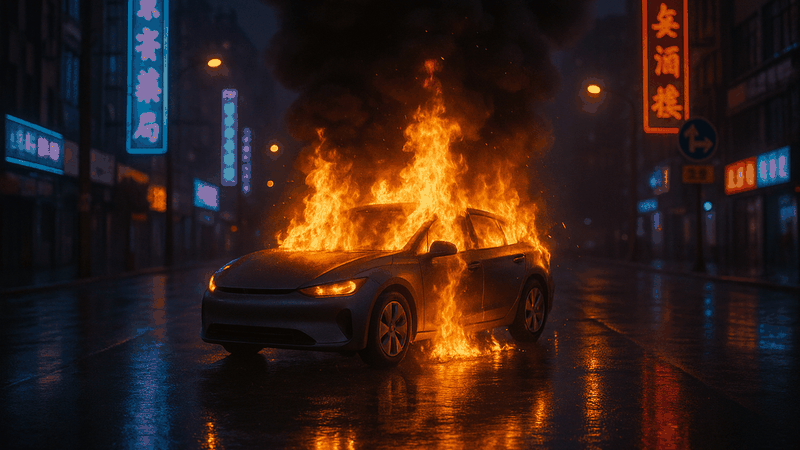
(Image: Image: AI-generated)
Three dangerous fires within a few days have triggered a new debate in China about the safety of electric cars. From the state television station CCTV to the trade press and social media, the debate is heated.
“I have completely lost trust in ternary lithium batteries,” quotes the portal Jiazi Guangnian from a user. All three fires involved rather expensive sedans equipped with ternary NCM batteries.
On October 23, a "Li Mega" caught fire at an intersection in Shanghai. A camera recorded how the first sparks were visible under the chassis. It allegedly took less than ten seconds for the entire car to be engulfed in flames.
Passengers Were Lucky
Fortunately, this time the doors could still be opened, and the occupants were able to quickly escape to safety. However, the fire blazed so intensely that not much was left of the car after a short time. The video went viral on social media and shocked many Chinese viewers.
Just a day later, on October 24, a Porsche Taycan caught fire in Xi'an, in western China. Here, as well, reports dramatically but accurately described that "only a skeleton was left." After the fire, only the heavily charred frame of the German luxury car remained.
Fire After Collision
The third fire in this infamous series occurred on October 13 in Chengdu, the capital of Sichuan Province. This incident followed a collision before the involved Xiaomi SU7 Ultra caught fire and burned. The driver tragically lost their life in the accident.
The spate of these fires and the dramatic images have sparked a fierce debate in China once again about "whether electric vehicles are truly safe." Even industry media are referring to a crisis that has reportedly set back public trust in electromobility by ten years.
Debate Started in Spring 2025
One reason for the particularly strong public reaction is that a similar debate took place earlier in the spring. On March 29, three female students burned alive in a Xiaomi "SU7" because the car doors could not be opened from the inside or outside after the vehicle caught fire following an accident.
This tragic incident occurred at a highway construction site in Anhui Province. The manufacturer Xiaomi later announced that its NOA autopilot had functioned correctly and had warned the driver of the obstacle. Nevertheless, all of China was left in shock.
Authorities Enact New Rules
Following the fatal Xiaomi accident in March, the Chinese government responded relatively quickly by issuing new, stricter regulations—both regarding the fire safety of automotive batteries and the safety mechanisms for door handles in emergencies.
Among other mandates, it was ordered that the mechanical stability of the batteries must be improved to reduce the risk of dangerous "thermal runaway" in the event of overheating. Manufacturers have also been required to conduct a series of new tests before they can sell a new electric drive model.
Additionally, the extensive regulations stipulated a minimum duration of five minutes during which a vehicle should not be completely engulfed in flames, allowing occupants enough time to escape. These regulations have long since come into effect.
“Clearly, the Li Mega in this incident did not meet this standard,” commented Jiazi Guangnian following the dramatic fire in Shanghai on October 23.
Vehicles Ignited in Seconds
In all three fires in October, observers speculate that thermal runaways occurred, pointing to the almost explosive speed with which the flames spread. State broadcaster CCTV reported that in one of the cases, it took only 64 seconds for the flames to engulf the vehicle, while the Li Mega took about ten seconds to catch fire.
In the current cases, the results of ongoing investigations by the authorities are still pending. Therefore, many of the debates currently circulating are still speculative—yet this does not dampen their intensity. China's automotive industry is clearly experiencing another crisis of confidence regarding electric vehicles, particularly pure electric vehicles (BEVs).
Boundaries of Battery Technology Overstepped
Experts are questioning whether the race for greater ranges and shorter charging times has pushed battery design into dangerous territories. They remind us that range, charging power, and safety are interconnected in a complex relationship.
Date: 08.12.2025
Naturally, we always handle your personal data responsibly. Any personal data we receive from you is processed in accordance with applicable data protection legislation. For detailed information please see our privacy policy.
Consent to the use of data for promotional purposes
I hereby consent to Vogel Communications Group GmbH & Co. KG, Max-Planck-Str. 7-9, 97082 Würzburg including any affiliated companies according to §§ 15 et seq. AktG (hereafter: Vogel Communications Group) using my e-mail address to send editorial newsletters. A list of all affiliated companies can be found here
Newsletter content may include all products and services of any companies mentioned above, including for example specialist journals and books, events and fairs as well as event-related products and services, print and digital media offers and services such as additional (editorial) newsletters, raffles, lead campaigns, market research both online and offline, specialist webportals and e-learning offers. In case my personal telephone number has also been collected, it may be used for offers of aforementioned products, for services of the companies mentioned above, and market research purposes.
Additionally, my consent also includes the processing of my email address and telephone number for data matching for marketing purposes with select advertising partners such as LinkedIn, Google, and Meta. For this, Vogel Communications Group may transmit said data in hashed form to the advertising partners who then use said data to determine whether I am also a member of the mentioned advertising partner portals. Vogel Communications Group uses this feature for the purposes of re-targeting (up-selling, cross-selling, and customer loyalty), generating so-called look-alike audiences for acquisition of new customers, and as basis for exclusion for on-going advertising campaigns. Further information can be found in section “data matching for marketing purposes”.
In case I access protected data on Internet portals of Vogel Communications Group including any affiliated companies according to §§ 15 et seq. AktG, I need to provide further data in order to register for the access to such content. In return for this free access to editorial content, my data may be used in accordance with this consent for the purposes stated here. This does not apply to data matching for marketing purposes.
Right of revocation
I understand that I can revoke my consent at will. My revocation does not change the lawfulness of data processing that was conducted based on my consent leading up to my revocation. One option to declare my revocation is to use the contact form found at https://contact.vogel.de. In case I no longer wish to receive certain newsletters, I have subscribed to, I can also click on the unsubscribe link included at the end of a newsletter. Further information regarding my right of revocation and the implementation of it as well as the consequences of my revocation can be found in the data protection declaration, section editorial newsletter.
The Li Mega utilizes a Qilin battery from CATL with ternary chemistry and 5C fast charging. The system energy density is reported to be up to 255 Wh/kg, bringing the cell chemistry close to the physical limits of liquid lithium systems. Particularly, the "811" type among ternary batteries is again hotly debated due to its history of frequent fires.
Li Auto and CATL Provide No Information
Neither CATL nor Li Auto has disclosed since the accident in Shanghai whether the battery that caught fire this time was one with the so-called NCM-811 composition. Batteries of this type have a particularly high nickel content, which increases performance but also raises the risk of fire.
Until further details are available, it remains to be seen whether this could be one of the causes. However, the public debate is not waiting for this. "811 is the most dangerous," is one of the widespread comments following the Li Mega fire.
Stricter Regulations Followed—Still Caught Fire
The government's regulatory framework is also being discussed again. Since July 1, 2025, a stricter mandate has been in place stating that batteries must not catch fire or explode even in the event of a thermal incident.
Li Auto had reported in May 2025, prior to the regulation coming into effect, that all its models introduced since 2022 met this new standard, including the Mega. Now the company finds itself in a position requiring clarification.
Insight into Battery Management Systems
Professionals in the Chinese industry are discussing in detail the technical balancing act between strong battery performance and the necessary safety.
In recent years, manufacturers have increasingly optimized the use of materials, battery design, and battery management systems (BMS) for high performance. This includes using graphite coatings with smaller particle sizes to accelerate ion uptake on the negative electrode, reducing the likelihood of what is known as lithium plating.
Optimized battery management systems monitor current, voltage, and temperature with increasing accuracy and are intended to interrupt the circuit in case of emergency. However, this apparently does not prevent fire hazards in certain situations.
"In high-performance systems, short circuits can still exceed the sampling rate and response time of such BMS," writes the journal Yujian Insight in an analysis.
New Cell Concepts in Focus
So far, there appears to be no completely safe design to prevent battery fires. Even BYD's elongated "Blade Cell," which is regarded as very safe in the industry, improves heat dissipation but poses the risk that the very long cells might bend during collisions, potentially causing internal short circuits, as discussed in the debate.
Another possible weakness currently under intense discussion is the "passive isolation" between the cells. CATL's Qilin system integrates multi-layer interlayers made of aerogel and cooling plates, which are intended to prevent the spread of fires from hotspots to the entire battery.
However, if one of these barriers fails or partially loses its protective effect in critical situations, heat can apparently be transferred between cells even faster than with other design solutions. One of the questions at hand concerns the reliability of these aerogel layers, which could vary among different battery types.
Performance Must Not Come at the Expense of Safety
Other observers remind us that fires in electric vehicles are statistically rare, and vehicles with internal combustion engines also occasionally catch fire. However, in electric vehicles, the window of time for escape is often smaller. This makes early warning systems, crash resistance, and thermal decoupling crucial.
All voices in the Chinese industry agree that performance should no longer come at the expense of safety. Similar to many years ago with Tesla, which continuously improved its BMS and battery design after initial problems with battery fires, a phase of even greater focus on fire safety is likely beginning in China.



:quality(80)/p7i.vogel.de/wcms/94/81/948196fc18c3feb4ec87165b218b5650/0129493778v1.jpeg "This is the Vector reconnaissance drone from the start-up Quantum Systems from Gilching near Munich. The specialists are so well received by investors that they can now look forward to an injection of 150 million euros to strengthen their position even further. (Image:Quantum Systems)")
:quality(80)/p7i.vogel.de/wcms/da/b1/dab1af09c1f7fd43c841d8c8c60882d7/0129466462v1.jpeg "The yellow device is an auxiliary tool that Subaru needs in vehicle production. The production of such tools can now be accelerated using the high-speed T25 nozzle from Stratsys in combination with the F770-3D 3D printer. Read more here ... (Image:Subaru)")
:quality(80)/p7i.vogel.de/wcms/26/50/2650410753c0bdf9c55989b752891a4f/0129485561v1.jpeg "Northern German industrial companies' confidence in relations with the USA is waning. (Image:ChatGPT)")
:quality(80)/p7i.vogel.de/wcms/37/9f/379f62914fcef347331e271270e3f755/ad1i8940-4368x2456v1.jpeg "(Source: SIMTOS)")
:quality(80)/p7i.vogel.de/wcms/05/63/05633ca5deb577945793fd0f553356b3/0129493475v1.jpeg "Lapp continued to invest in production capacities and technologies worldwide in the 2025 financial year. (Image:Lapp)")
:quality(80)/p7i.vogel.de/wcms/97/3a/973acc83133c28605f855d750523142e/0129492013v1.jpeg "During the opening, Agile One symbolically pressed the start button. (Image:Deutsche Telekom AG / Cindy Albrecht)")
:quality(80)/p7i.vogel.de/wcms/dd/4e/dd4e6ce73e0e700dcc0f0584813ef47f/0128875162v1.jpeg "Thanks to their high precision, robustness and integration capability, Micro-Epsilon's measurement technology solutions are not only suitable for new systems, but also ideal for retrofit applications. (Image:Micro-Epsilon Messtechnik GmbH & Co. KG)")
:quality(80)/p7i.vogel.de/wcms/17/61/1761a0165c23fe007d0a8e62d2a23121/0129467133v1.jpeg "The partnership between Dassault Systèmes and Nvidia aims to make the industry more effective with the help of AI and digital twins. (Picture: ©DC Studio - stock.adobe.com)")
:quality(80)/p7i.vogel.de/wcms/9b/e7/9be7c2ceb897aa2bf1ab4eb2198b8b96/roboter-20hand1-1240x698v1v1.jpeg "What if you could 3D print a soft robot with predictable shape-shifting capabilities already built in? (Image:Picture: Harvard University)")
:quality(80)/p7i.vogel.de/wcms/a7/34/a73475e9638e032c32288f53006abab7/newsimage417867-2665x1500v1v1.jpeg "Combination of a model from a scanning electron microscope image (left) with a section of the underlying crystal structure of a studied MXene with precisely controlled surface terminations. (Image:B. Schröder/HZDR)")
:quality(80)/p7i.vogel.de/wcms/d2/1a/d21a9b3e1333f306ffd6421e84f9e3d0/semiconductor-20image-20courtesy-20of-20gelest-3000x1688v1.jpeg "In a new collaboration, IBM will test the performance of Gelest precursor materials for dry resist EUV lithography, generating results that aim to guide Gelest on materials research and speed innovation toward smaller devices. (Source: Gelest)")
:quality(80)/p7i.vogel.de/wcms/f5/c6/f5c6cefa374d48138dc702821d41c7c6/greenspeed-visual-home-1500x843v1v1.jpeg "The EU Green Speed project is laying the foundations for cleaner and more competitive production of lithium-ion batteries in Europe. (Image:greenSPEED Consortium / VIRTUAL VEHICLE)")
:quality(80)/p7i.vogel.de/wcms/b9/47/b9470dd7a30574d74b6d95d26e4e4ee8/0129473060v1.jpeg "UE Studios has presented the Self-Driving Urban E-Shuttle to the public for the first time. (Image:UE Studios)")
:quality(80)/p7i.vogel.de/wcms/d0/bb/d0bb569e57d4b98f28bfa4b9600b245e/0129453908v1.jpeg "Tobias Sühlmann is Head of Design at Porsche. (Image:McLaren)")
:quality(80)/p7i.vogel.de/wcms/eb/73/eb73c6f1dc08af55057cfc298c8ef72f/0128683789v1.jpeg "Alpina has been an independent brand since January. In the picture: the BMW Alpina Roadstar V8 from 2002. (Image:BMW)")
:quality(80)/p7i.vogel.de/wcms/b7/1d/b71d25d354a0800790b525ebacd45168/a260075-large-960x540v1v1.jpeg "With the AI-supported dryer control system, Audi is testing the first application from an IPAI cooperation in series production in the paint shop at the Neckarsulm site. (Image:Audi)")
:quality(80)/p7i.vogel.de/wcms/8d/ff/8dffe7518cc69b90ea89c7b37f7de781/0129470810v1.jpeg "Demo of the ChipStack AI Super Agent. (Image:Cadence)")
:quality(80)/p7i.vogel.de/wcms/35/a7/35a7cbca29eb719318324ca2e70c33c7/0129484567v1.jpeg "The above-ground part of the IceCube experiment and the graphic simulation of a measurement signal from the detectors in the ice. Researchers can measure cosmic neutrinos with the IceCube observatory. (Image:Stephan Richter, IceCube; photomontage: Beatrix von Puttkamer)")
:quality(80)/p7i.vogel.de/wcms/42/c0/42c09f523fbe58320ac017087fb678b4/0129455974v1.jpeg "Schematic representation of a microlaser with a surface grating structured with nanometer precision. The compact semiconductor laser generates a directed beam of light with a beam profile that is precisely tailored to the respective application. (Image:AG Reitzenstein/TU Berlin)")
:quality(80)/p7i.vogel.de/wcms/72/e8/72e82e7be7eb9c7f3fe6e7bd6442b95d/0129427931v1.jpeg "Strategic: EPC licenses eGaN technology to Renesas (Image:freely licensed)")
:fill(fff,0)/images.vogel.de/vogelonline/companyimg/76800/76895/65.jpg "FAULHABER_120mm.jpg ()")
:fill(fff,0)/p7i.vogel.de/companies/67/eb/67eba621ef6ea/logo2.png "logo2 (Wuxi InfiMotion)")
:quality(80)/p7i.vogel.de/wcms/d6/11/d611c03c0e5295f971753064c76d16b2/100d8a012u9685c41272efa4bb35cc26-2560x1439v1v1.png "The schematic structure of CATL's new Shenxing Pro battery. (Source: CATL)")
:quality(80)/p7i.vogel.de/wcms/5f/53/5f5397effeaca69009f9a4fd839a47c7/0124325750v1.jpeg "German manufacturers like Mercedes-Benz must put in a special effort in China to avoid losing ground there. (Image:Mercedes-Benz AG)")