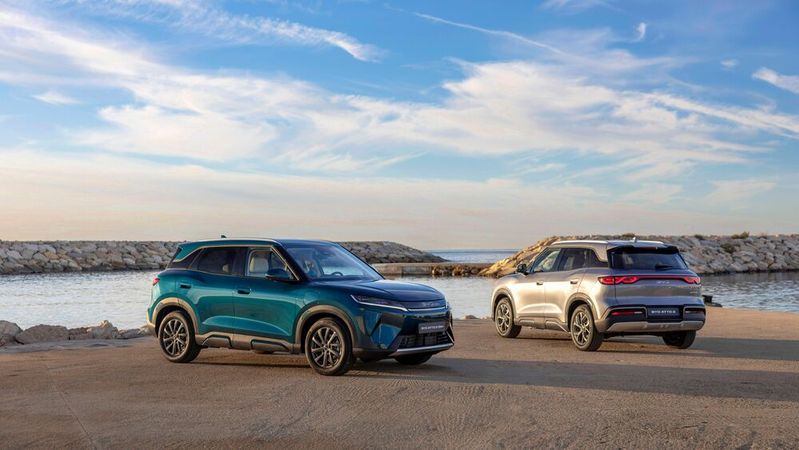
After the introduction of the electric compact SUV Atto 2 in the spring, there was criticism of the poor charging speed and low range. Now BYD has made improvements and is additionally offering a plug-in hybrid.
BYD steps up the powertrain for the Atto 2.
(Image: BYD)
The handbrake is slowly being released. Chinese manufacturers are gradually gaining traction in Germany as the skepticism of car buyers gives way to a certain level of acceptance and curiosity. By October of this year, around 47,000 vehicles from Chinese manufacturers had been registered here. Counting brands that belong to Chinese corporations, such as Volvo, Polestar, Smart, or Lotus, the number is significantly higher.
Chinese number one in Germany remains MG. Behind it, BYD has been gaining significant momentum with over 16,000 units in the first ten months. In 2024, the total was only 2,900 units. The manufacturer is no longer viewed askance like an uninvited guest at the German auto buffet. This is not only due to the attractive prices and broadly appealing design but also to the steep learning curve. A clear example of this is the compact SUV Atto 2. Introduced only in March, the Chinese are already responding to initial criticism.
At market launch, range and charging performance were considered disappointing and hardly suitable for long-distance travel, while the drivetrain technology was deemed okay but not groundbreaking. This is exactly where BYD stepped in—presenting an electrified double flagship that recharges the SUV: the Atto 2 Comfort as the all-electric top version and the plug-in hybrid Atto 2 DM-i as the range king.
Significantly Larger Battery
First, to the electric model. While the existing E-versions Active and Boost remain in the lineup, BYD becomes significantly more competitive with the new Atto 2 Comfort (starting at US$ 48,700). Its Blade battery, integrated into the vehicle's structure to provide increased stability, still relies on LFP chemistry but now offers significantly higher performance. The spec sheet now lists nearly 65 kWh of usable capacity—an increase of almost 20 kWh compared to the previous versions. The enlarged battery is the key to the promised range increase to 267 miles (previously 194 miles), and in city driving, it is said to exceed 373 miles.
But range alone is just one note in the overall composition. Charging performance, in particular, is becoming an increasingly decisive purchasing factor. BYD has responded here as well with a remarkable leap: the Atto 2 Comfort now charges with up to 155 kW DC (previously 65 kW). This reduces the charging time from 30 to 80 percent to 19 minutes—a figure that suddenly propels the model into the top third of compact SUVs. Due to the new battery weighing around 331 pounds more, the performance has also been adjusted. It now stands at 150 kW instead of 130 kW, with 230 lb-ft of torque instead of 215. This keeps the Atto 2 a zippy contender, accelerating from 0 to 62 mph in 7.9 seconds. During the first test drive, it also became apparent that BYD has likely improved the insulation of driving noise. The SUV rolls extremely quietly, which in turn highlights wind noise more prominently.
To make room for the new battery, the E-Platform 3.0 was also modified for the Comfort version. A complex multi-link rear suspension replaces the previous torsion beam axle—a costly transplant that has paid off. Driving precision and stability have improved, although the Atto 2 already comes from the sporty corner. Tuned more firmly than softly, you can certainly feel the condition of the road surface. Nevertheless, it offers a decent compromise between handling and comfort. Another advantage of the new suspension is the added space in the trunk. 119 gallons mean 13.2 gallons more than before.
Inside, the electric Atto 2 demonstrates that BYD has reached a level of material quality and craftsmanship in a short time that leaves little room for criticism—at least in its brand-new state. Added to this is a generous standard equipment package, which offers a few more extras compared to the other E-versions. These include faster USB ports, 50-watt charging pads for two phones, or an electric lumbar support for the driver. There is also a large panoramic roof, plenty of assistants, a 12.8-inch touchscreen, and a multimedia system that executes commands swiftly—and a strict female voice that sharply reprimands any little driver inattentiveness from the off: "Keep your eyes on the road!"
Atto 2 DM-i: Plug-in Hybrid
We switch the driver's seat and get into the Atto 2 DM-i. BYD has already presented this plug-in hybrid concept a few weeks ago in the Seal. It targets those who have so far been hesitant to fully trust pure electric drives and prioritize reliability on longer journeys. While many European manufacturers are scaling back or reorganizing their PHEV programs, BYD is placing significant emphasis on this hybrid technology, which is experiencing massive growth in China.
Date: 08.12.2025
Naturally, we always handle your personal data responsibly. Any personal data we receive from you is processed in accordance with applicable data protection legislation. For detailed information please see our privacy policy.
Consent to the use of data for promotional purposes
I hereby consent to Vogel Communications Group GmbH & Co. KG, Max-Planck-Str. 7-9, 97082 Würzburg including any affiliated companies according to §§ 15 et seq. AktG (hereafter: Vogel Communications Group) using my e-mail address to send editorial newsletters. A list of all affiliated companies can be found here
Newsletter content may include all products and services of any companies mentioned above, including for example specialist journals and books, events and fairs as well as event-related products and services, print and digital media offers and services such as additional (editorial) newsletters, raffles, lead campaigns, market research both online and offline, specialist webportals and e-learning offers. In case my personal telephone number has also been collected, it may be used for offers of aforementioned products, for services of the companies mentioned above, and market research purposes.
Additionally, my consent also includes the processing of my email address and telephone number for data matching for marketing purposes with select advertising partners such as LinkedIn, Google, and Meta. For this, Vogel Communications Group may transmit said data in hashed form to the advertising partners who then use said data to determine whether I am also a member of the mentioned advertising partner portals. Vogel Communications Group uses this feature for the purposes of re-targeting (up-selling, cross-selling, and customer loyalty), generating so-called look-alike audiences for acquisition of new customers, and as basis for exclusion for on-going advertising campaigns. Further information can be found in section “data matching for marketing purposes”.
In case I access protected data on Internet portals of Vogel Communications Group including any affiliated companies according to §§ 15 et seq. AktG, I need to provide further data in order to register for the access to such content. In return for this free access to editorial content, my data may be used in accordance with this consent for the purposes stated here. This does not apply to data matching for marketing purposes.
Right of revocation
I understand that I can revoke my consent at will. My revocation does not change the lawfulness of data processing that was conducted based on my consent leading up to my revocation. One option to declare my revocation is to use the contact form found at https://contact.vogel.de. In case I no longer wish to receive certain newsletters, I have subscribed to, I can also click on the unsubscribe link included at the end of a newsletter. Further information regarding my right of revocation and the implementation of it as well as the consequences of my revocation can be found in the data protection declaration, section editorial newsletter.
Visually, the Atto 2 DM-i shows hardly any differences compared to the E-versions. These are limited to the lettering and open instead of closed slats under the license plate. Technically, however, the DM-i takes a completely different path. It combines a 0.40 gallon gasoline engine with two electric motors and a battery. Two configurations are available. First, the Active version (starting at US$ 41,800) with a system output of 122 kW and a 7.8 kWh battery, which is said to achieve 25 miles purely electrically and promises a total range of 578 miles . Second, the DM-i Boost (starting at US$ 45,200) with 156 kW and a battery capacity of 18 kWh. It is said to achieve 56 miles purely electrically, with BYD claiming a total range of almost 621 miles.
Thermal Efficiency of 43 Percent Surprises
This is made possible, among other things, by the thermal efficiency of the combustion engine, which stands at an impressive 43 percent—similar to that of a modern diesel engine. Regular gasoline engines achieve an efficiency of about 20 percent in everyday operation. The goal was to drive the Atto 2 as much as possible like an electric car. In this setup, the gasoline engine essentially acts as a generator in the background, supplying the battery and electric motors with power via an inverter, while the drive remains electric. When additional power is needed, the drivetrain switches from serial to parallel operation, harnessing the potential of both the gasoline and electric motors.
The functionality is clearly designed for efficiency. Although the "strong" version we drove with 156 kW accelerates ambitiously, it quickly becomes clear: this car isn’t about burning rubber but rather about completing journeys with minimal energy consumption. That should work. According to the onboard computer, fuel consumption well below five liters is no magic trick. In terms of feel, the DM-i drives like an electric car: very quiet and almost vibration-free. Even when the combustion engine kicks in—such as during overtaking—it remains smooth. Although the DM-i has to forgo the more responsive multi-link rear suspension and overall rides a bit firmer, it is likely the more attractive option for many. It drives like an electric vehicle, just without range anxiety. This might convince many skeptics.



:quality(80)/p7i.vogel.de/wcms/23/99/23992bf2dcdc432c9b7209c34a4a7c48/0129733089v1.jpeg "Stork relies on the modular Neoswiss turning system from Iscar to shorten the set-up times for its sliding headstock lathes and work more productively. (Image:Iscar)")
:quality(80)/p7i.vogel.de/wcms/7d/e2/7de2923434b2f1a78ba5482d8d335269/0113143253v1.jpeg "In our China Market Insider we regularly provide you with relevant information directly from China. (Image:© Eisenhans - stock.adobe.com)")
:quality(80)/p7i.vogel.de/wcms/9d/2b/9d2b802f800e5caf17b2831e74228cd3/screenshot-202026-03-03-20103822-609x343v1v1.png "Visual comparison: on the left, a clean, burr-free cut edge; on the right, typical burr formation with oxidation discoloration. This illustrates how strongly parameter control and gas management influence the quality of the result. (CO₂ laser, oxygen cutting gas, sheet thickness approx. 15 mm). (Image:Picture: Rime)")
:quality(80)/p7i.vogel.de/wcms/dd/08/dd086510d9ae7b50181f6070e4463b44/0129363730v1.jpeg "Typical application for ionizing devices: Wrapping films. (Picture: ©Adobe Stock/SMC)")
:quality(80)/p7i.vogel.de/wcms/b7/36/b736dfebc16c42d6901d0d0e1f390493/3d-druck-20factory-20--20ki-20generiert-1920x1079v1.png "(Source: AI-generated)")
:quality(80)/p7i.vogel.de/wcms/79/b2/79b21aad663f4a7bd4472afc1c1afc62/0130433994v1.jpeg "Mission Joyride: The free-flying robot (shown here in the rendering) will relieve the ISS crew of logistics tasks from 2027 with its two mechanical arms. (Image:Icarus Robotics)")
:quality(80)/p7i.vogel.de/wcms/6b/45/6b4546fa6ebf305c3660326909363f32/0130437089v1.jpeg "Industrial AI in action: Rockwell Automation presents practical solutions for self-controlling production systems at the Hannover Messe. (Image:Rainer Jensen, Deutsche Messe)")
:quality(80)/p7i.vogel.de/wcms/78/e9/78e9188c25a8a94e67c34c9bf8ffe495/visual-agile-20robots-20and-20google-20deepmind-20partner-20to-20bring-20intelligence-20to-20robotics-2500x1406v1v1.jpeg "Together, the partners are developing adaptable, intelligent robots for a wide range of applications (Image:Agile Robots SE)")
:quality(80)/p7i.vogel.de/wcms/59/a2/59a2b11f0aa1b700eff02addd5de8703/adobestock-1788280853--c2-a9-20satria-20-e2-80-93-20stock-adobe-com-5081x2860v1v1.jpeg "Quantum computers require extreme cooling to temperatures close to absolute zero in order to keep qubits stable. (Image:satria - stock.adobe.com)")
:quality(80)/p7i.vogel.de/wcms/62/5f/625f41e87ebfef156a98c8e6393e32fd/0130211654v1.jpeg "Axial flux motors have some advantages over radial flux motor—but their production is currently still expensive. (Image:RWTH Aachen University)")
:quality(80)/p7i.vogel.de/wcms/f6/ae/f6aec4f6241b36ed5e3a990ac9176b42/0130429460v1.jpeg "Verne, Pony.ai and Uber want to launch a robotaxi service in Europe. (Image:Verne)")
:quality(80)/p7i.vogel.de/wcms/d7/88/d788699f2974708a332baa4e7a62fa9e/0130438967v1.jpeg "Skoda is withdrawing from China. The brand has produced well over three million vehicles there. (Image:Skoda car)")
:quality(80)/p7i.vogel.de/wcms/b0/43/b043b86899837532aad62d63368a917a/0130371361v1.jpeg "Skoda leaves the chinese market.
(Image:Skoda)")
:quality(80)/p7i.vogel.de/wcms/c3/c4/c3c4ce270b083eeac55654148611f064/0130237945v1.jpeg "China is not giving up on hydrogen, but is intensifying its efforts. (Image:freely licensed from Pixabay)")
:quality(80)/p7i.vogel.de/wcms/10/6c/106cd22de5f68a0f74639d654827228c/0130345302v1.jpeg "Made in India: According to the India Electronics and Semiconductor Association (IESA), the country should be able to produce between 75 and 80 million chips by the beginning of 2027, once the plants currently under construction become operational. (Image:Pixabay (Montage: Sebastian Gerstl))")
:quality(80)/p7i.vogel.de/wcms/a5/ed/a5ed6fda029d362732a293d6b19d74c4/0130444216v1.jpeg "Thirteen executives from the Chinese chip industry have drawn up a plan to achieve an 80% self-sufficiency rate for semiconductors by 2030. (Image:Maxim_Kazmin - stock.adobe.com)")
:quality(80)/p7i.vogel.de/wcms/31/a6/31a646018b34d8e0a44bfc8bf17837f6/0130361632v1.jpeg "For many companies, PFAS are considered indispensable in electronics production. (Image:freely licensed)")
:quality(80)/p7i.vogel.de/wcms/4d/dd/4dddf438e91f394c04a095dbfd109d1c/0130236430v1.jpeg "Measurement modules: The 720301 module in combination with the SL2000 enables RMS and power calculations, among other things. (Image:Yokogawa)")
:fill(fff,0)/images.vogel.de/vogelonline/companyimg/76800/76895/65.jpg "FAULHABER_120mm.jpg ()")
:quality(80)/p7i.vogel.de/wcms/da/88/da88a49fccdb0d15563ae214562aab33/0128073586v1.jpeg "450 liters of trunk volume mean 50 liters more than before.(Image: BYD)")
:quality(80)/p7i.vogel.de/wcms/6a/ad/6aad51b79729443cc2dd9447dd40469e/0128073582v1.jpeg "The dual charging tray with 50 watts is standard.(Image: BYD)")
:quality(80):fill(efefef,0)/p7i.vogel.de/wcms/67/ad/67adf4a647532/elatec-wp-machine-authentication.png "Elatec WP Machine Authentication")
:quality(80)/p7i.vogel.de/wcms/78/19/78196fb2803b472a56f96662b03a4a9a/0126557286v1.jpeg "With the Seal DM-i Touring, BYD appeals to a broad target group. (Image:Mauritz – VCG)")
:quality(80)/p7i.vogel.de/wcms/2d/47/2d47148421a92c46227bf41a06428478/0123872708v1.jpeg "The electric midsize SUV C10 is now also available with a range extender. (Image:Leapmotor)")