New ModelsBYD Seal DM-i Touring—Space Meets Efficiency
By
Julia Mauritz
| Translated by AI
4 min Reading Time
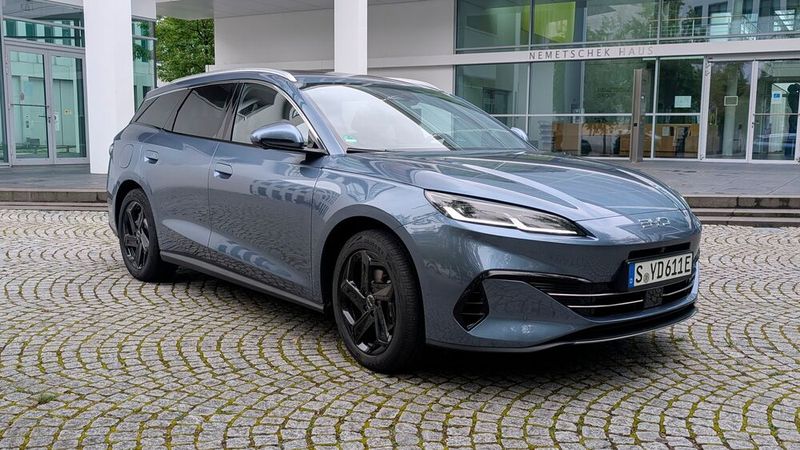
BYD is filling a gap created by established manufacturers with its PHEV estate. With an attractive price-performance ratio and plenty of space, the Seal Touring offers sought-after features.
With the Seal DM-i Touring, BYD appeals to a broad target group.
(Image: Mauritz – VCG)
While the range of models in the SUV segment continues to grow year after year, the selection of estates is now limited—especially when it comes to plug-in hybrids with a decent electric range. BYD fills this gap with its eleventh model—the Seal 6 DM-i Touring.
The 15.9 feet long station wagon with its bulky name and appealing design competes in the highly popular D-segment. Developed for the European market and specifically for Germany, the model is expected to significantly contribute to the ambitious sales targets of the Chinese manufacturer in Germany. BYD Germany's CEO, Lars Bialkowski, does not reveal how many units of the PHEV station wagon he plans to sell. However, he is optimistic that the Seal 6 DM-i Touring will become one of the best-selling models in the portfolio here.
Plug-in Hybrid for the Transition
When it comes to the target audience for its latest model addition, BYD is certainly not picky: According to the Chinese manufacturer, it simply targets everyone—private customers as well as fleets, user choosers, and mobility providers such as taxi companies, Uber, or subscription specialists. Lars Bialkowski estimates the private customer share to be 30 to at best 40 percent.
BYD views plug-in hybrids as a bridging technology for customers who shy away from buying an electric car due to range anxiety but want to drive electrically for their daily commute and in the city while also valuing the highest possible overall range. The Chinese manufacturer claims that its top model offers a range of up to 839 miles with a full battery and a full tank. It can drive up to 62 miles purely electrically.
BYD focused on economical and efficient driving, an attractive price-performance ratio, and generous space when developing its PHEV station wagon. All three aspects are indeed present: while the starting price of $46,000 is not exactly a bargain, the Seal 6 DM-i Touring impresses even in the base version with solid standard equipment—from Apple CarPlay and Android Auto to electrically adjustable seats, an electric tailgate, and rear parking radar. The selection of equipment options and paint colors is intentionally limited: there are just four colors and two equipment variants. At launch, a third option will be added, limited to 1,000 units.
The top-tier Comfort version, priced at $53,000, features a panoramic glass sunroof, a 360-degree camera, heated and ventilated front seats, two wireless smartphone charging stations, and a high-quality sound system with eight speakers. It also includes a 6.6 kW onboard charger.
The Trunk Holds 675 Liters
The interior concept is impressive: passengers in the rear benefit from ample legroom and headroom. Most notably, the trunk is generously sized with a volume of 675 liters, or 1,535 liters with the rear seats folded down. This is combined with a harmonious mix of materials and a tidy cockpit. The centerpiece, depending on the equipment variant, is a 12.8 or 15.6-inch touchscreen mounted on the center console.
With the entry-level variant Boost, the manufacturer positions itself against competitors in the C-segment, targeting primarily private customers. However, those opting for this variant with a 10-kWh lithium iron battery and a system output of 135 kW/184 hp will have to accept significant compromises in electric range: instead of 62 miles, it only covers 31 miles. The top version Comfort, with a 19-kWh battery and a range of 62 miles, meanwhile, targets commercial customers as it benefits from reduced taxation.
About Five Liters of Fuel Consumption
During an initial test drive in the top variant, the Seal DM-i Touring demonstrated its efficiency. While it is usually common to see the purely electric range of a plug-in hybrid quickly drop to zero, the onboard computer of the BYD station wagon reported a higher electric range than at the start of the journey after a roughly 62 miles mix of city traffic, country roads, and highways, with a fuel consumption of 4.7 liters and an electricity consumption of 4.8 kWh/100 mi.
Date: 08.12.2025
Naturally, we always handle your personal data responsibly. Any personal data we receive from you is processed in accordance with applicable data protection legislation. For detailed information please see our privacy policy.
Consent to the use of data for promotional purposes
I hereby consent to Vogel Communications Group GmbH & Co. KG, Max-Planck-Str. 7-9, 97082 Würzburg including any affiliated companies according to §§ 15 et seq. AktG (hereafter: Vogel Communications Group) using my e-mail address to send editorial newsletters. A list of all affiliated companies can be found here
Newsletter content may include all products and services of any companies mentioned above, including for example specialist journals and books, events and fairs as well as event-related products and services, print and digital media offers and services such as additional (editorial) newsletters, raffles, lead campaigns, market research both online and offline, specialist webportals and e-learning offers. In case my personal telephone number has also been collected, it may be used for offers of aforementioned products, for services of the companies mentioned above, and market research purposes.
Additionally, my consent also includes the processing of my email address and telephone number for data matching for marketing purposes with select advertising partners such as LinkedIn, Google, and Meta. For this, Vogel Communications Group may transmit said data in hashed form to the advertising partners who then use said data to determine whether I am also a member of the mentioned advertising partner portals. Vogel Communications Group uses this feature for the purposes of re-targeting (up-selling, cross-selling, and customer loyalty), generating so-called look-alike audiences for acquisition of new customers, and as basis for exclusion for on-going advertising campaigns. Further information can be found in section “data matching for marketing purposes”.
In case I access protected data on Internet portals of Vogel Communications Group including any affiliated companies according to §§ 15 et seq. AktG, I need to provide further data in order to register for the access to such content. In return for this free access to editorial content, my data may be used in accordance with this consent for the purposes stated here. This does not apply to data matching for marketing purposes.
Right of revocation
I understand that I can revoke my consent at will. My revocation does not change the lawfulness of data processing that was conducted based on my consent leading up to my revocation. One option to declare my revocation is to use the contact form found at https://contact.vogel.de. In case I no longer wish to receive certain newsletters, I have subscribed to, I can also click on the unsubscribe link included at the end of a newsletter. Further information regarding my right of revocation and the implementation of it as well as the consequences of my revocation can be found in the data protection declaration, section editorial newsletter.
This is made possible by BYD's "Super Hybrid DM Technology": similar to the SUV counterpart Seal U DM-i, the station wagon also features two self-developed electric motors with integrated control, which in the top version are combined with a lithium iron battery and a 1.5-liter gasoline engine delivering 72 kW/98 hp with an efficiency of 43 percent. Unlike traditional PHEV concepts, the combustion engine serves solely as support for the electric motors. The total system output amounts to 156 kW/212 hp.
Compatible With Fast Charging Stations
The system can be operated in two modes: In EV mode, the wheels are driven exclusively by the electric motor. In HEV mode, the gasoline engine supplies power to the battery and the electric motor via an inverter, while the car maintains the responsiveness of a pure electric vehicle. In moments when additional power is required, the HEV mode can switch from a series to a parallel connection.
Although efficiency was the primary focus in the drivetrain development, driving pleasure is not neglected: during the test drive, the PHEV station wagon proved to be both powerful and responsive, typical of an electric car. By the way, the station wagon can be charged not only at a wallbox but also at fast-charging stations, although the charging capacity of 26 kW is modest: according to the manufacturer, charging from 30 to 80 percent takes 23 minutes.



:quality(80)/p7i.vogel.de/wcms/a4/4c/a44ce96743685179c9e0fc31f35b1686/0132816576v1.jpeg "Laser Dicing: From the recoil force of the laser pulse upon impact on the semiconductor, a reproducible process signal can be derived in real time, enabling automated control of wafer dicing. (Image:Ciba University / CC BY-SA 4.0 / sciencedirect.com)")
:quality(80)/p7i.vogel.de/wcms/fe/c1/fec12ad4ec9ef66b02eb90f93c9b39f8/0113143253v1.jpeg "In our China Market Insider, we regularly provide you with relevant information directly from China. (Image:© Eisenhans - stock.adobe.com)")
:quality(80)/p7i.vogel.de/wcms/1f/59/1f5902056602846c4594d929d43a70a3/rose-tragarmsystem-gt-hd-print-20-28002-29v1.jpeg "The GT-HD support arm system from Rose was developed for use in particularly hygiene-critical areas (Source: Rose Systemtechnik)")
:quality(80)/p7i.vogel.de/wcms/25/51/2551b61097c77bc1001804d51b3b3adb/0132795572v1.jpeg "A five-axis milling machine no longer necessarily has to be located in a production hall. If it fits through a standard door and can be operated without specialized training, numerous possibilities open up. (Image:Gemini / LBR Manufacturing / AI-generated)")
:quality(80)/p7i.vogel.de/wcms/f8/f1/f8f1c458e77657803454f0a7c7b45ec9/0131615052v1.jpeg "The R-C2 automation from Gressel enables fully automatic complete machining of components with dimensions up to 217 millimeters x 217 millimeters x 217 millimeters. (Image:Spinner automation)")
:quality(80)/p7i.vogel.de/wcms/15/32/153251dffcb464d900d3cb0901ce9345/zimmer--cbps--sall--apr--v1v1.jpeg "Braking pneumatic cylinders: With safety certification according to DIN EN ISO 13849-1/-2, the clamping and braking elements of the CBPS series from Zimmer are suitable for safety-critical applications. (Source: Zimmer)")
:quality(80)/p7i.vogel.de/wcms/c7/8a/c78a9436a949192db665cbb6023ea27f/0132539338v1.jpeg "Many manufacturers meet all compliance requirements—yet remain vulnerable to cyberattacks. The problem does not lie in a lack of tools but in fragmented security strategies. (Image: ©solom - stock.adobe.com)")
:quality(80)/p7i.vogel.de/wcms/6b/70/6b70cd2fc515dee01219b578d82eb419/0132755946v1.jpeg "Artificial intelligence can help detect quality issues earlier and turn the 8D report into an efficiency booster. (Image:AI-generated)")
:quality(80)/p7i.vogel.de/wcms/b4/9a/b49aaad0500e06e253f7d75ecb77338a/adobestock-4840668--dani-kreienb-hl-stock-adobe-comv1.jpeg "Metal processing in 2026 will be more digital, automated, and data-driven – but not automatically easier. (Image:© Dani Kreienbühl - stock.adobe.com)")
:quality(80)/p7i.vogel.de/wcms/1a/59/1a59392a5924d433a9bf21e34ecad8ce/ed2456-ferry-boat-123059v1.jpeg "New project brings hydrogen to passenger ships. (Source: Meyer Werft)")
:quality(80)/p7i.vogel.de/wcms/dc/0b/dc0bb45fae3c250a7e75c1d9a1f5e041/thyssenkrupp-profile-aus-zm-beschichteten-bandstahlv1.jpeg "With ZM Ecoprotect Solar, thyssenkrupp Steel offers a variant developed for PV mounting systems. The coating is applied to the steel strip before forming, allowing profiles to be produced without the disadvantages of subsequent batch galvanizing. (Source: Thyssenkrupp Steel)")
:quality(80)/p7i.vogel.de/wcms/ca/90/ca90a13919cdade100d393bb3d2f4b3a/0132724138v1.jpeg "Improved cooling concept: Thanks to the cavity microstructure, known as vascular metamaterials, not only are volume and weight reduced, but the cooling capacity is also increased. (Image:Automoteam)")
:quality(80)/p7i.vogel.de/wcms/01/6a/016a20552c41084d80300e5eb073d192/0132817472v1.jpeg "The Chinese government plans to ban the so-called \"Automated Driving System Marker Lamps\" on new vehicles. They are distracting and can, among other things, dazzle other drivers. (Image:created with AI)")
:quality(80)/p7i.vogel.de/wcms/e4/ed/e4ed2843e0cfab50eb97a6d51601fc8f/org-blobs-user-response-file-output-a0911f41-dcc8-463c-a199-cab8094308fe-file-1786616125332-jpgv1.jpeg "In a survey by Capgemini, two-thirds of respondents from car manufacturers stated that they had already significantly accelerated their concept phases using AI. (Image:KI-generiert)")
:quality(80)/p7i.vogel.de/wcms/05/3a/053adcaaed4cfcb63fc47e6a484a7c22/porsche-911-reimagined-by-singer---classic--classic-turbo-02v1.jpeg "Louis Vuitton has given two Porsche 911 conversions by Singer a more luxurious touch. (Source: Singer)")
:quality(80)/p7i.vogel.de/wcms/18/26/18267dfa557eb442ee4450f505f82537/0132817699v1.jpeg "In Europe, Honda is significantly reducing its EV lineup in multiple ways: the Super-N is now the only electric vehicle, competing in the kei car class and, for the time being, only in the UK. (Image:Honda)")
:quality(80)/p7i.vogel.de/wcms/90/dc/90dc332e30a3e4bd3ff77646ed0633b7/0132833369v1.jpeg "Through a compromised repository of the widely used open-source tool LiteLLM, attackers were able to capture several terabytes of data and login credentials. Security company CloudSEK concludes, after analyzing the data, that the attack conducted in March of this year affected more than 2,000 companies, including major players like Microsoft, Nvidia, AWS, and Deutsche Bahn. (Image:freely licensed)")
:quality(80)/p7i.vogel.de/wcms/93/40/9340a3a1088dd79fce6bda5c73b7dd2f/0132818390v1.jpeg "Already in 1980, Intel exited the production of DRAM chips, and in 2022, the Optane series, manufactured using the 3D XPoint process, marked the company's last commercial venture in the field of memory technologies. However, in light of the memory crisis and the growing demand for fast memory chips, Intel CEO Lip-Bu Tan now appears to be considering a possible return to the memory business. (Image: Intel)")
:quality(80)/p7i.vogel.de/wcms/b5/2a/b52a740bb2b6e48b2e530a9bb03fcd3b/0132819357v1.jpeg "Industrial high-speed communication: The CAN XL transceiver TCAN6062 transfers more data at higher speeds, making it suitable for applications such as humanoid robots, industrial robots, and HMI systems. (Image:Texas Instruments)")
:quality(80)/p7i.vogel.de/wcms/e6/2b/e62bcec6fb21127dd59cb4d79c04381e/0132806622v1.jpeg "Next-generation packaging and testing solutions for high-density 3D power modules by JCET. (Image:JCET)")
:quality(80)/p7i.vogel.de/wcms/80/51/8051f680b9f38bb06af2019e5dd2d08e/0126556532v1.jpeg "The cockpit feels very tidy, the sense of space is airy, and there is plenty of storage. The interior also adopts the ocean-inspired, wave-like design language. The seats are upholstered in vegan leather and provide good lateral support; however, the seat surface is quite firm, which detracts from seating comfort.(Image: Mauritz VCG)")
:quality(80)/p7i.vogel.de/wcms/82/3a/823ae3fb6da0ab2a711ed20c7f00afa0/0126556550v1.jpeg "In the top-tier Comfort trim, a 15.6-inch touchscreen is installed, mounted on the center console. Operating it requires some practice due to the wide range of functionalities.(Image: Mauritz – VCG)")
:quality(80)/p7i.vogel.de/wcms/1c/20/1c207c123a228865c3d5726152cc34a8/0126556943v1.jpeg "BYD has retained the driver information display above the steering wheel. A small drawback: some of the displays are very small. A head-up display is not available even in the top version.(Image: Mauritz – VCG)")
:quality(80)/p7i.vogel.de/wcms/f0/58/f05813376f2d71fcf7dab75ee4988345/0126557171v1.jpeg "Legroom and headroom in the rear are generous. However, you have to bend your legs quite a bit in the back.(Image: Mauritz – VCG)")
:quality(80):fill(efefef,0)/p7i.vogel.de/wcms/67/ad/67adf4a647532/elatec-wp-machine-authentication.png "Elatec WP Machine Authentication")
:quality(80)/p7i.vogel.de/wcms/63/7f/637f879a4f898a185de44e207c1e98ac/0128073585v1.jpeg "BYD steps up the powertrain for the Atto 2. (Image:BYD)")
:quality(80)/p7i.vogel.de/wcms/91/79/91794b55ca69b00d3d91f2c2cad7fb16/0131799108v1.jpeg "The BYD Dolphin \"G DM-i\" with plug-in hybrid drive is set to compete in the B-segment. (Image: Wehner - VCG)")