Logistics is undergoing a disruptive and revolutionary transformation. Globalization, digitization, and environmentalism have not only massively accelerated the entire industry but also led to a fundamental reassessment of the profession.
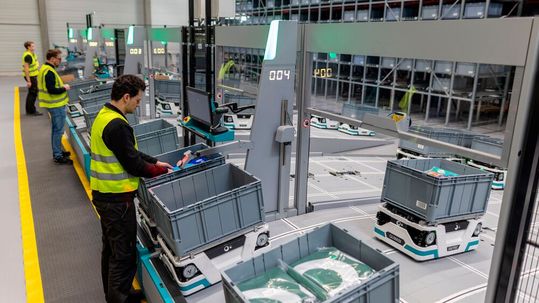
Picking tasks using Exotec's Skypod warehouse robot are carried out efficiently and effectively, allowing pick and pack processes to be combined.
(Image: Exotec)
The aforementioned trends have brought forth new ideas regarding the circular economy and sparked reflection on the ethical and ecological footprint of the industry. So, what does the future of logistics look like?
Exotec, a provider of innovative warehouse automation solutions and scalable robotics systems for intralogistics, presents six trends driving the transformation of the logistics industry.
1. "Higher, Faster, Further" is a Thing of the Past
The e-commerce boom of the 2010s, driven primarily by players like Amazon and Alibaba, has pushed global supply chains into a state of constant acceleration. The expectation is clear and unmistakable: orders that previously took several days to reach their destination are now expected to arrive within just a few hours. Those who want to stay competitive in the logistics market must make enormous efforts in an intense race for speed.
The pandemic and the significantly increased public environmental awareness in recent years have also highlighted the immense economic and ecological costs of this mentality. The relentless pursuit of "bigger, faster, further" seems to have reached its peak. Particularly in Europe, the consequences of this approach are increasingly leading to a shift in thinking, as societal acceptance declines. Accordingly, logistics companies are increasingly committing to social and environmental responsibilities and seeking sustainable alternatives.
2. Storage Spaces must be Compacted
Warehousing is now attempting to square the circle: storage locations should remain as small as possible while the product range continues to grow. In light of increasing customer demands, competition, particularly among retailers, is steadily intensifying, prompting many to continuously expand their portfolios.
Whether they suffer from a lack of space in dense city centers or are restricted in rural areas by zoning plans or other regulations, there is no choice but to find new ways to optimize the use of available spaces. The vertical and automated expansion of warehouses is often the only solution.
3. Automation Means Flexibility
Against the backdrop of increasing economic uncertainty, fluctuating demand, and changing consumer behavior, logistics providers are increasingly reliant on adapting their infrastructures quickly and flexibly to meet the respective requirements. Seasonal peaks, new customers, and a growing product range are driving ever-increasing demand, which is difficult to manage with conventional facilities. Here, too, automation offers solutions for infrastructure flexibility—suitable systems can rapidly increase capacities while simultaneously boosting productivity.
4. "Human and Machine" Instead of "Human Versus Machine"
With the e-commerce boom, the demand for labor in the logistics industry continues to grow steadily. At the same time, finding qualified employees, especially for warehouse locations, is becoming increasingly challenging. Factors such as the physical demands of the job, the often remote location of workplaces, and limited development opportunities make it difficult to fill open positions. This tension between growing demand and a shortage of skilled workers presents the industry with new challenges.
A labor shortage is by no means inevitable. Like many other industries, logistics must embrace a workplace revolution by leveraging digitalization and automation—not to replace human labor but to create jobs that retain highly skilled professionals in the long term and increase the attractiveness of the industry. Additionally, this can attract employees with expertise—such as in data management and predictive maintenance—that has so far been scarcely available in warehouses but is urgently needed.
5. Logistics is far more than just Transportation from A to B
With the growing focus on the circular economy, companies along the supply chain face the challenge of fundamentally rethinking their processes. The goal is to manage goods flows that are more complex than ever and involve more actors and stakeholders than ever before. The underlying commitment aims not only to handle traditional logistics but also to organize returns, processing, manufacturing, and redistribution. For retailers, this also means offering rental services, second-life options, and repair services.
Date: 08.12.2025
Naturally, we always handle your personal data responsibly. Any personal data we receive from you is processed in accordance with applicable data protection legislation. For detailed information please see our privacy policy.
Consent to the use of data for promotional purposes
I hereby consent to Vogel Communications Group GmbH & Co. KG, Max-Planck-Str. 7-9, 97082 Würzburg including any affiliated companies according to §§ 15 et seq. AktG (hereafter: Vogel Communications Group) using my e-mail address to send editorial newsletters. A list of all affiliated companies can be found here
Newsletter content may include all products and services of any companies mentioned above, including for example specialist journals and books, events and fairs as well as event-related products and services, print and digital media offers and services such as additional (editorial) newsletters, raffles, lead campaigns, market research both online and offline, specialist webportals and e-learning offers. In case my personal telephone number has also been collected, it may be used for offers of aforementioned products, for services of the companies mentioned above, and market research purposes.
Additionally, my consent also includes the processing of my email address and telephone number for data matching for marketing purposes with select advertising partners such as LinkedIn, Google, and Meta. For this, Vogel Communications Group may transmit said data in hashed form to the advertising partners who then use said data to determine whether I am also a member of the mentioned advertising partner portals. Vogel Communications Group uses this feature for the purposes of re-targeting (up-selling, cross-selling, and customer loyalty), generating so-called look-alike audiences for acquisition of new customers, and as basis for exclusion for on-going advertising campaigns. Further information can be found in section “data matching for marketing purposes”.
In case I access protected data on Internet portals of Vogel Communications Group including any affiliated companies according to §§ 15 et seq. AktG, I need to provide further data in order to register for the access to such content. In return for this free access to editorial content, my data may be used in accordance with this consent for the purposes stated here. This does not apply to data matching for marketing purposes.
Right of revocation
I understand that I can revoke my consent at will. My revocation does not change the lawfulness of data processing that was conducted based on my consent leading up to my revocation. One option to declare my revocation is to use the contact form found at https://contact.vogel.de. In case I no longer wish to receive certain newsletters, I have subscribed to, I can also click on the unsubscribe link included at the end of a newsletter. Further information regarding my right of revocation and the implementation of it as well as the consequences of my revocation can be found in the data protection declaration, section editorial newsletter.
6. The Ecological Footprint must be Reduced
Societal expectations regarding environmental and climate protection have long left a significant mark on politics and have also led to a rethinking in logistics. The goal is: decarbonization, water and air quality, biodiversity, and waste production are just some of the areas where the entire industry leaves an undeniable footprint.
However, logistics companies have more tools and measures at their disposal than just trying to reduce their own emissions. For example, they could encourage business partners and customers to adopt lower-emission behaviors and collaborate more closely with municipalities to jointly work on solutions.
* Sabrina Seubert is Senior Marketing Manager at Exotec Deutschland GmbH in 80335 Munich, Tel. +49-173-7830182, sabrina.seubert@exotec.com
5 Key Tips for Selecting Your Next Laser Cutting Machine
Facing rising demands and labor shortages, manufacturers must choose smarter laser systems. This guide helps you make informed decisions for flatbed and tube cutters—balancing cost, capacity, and future automation needs. Learn more about:
(Image: aai)
How to size your laser cutter for current and future production needs
Choosing the appropriate laser power for your material mix and thickness
Key differences between entry-level and high-performance cutting systems
When to consider tube laser cutting and how to evaluate its ROI
Why automation readiness is essential for operational efficiency in 2025



:quality(80)/p7i.vogel.de/wcms/dd/08/dd086510d9ae7b50181f6070e4463b44/0129363730v1.jpeg "Typical application for ionizing devices: Wrapping films. (Picture: ©Adobe Stock/SMC)")
:quality(80)/p7i.vogel.de/wcms/35/57/3557c819943c53acec41a0ccba87da4f/0130049064v1.jpeg "Researchers at the Fraunhofer IWU in Chemnitz have long known that many typical sheet metal parts can be manufactured more cost-effectively using hollow embossing rollers. Now there is news to report ... (Image:Fraunhofer IWU)")
:quality(80)/p7i.vogel.de/wcms/59/02/590246e3b3f415c65edbee377c14ca77/26-06-pi-fraunhofer-iws-41450-direktplattieren-pic-01-7771x4369v1v1.jpeg "The Fraunhofer IWS has developed the new \"direct laser cladding\" process, which creates a functional layer directly on the base body by applying a strip-shaped metal to rotationally symmetrical components in a spiral and bonding it locally by laser. (Image:Christoph Wilsnack/Fraunhofer IWS)")
:quality(80)/p7i.vogel.de/wcms/73/60/73608418789b1d9c393f5e2fa974eda2/0130209906v1.jpeg "The robots of the X6 generation from b+m enable very high painting quality and are also particularly compact and easy to maintain. (Image:Beckhoff)")
:quality(80)/p7i.vogel.de/wcms/78/e9/78e9188c25a8a94e67c34c9bf8ffe495/visual-agile-20robots-20and-20google-20deepmind-20partner-20to-20bring-20intelligence-20to-20robotics-2500x1406v1v1.jpeg "Together, the partners are developing adaptable, intelligent robots for a wide range of applications (Image:Agile Robots SE)")
:quality(80)/p7i.vogel.de/wcms/e7/66/e7669ecf0260ae8fc54c214e34e4902a/0130316817v1.jpeg "Siemens and Palo Alto Networks offer tested cybersecurity solution for industrial 5G. (Image:Siemens)")
:quality(80)/p7i.vogel.de/wcms/9f/55/9f55324832c4f426958031375124d9de/siemens-20ubtech-20hmnd-1920x1079v1v1.png "Ready for the factory floor: While Ubtech is planning mass production, Siemens is already testing humanoids in real factory applications in Erlangen. (Image:Siemens)")
:quality(80)/p7i.vogel.de/wcms/11/36/113695ed260e29c8c2d9d39dc5f9d869/0130213768v1.jpeg "AI can work cheaply in China and deliver the results rapidly all over the world. (Image:Dall-E / AI-generated)")
:quality(80)/p7i.vogel.de/wcms/62/5f/625f41e87ebfef156a98c8e6393e32fd/0130211654v1.jpeg "Axial flux motors have some advantages over radial flux motor—but their production is currently still expensive. (Image:RWTH Aachen University)")
:quality(80)/p7i.vogel.de/wcms/77/9b/779b0685d010dfe45c9c2cb1cfecd467/0128886425v1.jpeg "The BlueEye is the first \"real\" hyperspectral camera for the UV range and covers the wavelength range from 220 to 380nm. (Image:Inno-spec GmbH)")
:quality(80)/p7i.vogel.de/wcms/e4/51/e451d52ce0182fb0aaa46a5774f832ef/26-04-pi-fraunhofer-iws-21160-bioslide-pic-01-4128x2321v1v1.jpeg "With the BioSlide research project, the Fraunhofer IWS is investigating how sliding systems can be designed to be more sustainable and energy-efficient. New materials can be tested in a particularly application-oriented manner on this plain bearing test stand. (Image:Fraunhofer IWS)")
![Thanks to advanced 3D printing technology, a more efficient use of resources should contribute to lower-emission aviation—this is the goal of ['skai]-lab. (Image:Oleksandr Pashchenko - stock.adobe.com / AI-generated)](https://cdn1.vogel.de/nghHNSbySccfOjG3n1qCA-FVOjQ=/288x162/smart/filters:format(jpg):quality(80)/p7i.vogel.de/wcms/62/64/626424c97a16e69f871bf216c9629c2a/adobestock-1927043193--c2-a9-20oleksandr-20pashchenko-20-e2-80-93-20stock-adobe-com-ki-generiertv1v1.jpeg "Thanks to advanced 3D printing technology, a more efficient use of resources should contribute to lower-emission aviation—this is the goal of ['skai]-lab. (Image:Oleksandr Pashchenko - stock.adobe.com / AI-generated)")
:quality(80)/p7i.vogel.de/wcms/c3/c4/c3c4ce270b083eeac55654148611f064/0130237945v1.jpeg "China is not giving up on hydrogen, but is intensifying its efforts. (Image:freely licensed from Pixabay)")
:quality(80)/p7i.vogel.de/wcms/4e/c0/4ec0bd19390b169edfa23677373dcdf1/0130260089v1.jpeg "Renewable fuels can supply European road traffic, according to a study. (Image:Aral)")
:quality(80)/p7i.vogel.de/wcms/6f/c9/6fc9050301d745cad25585c6780f8f51/0130197341v1.jpeg "Production facilities are a worthwhile target and are therefore at risk. (Image:ABB Robotics)")
:quality(80)/p7i.vogel.de/wcms/b6/62/b662adc2cec8227d8172509bbfb6ee42/25c0207-107-4961x2789v1v1.jpeg "The GLB is the second model based on Mercedes' new MMA platform. Apparently, Geely's platform is better and cheaper, which is why the two companies are negotiating a partnership. (Image:Mercedes-Benz)")
:quality(80)/p7i.vogel.de/wcms/4d/dd/4dddf438e91f394c04a095dbfd109d1c/0130236430v1.jpeg "Measurement modules: The 720301 module in combination with the SL2000 enables RMS and power calculations, among other things. (Image:Yokogawa)")
:quality(80)/p7i.vogel.de/wcms/61/fc/61fcf95f5cca15494ad18343901ae585/0130317237v1.jpeg "With the AGI CPU, Arm says it is taking a \"historic step\": With the processor aimed at AI in data centers, the company is presenting itself for the first time as a provider of its own chips, not just as a pure IP licensor. (Image:Arm)")
:quality(80)/p7i.vogel.de/wcms/82/90/8290dfe3595b6c6b33726ae8b76172c7/0130319587v1.jpeg "The concept image illustrates how the pattern of tiny protrusions and depressions created on the substrate (MgO, bottom) controls the arrangement of atoms in the superconducting material (YBCO, top). At the interface between the two layers, an electronic structure enables superconductivity to occur at higher temperatures than previously possible. (Image:Chalmers University of Technology / Riccardo Arpaia)")
:fill(fff,0)/images.vogel.de/vogelonline/companyimg/76800/76895/65.jpg "FAULHABER_120mm.jpg ()")
:fill(fff,0)/p7i.vogel.de/companies/67/eb/67eba621ef6ea/logo2.png "logo2 (Wuxi InfiMotion)")

:quality(80):fill(efefef,0)/p7i.vogel.de/wcms/67/ac/67acb931a438c/elatec-wp-gmp.png "Elatec WP GMP")
:quality(80)/p7i.vogel.de/wcms/b2/42/b242f846db997ca04f86cf590665b472/0125790556v1.jpeg "Through the Locus-One implementation, the warehouse infrastructure was adjusted to shorten paths, reduce manual steps, and partially eliminate consolidation processes. (Image:Locus Robotics)")
:quality(80)/p7i.vogel.de/wcms/c6/4e/c64e217a9fff02fa80dfe81621f9c4b5/swd-technologien-stator-segmentierung-04-500x281v1v1.jpeg "Stator segmentation. (Image:SWD)")