The manufacturing of stators and rotors is facing a fundamental paradigm shift. Traditional pressing technologies are increasingly reaching their technical, economic, and ecological limits. New approaches are needed that drastically reduce material usage, CO₂ emissions, and investment risks while putting flexibility and precision at the forefront.
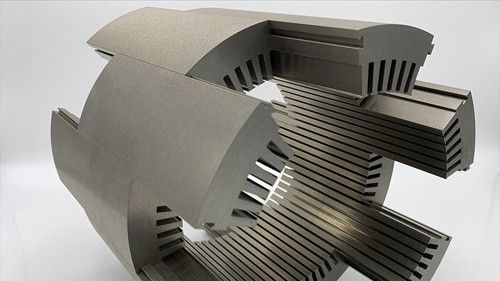
Stator segmentation.
(Image: SWD)
The solution lies in modular manufacturing concepts and innovative processes such as automated segmentation, paving the way for sustainable electromobility production.
Limits of Classic Press Technologies
The production of stator and rotor laminations for electric motors has relied for decades on central, large stamping presses and large, complex stamping tools. However, the disadvantages of this approach are becoming increasingly apparent. "The enormous investment costs tie up capital for many years amid rising uncertainty about the actually needed capacities," explains Thomas Stäuble, CEO of SWD AG, a Swiss specialist in stator and rotor technology. Additionally, there is high material consumption, as the full-circle stamping process generates large amounts of high-quality electrical steel as scrap. Furthermore, the stator and rotor laminations are made from the same material in this process, which is often not sensible for the electric motor. The complexity of the geometries increases, requiring ever larger tools and presses. Weaknesses also appear in logistics: materials and lamination stacks must be transported in large quantities, leading to additional costs and significant CO₂ emissions.
In addition to the economic aspects, the ecological dimension is increasingly coming into focus. The high energy consumption of classic presses and the fragmented supply chains are becoming less compatible with the demands of sustainable production. "The traditional supply structure is too rigid, too resource-intensive, and too inflexible to meet the challenges of electromobility; instead, on-site production is needed," says Stäuble.
The Technological Leap: Decentralized Special Machine Concepts
Against this backdrop, a paradigm shift is inevitable. Decentralized manufacturing concepts offer the possibility to move production processes closer to actual demand—directly to the location of the OEM or engine manufacturer. "This not only shortens transportation routes and saves CO₂, but it also significantly reduces investment risk," emphasizes Stäuble. Instead of a central large press, OEMs can utilize smaller, modular facilities that can be expanded and/or duplicated as needed. This allows production capacities to be adjusted dynamically, making companies more resilient to market volatility.
A core component of these new approaches is automated segmentation, as applied by SWD, for example. This method replaces full-circle stamping with the production of individual segments that are subsequently assembled precisely. "This procedure drastically reduces material usage while simultaneously improving geometric precision," explains Stäuble. In pilot projects, SWD demonstrated that segmentation could save up to 27,000 tons of material and nearly 70,000 tons of CO₂ in large-scale production.
Material Usage and Energy Efficiency in Comparison
more material per stator-rotor pair, the demand in the segmented process is significantly lower, allowing for the possibility of using different materials for the stator and rotor. This effectively halves material usage, which has substantial positive effects on costs and sustainability. "Energy efficiency also improves: Fully automated, integrated systems for segments achieve OEE (Overall Equipment Effectiveness) values of up to 95 percent, while traditional presses often stagnate at 65 percent," adds Stäuble. The result is a significantly higher manufacturing efficiency.The modular machine concepts, such as those from SWD AG, are also designed to integrate seamlessly into existing production environments. They require less space than central presses and can be flexibly installed in existing facilities. "OEMs can start with one machine and later gradually duplicate it. This keeps investments manageable and allows production to grow in line with demand," explains Stäuble.In addition to material and energy efficiency, the new concepts score points for their high maintainability. The small and compact tools achieve a usage duration of up to 50 million strokes without needing re-sharpening. "This not only means lower operating costs but also significantly greater process reliability," emphasizes Stäuble. This is complemented by a high level of automation, which ensures stable quality and reduces the need for skilled labor.
Shift in Manufacturing and New Logistics Models
The relocation of manufacturing directly to the engine site changes the entire logistics approach. Instead of stamping and transporting tons of sheet metal packages centrally, processing occurs directly on-site. "This not only reduces the ecological footprint, but also increases the supply security for the OEMs," explains Stäuble. Dependency on global supply chains decreases, while responsiveness to market fluctuations increases.This new manufacturing technology offers further advantages: the small stamping tools are highly precise, and the influences of edge defects are reduced. Additionally, the material is not straightened, which leads to lower electromagnetic losses in the finished electric motor compared to traditional manufacturing. Thanks to segmentation and bonding technologies, lamination stacks can be produced with minimal tolerances. "All these factors reduce magnetic losses and significantly increase motor performance. This presents another crucial advantage for electromobility and aviation," says Stäuble.While the automotive industry currently has the greatest need, the application fields extend far beyond that. Industries such as aviation, energy generation, industrial drives, and household appliances can benefit from the advantages of modular and segmented manufacturing concepts. "Wherever electric drives are used, significant efficiency and sustainability gains can be achieved," adds Stäuble.
Date: 08.12.2025
Naturally, we always handle your personal data responsibly. Any personal data we receive from you is processed in accordance with applicable data protection legislation. For detailed information please see our privacy policy.
Consent to the use of data for promotional purposes
I hereby consent to Vogel Communications Group GmbH & Co. KG, Max-Planck-Str. 7-9, 97082 Würzburg including any affiliated companies according to §§ 15 et seq. AktG (hereafter: Vogel Communications Group) using my e-mail address to send editorial newsletters. A list of all affiliated companies can be found here
Newsletter content may include all products and services of any companies mentioned above, including for example specialist journals and books, events and fairs as well as event-related products and services, print and digital media offers and services such as additional (editorial) newsletters, raffles, lead campaigns, market research both online and offline, specialist webportals and e-learning offers. In case my personal telephone number has also been collected, it may be used for offers of aforementioned products, for services of the companies mentioned above, and market research purposes.
Additionally, my consent also includes the processing of my email address and telephone number for data matching for marketing purposes with select advertising partners such as LinkedIn, Google, and Meta. For this, Vogel Communications Group may transmit said data in hashed form to the advertising partners who then use said data to determine whether I am also a member of the mentioned advertising partner portals. Vogel Communications Group uses this feature for the purposes of re-targeting (up-selling, cross-selling, and customer loyalty), generating so-called look-alike audiences for acquisition of new customers, and as basis for exclusion for on-going advertising campaigns. Further information can be found in section “data matching for marketing purposes”.
In case I access protected data on Internet portals of Vogel Communications Group including any affiliated companies according to §§ 15 et seq. AktG, I need to provide further data in order to register for the access to such content. In return for this free access to editorial content, my data may be used in accordance with this consent for the purposes stated here. This does not apply to data matching for marketing purposes.
Right of revocation
I understand that I can revoke my consent at will. My revocation does not change the lawfulness of data processing that was conducted based on my consent leading up to my revocation. One option to declare my revocation is to use the contact form found at https://contact.vogel.de. In case I no longer wish to receive certain newsletters, I have subscribed to, I can also click on the unsubscribe link included at the end of a newsletter. Further information regarding my right of revocation and the implementation of it as well as the consequences of my revocation can be found in the data protection declaration, section editorial newsletter.
Operational Systems and Pilot Projects Demonstrate Market Readiness
Today, SWD AG has successfully implemented such machine concepts for its customers. The practicality of their approaches has been proven in various studies and pilot projects. In addition to material and CO₂ savings, the production processes have primarily been stabilized, and flexibility has increased. "This shows that we are on the right track and that our solutions are ready for mass production," explains Stäuble.
The future of stator and rotor manufacturing will be shaped by modular machine concepts. Automated segmentation will establish itself as the standard, not only in electromobility but also in other industries. The advantages are too significant to be ignored: substantial CO₂ reductions, flexible production capacities, lower costs, and higher precision.
The limitations of traditional press technologies make a technological leap unavoidable. Modular plant concepts and automated segmentation are paving the way for sustainable and economical production of electrical steel packages. OEMs are provided with solutions that combine investment security, flexibility, and ecological benefits. This opens a new chapter in the production of electric motors—one that benefits both the industry and the environment.



:quality(80)/p7i.vogel.de/wcms/eb/2b/eb2bd1b8487afe577b37363cd02f16ff/0113143253v1.jpeg "In our China Market Insider, we regularly provide you with relevant information straight from China. (Image:© Eisenhans - stock.adobe.com)")
:quality(80)/p7i.vogel.de/wcms/dd/b8/ddb8edc98c49b384734ab2432b297eb5/adobestock-1913662309--irene-stock-adobe-com-ki-generiertv1.jpeg "Rotary joints are used in grippers and swivel mechanisms to allow assemblies to rotate or swivel smoothly relative to one another, even under very high loads (illustrative image). (Source: Irene - stock.adobe.com / KI-generiert)")
:quality(80)/p7i.vogel.de/wcms/d1/ef/d1ef6b6f7d4543f7999980bacccaf22b/0133499261v1.jpeg "As the growing imbalance in trade relations with China continues to widen, the EU Chamber of Commerce foresees a day when trade with China will have to be seriously reevaluated ... (Image: AI-generated)")
:quality(80)/p7i.vogel.de/wcms/fe/1f/fe1fa5ee713f94deaba963dc24c3abc5/0133299273v1.jpeg "The Flexistar enables highly flexible production of laser-welded tubes thanks to its tool-free clamping system. (Image:Because Technology, LLC)")
:quality(80)/p7i.vogel.de/wcms/60/ef/60ef4f07e4829b2c2929befc0f353c58/0133511729v1.jpeg "Humanoid robots can match human performance in certain tasks. (Image:Gemini / AI-generated)")
:quality(80)/p7i.vogel.de/wcms/2e/99/2e99726b522e4b35b690e25eb6a42643/0133463991v1.jpeg "Robotics: In AMR applications, connection technology must reliably transmit power, signals, and data despite vibration and shock loads—in very confined spaces and in a way that allows for regular maintenance. (Image:Hyperever)")
:quality(80)/p7i.vogel.de/wcms/d0/18/d01801e3d5dbd7bc9d0b4f60408b630c/0133468429v1.jpeg "Quality requirements for film packaging are on the rise. At the same time, many companies are turning to recyclable film materials, which, however, have their own challenges. Fraunhofer researchers have therefore developed a fast system that detects problems in real time. (Image:Fraunhofer IKTS)")
:quality(80)/p7i.vogel.de/wcms/b1/06/b106cf44923ce39565c3264982fd20eb/0133414574v1.jpeg "Robots Build Robots: At the new Ubtech factory, automated systems even handle parts of the material supply and logistics for the production of humanoid robots. (Image:Ubtech)")
:quality(80)/p7i.vogel.de/wcms/c0/52/c052f405eb55fc3d08c4837e77206fc0/adobestock-2021845957--aucartstudio-stock-adobe-com-ki-generiertv1.jpeg "An innovation from China to combat extreme summer heat: A novel coating lowers temperatures. (Source: © AucArtStudio – stock.adobe.com_AI-generated)")
:quality(80)/p7i.vogel.de/wcms/66/a7/66a7b78159caeacce57136529688799f/0133503398v1.jpeg "Sunlight Makes Stone! These stone blocks weren't made the traditional way. Instead, they were additively manufactured from sand using a laser. In the future, however, the laser is set to be replaced by concentrated sunlight—if the startup Addisol is successful... (Image:Addisol / F. Fiedler)")
:quality(80)/p7i.vogel.de/wcms/72/b9/72b995c2c8d812c5e2115cbef31e035a/0133462727v1.jpeg "Eggl manufactures center hoods that are precisely tailored to each cooking island—whether standard size or custom shape. They are made entirely of stainless steel and are individually customized in terms of size and filter arrangement. (Image:SPI)")
:quality(80)/p7i.vogel.de/wcms/13/5d/135dfae6229ceaf5c55467a43e8f7257/adobestock-1879961393--ardi-stock-adobe-com-ki-generiertv1.jpeg "Annoying chatterboxes or awkward silences in response to questions—a moderator should specifically prepare for difficult situations in order to navigate them effectively. (Image:ardi - stock.adobe.com_AI-generated)")
:quality(80)/p7i.vogel.de/wcms/aa/a2/aaa2c6dd2daa24b485cddbf9297590c0/0133467318v1.jpeg "Battery Monitoring: Battery monitoring using electrochemical impedance spectroscopy offers several advantages. (Image:TI)")
:quality(80)/p7i.vogel.de/wcms/39/b2/39b21bf03be1683831862239a369987c/0133469638v1.jpeg "Data from autonomous vehicles and robots operating autonomously is in high demand, and Ruqi wants to capitalize on this. (Image:Ruqi Mobility)")
:quality(80)/p7i.vogel.de/wcms/8a/bb/8abbb6217220595edc1549ac9b84f307/0133429906v1.jpeg "The IAA in Hanover showcased the ambitions of Chinese commercial vehicle manufacturers in Europe. (Image:Wehner - VCG)")
:quality(80)/p7i.vogel.de/wcms/0c/53/0c5313ef91c14b6df0d0996efc33c8ad/jpg03568-bearbeitetv1.jpeg "The category winners of the 2027 German Car of the Year award. (Source: GCOTY)")
:quality(80)/p7i.vogel.de/wcms/48/15/4815da27c45973ca629a99b375ac3aef/0133509585v1.jpeg "Ventuno Q RoadTest: Designed to help the Element14 community gain practical insights from real-world tests using the Ventuno Q. (Image:Farnell/Element14)")
:quality(80)/p7i.vogel.de/wcms/17/2b/172bd132f9febdfcbcedba292ad0504d/aufmacherv1.jpeg "Micro-Epsilon offers a wide range of IO-Link-compatible sensors. (Source: Micro-Epsilon Messtechnik GmbH & Co. KG)")
:quality(80)/p7i.vogel.de/wcms/ca/b4/cab46fd26d19d6a2febca032048200b6/0133471827v1.jpeg "Photonics SDK for C and Python: Computational operations are now abstracted as standard mathematical functions. (Image:Q.ANT)")
:quality(80)/p7i.vogel.de/wcms/92/b2/92b2ed5299cde450c0764f4f64468395/0133505895v1.jpeg "The \"Iris 100\" test system for high-precision volume production of microLEDs uses a spectrometer and a high-resolution camera. (Image:Teradyne)")
:fill(fff,0)/images.vogel.de/vogelonline/companyimg/76800/76895/65.jpg "FAULHABER_120mm.jpg ()")
:fill(fff,0)/p7i.vogel.de/companies/69/de/69de1b7403b0d/simtos-logo.jpeg "simtos-logo (SIMTOS)")
:quality(80)/p7i.vogel.de/wcms/1b/34/1b3437fb1a1da6828e1f0e5ce72047f3/0128402395v1.jpeg "The compact design and high power density of axial flux motors open up new possibilities for vehicle concepts in the field of electromobility. (Image: ©paul_craft - stock.adobe.com)")
:quality(80)/p7i.vogel.de/wcms/ac/5f/ac5fae3da6bfc872956b362c6e2a58b6/0132874046v1.jpeg "Dysprosium: The heavy rare earth is used, among other things, in high-performance permanent magnets to increase their temperature and demagnetization resistance. (Image:Dall-E / AI-generated)")