A team at Saarland University (Germany) aims to make 3D printing more precise. Doctoral student Oliver Maurer has now succeeded in significantly improving the quality of small metal components printed in the powder bed—using sound. This could enable industry to produce components with significantly higher load capacities. The researchers are looking for collaboration partners.
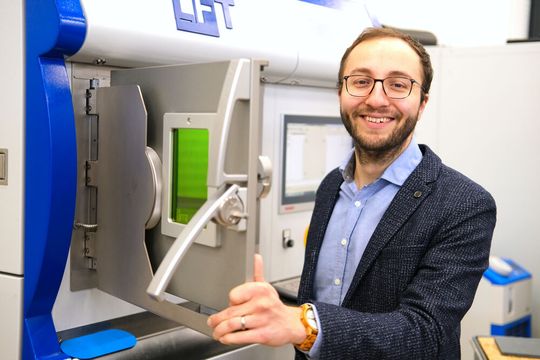
With the new process developed by Dr. Oliver Maurer, smaller metal components can be printed significantly finer and with higher quality using a 3D printer.
(Image: Claudia Ehrlich/Saarland University)
Shaking vigorously makes concrete more stable and load-bearing. The intense back-and-forth motion reduces voids between grains and pebbles, compacting everything. Similarly, the particles of metal powder in a 3D printer can move closer together. When the laser melts the compacted powder, the component that forms layer by layer from the molten metal becomes more stable, with the metal crystals forming in a finer mesh in the melt—provided all the critical parameters in the printing process are properly aligned. This has been demonstrated by the now-doctorate manufacturing engineer Oliver Maurer in his doctoral thesis under Professor Dirk Bähre, Chair of Manufacturing Technology at Saarland University. For the shaking, he used sound—after all, high precision is essential in 3D printing. "Sound can be controlled and measured very precisely," explains Oliver Maurer, highlighting why he prefers sound over a mechanical shaking device.
The melting process is more controlled with this new method. Specifically, the sound raises or lowers the powder surface within defined limits out of the laser focus. Additionally, the sound influences how the melt solidifies. Due to the densification, the supporting effect of the powder bed on the component is also higher, meaning the component stays in place, and the melt does not flow into gaps.
Oliver Maurer
3D-Printed Products Become More Durable
For this purpose, the manufacturing engineer installed a speaker in a standard metal 3D printer, specifically under the substrate plate where the metal powder is placed. The sound waves create vibrations and vertical shaking movements on the plate. Through the abrupt, intense shaking, the powder is deliberately compacted before the laser melts it. "This reduces pores, the microstructure of the metal layers becomes more homogeneous, the surface smoother, and the components are even geometrically more precise," says the researcher. This also means: 3D-printed products are far more durable due to their higher quality, they become more robust, their assembly is easier and faster, fewer defective parts are produced, and less post-processing is required.
"The melting process proceeds more controlled with this new method. Specifically, the sound raises or lowers the powder surface within defined limits out of the laser focus. Additionally, the sound influences how the melt solidifies. Due to the compaction, the supporting effect of the powder bed on the component is also higher, so the component remains in place, and the melt does not flow into gaps," explains Oliver Maurer. He further notes that the residual stress of the component is likely reduced as well, although this still needs further investigation.
After the laser melts the metal particles, metal crystals grow until they are fully solidified. "If the new component remains in constant vibration during this process, shorter rather than longer metal crystallites form in all directions. We can specifically control this process with sound," explains Oliver Maurer. This makes the printed component significantly more stable in its structure. This is because the crystallites do not simply grow long next to each other, which can lead to dreaded voids or bubbles in the melt, leaving holes in the components where there shouldn’t be any. A component weakened by such pores withstands stress less effectively. "Through the sound vibrations, the crystallites encounter neighboring crystallites more quickly, allowing us to achieve a better ratio of length to width of the crystallites, which are more densely interconnected. The metal structure is thus refined, becoming stronger and more stable," says Oliver Maurer.
Complicatedly Shaped Special Components With Many Corners And Edges are No Problem
With the new method, smaller components can be printed significantly finer, more accurately, and thus with higher quality. "Roughly up to a size that fits in one hand," adds Oliver Maurer. Prime examples would be intricately shaped specialized components with many corners and edges for aerospace, automotive industries, and even medical technology, such as prosthetics. Such metal components from 3D printers often fail to meet the high-quality standards today.
That sound can lead to better results in manufacturing processes was already known in laser cladding, the so-called laser deposition welding. To make workpieces more stable, metal structures are built on a base body by welding wire or powder.
Oliver Maurer
Anyone who thinks it's enough to just shake the 3D printer or simply expose the plate to sound is gravely mistaken: the process must be precisely calibrated on a case-by-case basis – and this is an extremely tricky task. "The individual process parameters differ significantly with and without sound," says Oliver Maurer, who specializes in this. Through countless experiments over several years, Professor Bähre's team gained experience in fine-tuning these processes. After all, the sound application must be perfectly aligned with all parameters of 3D printing, starting from laser power and speed to the thickness of the powder layer and the characterization of the metal type; otherwise, the component will not be perfect.
Three to Five Watts of Sound Power are Sufficient
"That sound can lead to better results in manufacturing processes was already known in laser cladding, the so-called laser deposition welding. To make workpieces more stable, metal structures are built up on a base material by welding wire or powder," says Oliver Maurer, who has now shown that sound can also lead to better results in powder-bed-based 3D printing. While laser cladding uses a sound power of 1000 watts, the much finer powder-bed-based 3D printing with Oliver Maurer's method requires just three to five watts of sound power. The Saarbrücken manufacturing engineer researched this method in his doctoral thesis using an aluminum alloy. "But the method can also be applied to other alloys. However, it is always crucial to tailor the entire process, especially the frequency of the sound application, to the specific requirements," says Maurer.
Date: 08.12.2025
Naturally, we always handle your personal data responsibly. Any personal data we receive from you is processed in accordance with applicable data protection legislation. For detailed information please see our privacy policy.
Consent to the use of data for promotional purposes
I hereby consent to Vogel Communications Group GmbH & Co. KG, Max-Planck-Str. 7-9, 97082 Würzburg including any affiliated companies according to §§ 15 et seq. AktG (hereafter: Vogel Communications Group) using my e-mail address to send editorial newsletters. A list of all affiliated companies can be found here
Newsletter content may include all products and services of any companies mentioned above, including for example specialist journals and books, events and fairs as well as event-related products and services, print and digital media offers and services such as additional (editorial) newsletters, raffles, lead campaigns, market research both online and offline, specialist webportals and e-learning offers. In case my personal telephone number has also been collected, it may be used for offers of aforementioned products, for services of the companies mentioned above, and market research purposes.
Additionally, my consent also includes the processing of my email address and telephone number for data matching for marketing purposes with select advertising partners such as LinkedIn, Google, and Meta. For this, Vogel Communications Group may transmit said data in hashed form to the advertising partners who then use said data to determine whether I am also a member of the mentioned advertising partner portals. Vogel Communications Group uses this feature for the purposes of re-targeting (up-selling, cross-selling, and customer loyalty), generating so-called look-alike audiences for acquisition of new customers, and as basis for exclusion for on-going advertising campaigns. Further information can be found in section “data matching for marketing purposes”.
In case I access protected data on Internet portals of Vogel Communications Group including any affiliated companies according to §§ 15 et seq. AktG, I need to provide further data in order to register for the access to such content. In return for this free access to editorial content, my data may be used in accordance with this consent for the purposes stated here. This does not apply to data matching for marketing purposes.
Right of revocation
I understand that I can revoke my consent at will. My revocation does not change the lawfulness of data processing that was conducted based on my consent leading up to my revocation. One option to declare my revocation is to use the contact form found at https://contact.vogel.de. In case I no longer wish to receive certain newsletters, I have subscribed to, I can also click on the unsubscribe link included at the end of a newsletter. Further information regarding my right of revocation and the implementation of it as well as the consequences of my revocation can be found in the data protection declaration, section editorial newsletter.
The manufacturing engineers are seeking interested companies to further develop their process for various applications.



:quality(80)/p7i.vogel.de/wcms/a0/47/a04725ef9bd09fb6c9341a1bea1b5d93/0130443083v1.jpeg "Here, a type of plastic pallet is produced by thermoforming (vacuum forming or deep drawing) at the corresponding division of New England Plastics in the USA. This division, which specializes in so-called liners, is now part of Ringmetall ... (Image:New England Plastics)")
:quality(80)/p7i.vogel.de/wcms/e3/42/e342b3c593ea92d56604d3be969e9c9a/0130437231v1.jpeg "Daimler Truck will be building even more trucks at its Czech plant in Cheb in the future. This is because it is now being expanded for strategic cost-saving reasons ... (Image:Daimler Truck)")
:quality(80)/p7i.vogel.de/wcms/23/99/23992bf2dcdc432c9b7209c34a4a7c48/0129733089v1.jpeg "Stork relies on the modular Neoswiss turning system from Iscar to shorten the set-up times for its sliding headstock lathes and work more productively. (Image:Iscar)")
:quality(80)/p7i.vogel.de/wcms/7d/e2/7de2923434b2f1a78ba5482d8d335269/0113143253v1.jpeg "In our China Market Insider we regularly provide you with relevant information directly from China. (Image:© Eisenhans - stock.adobe.com)")
:quality(80)/p7i.vogel.de/wcms/b7/36/b736dfebc16c42d6901d0d0e1f390493/3d-druck-20factory-20--20ki-20generiert-1920x1079v1.png "(Source: AI-generated)")
:quality(80)/p7i.vogel.de/wcms/79/b2/79b21aad663f4a7bd4472afc1c1afc62/0130433994v1.jpeg "Mission Joyride: The free-flying robot (shown here in the rendering) will relieve the ISS crew of logistics tasks from 2027 with its two mechanical arms. (Image:Icarus Robotics)")
:quality(80)/p7i.vogel.de/wcms/6b/45/6b4546fa6ebf305c3660326909363f32/0130437089v1.jpeg "Industrial AI in action: Rockwell Automation presents practical solutions for self-controlling production systems at the Hannover Messe. (Image:Rainer Jensen, Deutsche Messe)")
:quality(80)/p7i.vogel.de/wcms/78/e9/78e9188c25a8a94e67c34c9bf8ffe495/visual-agile-20robots-20and-20google-20deepmind-20partner-20to-20bring-20intelligence-20to-20robotics-2500x1406v1v1.jpeg "Together, the partners are developing adaptable, intelligent robots for a wide range of applications (Image:Agile Robots SE)")
:quality(80)/p7i.vogel.de/wcms/59/a2/59a2b11f0aa1b700eff02addd5de8703/adobestock-1788280853--c2-a9-20satria-20-e2-80-93-20stock-adobe-com-5081x2860v1v1.jpeg "Quantum computers require extreme cooling to temperatures close to absolute zero in order to keep qubits stable. (Image:satria - stock.adobe.com)")
:quality(80)/p7i.vogel.de/wcms/62/5f/625f41e87ebfef156a98c8e6393e32fd/0130211654v1.jpeg "Axial flux motors have some advantages over radial flux motor—but their production is currently still expensive. (Image:RWTH Aachen University)")
:quality(80)/p7i.vogel.de/wcms/f6/ae/f6aec4f6241b36ed5e3a990ac9176b42/0130429460v1.jpeg "Verne, Pony.ai and Uber want to launch a robotaxi service in Europe. (Image:Verne)")
:quality(80)/p7i.vogel.de/wcms/d7/88/d788699f2974708a332baa4e7a62fa9e/0130438967v1.jpeg "Skoda is withdrawing from China. The brand has produced well over three million vehicles there. (Image:Skoda car)")
:quality(80)/p7i.vogel.de/wcms/b0/43/b043b86899837532aad62d63368a917a/0130371361v1.jpeg "Skoda leaves the chinese market.
(Image:Skoda)")
:quality(80)/p7i.vogel.de/wcms/c3/c4/c3c4ce270b083eeac55654148611f064/0130237945v1.jpeg "China is not giving up on hydrogen, but is intensifying its efforts. (Image:freely licensed from Pixabay)")
:quality(80)/p7i.vogel.de/wcms/ee/09/ee09acbd6dc896df25affaa9e871e6e5/0130440053v1.jpeg "IMS chip module for simple system integration into an ion mobility spectrometer. (Image:Fraunhofer IPMS)")
:quality(80)/p7i.vogel.de/wcms/10/6c/106cd22de5f68a0f74639d654827228c/0130345302v1.jpeg "Made in India: According to the India Electronics and Semiconductor Association (IESA), the country should be able to produce between 75 and 80 million chips by the beginning of 2027, once the plants currently under construction become operational. (Image:Pixabay (Montage: Sebastian Gerstl))")
:quality(80)/p7i.vogel.de/wcms/a5/ed/a5ed6fda029d362732a293d6b19d74c4/0130444216v1.jpeg "Thirteen executives from the Chinese chip industry have drawn up a plan to achieve an 80% self-sufficiency rate for semiconductors by 2030. (Image:Maxim_Kazmin - stock.adobe.com)")
:quality(80)/p7i.vogel.de/wcms/31/a6/31a646018b34d8e0a44bfc8bf17837f6/0130361632v1.jpeg "For many companies, PFAS are considered indispensable in electronics production. (Image:freely licensed)")
:fill(fff,0)/images.vogel.de/vogelonline/companyimg/76800/76895/65.jpg "FAULHABER_120mm.jpg ()")
:quality(80):fill(efefef,0)/p7i.vogel.de/wcms/67/ad/67adf4a647532/elatec-wp-machine-authentication.png "Elatec WP Machine Authentication")
:quality(80)/p7i.vogel.de/wcms/1c/18/1c188a2a23605e9e8d83344404d69eff/0128047590v1.jpeg "When the laser learns: Laser-based welding processes can be optimized in real time thanks to machine learning. (Image:Empa)")
:quality(80)/p7i.vogel.de/wcms/04/48/0448793cb0544e781f912775b3edd363/0124947839v1.jpeg "When the laser learns: Laser-based welding processes can be optimized in real-time thanks to machine learning. (Image:Empa)")