Laser-based metal processing enables the automated and precise production of complex components, whether for the automotive industry or for medicine. However, standard procedures require costly preliminary trials. Empa researchers have developed how machine learning makes laser processes more precise, cost-effective, and efficient.
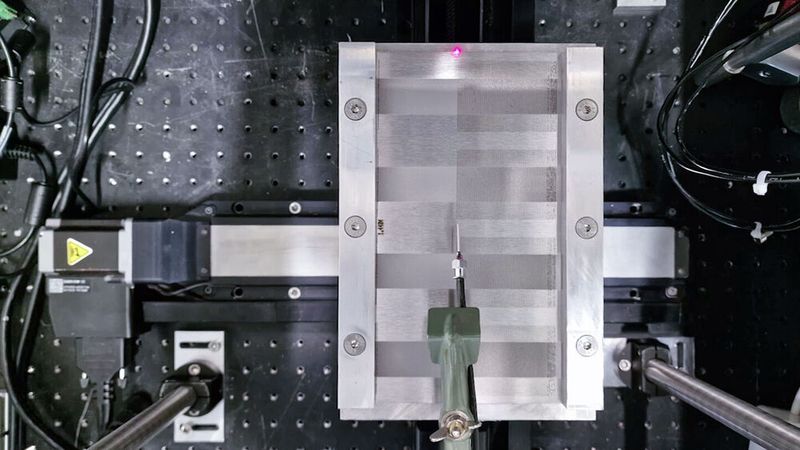
When the laser learns: Laser-based welding processes can be optimized in real-time thanks to machine learning.
(Image: Empa)
Laser-based processes allow for the precise welding of metal components or the creation of more complex parts using 3D printing—quickly, accurately, and automatable. Therefore, laser-based processes are used in numerous industries, such as the automotive and aerospace industries, where the highest precision is required, or in medical technology, for example, to manufacture custom-made titanium implants. The problem: Laser processes are technically demanding. The interactions between laser and material make the process sensitive to the slightest deviations— whether in material properties or laser parameter settings. Even minor fluctuations can lead to production errors.
"In order for laser-based processes to be used flexibly and achieve consistent results, we are working on better understanding, monitoring, and controlling laser-based processes," says Elia Iseli, research group leader in the Empa department of Advanced Materials Processing in Thun. In line with these principles, Giulio Masinelli and Chang Rajani, two researchers from the group, aim to make laser-based production methods cheaper, more efficient, and more accessible—by means of machine learning.
Two Different Modes: Evaporate or Melt?
First, the two researchers focused on additive manufacturing, namely the 3D printing of metals using lasers. This process, technically called Powder Bed Fusion (PBF), works somewhat differently than conventional 3D printing. Thin layers of metal powder are melted with the laser precisely at the right spots, gradually "welding" the finished component out of it.
With PBF, complex geometries are possible that can hardly be realized with other methods. Before production can begin, a series of preliminary tests is necessary. This is because, in laser processing of metal, including PBF, there are fundamentally two modes: In the so-called "Conduction Mode," the metal is merely melted. In the "Keyhole Mode," or deep welding, it is partially vaporized. The slower "Conduction Mode" is suitable for thin and very precise parts. Deep welding is somewhat less accurate but much faster and also suitable for thicker workpieces.
Where exactly the boundary between these two modes lies depends on a multitude of parameters. For the best quality of the finished product, the correct settings are needed—and they vary greatly depending on the material being processed. "Even a new batch of the same starting powder can require completely different settings," says Masinelli.
Reduce Preliminary Trials by About Two-Thirds
Normally, a series of tests must be conducted before each batch to determine the optimal settings for parameters such as scan speed and laser power for the respective component. This consumes a lot of material and requires supervision by a professional. "Many companies cannot afford PBF for this reason," says Masinelli.
Masinelli and Rajani have optimized this series of tests using machine learning. They utilize data from optical sensors that are already present in the laser machines. The researchers have taught their algorithm to "see," based on these optical data, which welding mode the laser is currently in during a trial. Based on this, the algorithm determines the settings for the next trial. This reduces the number of required preliminary tests by about two-thirds while maintaining the same quality of the final product.
"We hope that our algorithm will allow even non-experts to use PBF equipment," Masinelli summarizes. For the algorithm to be used in industry, it would just need to be integrated into the firmware of laser welding machines by the equipment manufacturers.
Optimize Welding Process in Real-Time
In another project, Rajani and Masinelli focused on laser welding and went even further. They optimized not only the preliminary trials but also the welding process itself. Even with optimal settings, laser welding can be unpredictable, especially if tiny defects on the metal surface come under the laser beam.
"Influencing the welding process in real-time is currently not possible," says Chang Rajani. "That exceeds the capabilities of human experts." The speed at which data needs to be evaluated and decisions made is a challenge even for computers. Therefore, Rajani and Masinelli used a special type of computer chip for this task, a so-called Field-Programmable Gate Array (FPGA). "With FPGAs, we know exactly when they will execute a command and how long the execution will take—which is not the case with a conventional PC," explains Masinelli.
Date: 08.12.2025
Naturally, we always handle your personal data responsibly. Any personal data we receive from you is processed in accordance with applicable data protection legislation. For detailed information please see our privacy policy.
Consent to the use of data for promotional purposes
I hereby consent to Vogel Communications Group GmbH & Co. KG, Max-Planck-Str. 7-9, 97082 Würzburg including any affiliated companies according to §§ 15 et seq. AktG (hereafter: Vogel Communications Group) using my e-mail address to send editorial newsletters. A list of all affiliated companies can be found here
Newsletter content may include all products and services of any companies mentioned above, including for example specialist journals and books, events and fairs as well as event-related products and services, print and digital media offers and services such as additional (editorial) newsletters, raffles, lead campaigns, market research both online and offline, specialist webportals and e-learning offers. In case my personal telephone number has also been collected, it may be used for offers of aforementioned products, for services of the companies mentioned above, and market research purposes.
Additionally, my consent also includes the processing of my email address and telephone number for data matching for marketing purposes with select advertising partners such as LinkedIn, Google, and Meta. For this, Vogel Communications Group may transmit said data in hashed form to the advertising partners who then use said data to determine whether I am also a member of the mentioned advertising partner portals. Vogel Communications Group uses this feature for the purposes of re-targeting (up-selling, cross-selling, and customer loyalty), generating so-called look-alike audiences for acquisition of new customers, and as basis for exclusion for on-going advertising campaigns. Further information can be found in section “data matching for marketing purposes”.
In case I access protected data on Internet portals of Vogel Communications Group including any affiliated companies according to §§ 15 et seq. AktG, I need to provide further data in order to register for the access to such content. In return for this free access to editorial content, my data may be used in accordance with this consent for the purposes stated here. This does not apply to data matching for marketing purposes.
Right of revocation
I understand that I can revoke my consent at will. My revocation does not change the lawfulness of data processing that was conducted based on my consent leading up to my revocation. One option to declare my revocation is to use the contact form found at https://contact.vogel.de. In case I no longer wish to receive certain newsletters, I have subscribed to, I can also click on the unsubscribe link included at the end of a newsletter. Further information regarding my right of revocation and the implementation of it as well as the consequences of my revocation can be found in the data protection declaration, section editorial newsletter.
Nonetheless, the FPGA in their system is also connected to a PC, which serves as a kind of "backup brain." While the special chip is busy observing and controlling the laser parameters, the algorithm on the PC learns from this data. "If we are satisfied with the algorithm's performance in the PC's virtual environment, we can 'transfer' it to the FPGA and make the chip smarter all at once," Masinelli explains.
The two Empa researchers are convinced that machine learning and artificial intelligence can contribute a lot in the field of laser processing of metals. Therefore, they continue to develop their algorithms and models and expand their application area—in collaboration with partners from research and industry.



:quality(80)/p7i.vogel.de/wcms/89/e2/89e2a924bda16e3ad79db4c227d7276d/0130958544v1.jpeg "A TDXU 3E-0.3 multifunctional indexable insert from Ingersoll can be used at Sysbohr for threads in all sizes, replacing several special threaded inserts from another manufacturer. (Image:Ingersoll)")
:quality(80)/p7i.vogel.de/wcms/19/6c/196c2ee687a7bb52439b4fd217eb432a/0131032128v1.jpeg "Hendrick Motorsports manufactures cylinder blocks on the Grob universal machines, among other things. (Image:Grob-Werke)")
:quality(80)/p7i.vogel.de/wcms/9e/9a/9e9af2b4e620ecf3cd71f0b80d1e9fe6/0113143253v1.jpeg "In our China Market Insider, we regularly provide you with relevant information directly from China. (Image:© Eisenhans - stock.adobe.com)")
:quality(80)/p7i.vogel.de/wcms/af/6e/af6e728abeec9ef0868548fce83213be/0130628192v1.jpeg "Electropermanent technology only requires a short current pulse for magnetization, which reduces energy consumption by around 90 percent compared to traditional electromagnets. (Image:Schunk)")
:quality(80)/p7i.vogel.de/wcms/a3/d0/a3d07d650f6bd3a34cc43f251ad7de6f/aiengineeringkeyvisualmaletwoscreens2026-4320x2428v1v1.jpeg "Siemens is bringing AI into the physical world with the \"Eigen Engineering Agent\". (Image:Siemens)")
:quality(80)/p7i.vogel.de/wcms/4e/f4/4ef450a8e710b47e540a15216d554501/screenshot-202026-05-06-20085045-2217x1248v1.png "China has placed robotics at the heart of its modern industrial system.
(Source: Hangzhou Robotphoenix Industrial Robotics)")
:quality(80)/p7i.vogel.de/wcms/66/94/66943e8e39f723797ec73378a62a488f/0130379691v1.jpeg "Business in the critical infrastructure sector places high demands on information security. (Image:Lufthansa Industries/iStock, bjdlzx)")
:quality(80)/p7i.vogel.de/wcms/5e/db/5edb822e9babf4f8c0fce004b97ff630/0130658294v1.jpeg "Condition monitoring via sensors: Bladecontrol collects data from various areas of the wind turbine. (Image:Weidmüller)")
:quality(80)/p7i.vogel.de/wcms/6e/d2/6ed2f5e45cc7dcbde6cccb5d0076b043/0130177635v1.jpeg "Digital twin: The paperless electrical enclosure corresponds 100 percent to the digital twin. At UVP, the digital twin stands above every process - from planning to final testing - and brings all data together as a digital representation of the enclosure. (Image:RRP)")
:quality(80)/p7i.vogel.de/wcms/a1/7f/a17f6b122b3b2c2033e3fe0aaa64fc9f/emc-groundbreaking-photo-2560px-2560x1440v1.jpeg "Celebrating UL Solutions’ continued expansion and investment in Germany, President and CEO Jennifer Scanlon, EVP and CFO Ryan Robinson and other UL Solutions leaders are joined by Dirk Gene Hagelstein, mayor of Neu-Isenburg and Oliver Quilling, district administrator of the District of Offenbach, to mark the groundbreaking of the company’s new testing laboratory, due to open mid-2027. (Source: UL Solutions)")
:quality(80)/p7i.vogel.de/wcms/ab/e9/abe94c44bb91910105d3dd8cfb63cf32/pm0626-1-2675x1504v1v1.jpeg "With Iglidur i190PF, Igus has developed a highly stable filament for the 3D printing of wear-resistant and PTFE-free special parts. (Image:Igus)")
:quality(80)/p7i.vogel.de/wcms/ac/4a/ac4ac41833e4d72d7e5fe55b12291134/0131065166v1.jpeg "Robin Zeng, Chairman and CEO of CATL, is driving forward the development of modern battery technologies. (Image:CATL)")
:quality(80)/p7i.vogel.de/wcms/e2/33/e2335bb83af63d65d124bcfdb29fec72/volvo-svat-hero-5676x3190v1v1.jpeg "The autonomously driving Volvo VNL with \"Aurora Driver\" transports freight from Dallas to Oklahoma City on five working days. (Image:Aurora)")
:quality(80)/p7i.vogel.de/wcms/ab/ec/abec1abc604e177a528af7da6677a0d1/0131024895v1.jpeg "Mercedes-Benz has officially started production of the facelift versions of the S-Class, Mercedes-Maybach S-Class and EQS in Sindelfingen. Head of the Works Council Ergun Lümali (left), Plant Manager Sara Gielen and Board Member for Production Michael Schiebe were present. (Image:Mercedes-Benz)")
:quality(80)/p7i.vogel.de/wcms/63/bf/63bf7e4c7609a792683899c0557c8bda/0130967702v1.jpeg "Joint solution: E.on, Neot and Mitsui offer fast charging stations for e-trucks and suitable charging tariffs as part of Charging-as-a-Service. (Image:E.On)")
:quality(80)/p7i.vogel.de/wcms/48/03/4803e4374f22fab8527db4b0518b0a17/0131062677v1.jpeg "To strengthen its portfolio, particularly with regard to edge cloud infrastructure for AI solutions, low-power FPGA specialist Lattice Semiconductor is acquiring firmware and cloud software developer AMI. (Image:Lattice)")
:quality(80)/p7i.vogel.de/wcms/19/22/1922d66f09ca71f9c5e4260a7bde3b3e/0131025523v1.jpeg "Figure 1: Switched-mode voltage transformer with corresponding compensation components for adjusting the control loop speed and stability. (Image:ADI)")
:quality(80)/p7i.vogel.de/wcms/8c/2f/8c2f742cb71da7b314db3727cd093571/0131025255v1.jpeg "Figure 1: System block diagram of a functionally safe mobile robot. (Image:TI)")
:fill(fff,0)/images.vogel.de/vogelonline/companyimg/76800/76895/65.jpg "FAULHABER_120mm.jpg ()")
:quality(80):fill(efefef,0)/p7i.vogel.de/wcms/67/ad/67adf4a647532/elatec-wp-machine-authentication.png "Elatec WP Machine Authentication")
:quality(80)/p7i.vogel.de/wcms/1c/18/1c188a2a23605e9e8d83344404d69eff/0128047590v1.jpeg "When the laser learns: Laser-based welding processes can be optimized in real time thanks to machine learning. (Image:Empa)")
:quality(80)/p7i.vogel.de/wcms/fd/5e/fd5e22f13f804834f8a4536e5aff7f9a/0125422988v1.jpeg "With the new process developed by Dr. Oliver Maurer, smaller metal components can be printed significantly finer and with higher quality using a 3D printer. (Image:Claudia Ehrlich/Saarland University)")