Lithuania is investing in one of the largest battery storage projects in the Baltic region: 291 MW of output and 582 MWh of capacity are to stabilize the electricity grid and integrate renewable energies more flexibly from 2027.
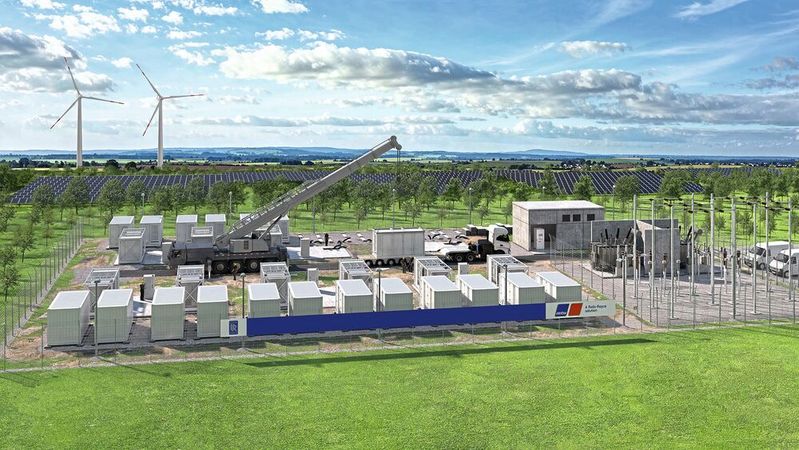
The storage facilities are being built at three locations in Lithuania.
(Image: Nidec Conversion)
A battery storage system with a total output of 291 megawatts and a storage capacity of 582 megawatt hours is currently being built at three strategically important locations in Lithuania. The Ignitis Group, the largest listed energy company in the Baltic States, is in charge of the project. The project is being implemented technologically together with the Power Systems division of Rolls-Royce. Nidec Conversion is supplying a central component with its integrated power modules.
With full commissioning planned by 2027, the project should not only accelerate the integration of renewable energies, but above all strengthen the country's energy security. In view of increasing electrification and fluctuating feed-in from wind and solar energy, this type of infrastructure is becoming strategically important for national electricity systems.
291 MW / 582 MWh: Dimension And Significance
The systems will be installed at the Kelmė and Mažeikiai wind farm sites and near the Kruonis pumped storage power plant. This choice of location is strategic: wind farms generate highly fluctuating power, while the existing pumped storage power plant already plays a central role in stabilizing the grid. The battery storage units act here as an additional, particularly fast-acting flexibility reserve.
Rolls-Royce is supplying the mtu EnergyPack systems as part of its largest order to date in the field of stationary battery storage. These containerized solutions are designed for utility-scale applications and integrate battery modules, power electronics, control technology and safety components into a scalable overall system.
The Role of Nidec: Integrated Power Modules at the Heart of the System
While the focus is often on battery systems, it is the power electronics that determine their actual network effectiveness. This is the task of Nidec Conversion. The company supplies power modules that act as a link between the battery and the power grid.
The module is designed as a pre-assembled system mounted on a skid. It combines an energy conversion system cabinet, i.e. the actual power conversion system, a transformer and a medium-voltage switchgear in one integrated unit. This combination reduces interfaces, simplifies installation on site and minimizes potential sources of error.
The power conversion system handles the bidirectional conversion of direct current from the batteries into grid-compliant alternating current and vice versa. The transformer adapts the voltage to the respective grid level, while the medium-voltage switchgear enables safe integration into the higher-level grid. The integration of these components in a compact module results in a high power density with reduced space requirements.
For utility-scale projects in particular, aspects such as noise levels, maintenance accessibility and modular expandability are crucial. The system from Nidec is designed for a low noise level and is therefore also suitable for locations in sensitive environments. At the same time, it is based on the company's decades of experience in industrial power electronics and grid technology.
Grid Stability As A Strategic Goal
Battery storage systems of this size fulfill several functions in the electricity system. They smooth load peaks, provide primary and secondary control energy and enable surplus renewable energy to be fed into the grid with a time delay. Such systems are becoming increasingly important, particularly in regions with rapidly growing wind energy, as is the case in Lithuania.
If wind farms generate more electricity than is currently being consumed, the energy can be stored temporarily instead of shutting down systems. When demand increases or feed-in decreases, it is released back into the grid. This reduces the dependency on fossil reserve power plants and the grid frequency remains stable. For Lithuania, the project also represents a further step towards greater energy independence and resilience.
Partnership
The cooperation between Ignitis Group, Rolls-Royce and Nidec Conversion shows how international industrial companies and national utilities are working together to transform the energy system. For Rolls-Royce, the order marks the biggest milestone to date in the BESS segment, while for Nidec it underlines its position as a provider of integrated power electronics solutions in the global market.
Date: 08.12.2025
Naturally, we always handle your personal data responsibly. Any personal data we receive from you is processed in accordance with applicable data protection legislation. For detailed information please see our privacy policy.
Consent to the use of data for promotional purposes
I hereby consent to Vogel Communications Group GmbH & Co. KG, Max-Planck-Str. 7-9, 97082 Würzburg including any affiliated companies according to §§ 15 et seq. AktG (hereafter: Vogel Communications Group) using my e-mail address to send editorial newsletters. A list of all affiliated companies can be found here
Newsletter content may include all products and services of any companies mentioned above, including for example specialist journals and books, events and fairs as well as event-related products and services, print and digital media offers and services such as additional (editorial) newsletters, raffles, lead campaigns, market research both online and offline, specialist webportals and e-learning offers. In case my personal telephone number has also been collected, it may be used for offers of aforementioned products, for services of the companies mentioned above, and market research purposes.
Additionally, my consent also includes the processing of my email address and telephone number for data matching for marketing purposes with select advertising partners such as LinkedIn, Google, and Meta. For this, Vogel Communications Group may transmit said data in hashed form to the advertising partners who then use said data to determine whether I am also a member of the mentioned advertising partner portals. Vogel Communications Group uses this feature for the purposes of re-targeting (up-selling, cross-selling, and customer loyalty), generating so-called look-alike audiences for acquisition of new customers, and as basis for exclusion for on-going advertising campaigns. Further information can be found in section “data matching for marketing purposes”.
In case I access protected data on Internet portals of Vogel Communications Group including any affiliated companies according to §§ 15 et seq. AktG, I need to provide further data in order to register for the access to such content. In return for this free access to editorial content, my data may be used in accordance with this consent for the purposes stated here. This does not apply to data matching for marketing purposes.
Right of revocation
I understand that I can revoke my consent at will. My revocation does not change the lawfulness of data processing that was conducted based on my consent leading up to my revocation. One option to declare my revocation is to use the contact form found at https://contact.vogel.de. In case I no longer wish to receive certain newsletters, I have subscribed to, I can also click on the unsubscribe link included at the end of a newsletter. Further information regarding my right of revocation and the implementation of it as well as the consequences of my revocation can be found in the data protection declaration, section editorial newsletter.
With the planned full commissioning by 2027, a storage infrastructure is being created in Lithuania that goes far beyond a single project. It is part of a strategic realignment towards a flexible, digitally controlled and renewable energy system. The combination of powerful battery storage systems and integrated converter technology forms the technical backbone for a stable grid in times of increasing volatility.
The project is an example of a development that is gaining momentum throughout Europe: the expansion of renewable energies alone is not enough. (mr)



:quality(80)/p7i.vogel.de/wcms/45/e4/45e497fad5299ffbb7278c1636a261ba/0129304667v1.jpeg "Screw head forming with heat: The heads of the blanks are heated to over 1,000 °C in the induction stage. (Image:Aachen mechanical engineering)")
:quality(80)/p7i.vogel.de/wcms/bc/df/bcdfa690253179f44dfa43986e35e3d4/0129302450v1.jpeg "The VSC 400 DDS retrofit machine from EMAG at EWS Weigele with tool shuttle for external tool preparation - the basis for reliable hard machining of gears. (Image:Emag Systems)")
:quality(80)/p7i.vogel.de/wcms/f7/85/f785e961fa2a55ecf4380e1a204c79e3/0129432203v1.jpeg "This is the new Artis 300, which completes the Artis range as the third variant. It stands for TIG DC welding up to 300 amps and is designed as an XT variant for all common voltage levels worldwide. (Image:Fronius)")
:quality(80)/p7i.vogel.de/wcms/28/7c/287ccc5ac565d6e6041bebb1e3e073f0/0113143253v1.jpeg "In our China Market Insider, we regularly provide you with relevant information directly from China. (Image:© Eisenhans - stock.adobe.com)")
:quality(80)/p7i.vogel.de/wcms/99/2e/992e57a54c4ddeaafc113de8e56f2b73/0129501004v1.jpeg "Sereact's AI-based control system can process new and unknown items without prior data collection. (Image:Sereact)")
:quality(80)/p7i.vogel.de/wcms/97/3a/973acc83133c28605f855d750523142e/0129492013v1.jpeg "During the opening, Agile One symbolically pressed the start button. (Image:Deutsche Telekom AG / Cindy Albrecht)")
:quality(80)/p7i.vogel.de/wcms/dd/4e/dd4e6ce73e0e700dcc0f0584813ef47f/0128875162v1.jpeg "Thanks to their high precision, robustness and integration capability, Micro-Epsilon's measurement technology solutions are not only suitable for new systems, but also ideal for retrofit applications. (Image:Micro-Epsilon Messtechnik GmbH & Co. KG)")
:quality(80)/p7i.vogel.de/wcms/17/61/1761a0165c23fe007d0a8e62d2a23121/0129467133v1.jpeg "The partnership between Dassault Systèmes and Nvidia aims to make the industry more effective with the help of AI and digital twins. (Picture: ©DC Studio - stock.adobe.com)")
:quality(80)/p7i.vogel.de/wcms/f8/2d/f82d45c2610205e2c0c188968022890d/more-liftoff-power-first-ariane-6-with-four-boosters-launched-4781x2691v1v1.jpeg "The Ariane 6 can be modularly adapted to any mission—either with two or four boosters and a variable payload fairing length. (Image:ESA-M. Pedoussaut)")
:quality(80)/p7i.vogel.de/wcms/9b/e7/9be7c2ceb897aa2bf1ab4eb2198b8b96/roboter-20hand1-1240x698v1v1.jpeg "What if you could 3D print a soft robot with predictable shape-shifting capabilities already built in? (Image:Picture: Harvard University)")
:quality(80)/p7i.vogel.de/wcms/a7/34/a73475e9638e032c32288f53006abab7/newsimage417867-2665x1500v1v1.jpeg "Combination of a model from a scanning electron microscope image (left) with a section of the underlying crystal structure of a studied MXene with precisely controlled surface terminations. (Image:B. Schröder/HZDR)")
:quality(80)/p7i.vogel.de/wcms/d2/1a/d21a9b3e1333f306ffd6421e84f9e3d0/semiconductor-20image-20courtesy-20of-20gelest-3000x1688v1.jpeg "In a new collaboration, IBM will test the performance of Gelest precursor materials for dry resist EUV lithography, generating results that aim to guide Gelest on materials research and speed innovation toward smaller devices. (Source: Gelest)")
:quality(80)/p7i.vogel.de/wcms/ad/72/ad72626a52c9a9332591f457e5afabca/0129497458v1.jpeg "BMW's new Board Member for Development Joachim Post in the new iX3 model. (Image:BMW)")
:quality(80)/p7i.vogel.de/wcms/12/ce/12ce3b8d4062d9e433419e9ada594c34/adobestock-1669527454-marewa-4096x2304v1v1.jpeg "Symbol image (Image:Marewa - stock.adobe.com)")
:quality(80)/p7i.vogel.de/wcms/e8/1f/e81f2bd61d820a0cf982dd3831f273dd/0129511298v1.jpeg "In China, certain functions in new cars will once again be directly accessible via haptic input—without a screen. (Image:BYD)")
:quality(80)/p7i.vogel.de/wcms/0b/02/0b02abc1524e267ae66ad0609ce08b20/0129482073v1.jpeg "The Haval Jolion Pro competes in the compact SUV segment. (Image:GWM)")
:quality(80)/p7i.vogel.de/wcms/68/ec/68ec268edc51a26c4e6e2de7187e8e4f/0129456364v1.jpeg "The storage facilities are being built at three locations in Lithuania. (Image:Nidec Conversion)")
:quality(80)/p7i.vogel.de/wcms/a0/36/a03679debcdda99158f4eaa0d6fbe43d/0129505643v1.jpeg "Arduino App Lab: The current release 0.4.0 brings a number of helpful new features. (Image:Arduino)")
:quality(80)/p7i.vogel.de/wcms/36/c8/36c8b329076027abf5def92031e3028e/0129508876v1.jpeg "Microsoft German headquarters in Munich: As part of the Munich Security Conference, 15 international companies along the entire electronics value chain have formed a tech alliance for digital sovereignty and common trust standards under the leadership of Microsoft and Ericsson. (Image:Microsoft)")
:quality(80)/p7i.vogel.de/wcms/d5/6e/d56e97cb8afab17e93794c1cca214228/0129419457v1.jpeg "China is investing heavily in its domestic semiconductor ecosystem. If you want to be part of it, you should know in advance where which cluster is located and which technology it is driving forward. (Image:Dall-E / AI-generated)")
:fill(fff,0)/images.vogel.de/vogelonline/companyimg/76800/76895/65.jpg "FAULHABER_120mm.jpg ()")
:fill(fff,0)/p7i.vogel.de/companies/69/88/69882c428938e/tmts2026-ticec-banner-en-2000px.png "tmts2026-ticec-banner-en-2000px (https://www.tmts.tw/en)")
:fill(fff,0)/p7i.vogel.de/companies/67/eb/67eba621ef6ea/logo2.png "logo2 (Wuxi InfiMotion)")
:quality(80):fill(efefef,0)/p7i.vogel.de/wcms/66/d0/66d08fb5ceae0/dossier-battery-technology.png "Dossier Battery Technology")
:quality(80)/p7i.vogel.de/wcms/2d/d3/2dd39c1ef4e8136a25ac906f765c7480/0127131722v1.jpeg "MTU gas generators of the 4000 series, which reach full load in 120 seconds, can already be used for power supply in data centers. (Image:Rolls-Royce)")
:quality(80)/p7i.vogel.de/wcms/d9/d2/d9d2201409159474446769c13ac97644/0128370099v1.jpeg "The ReNew project is developing system concepts for megawatt charging stations. (Image:Fraunhofer ISE | AI)")