The American system integrator Vision Optronix has developed an imaging system that checks the quality of self-adhesive cohesive material during production. Line cameras from Teledyne Dalsa form the basis of this system, which significantly reduces scrap.
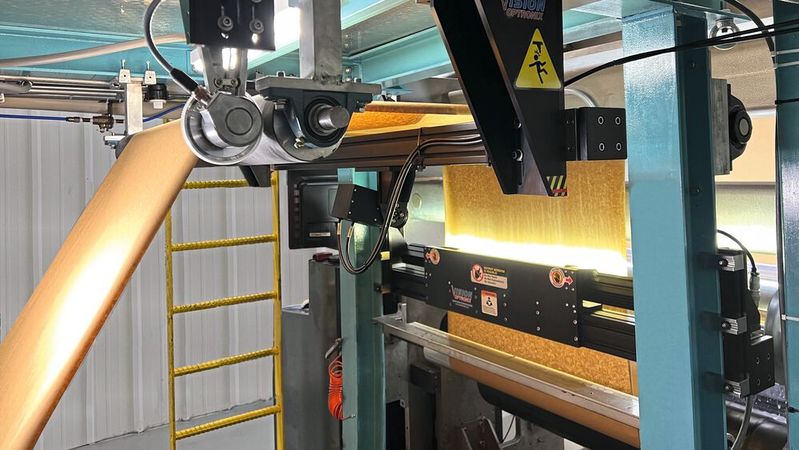
The installed wrinkle detection system by Vision Optronix in the user's coating plant reduces scrap.
(Image: Vision Optronix)
Self-adhesive cohesive materials and tapes, known as Pressure-Sensitive Adhesives (PSA), are commonly used in the manufacture of medical products such as wound dressings and are based on non-reactive adhesives that form a bond when pressure is applied to affix the material to a surface. In the medical field, PSAs are most frequently used for wound care or surgical repair procedures, which is why the quality of the material is of the utmost importance. PSAs offer potential advantages over traditional sealants and adhesives, such as ease of application and versatility in bond strength.
A manufacturer of PSAs for medical applications was experiencing yield losses on its production line due to folding defects that occurred in the nonwoven fabric layer of the product. These nonwoven PSAs are produced on lightweight PET plastic and paper carrier materials with a width of about 70 centimeters and a thickness of 0.025 to 0.075 millimeters. After the adhesive coating is applied to the carrier material, a thick, white nonwoven material of approximately the same thickness, 0.025 to 0.075 millimeters, is laminated onto the carrier material at speeds of up to 55 meters per minute.
During the lamination process, the nonwoven fabric material can periodically form folds that render the product unusable and lead to waste. The folds created during manufacturing are difficult to detect with the human eye, as the gauze-like nonwoven material is very thin and translucent. If these folds are not detected and eliminated, they can extend over hundreds of meters, resulting in a loss of raw materials, wasted labor, and increased overhead costs for the order. More critically, if the folds are not discovered and removed before shipment, customers may reject the product. Worse still, the manufacturer and the end-user in the medical facility could suffer reputational and brand damage. Effective quality control measures are essential to detect these defects early in the production process to minimize losses and protect the brand's integrity.
Since the manufacturer could not find a commercially available imaging solution for this application, they turned to the American system integrator Vision Optronix to develop an imaging system that assists in detecting, locating, and reporting folding defects during the production of PSAs. The goal of this new imaging system was to alert the PSA manufacturer's operators so they could immediately rectify any occurring folds, and also to automatically mark the position of the fold defects. Additionally, a file with detected fold defects was to be created and stored along with the defect images. Using this error file, technicians and operators of the cutting machine could remove the fold defects marked by the imaging system later in the production process before shipping the product. This ensures the quality and usability of the final product while minimizing waste and potential reputation damage from defective products reaching customers.
The solution
Vison Optronix analyzed the problem in its laboratory to find the best method for imaging the wrinkle defects. While the size of the defects and the process speed determined the design requirements for the camera and image processing system, it became clear that the lighting requirements were a technically challenging aspect that needed to be considered.
During an on-site assessment, Vision Optronix initially examined the folding defects and the web coating system that applies the special coatings. It was crucial to understand how the various components of the imaging system needed to be optomechanically designed to fit within the available space. Based on this understanding, the system integrator developed, implemented, programmed, and tested a preliminary design of the imaging system including the necessary electronics, image processing algorithms, and the graphical user interface for the customer. This comprehensive approach ensured that the system was effectively tailored to meet the specific needs and constraints of the production environment.
The implementation
The development of contrast was particularly challenging for this customer application, especially for the ultra-thin, gauze-like white nonwoven material laminated onto white PET. With the assistance of Massachusetts-based CPU Automation, Vision Optronix selected commercial CCS line lights for this task. These lights enabled the imaging system to develop sufficient contrast to detect the folding defects. To ensure that the system detected as many fold defects as possible while minimizing false detections, Vision Optronix implemented a series of image processing algorithms. These algorithms were fine-tuned to detect subtle variations and imperfections in the material, critical for ensuring the highest quality in the final product.
Date: 08.12.2025
Naturally, we always handle your personal data responsibly. Any personal data we receive from you is processed in accordance with applicable data protection legislation. For detailed information please see our privacy policy.
Consent to the use of data for promotional purposes
I hereby consent to Vogel Communications Group GmbH & Co. KG, Max-Planck-Str. 7-9, 97082 Würzburg including any affiliated companies according to §§ 15 et seq. AktG (hereafter: Vogel Communications Group) using my e-mail address to send editorial newsletters. A list of all affiliated companies can be found here
Newsletter content may include all products and services of any companies mentioned above, including for example specialist journals and books, events and fairs as well as event-related products and services, print and digital media offers and services such as additional (editorial) newsletters, raffles, lead campaigns, market research both online and offline, specialist webportals and e-learning offers. In case my personal telephone number has also been collected, it may be used for offers of aforementioned products, for services of the companies mentioned above, and market research purposes.
Additionally, my consent also includes the processing of my email address and telephone number for data matching for marketing purposes with select advertising partners such as LinkedIn, Google, and Meta. For this, Vogel Communications Group may transmit said data in hashed form to the advertising partners who then use said data to determine whether I am also a member of the mentioned advertising partner portals. Vogel Communications Group uses this feature for the purposes of re-targeting (up-selling, cross-selling, and customer loyalty), generating so-called look-alike audiences for acquisition of new customers, and as basis for exclusion for on-going advertising campaigns. Further information can be found in section “data matching for marketing purposes”.
In case I access protected data on Internet portals of Vogel Communications Group including any affiliated companies according to §§ 15 et seq. AktG, I need to provide further data in order to register for the access to such content. In return for this free access to editorial content, my data may be used in accordance with this consent for the purposes stated here. This does not apply to data matching for marketing purposes.
Right of revocation
I understand that I can revoke my consent at will. My revocation does not change the lawfulness of data processing that was conducted based on my consent leading up to my revocation. One option to declare my revocation is to use the contact form found at https://contact.vogel.de. In case I no longer wish to receive certain newsletters, I have subscribed to, I can also click on the unsubscribe link included at the end of a newsletter. Further information regarding my right of revocation and the implementation of it as well as the consequences of my revocation can be found in the data protection declaration, section editorial newsletter.
Vision Optronix chose line scan cameras from Teledyne Dalsa, specifically the Linea 2K and 4K models, for their integrated encoders and line illumination, making them particularly suitable for this application. Since the nonwoven PSAs are produced in a web process and the material moves over rollers during the manufacturing process, these cameras are ideal for capturing high-speed, continuous images. To optimize imaging performance while fitting into the available space of the web coating system, Vision Optronix selected a special lens. Optomechanical devices were designed and implemented to accurately align and maintain the positioning of the camera and line light. This setup ensures that the entire web process during manufacturing is imaged with sufficient contrast. Various image processing algorithms were applied, running on the Vision Controller at the necessary web coating speeds. This setup ensured that each frame of the process could be analyzed to detect, locate, and report folding defects effectively. This robust system design helps in providing high-quality control by consistently monitoring for any imperfections, ensuring that the production line maintains high standards of quality.
The system from Vision Optronix is equipped with digital inputs and outputs for process control and monitoring, as well as options for storing error images and generating reports. Additionally, a graphical user interface has been developed, enabling operators and engineers to configure the image processing system for each product using recipes that are applied during every production run. This user-friendly interface allows for easy adjustments and optimizations tailored to specific requirements, greatly enhancing the system's flexibility and efficiency in handling different products on the same production line. Through this interface, operators can quickly respond to and correct any detected defects, ensuring a consistent quality standard across the manufacturing process.
After Vision Optronix developed recipes for three of the customer's products in the lab, these were further optimized on-site while the customer's engineers were trained in the recipe development process for further use with all of the customer’s products. The user interface allows operators to input job data, select recipes, and control other parameters such as image handling, storage options, error classification settings, and input/output control settings. Vision Optronix used the Teledyne Sapera CamExpert configuration application to set up and test the Linea cameras. Additionally, the team was able to activate line triggering via an encoder, enabling the line capture to be synchronized with the integrated multiplier/divider to match the optical resolution (pixels on the web). This precision in synchronization ensures that the imagery captured reflects the actual conditions of the web process, allowing for accurate and dependable monitoring and analysis, thus enhancing the overall quality control process.
The design of the inspection system required the integration of various components, including the connection of digital IO electronics, line triggering with the integrated multiplier/divider, and setting up an image buffer size to limit the likelihood of lost images.
Ultimately, the costs of constructing and developing the system and the minor modifications to the production line to accommodate the new imaging system were significantly lower than the losses from a single batch of material and other associated direct costs.
Furthermore, the system enhances safety and relieves operators who previously had to spend considerable time near the laminating machine to monitor for potential folding. Vision Optronix also fulfilled the user's request to display captured images on a large screen at native resolution, making the web post-lamination visible to everyone in a straightforward manner. The system also stores recognized errors on a hard drive and references them in a report. Vision Optronix has designed, developed, and installed a custom image processing system leveraging top-tier electronic, photonic, and machine vision technologies. This system has helped the manufacturer address its quality issues in the production of PSAs for the medical industry. The realized installation ensures the highest quality of medical products and significantly reduces costly waste, much to the manufacturer's satisfaction. This implementation showcases the impact of advanced imaging and automation technologies in enhancing productivity and product quality in industry settings.



:quality(80)/p7i.vogel.de/wcms/31/84/3184f9ac736d8df7c2e934593684bc74/0130024314v1.jpeg "Here, the Bavarian car manufacturer BMW looks ahead to 2025: business was sluggish due to US tariffs and weakening sales in China ... (Image:BMW)")
:quality(80)/p7i.vogel.de/wcms/49/09/49095c6192a6c46d47b567e1def31ea6/0130024626v1.jpeg "The new TUM \"RoboGym\" (powered by Neura) is Europe's largest training center for next-generation humanoid robots. It focuses on the implementation of artificial intelligence in robotic systems. At the same time, it is a forge for AI experts ... (Image:Neura Robotics)")
:quality(80)/p7i.vogel.de/wcms/fe/8a/fe8af1b829b085210fef4c1fa8abddb5/0129784389v1.jpeg "As an integral part of Koch Pac-Systeme's Predictive Pack digital service product, the gearboxes with Cynapse and Wittenstein's Smart Services make it possible to detect damage risks in the packaging specialist's machines at an early stage. (Image:Koch Pac systems)")
:quality(80)/p7i.vogel.de/wcms/9f/7b/9f7be35880605811e045acd3af8b571b/0129558586v1.jpeg "An example of the V210 processing machine, which, according to Voortman, supplements the laser cutting of the V353 with drilling, thread cutting and milling. (Image:Voortman)")
:quality(80)/p7i.vogel.de/wcms/db/68/db689490e348201603dd30447711ea2b/0129578734v1.jpeg "With three-axis vibration measurement (X, Y and Z axes) and temperature detection, the CMSVT38 condition monitoring sensor provides detailed status information that helps to detect machine damage at an early stage. (Image:Kübler)")
:quality(80)/p7i.vogel.de/wcms/92/5e/925ee98ea36ad9bd574fa1cea11d0e53/0129964352v1.jpeg "The production of hardware components for humanoid robots offers great market potential. (Image:Fraunhofer IPA)")
:quality(80)/p7i.vogel.de/wcms/08/72/0872dd2dd119a54824c41e0e580e45a8/0129576591v1.jpeg "The Rose enclosure systems can be customized on request. (Image:Rose Systemtechnik GmbH)")
:quality(80)/p7i.vogel.de/wcms/73/17/7317794432521bf911711b91287cfc28/0129961259v1.jpeg "ABB Robotics and Nvidia are enabling the widespread use of physical AI in the world of robotics. This means that systems can be created virtually and with high precision and optimized much more cost-effectively. In the large image the virtual system, next to it the real robot cell ... (Image:ABB)")
:quality(80)/p7i.vogel.de/wcms/cb/fe/cbfe2741917274bbbf93d5b93e47a4f5/contact-software-launcht-fourier-20aiv1v1.png "Fourier AI combines AI models with AI applications developed for demanding engineering tasks. (Image:Contact Software)")
:quality(80)/p7i.vogel.de/wcms/bc/f7/bcf7a56980850be13ed37d220cd514bc/elchinator-security-5042249-1280-1280x720v1v1.jpeg "The HP Wolf Security Report shows: Attackers use AI for speed, modularity and automation, while the quality of campaigns is low. (Image:Picture: Pixabay)")
:quality(80)/p7i.vogel.de/wcms/68/89/688937087188b77da95b2079399ca862/0130009534v1.jpeg "Here you can see the Dualis layout configurator in use at Montratec. (Picture: ©Gorodenkoff - stock.adobe.com)")
:quality(80)/p7i.vogel.de/wcms/9e/98/9e984afbf9c6f2bcc8963bd13465b180/26-02-pi-fraunhofer-iws-41300-ultragrain-project-closing-pic-02-1562x878v1v1.png "The process of laser wire build-up welding (DED-LB) with pulse laser-induced plasma, which contributed to the success of the Ultra Grain project, is shown at high speed. (Image:Fraunhofer IWS)")
:quality(80)/p7i.vogel.de/wcms/69/f5/69f516f07a0ba999c5ba8763891853f1/0130030553v1.jpeg "Can be reloaded in 210 seconds for a return trip on the Greenford branch line: the GWR's 230001. (Image:Jack Boskett Media | GWR)")
:quality(80)/p7i.vogel.de/wcms/f0/5e/f05e720c52f757660ddbf7c410074f64/adobestock-222131875-5616x3157v1.jpeg "(Source: © jeson - stock.adobe.com)")
:quality(80)/p7i.vogel.de/wcms/b2/64/b2641254fef5afa15645cefc37089c88/0130021093v1.jpeg "Daimler Truck and Quantum Systems are jointly developing unmanned military vehicles. (Image:Quantum Systems)")
:quality(80)/p7i.vogel.de/wcms/30/7e/307e71ec64f7c52c29458544ca29adf1/org-blobs-user-response-file-output-799034cb-2ad7-4031-859a-15013f5b78e3-plugin-output-toolu-01vwfuenhw3cadvud7pddgyq-1536x864v1v1.png "China's government is debating the contents of the 15th five-year plan. The focus will change for the automotive industry. (Image:AI-generated)")
:quality(80)/p7i.vogel.de/wcms/61/8f/618f16f8fa95ec6cc838ca9bfb5dbaf1/0130027046v1.jpeg "The Belgian Research Institute has set up a European university consortium on the subject of CMOS 2.0. It brings together 26 university groups to research chip technologies that go beyond conventional transistor scaling. (Image:Imec)")
:quality(80)/p7i.vogel.de/wcms/db/a2/dba29322d0934dea1bbc4b31df80e392/0129953760v1.jpeg "SEM image: High-density electrode array with 128 nm dots. (Image:imec)")
:quality(80)/p7i.vogel.de/wcms/c2/a8/c2a8a93f306c1475489dff074ad59731/0129967672v1.jpeg "Figure 1: Imec's logic technology roadmap showing the extension of the nanosheet era from 2nm to the A10 node with the outer-wall forksheet, before the transition to CFET for A7 and beyond. (Image:imec)")
:quality(80)/p7i.vogel.de/wcms/07/79/0779a3ba2b38d583fc9b515900be2add/0129957428v1.jpeg "If the Chinese government has its way, domestic data centers full of Nvidia hardware will be a thing of the past. (Image:Nvidia)")
:fill(fff,0)/images.vogel.de/vogelonline/companyimg/76800/76895/65.jpg "FAULHABER_120mm.jpg ()")
:fill(fff,0)/p7i.vogel.de/companies/67/eb/67eba621ef6ea/logo2.png "logo2 (Wuxi InfiMotion)")
:quality(80)/p7i.vogel.de/wcms/58/ed/58eda0cca5a5f636284120e6e6fcd6a8/0119177901v1.jpeg "The installed wrinkle detection system by Vision Optronix in the user's coating plant reduces scrap.(Image: Vision Optronix)")
:quality(80)/p7i.vogel.de/wcms/6b/8a/6b8ae78d32baec7f4ef7a3140dc6b30b/0119186228v1.jpeg "Model of the designed wrinkle detection system in the manufacturer's web coating plant after measurement.(Image: Vision Optronix)")
:quality(80)/p7i.vogel.de/wcms/50/c7/50c7dbcb92b8ebe364e08aa8dc0aadf9/0119178015v1.jpeg "The installed control unit for the wrinkle detection system.(Image: Vision Optronix)")
:quality(80)/p7i.vogel.de/wcms/e1/63/e1637c395a823efc2febce719ff84d7f/0119178008v1.jpeg "The Linea 2K and 4K line cameras from Teledyne Dalsa were the optimal choice for Vision Optronix due to their high resolution and speed, as well as the integrated encoder and line illumination, for the realized wrinkle detection system.(Image: Teledyne Dalsa)")
:quality(80)/p7i.vogel.de/wcms/89/9d/899d884f9985332b5b1d24accaeda899/0127167987v1.jpeg "Image processing systems ensure economical quality control at a U.S. diesel engine manufacturer. (Image: ©Vision On Line/AdobeStock)")
:quality(80)/p7i.vogel.de/wcms/ad/ea/adeaeff9b0a5cd1ae73b8c25d8d40ffe/0124551277v1.jpeg "A major US manufacturer ensures the quality of its motor fans with image processing. (Image:AI-generated)")