Image processing systems from Vision On Line ensure reliable and economical quality control during the production of fans for diesel engines at a globally operating U.S. manufacturer.
Image processing systems ensure economical quality control at a U.S. diesel engine manufacturer.
Engines for automobiles are highly technically advanced systems and essential for the functionality of the overall product. For this reason, every single component of a power unit matters: all components must meet exact specifications and be correctly integrated to function flawlessly over the expected lifespan.
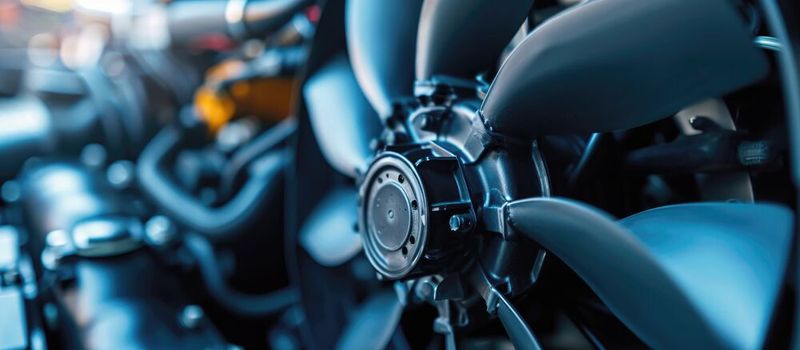
This also applies to the fans in engines, which ensure necessary cooling. If these components fail, it can lead to the engine block overheating and, in the worst case, engine damage. This is not only troublesome and costly for the driver but can also damage a brand's reputation, potentially leading to a loss in sales.
Gallery
Versatile Automotive Components
One of the world's leading manufacturers of automotive components supplies nearly all major automakers with its technologies. Its product portfolio covers virtually all required segments for both internal combustion engine vehicles and electromobility, including solutions ranging from the actual drivetrain to battery systems and charging stations. In the temperature management segment, the American company's offerings also include fans for large engines, such as those used in trucks, construction machinery, and other commercial vehicles. Since the beginning of 2024, Vision On Line's image processing systems have ensured reliable and cost-effective quality control of these fans at four inspection stations.
The company aimed to increase the level of automation in the production process and supply its customers with only guaranteed flawless fans for later installation in engines, thereby avoiding potentially high follow-up costs in case of defects.
Andreas Schaarschmidt, Managing Director, Vision On Line
"To implement the required image processing systems, the company sought an experienced partner. We had already successfully supported the company in previous projects, so we were very familiar with the manufacturer's expectations and processes. Within a few months, we were able to develop a powerful solution that met all requirements," says Schaarschmidt.
High Accuracy Required
The image processing systems from Vision On Line were integrated into the production process of the fans at four stations, where the components are balanced after manufacturing. Once a test piece is placed, the integrated vision system initially detects a metallic, black-painted metal part that contains a Data Matrix code with information about the specific fan model. As soon as the vision system reads this information from the centrally placed metal part, it communicates the data to the manufacturer's internal PC-based control system to retrieve the target values for the fan under inspection.
In the next step, the image processing system checks a series of component features for compliance with specifications. Among other things, it examines the correct number and geometric dimensions of the individual fan blades. For optimal operation of the finished fans, it is crucial that oversprays or missing material are reliably detected with an accuracy of ±0.04 inches.
The measured data is subsequently compared with the specified values of the central control system, and the inspected fan can proceed to the next steps for static balancing and later be delivered to customers for installation in engines if all specified parameters are met. Defective components are removed from the process and either reworked or disposed of, depending on the type of defect.
Optimally Selected Image Processing
The scope of work for Vision On Line was extensive: On the one hand, this manufacturer previously had no system in place where such fans were automatically inspected, which could have simply been optimized. On the other hand, the test components required a precisely tailored design of the image processing system, as the fans, with diameters of up to 31.5 inches, necessitated a relatively large field of view.
We were only able to achieve the required accuracy by selecting a large, powerful overhead lighting system from Büchner and a high-resolution 20 MP camera from SVS-Vistek with the appropriate optics from OPT.
Andreas Schaarschmidt, Managing Director, Vision On Line
The evaluation of the captured images is carried out using the Halcon software library from MVTec.
A crucial factor of the final image processing system in this application was the lighting, for which Vision On Line selected a custom model from the TLS series by Büchner Lichtsysteme GmbH. These overhead area illuminations operate with direct or diffuse light, are available in the light colors blue, green, red, white, and infrared, and allow for multiple camera openings if needed.
Date: 08.12.2025
Naturally, we always handle your personal data responsibly. Any personal data we receive from you is processed in accordance with applicable data protection legislation. For detailed information please see our privacy policy.
Consent to the use of data for promotional purposes
I hereby consent to Vogel Communications Group GmbH & Co. KG, Max-Planck-Str. 7-9, 97082 Würzburg including any affiliated companies according to §§ 15 et seq. AktG (hereafter: Vogel Communications Group) using my e-mail address to send editorial newsletters. A list of all affiliated companies can be found here
Newsletter content may include all products and services of any companies mentioned above, including for example specialist journals and books, events and fairs as well as event-related products and services, print and digital media offers and services such as additional (editorial) newsletters, raffles, lead campaigns, market research both online and offline, specialist webportals and e-learning offers. In case my personal telephone number has also been collected, it may be used for offers of aforementioned products, for services of the companies mentioned above, and market research purposes.
Additionally, my consent also includes the processing of my email address and telephone number for data matching for marketing purposes with select advertising partners such as LinkedIn, Google, and Meta. For this, Vogel Communications Group may transmit said data in hashed form to the advertising partners who then use said data to determine whether I am also a member of the mentioned advertising partner portals. Vogel Communications Group uses this feature for the purposes of re-targeting (up-selling, cross-selling, and customer loyalty), generating so-called look-alike audiences for acquisition of new customers, and as basis for exclusion for on-going advertising campaigns. Further information can be found in section “data matching for marketing purposes”.
In case I access protected data on Internet portals of Vogel Communications Group including any affiliated companies according to §§ 15 et seq. AktG, I need to provide further data in order to register for the access to such content. In return for this free access to editorial content, my data may be used in accordance with this consent for the purposes stated here. This does not apply to data matching for marketing purposes.
Right of revocation
I understand that I can revoke my consent at will. My revocation does not change the lawfulness of data processing that was conducted based on my consent leading up to my revocation. One option to declare my revocation is to use the contact form found at https://contact.vogel.de. In case I no longer wish to receive certain newsletters, I have subscribed to, I can also click on the unsubscribe link included at the end of a newsletter. Further information regarding my right of revocation and the implementation of it as well as the consequences of my revocation can be found in the data protection declaration, section editorial newsletter.
Another key feature for the application was that the dimensions of the illuminated area could be selected in 0.8 inches increments, up to 6.6 ft × 9.8 ft. Depending on the task, TLS illuminations are equipped with suitable LEDs in a very fine grid to achieve maximum intensity and homogeneity. For the fan inspection, Büchner produced a TLS variant with an illuminated area of approximately 24 in × 24 in and a total of 3,500 blue LEDs, with an electrical power of 177 watts, which can theoretically operate in flash mode at currents of up to 112 amperes. For optimal...
In close consultation with Vision On Line, Büchner also designed a specific mount for the lighting, enabling the selected camera to be installed in the camera opening of the lighting.
When selecting the appropriate camera, Schaarschmidt relied on his extensive experience with SVS-Vistek: “In the past, we have very often integrated industrial cameras from this partner into our systems because we are absolutely convinced of the quality of these products. Additionally, due to the in-house manufacturing of the cameras at SVS-Vistek in Gilching, we can rely on the reliable delivery of the ordered cameras, which is a particularly important factor in project work.”
For inspecting the fans of the American manufacturer, the exo183MGE model is used. It is particularly suitable for this application due to its high resolution of 20 megapixels and a data rate of up to 120 megabits per second via the integrated GigE Vision interface. The integrated 4-channel power strobe controller in these cameras enables precise timing control of the LED illumination—another advantage, as this eliminates the need for an external controller typically required, thereby reducing the overall cost of the image processing system.
Productivity Increased
Based on feasibility studies precisely tailored to the task, Vision On Line ensured in advance that the selected image processing components deliver optimal results in this application. Additionally, the vision experts supported the fan manufacturer in integrating the vision system into the facility and in programming.
Another challenge for Vision On Line was integrating the image processing system into the internal PC-based control system to seamlessly utilize and document the results of the vision inspections within the facility.
With four inspection systems commissioned in 2024, the U.S. corporation was able to significantly increase its productivity in fan manufacturing and identify defects in components more quickly and reliably. Due to these positive results, the company is currently, according to Schaarschmidt, reassessing quality inspection processes for other products at multiple locations and upgrading them with Vision On Line's image processing systems.
Peter Stiefenhöfer, PS Marcom Services
Secure and Compliant Authentication in Laboratories



:quality(80)/p7i.vogel.de/wcms/d2/73/d273374d6347651e4e6200cf6061ea4e/0132860560v1.jpeg "Even in July, the flag of the Chinese economy did not flutter particularly briskly in the air. Read here what’s happening and why production in China is apparently declining ... (Image:AI-generated)")
:quality(80)/p7i.vogel.de/wcms/18/47/1847f131e3afda201d1dbb98ad0ecb04/0132826776v1.jpeg "Image 1: Difender armored steels from Dillinger stand out with top scores in ballistic testing and cold bending. Defense companies therefore readily choose them. They can be found, for example, in the armored vehicles Fuchs and GTK Boxer of the German Armed Forces. (Image: Dillinger)")
:quality(80)/p7i.vogel.de/wcms/1e/7d/1e7d651782e0e97b3efc25abf2b52350/img-3485v1.jpeg "The Siemens Energy employees attach balancing weights at the precisely calculated and adjusted angular position to achieve the best possible result. (Source: Schenck Rotec)")
:quality(80)/p7i.vogel.de/wcms/a4/4c/a44ce96743685179c9e0fc31f35b1686/0132816576v1.jpeg "Laser Dicing: From the recoil force of the laser pulse upon impact on the semiconductor, a reproducible process signal can be derived in real time, enabling automated control of wafer dicing. (Image:Ciba University / CC BY-SA 4.0 / sciencedirect.com)")
:quality(80)/p7i.vogel.de/wcms/a2/85/a285b12508af812e28b17be3482a736c/0132488872v1.jpeg "NIS2 is no longer an abstract requirement in the distant future for many industrial companies. (Image:AI-generated)")
:quality(80)/p7i.vogel.de/wcms/e5/59/e5590f11cef563bf9ae1872bdc4e0fea/0132468153v1.jpeg "Matthias Wolfer is Product Manager Controller at Pilz. (Image: Pilz)")
:quality(80)/p7i.vogel.de/wcms/02/52/0252e5484816b31ca0bc0372bc62a19e/2-fi-pp-thermoprocess-technology-766561828v1.jpeg "Energy-intensive thermal processes require precise temperature control: Smart power controllers ensure the necessary energy efficiency and grid compatibility. (Source: Jumo)")
:quality(80)/p7i.vogel.de/wcms/20/d6/20d67956343287c2365a5eca2eb0a8b7/aufmacher-bihl-2bwiedemann-diagnoserepeater-20--20kopiev1.jpeg "With the ASi-5/ASi-3 diagnostic repeater, the cable length of an ASi network can be significantly extended. (Source: Bihl+Wiedemann)")
:quality(80)/p7i.vogel.de/wcms/44/fe/44fe86a16c26c09bb363b3671bf0b930/0132847771v1.jpeg "CoreTechnologie (CT) points out that the 3D printing software 4D_Additive has been equipped with additional application possibilities. Here you can learn more about what the new version 1.8 can do – such as generating complex lattice structures or optimizing faulty data ... (Image:CT)")
:quality(80)/p7i.vogel.de/wcms/b4/f2/b4f2c272247f79c5e87334a6839f20cb/0132549860v1.jpeg "Morefire analysis: Many mechanical engineering websites focus on technical specs instead of customer benefits. Translating features into clear benefits increases visibility, inquiries, and competitiveness. (Image: ©peopleimages.com - stock.adobe.com)")
:quality(80)/p7i.vogel.de/wcms/b4/9a/b49aaad0500e06e253f7d75ecb77338a/adobestock-4840668--dani-kreienb-hl-stock-adobe-comv1.jpeg "Metal processing in 2026 will be more digital, automated, and data-driven – but not automatically easier. (Image:© Dani Kreienbühl - stock.adobe.com)")
:quality(80)/p7i.vogel.de/wcms/1a/59/1a59392a5924d433a9bf21e34ecad8ce/ed2456-ferry-boat-123059v1.jpeg "New project brings hydrogen to passenger ships. (Source: Meyer Werft)")
:quality(80)/p7i.vogel.de/wcms/5d/a5/5da58961ea36104111c4cb0e1f941712/0132848377v1.jpeg "With the JCB Hydromax, the U.S. company JCB has now set the new speed record for hydrogen-powered vehicles. Systems from Poppe + Potthoff in Germany have contributed to this ... (Image:JCB)")
:quality(80)/p7i.vogel.de/wcms/a5/81/a5819b9b1f3a48a2ff466685f2d4251c/0132849735v1.jpeg "The first fully electric Ferrari is called Luce and triggered a wave of criticism. Yet, sales figures show that it still has many fans. And the very first built vehicle has now also fetched a record sum at an auction ... (Image: Ferrari)")
:quality(80)/p7i.vogel.de/wcms/c4/65/c4655e175f09db99b0fb17667db9d486/0132853627v1.jpeg "Heart Aerospace has completed the first flight with its fully battery-electric aircraft study X1. (Image:Heart Aerospace)")
:quality(80)/p7i.vogel.de/wcms/a4/e8/a4e8a47c76cc0e0a1885e7ed6a7f73d8/voyah-e59bbee78987-98-e1786787519878v1.webp "Voyah advertises the Passion S model with a stunt in a tunnel. (Source: Voyah)")
:quality(80)/p7i.vogel.de/wcms/28/20/28204a4592a69a8682bfbf9a8f7e1dc2/0132846993v1.jpeg "The health status of a lithium-ion battery changes with increasing aging. AI models can utilize characteristic changes in the charge and voltage curves to estimate the state of health. (Image:freely licensed)")
:quality(80)/p7i.vogel.de/wcms/90/dc/90dc332e30a3e4bd3ff77646ed0633b7/0132833369v1.jpeg "Through a compromised repository of the widely used open-source tool LiteLLM, attackers were able to capture several terabytes of data and login credentials. Security company CloudSEK concludes, after analyzing the data, that the attack conducted in March of this year affected more than 2,000 companies, including major players like Microsoft, Nvidia, AWS, and Deutsche Bahn. (Image:freely licensed)")
:quality(80)/p7i.vogel.de/wcms/93/40/9340a3a1088dd79fce6bda5c73b7dd2f/0132818390v1.jpeg "Already in 1980, Intel exited the production of DRAM chips, and in 2022, the Optane series, manufactured using the 3D XPoint process, marked the company's last commercial venture in the field of memory technologies. However, in light of the memory crisis and the growing demand for fast memory chips, Intel CEO Lip-Bu Tan now appears to be considering a possible return to the memory business. (Image: Intel)")
:quality(80)/p7i.vogel.de/wcms/b5/2a/b52a740bb2b6e48b2e530a9bb03fcd3b/0132819357v1.jpeg "Industrial high-speed communication: The CAN XL transceiver TCAN6062 transfers more data at higher speeds, making it suitable for applications such as humanoid robots, industrial robots, and HMI systems. (Image:Texas Instruments)")
:fill(fff,0)/p7i.vogel.de/companies/69/de/69de1b7403b0d/simtos-logo.jpeg "simtos-logo (SIMTOS)")
:quality(80)/p7i.vogel.de/wcms/2a/19/2a19cccd2a18382483cc09f5ee74f9a5/0127180626v1.jpeg "The GigE Vision camera exo183MGE from SVS-Vistek provides the optimal basis for the image processing system used, thanks in part to its high resolution of 20 megapixels and a data rate of up to 120 MB/s.(Image: SVS-Vistek GmbH)")
:quality(80)/p7i.vogel.de/wcms/77/72/77720b6f4d6487564340ff3b4572cdb6/0127180736v1.jpeg "For optimal operation of the fans, an accuracy of ± 1 millimeter must be maintained, and overmolding or missing material must be reliably detected.(Image: Vision On Line)")
:quality(80)/p7i.vogel.de/wcms/4a/3d/4a3d54d424d70bd2448c94ee911000d7/0127167996v1.jpeg "The image processing systems from Vision On Line first read a Data Matrix code in the central black area of the fans and then check the geometric features of the component.(Image: Vision On Line)")
:quality(80)/p7i.vogel.de/wcms/e9/05/e9051d24d8d987ab50f25701036827c5/0127168827v1.jpeg "A custom overhead area lighting system of the TLS series from Büchner Lichtsysteme GmbH, with an illuminated area of approximately 600 millimeters x 600 millimeters and 3,500 blue LEDs, ensures optimal lighting conditions for inspecting the fans.(Image: Büchner Lichtsysteme GmbH)")
:quality(80):fill(efefef,0)/p7i.vogel.de/wcms/67/ac/67acb931a438c/elatec-wp-gmp.png "Elatec WP GMP")
:quality(80)/p7i.vogel.de/wcms/b3/0f/b30fa47b8a7e4a1703436255600dab10/0127132229v1.jpeg "Deflectometry for defect detection on reflective components (Image:MVTec Software GmbH)")
:quality(80)/p7i.vogel.de/wcms/2c/49/2c49d9f825dc45c046a7f14f5564fad6/0127037962v1.jpeg "Industrial image processing enables quality assurance in semiconductor manufacturing. (Image: ©Ali - stock.adobe.com)")