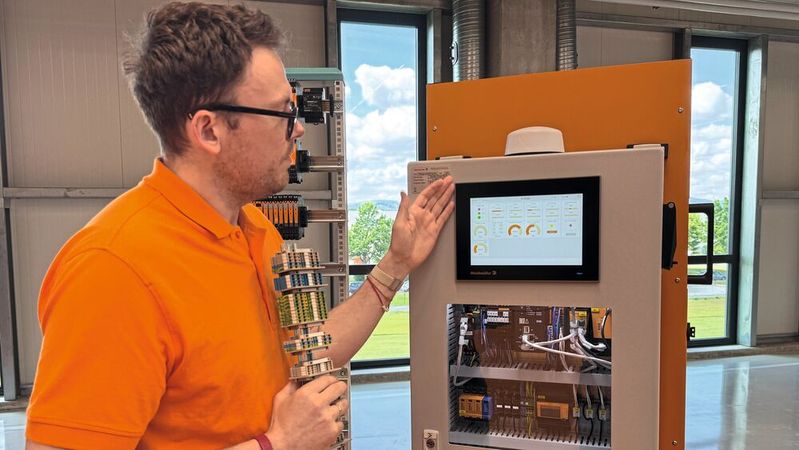
Digital value creation begins with machine data from the brownfield. Weidmüller demonstrated at its in-house exhibition how existing facilities can be made ready for digital production and energy management with open solutions.
Digitalization with Weidmüller: machine operation via HMI or via cloud.
(Image: M. Christa)
The digitalization of industry thrives on data. Many potentials remain untapped, particularly in mature machinery parks, because older systems are often not designed for systematic data collection – for instance, because they only have outdated interfaces, do not allow sensor integration, or only display data locally instead of providing it centrally.
To become more efficient in the long term and thus remain competitive, one must also ensure transparency in existing systems and make production data usable. The example of Weidmüller shows how, with open architectures and retrofittable solutions, machine data from existing plants can be accessed, analyzed, and specifically used for efficiency enhancement and sustainability. The range extends from modular hardware to flexible control technology to practical software for analysis, visualization, and resource management.
Weidmüller demonstrates digitization from its own practice: On an automated assembly line, the so-called Rail Assembler, Weidmüller shows how machine data can be generated and used during operation. The system cuts support rails to size, equips them with terminal blocks, and continuously provides data on position, consumption, and status. This information forms the basis for monitoring, maintenance, and energy optimization — for instance, through peak load management, consumption monitoring, or predictive maintenance strategies. The example shows how individual machines can become the starting point for a comprehensive digital strategy.
Brownfield as the Royal Discipline: Digitalization of Existing Systems
Many machinery fleets consist of systems that have been running reliably for years — mechanically robust but digitally isolated. This is where enormous potential for efficiency gains lies. Weidmüller refers to the "Champions League" scenario: digitization during ongoing operations without disturbing existing controls or processes. Retrofit components, open interfaces, and modular additions also turn older machines into data providers. This way, even long-used systems can be integrated into modern value chains.
From Sensor to Cloud: Components and System Architecture
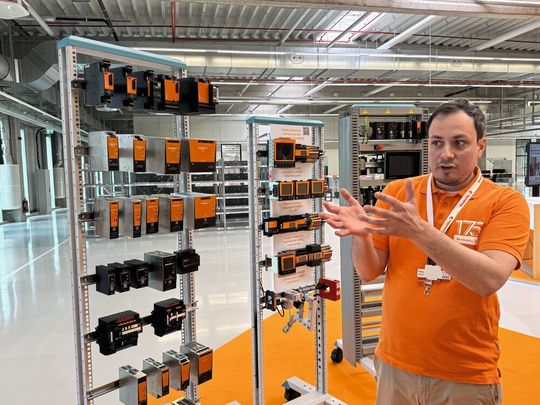
The technical foundation is formed by modular systems consisting of sensors, controls, and communication. Signal converters separate, convert, and amplify industrial signals. Communicative power supplies can also be integrated retrospectively.
The heart is the I/O-System U-Remote with adaptable architecture and common protocols such as EtherCAT or Profinet. The system is complemented by edge controllers based on Linux, which can be flexibly adapted via apps.
Digitalization with Weidmüller: Edge controllers, routers, and switches.
(Image: M. Christa)
In addition, Weidmüller offers an extensive portfolio of network components, including managed and unmanaged switches and security routers. These ensure secure and reliable data communication within the automation architecture and form the bridge to higher-level IT systems.
This creates an end-to-end connection: Sensors provide raw data, which is processed locally, analyzed by edge controllers, and transmitted over industrial networks to central systems or cloud platforms.
Software for Practice: Data Acquisition, Visualization and Analysis
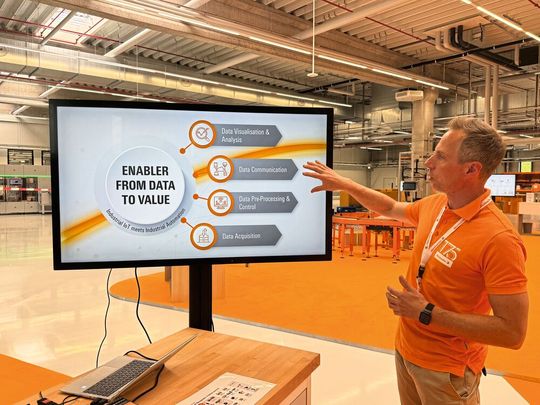
Without suitable software, any data collection remains ineffective. With Procon Connect, machine data can be quickly read and processed without programming. Procon Web provides role-based visualization: operators, maintenance personnel, and energy managers each see only what is relevant to them. Resma complements data analysis with functions for energy metrics and CO₂ balances, such as the automatic recording of consumption data, calculation of emission values according to Scope 1 and 2, and assignment of these data to production orders. The software components interlock and cover the entire path from acquisition to evaluation.
Digitalization with Weidmüller: How data becomes added value.
(Image: M. Christa)
Engineering and consulting: Support throughout the entire digitalization process Technology alone is not enough; digital transformation needs guidance. Weidmüller offers technical consulting, project planning, and support with regulatory requirements such as sustainability reports or later the Cyber Resilience Act.
Instead of isolated products, Weidmüller delivers seamless solutions, developed in collaboration with the customer. From specifications to implementation to operation, experienced contacts accompany the entire process, resulting in a practical, integrated digital strategy.
Date: 08.12.2025
Naturally, we always handle your personal data responsibly. Any personal data we receive from you is processed in accordance with applicable data protection legislation. For detailed information please see our privacy policy.
Consent to the use of data for promotional purposes
I hereby consent to Vogel Communications Group GmbH & Co. KG, Max-Planck-Str. 7-9, 97082 Würzburg including any affiliated companies according to §§ 15 et seq. AktG (hereafter: Vogel Communications Group) using my e-mail address to send editorial newsletters. A list of all affiliated companies can be found here
Newsletter content may include all products and services of any companies mentioned above, including for example specialist journals and books, events and fairs as well as event-related products and services, print and digital media offers and services such as additional (editorial) newsletters, raffles, lead campaigns, market research both online and offline, specialist webportals and e-learning offers. In case my personal telephone number has also been collected, it may be used for offers of aforementioned products, for services of the companies mentioned above, and market research purposes.
Additionally, my consent also includes the processing of my email address and telephone number for data matching for marketing purposes with select advertising partners such as LinkedIn, Google, and Meta. For this, Vogel Communications Group may transmit said data in hashed form to the advertising partners who then use said data to determine whether I am also a member of the mentioned advertising partner portals. Vogel Communications Group uses this feature for the purposes of re-targeting (up-selling, cross-selling, and customer loyalty), generating so-called look-alike audiences for acquisition of new customers, and as basis for exclusion for on-going advertising campaigns. Further information can be found in section “data matching for marketing purposes”.
In case I access protected data on Internet portals of Vogel Communications Group including any affiliated companies according to §§ 15 et seq. AktG, I need to provide further data in order to register for the access to such content. In return for this free access to editorial content, my data may be used in accordance with this consent for the purposes stated here. This does not apply to data matching for marketing purposes.
Right of revocation
I understand that I can revoke my consent at will. My revocation does not change the lawfulness of data processing that was conducted based on my consent leading up to my revocation. One option to declare my revocation is to use the contact form found at https://contact.vogel.de. In case I no longer wish to receive certain newsletters, I have subscribed to, I can also click on the unsubscribe link included at the end of a newsletter. Further information regarding my right of revocation and the implementation of it as well as the consequences of my revocation can be found in the data protection declaration, section editorial newsletter.
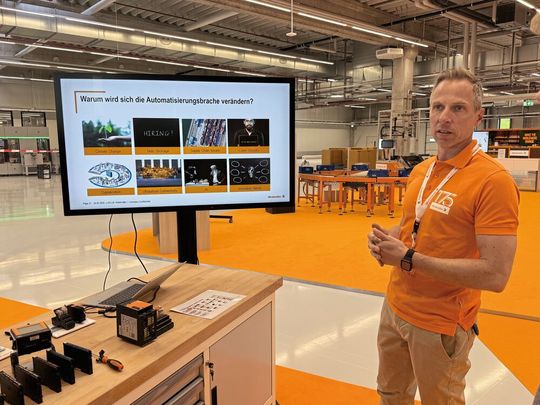
Flexibility as a Guiding Principle: Openness in Hardware and Software
Digitalization with Weidmüller: What's the point?
(Image: M. Christa)
Only a few large players can afford a closed, proprietary automation system. Medium-sized companies like Weidmüller, therefore, aim to score with open systems. Industrial PCs with Linux and Docker containers form the backbone of modern industrial architectures. Weidmüller relies on modular components and its own Linux-based operating system (u-OS), which can be individually extended via apps. Users can continue to use existing programming environments or integrate their own applications. This openness reduces dependencies, facilitates retrofitting, and enables manufacturer-independent concepts.
The future of production is data-driven, and this transformation does not start with new machines. Weidmüller demonstrates how existing systems can be digitally retrofitted with manageable effort. Essential for this is a combination of flexible hardware, open software, and targeted consulting. This creates a seamless data flow from the machine to the cloud, supporting both operational efficiency and regulatory requirements. Those who digitize in the brownfield today lay the foundation for resilient, sustainable, and future-proof production. (mc)



:quality(80)/p7i.vogel.de/wcms/a0/47/a04725ef9bd09fb6c9341a1bea1b5d93/0130443083v1.jpeg "Here, a type of plastic pallet is produced by thermoforming (vacuum forming or deep drawing) at the corresponding division of New England Plastics in the USA. This division, which specializes in so-called liners, is now part of Ringmetall ... (Image:New England Plastics)")
:quality(80)/p7i.vogel.de/wcms/e3/42/e342b3c593ea92d56604d3be969e9c9a/0130437231v1.jpeg "Daimler Truck will be building even more trucks at its Czech plant in Cheb in the future. This is because it is now being expanded for strategic cost-saving reasons ... (Image:Daimler Truck)")
:quality(80)/p7i.vogel.de/wcms/23/99/23992bf2dcdc432c9b7209c34a4a7c48/0129733089v1.jpeg "Stork relies on the modular Neoswiss turning system from Iscar to shorten the set-up times for its sliding headstock lathes and work more productively. (Image:Iscar)")
:quality(80)/p7i.vogel.de/wcms/7d/e2/7de2923434b2f1a78ba5482d8d335269/0113143253v1.jpeg "In our China Market Insider we regularly provide you with relevant information directly from China. (Image:© Eisenhans - stock.adobe.com)")
:quality(80)/p7i.vogel.de/wcms/b7/36/b736dfebc16c42d6901d0d0e1f390493/3d-druck-20factory-20--20ki-20generiert-1920x1079v1.png "(Source: AI-generated)")
:quality(80)/p7i.vogel.de/wcms/79/b2/79b21aad663f4a7bd4472afc1c1afc62/0130433994v1.jpeg "Mission Joyride: The free-flying robot (shown here in the rendering) will relieve the ISS crew of logistics tasks from 2027 with its two mechanical arms. (Image:Icarus Robotics)")
:quality(80)/p7i.vogel.de/wcms/6b/45/6b4546fa6ebf305c3660326909363f32/0130437089v1.jpeg "Industrial AI in action: Rockwell Automation presents practical solutions for self-controlling production systems at the Hannover Messe. (Image:Rainer Jensen, Deutsche Messe)")
:quality(80)/p7i.vogel.de/wcms/78/e9/78e9188c25a8a94e67c34c9bf8ffe495/visual-agile-20robots-20and-20google-20deepmind-20partner-20to-20bring-20intelligence-20to-20robotics-2500x1406v1v1.jpeg "Together, the partners are developing adaptable, intelligent robots for a wide range of applications (Image:Agile Robots SE)")
:quality(80)/p7i.vogel.de/wcms/59/a2/59a2b11f0aa1b700eff02addd5de8703/adobestock-1788280853--c2-a9-20satria-20-e2-80-93-20stock-adobe-com-5081x2860v1v1.jpeg "Quantum computers require extreme cooling to temperatures close to absolute zero in order to keep qubits stable. (Image:satria - stock.adobe.com)")
:quality(80)/p7i.vogel.de/wcms/62/5f/625f41e87ebfef156a98c8e6393e32fd/0130211654v1.jpeg "Axial flux motors have some advantages over radial flux motor—but their production is currently still expensive. (Image:RWTH Aachen University)")
:quality(80)/p7i.vogel.de/wcms/f6/ae/f6aec4f6241b36ed5e3a990ac9176b42/0130429460v1.jpeg "Verne, Pony.ai and Uber want to launch a robotaxi service in Europe. (Image:Verne)")
:quality(80)/p7i.vogel.de/wcms/d7/88/d788699f2974708a332baa4e7a62fa9e/0130438967v1.jpeg "Skoda is withdrawing from China. The brand has produced well over three million vehicles there. (Image:Skoda car)")
:quality(80)/p7i.vogel.de/wcms/b0/43/b043b86899837532aad62d63368a917a/0130371361v1.jpeg "Skoda leaves the chinese market.
(Image:Skoda)")
:quality(80)/p7i.vogel.de/wcms/c3/c4/c3c4ce270b083eeac55654148611f064/0130237945v1.jpeg "China is not giving up on hydrogen, but is intensifying its efforts. (Image:freely licensed from Pixabay)")
:quality(80)/p7i.vogel.de/wcms/ee/09/ee09acbd6dc896df25affaa9e871e6e5/0130440053v1.jpeg "IMS chip module for simple system integration into an ion mobility spectrometer. (Image:Fraunhofer IPMS)")
:quality(80)/p7i.vogel.de/wcms/10/6c/106cd22de5f68a0f74639d654827228c/0130345302v1.jpeg "Made in India: According to the India Electronics and Semiconductor Association (IESA), the country should be able to produce between 75 and 80 million chips by the beginning of 2027, once the plants currently under construction become operational. (Image:Pixabay (Montage: Sebastian Gerstl))")
:quality(80)/p7i.vogel.de/wcms/a5/ed/a5ed6fda029d362732a293d6b19d74c4/0130444216v1.jpeg "Thirteen executives from the Chinese chip industry have drawn up a plan to achieve an 80% self-sufficiency rate for semiconductors by 2030. (Image:Maxim_Kazmin - stock.adobe.com)")
:quality(80)/p7i.vogel.de/wcms/31/a6/31a646018b34d8e0a44bfc8bf17837f6/0130361632v1.jpeg "For many companies, PFAS are considered indispensable in electronics production. (Image:freely licensed)")
:fill(fff,0)/images.vogel.de/vogelonline/companyimg/76800/76895/65.jpg "FAULHABER_120mm.jpg ()")
:fill(fff,0)/p7i.vogel.de/companies/69/88/69882c428938e/tmts2026-ticec-banner-en-2000px.png "tmts2026-ticec-banner-en-2000px (https://www.tmts.tw/en)")
:quality(80)/p7i.vogel.de/wcms/12/33/1233c89ba209cb94a6a13615f6a1dbfa/0124873588v1.jpeg "Digitalization with Weidmüller: What's the point?(Image: M. Christa)")
:quality(80)/p7i.vogel.de/wcms/ce/a6/cea6d2e72eea0009c284b8b180e1091b/0124873582v1.jpeg "Digitalization with Weidmüller: Operation via HMI(Image: M. Christa)")
:quality(80)/p7i.vogel.de/wcms/af/a1/afa19f2fa8c8537351b8b76fb5ac8e96/0124873594v1.jpeg "Digitalization with Weidmüller: The Rail Assembler automatically equips the rail with terminal blocks.(Image: M. Christa)")
:quality(80)/p7i.vogel.de/wcms/b4/cf/b4cfdf86410811f73dc41774f0bd5180/0124873577v1.jpeg "Digitalization with Weidmüller: CTO Dr. Timo Berger presents the automation portfolio.(Image: M. Christa)")
:quality(80)/p7i.vogel.de/wcms/3b/29/3b29c72ab27603e34a34f5e7240e6761/0125565193v1.jpeg "Control cabinet with energy measurement module HUB-EN200. This is used for the continuous measurement and evaluation of currents and voltages in 1- and 3-phase networks with a neutral conductor. This makes it ideal for energy monitoring of machines and systems. (Image:in.hub)")
:quality(80)/p7i.vogel.de/wcms/c6/71/c671ce338f12be49d39d1b04b40a54f7/0129697443v1.jpeg "Claas is working on making its combine harvesters fit for refurbishment. (Image:Claas)")