US car manufacturers build anti-world cars. No wonder they have little success outside their own borders.
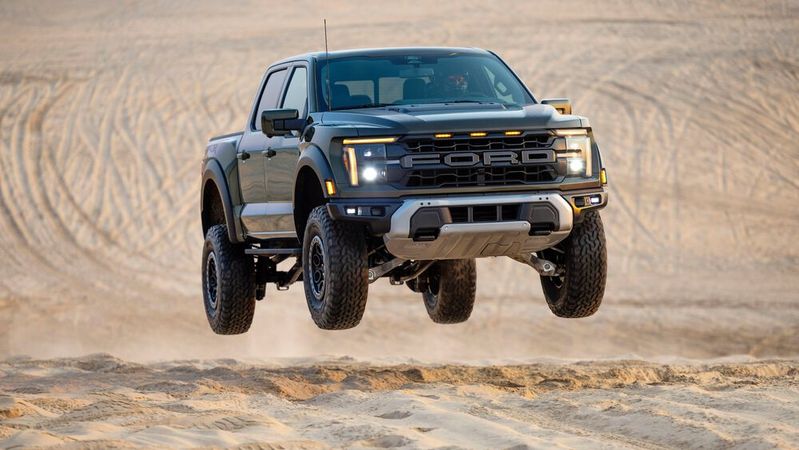
In the USA, models like the Ford F-150 are popular. Here is the extreme Raptor variant.
(Image: Ford)
US President Trump finds it unfair that countless German luxury cars are driving around the USA. While the Europeans arrogantly spurn American cars. However, the problem is home-made and will hardly be solved by customs policy.
It is not entirely correct that Europeans do not buy cars from the USA. According to data from the consulting company Inovev, around 205,000 cars from factories between New York and Los Angeles were imported into the EU, EFTA, and the United Kingdom last year. The number has been more or less constant for years, fluctuating only by a few thousand units. The potential problem from Trump's perspective: the vehicles are rarely from American brands. In 2024, 188,000 units bore logos from BMW and Mercedes. Additionally, there were 5,000 Volvos.
The USA Builds for Itself
The rest is accounted for by American-brand cars built in America. They actually play no role in Europe. What does make it across the pond are niche cars like the Jeep Wrangler SUV, the Ford Mustang sports car, or the Tesla Model X electric crossover. All of them are more lifestyle and luxury models, nothing that would generate high sales figures. This is also because the USA no longer manufactures cars with sales potential, at least from the perspective of European customers.
The US auto industry has detached itself from the rest of the world in terms of model policy and primarily builds cars for domestic tastes: large pick-ups and trucks. This development originated in the 1960s when the protectionist "Chicken Tax" initially shielded the US commercial vehicle market and made European or Japanese pickup trucks or off-road vehicles almost unsellable. Over the following decades, these former work tools increasingly established themselves as competition for passenger cars and gradually pushed the classic sedan out of product portfolios and road traffic.
Unsellable in Europe
The best-selling US cars in the USA are almost unsellable here outside of fan circles. The Ford F-150, a large pick-up, finds almost 200,000 customers annually in the States; in Europe, independent importers manage to get a handful on the road. It's a similar situation with the Chevrolet Silverado, Ram Pickup, or the GMC Sierra and the numerous off-road derivatives of these pickups. In the USA, they are top sellers, but in Europe, they are exotic. "For the local roads and cities, the cars are too big, too cumbersome, and too thirsty," says Ferdinand Dudenhöffer from the Center Automotive Research in Bochum (Germany). Additionally, there is a difference in quality perception in both markets—Europeans are significantly more demanding, especially regarding manufacturing quality and interior design. Thus, US manufacturers are happy to leave the European business to independent importers and have otherwise settled well into their North American habitat.
Pickup sales are a good business; the technology is rather simple, and the profits are high. Within the Ford Corporation, the F-150 is by far the car with the highest margin—despite the relatively modest prices in the USA. In this light, it is understandable that US industry representatives have withdrawn from other segments. The Japanese and Koreans were able to take over the shrinking sedan market, while the Germans bask undisturbed in the premium sector.
When US cars still played a role
At the beginning of the millennium, the situation was different. At that time, US car manufacturers still exported around 2.2 million vehicles worldwide, many of them to Europe. German customers could buy models like the Chrysler PT Cruiser, Cadillac CTS, or Dodge Caliber. Additionally, there were numerous vehicles from US brands built in Germany or South Korea: from the Chrysler Crossfire to the Chevrolet Aveo. Today, the most prominent US car is the Tesla Model Y, which is built in Brandenburg for the local market. Even Ford can no longer keep up—since the German branch of the US corporation had to cut its volume sedans Fiesta, Focus, and Mondeo due to lack of sales volume, the blue oval is increasingly disappearing into the lifestyle niche locally. According to Dudenhöffer, Ford is in a double dilemma: US cars are unsellable in Europe, and the European ones in the USA. The latter had to be sacrificed first.
It is unlikely that the situation for US cars will change again. Pickups and trucks will probably never become megasellers here. Moreover, there is no indication that US manufacturers will change their product strategy. Even if they did, they would face strong competition in Europe from the new Chinese brands. Although they may not always hit local tastes either, they are overall much closer and often technically ahead.
Date: 08.12.2025
Naturally, we always handle your personal data responsibly. Any personal data we receive from you is processed in accordance with applicable data protection legislation. For detailed information please see our privacy policy.
Consent to the use of data for promotional purposes
I hereby consent to Vogel Communications Group GmbH & Co. KG, Max-Planck-Str. 7-9, 97082 Würzburg including any affiliated companies according to §§ 15 et seq. AktG (hereafter: Vogel Communications Group) using my e-mail address to send editorial newsletters. A list of all affiliated companies can be found here
Newsletter content may include all products and services of any companies mentioned above, including for example specialist journals and books, events and fairs as well as event-related products and services, print and digital media offers and services such as additional (editorial) newsletters, raffles, lead campaigns, market research both online and offline, specialist webportals and e-learning offers. In case my personal telephone number has also been collected, it may be used for offers of aforementioned products, for services of the companies mentioned above, and market research purposes.
Additionally, my consent also includes the processing of my email address and telephone number for data matching for marketing purposes with select advertising partners such as LinkedIn, Google, and Meta. For this, Vogel Communications Group may transmit said data in hashed form to the advertising partners who then use said data to determine whether I am also a member of the mentioned advertising partner portals. Vogel Communications Group uses this feature for the purposes of re-targeting (up-selling, cross-selling, and customer loyalty), generating so-called look-alike audiences for acquisition of new customers, and as basis for exclusion for on-going advertising campaigns. Further information can be found in section “data matching for marketing purposes”.
In case I access protected data on Internet portals of Vogel Communications Group including any affiliated companies according to §§ 15 et seq. AktG, I need to provide further data in order to register for the access to such content. In return for this free access to editorial content, my data may be used in accordance with this consent for the purposes stated here. This does not apply to data matching for marketing purposes.
Right of revocation
I understand that I can revoke my consent at will. My revocation does not change the lawfulness of data processing that was conducted based on my consent leading up to my revocation. One option to declare my revocation is to use the contact form found at https://contact.vogel.de. In case I no longer wish to receive certain newsletters, I have subscribed to, I can also click on the unsubscribe link included at the end of a newsletter. Further information regarding my right of revocation and the implementation of it as well as the consequences of my revocation can be found in the data protection declaration, section editorial newsletter.
Future-Proof Authentication with Universal RFID Readers



:quality(80)/p7i.vogel.de/wcms/d8/f3/d8f30db5600432833565a4677c6f31be/screenshot-202026-03-03-20151742v1.png "Bridge components require the highest quality: The Easy Grinder fulfills this requirement. (Source: Teqram)")
:quality(80)/p7i.vogel.de/wcms/aa/fe/aafed03faf2d2a8643fbe2fa7d53a299/0130883828v1.jpeg "Stable material flow: OHT systems automatically transport sensitive wafers through production in protected FOUP containers. (Image:ALEX_GRETTER)")
:quality(80)/p7i.vogel.de/wcms/5e/73/5e73f5bc660738c0baeb8190cf894590/0130898283v1.jpeg "React immediately! Monometals already have useful properties, but alloys are even more useful. Researchers at KIT therefore want to use metallic nanopowders (symbolic image) to try and develop alloys that were previously impossible. (Image:Metal Heart)")
:quality(80)/p7i.vogel.de/wcms/57/f1/57f19b159f5491725e59c114ddd16331/0113143253v1.jpeg "In our China Market Insider, we regularly provide you with relevant information directly from China. (Image:© Eisenhans - stock.adobe.com)")
:quality(80)/p7i.vogel.de/wcms/66/b6/66b68f3adb3fa100b4338e0d6c83b9ba/0130920321v1.jpeg "Trumpf has found a more productive way of welding copper conductors to busbars very quickly and reliably using a laser. This makes the time-consuming screw connection obsolete ... (Picture:Trump)")
:quality(80)/p7i.vogel.de/wcms/87/b4/87b4eee1466def5499e8147f19744016/0130876930v1.jpeg "The market for cobots is set to grow rapidly over the next few years. ABB is taking advantage of this prospect and is launching the ultra-fast-acting cobot family called Powa ... (Image:ABB)")
:quality(80)/p7i.vogel.de/wcms/c3/8a/c38a10479e5bc6748f5be24a5fb46890/0130879174v1.jpeg "According to Savills' calculations, Europe's growing market for data centers will increase demand for logistics space by a whopping 8.5 million square feet. (Picture: ©DKPhoto - stock.adobe.com)")
:quality(80)/p7i.vogel.de/wcms/1f/46/1f46342b2f0dd64f7e8a1d1c6190948c/0130857572v1.jpeg "Hexagon, the Swiss expert for humanoid robot systems, such as the Aeon here, has know-how that Schaeffler now also wants to use as part of a cooperation. Read here what this is all about ... (Image:Hexagon Robotics)")
:quality(80)/p7i.vogel.de/wcms/42/f0/42f05894fe2f2c56ed34ab84fa3e7e4f/pm1826-1-3500x1968v1v1.jpeg "With the material Iglidur A351, Igus has developed a new bisphenol-free and FDA-compliant material that is approved for contact with food and is particularly resistant to cleaning chemicals and high temperatures of up to 356°F. (Image:Igus)")
:quality(80)/p7i.vogel.de/wcms/64/f6/64f6843ae30267c5c3f8e930d9b4d28a/iap-teaser-gross-1000px-x-800px-1000x563v1v1.jpeg "The newly developed biomimetic tissue substitute opens up new approaches for high-performance implants - demonstrated here on a printed pericardium. (Image:Fraunhofer IAP)")
:quality(80)/p7i.vogel.de/wcms/78/4e/784e2e52da701049408ebf90a497198f/0130734639v1.jpeg "The combination of smart sensors and intuitive software such as the Baumer Sensor Suite makes it extremely easy for users to use IO-Link. (Image:Baumer)")
:quality(80)/p7i.vogel.de/wcms/fd/25/fd2542c4abb445427a3044120703e917/0130799156v1.jpeg "Supply chains: Not only external, but also internal company weaknesses have a negative impact on the ability to deliver. (Image:freely licensed)")
:quality(80)/p7i.vogel.de/wcms/63/65/63658d1f2e2f6d9d82c4d748b76089b9/0130919056v1.jpeg "Which programming language is used to write vehicle software? This question is now moving into areas where decisions are made about architecture, risk and approval. (Image:freely licensed at Pexels)")
:quality(80)/p7i.vogel.de/wcms/8e/c9/8ec975064f4a4cbe027aa15166acb9bf/0130922769v1.jpeg "The OM M-Series marks a structural change in the architecture of charging infrastructure. (Image:ABB E-Mobility)")
:quality(80)/p7i.vogel.de/wcms/93/41/93413edb6f97cb435bad8da22f4f7d8a/0130816946v1.jpeg "The yoke steering wheel in the Lexus not only ensures comfortable steering, but also a better view (Image:Lexus)")
:quality(80)/p7i.vogel.de/wcms/2a/ac/2aac0d28ac5cb0a1c7bee37ce4b9576f/0130910559v1.jpeg "Porsche sells its shares in Bugatti Rimac and the Rimac Group. (Image:Porsche)")
:quality(80)/p7i.vogel.de/wcms/15/3f/153fa58cfd3e8238f0975376fbd4b64f/0130834955v1.jpeg "A gap between two material layers of molybdenum sulphide (MoS₂) and hafnium oxide (HfO₂), which are only bound together by van der Waal forces. As studies by TU Wien show, this tiny gap can have drastic effects for semiconductors based on such 2D materials. (Image:TU Vienna)")
:quality(80)/p7i.vogel.de/wcms/e9/51/e9519f6f6e2aedcf896e1306e37d7642/0130872105v1.jpeg "Figure 1: Principle of a sidecar solution for supplying power to AI data centers. (Image:TI)")
:quality(80)/p7i.vogel.de/wcms/4b/97/4b974b018c76a1e54ed5a624a213ce2f/0130907348v1.jpeg "During material and surface inspection, sources of error in the nm range must be reliably detected. Accordingly, the interaction between the positioning system and 3D measurement technology must be perfect. Even highly reflective or transparent surfaces must not lead to errors. (Picture:LMI and PEAK Metrology)")
:quality(80)/p7i.vogel.de/wcms/d7/dc/d7dcb6a8e3fbefbf1db738f128108aa6/0130804280v1.jpeg "Zone trigger: When conventional edge or pattern triggers reach their limits, the time has come for the zone trigger. By simply drawing zones on the oscilloscope display, rare anomalies can be isolated with pinpoint accuracy. (Picture:Rohde & Schwarz)")
:fill(fff,0)/images.vogel.de/vogelonline/companyimg/76800/76895/65.jpg "FAULHABER_120mm.jpg ()")
:quality(80):fill(efefef,0)/p7i.vogel.de/wcms/67/ae/67ae0b9ac31f8/elatec-wp-universal-reader.png "Elatec WP Universal Reader")
:quality(80)/p7i.vogel.de/wcms/0d/4a/0d4a1d7129c5838744eecb4765db6698/0126570766v1.jpeg "China currently accounts for two-thirds of global EV sales. Europe follows with 17 percent, and the USA with seven percent. (Image:AI-generated)")
:quality(80)/p7i.vogel.de/wcms/fd/ec/fdec3b1b0bddf151ffc1cfaddda087e1/0126570766v1.jpeg "China currently accounts for two-thirds of global EV sales. Europe follows with 17 percent, and the USA with seven percent. (Image:AI-generated)")