E-MobilityThe Future of Mobility – and the Roles of China, Europe, and the USA
From
Tina Rumpelt | Translated by AI
6 min Reading Time
E-mobility is revolutionary and disruptive – and unstoppable. Who are the beneficiaries, who stumbles, what is coming, what is not? In the spotlight: the e-car markets in China, the USA, and Europe.
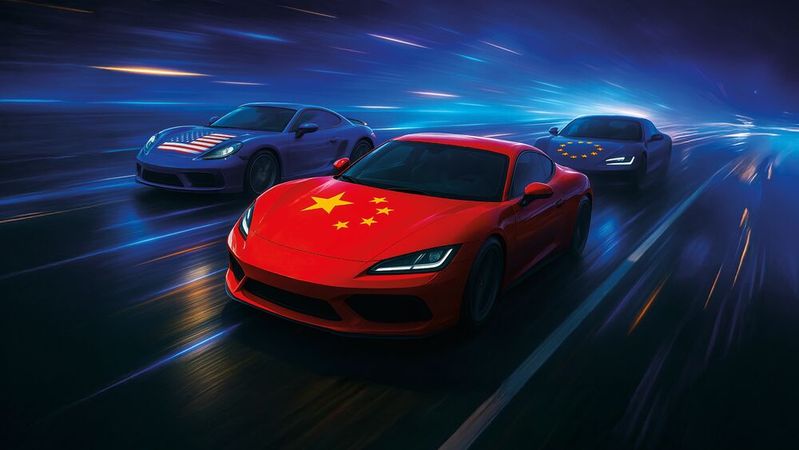
China currently accounts for two-thirds of global EV sales. Europe follows with 17 percent, and the USA with seven percent.
(Image: AI-generated)
The only certainty about the future is that it will come. The same applies to electromobility. Analysts at "BloombergNEF" expect 22 million Electric Vehicles (EVs) to be sold worldwide this year, 25 percent more than the previous year. Of these, nearly six million will be purely battery-electric vehicles (BEVs). By 2040, market experts predict a 40 percent share of EVs in the global car population. That would amount to around 700 million EVs. So, not bad prospects for the automotive industry.
EV Supernation China: The Price is Right
Initially, China's auto industry laughs. Within a few years, the Middle Kingdom has risen to become an EV superpower. Chinese drivers are cruising their roads as cleanly as never before, as they are buying more EVs than ever before and more than anywhere else in the world. Currently, China accounts for two-thirds of global EV sales. Europe follows with 17 percent, the USA with seven percent. In the first half of 2025, 5.5 million EVs of all types were sold in China. It’s booming, as evidenced by this: EVs in China now consume more electricity than the entire country of Sweden, according to Bloomberg analysts. The impacts? Another story.
1.01 Euros for 100 Kilometers
Not only are e-cars in China, with an average price of 28,500 dollars (Germany: 44,500 euros), cheaper than combustion engine vehicles, but electricity is also inexpensive. According to the "EV Attractiveness Index 2025" by "BearingPoint" and the Handelsblatt Research Institute, the electricity cost for 100 driven kilometers in China is 1.01 euros. In Germany, it's a hefty 6.60 euros, and in the USA, 2.89 euros.
"If the price is right, car buyers will also accept perceived disadvantages, such as range uncertainty or additional time needed for charging," explains Aleksandra O'Donovan, Head of Electrified Transport at BloombergNEF in London. She identifies "affordability" as one of the key factors for the mass adoption of EVs. This applies globally. "E-mobility is currently expanding beyond the premium niche into more price-sensitive buyer segments. Here, operating and maintenance costs are becoming more significant in purchase decisions," says the expert.
Battlefield: 130 Brands, 400 EV Models
China's OEMs have engaged in a ruthless cutthroat competition. It's also a political issue: Beijing has made it clear that it will no longer stand by and watch the ruinous price war. However, there are no concrete measures yet. "Nearly 130 brands with over 400 EV models are competing for customers," according to a McKinsey study from 2024. McKinsey partner Patrick Schaufuss therefore expects "a strong export orientation of successful Chinese brands." Germany, with over 200 EV models offered, ranks second behind China.
"The European brands in focus"
From China to Europe, the route on the electric track is not far. Schaufuss: "On the one hand, there will be overcapacity of more than 40 percent in the local market. On the other hand, Chinese manufacturers expect higher margins abroad due to their cost advantages of up to 30 percent compared to Western manufacturers." BYD is already building, Chery and Changan are planning factories in Europe as well, partly to avoid trade tariffs. "China's OEMs are coming to stay," says Henner Lehne, VP Global Vehicle and Powertrain Group, Global Mobility Division, S&P Global. Their "Premium by Technology" strategy is reminiscent of "Progress through Technology."
"They have European brands in their sights," confirms Aleksandra O'Donovan. Their goal is "affordable luxury." "We expect a focus on the target group of 'working professionals,' where brand loyalty is not yet strongly established," she explains. She gives Chinese OEMs good chances: "They listen to what consumers want, act quickly, and deliver what customers desire. And they act without wasting time." The notorious "China speed." "Nevertheless," says the London expert, "they will need time to gain consumer trust." Partnerships with Western OEMs could be helpful here – according to O'Donovan, such collaborations are "likely."
PHEV: BYD's Seal vs. VW Tiguan
Car imports from China are still manageable, but with high growth rates, as analyses by Jato Dynamics show: Topseller BYD brought about 70,500 units to Europe in the first half of 2025, more than in the entire previous year (57,000). With the Seal U DM-i hybrid SUV, BYD is targeting VW's Tiguan 1.5 eHybrid OPF in the mid-range segment.
Date: 08.12.2025
Naturally, we always handle your personal data responsibly. Any personal data we receive from you is processed in accordance with applicable data protection legislation. For detailed information please see our privacy policy.
Consent to the use of data for promotional purposes
I hereby consent to Vogel Communications Group GmbH & Co. KG, Max-Planck-Str. 7-9, 97082 Würzburg including any affiliated companies according to §§ 15 et seq. AktG (hereafter: Vogel Communications Group) using my e-mail address to send editorial newsletters. A list of all affiliated companies can be found here
Newsletter content may include all products and services of any companies mentioned above, including for example specialist journals and books, events and fairs as well as event-related products and services, print and digital media offers and services such as additional (editorial) newsletters, raffles, lead campaigns, market research both online and offline, specialist webportals and e-learning offers. In case my personal telephone number has also been collected, it may be used for offers of aforementioned products, for services of the companies mentioned above, and market research purposes.
Additionally, my consent also includes the processing of my email address and telephone number for data matching for marketing purposes with select advertising partners such as LinkedIn, Google, and Meta. For this, Vogel Communications Group may transmit said data in hashed form to the advertising partners who then use said data to determine whether I am also a member of the mentioned advertising partner portals. Vogel Communications Group uses this feature for the purposes of re-targeting (up-selling, cross-selling, and customer loyalty), generating so-called look-alike audiences for acquisition of new customers, and as basis for exclusion for on-going advertising campaigns. Further information can be found in section “data matching for marketing purposes”.
In case I access protected data on Internet portals of Vogel Communications Group including any affiliated companies according to §§ 15 et seq. AktG, I need to provide further data in order to register for the access to such content. In return for this free access to editorial content, my data may be used in accordance with this consent for the purposes stated here. This does not apply to data matching for marketing purposes.
Right of revocation
I understand that I can revoke my consent at will. My revocation does not change the lawfulness of data processing that was conducted based on my consent leading up to my revocation. One option to declare my revocation is to use the contact form found at https://contact.vogel.de. In case I no longer wish to receive certain newsletters, I have subscribed to, I can also click on the unsubscribe link included at the end of a newsletter. Further information regarding my right of revocation and the implementation of it as well as the consequences of my revocation can be found in the data protection declaration, section editorial newsletter.
The Chinese OEMs, however, face a market in Europe that has its challenges: brand loyalty and allegiance to domestic manufacturers are strong, as are consumers' general reservations about Chinese companies (see also graphic "EV Attractiveness Index 2025"). And only 16 percent of car buyers in the five largest European automotive markets are even willing to buy a BEV, according to a Bloomberg Intelligence study.
Europe is Recovering – Due to Plug-in Hybrids
The European EV market appears to be recovering rapidly after the dip in 2024: In the first half of 2025, the market share of e-cars rose to 15.6 percent (870,000 vehicles), up from 12.5 percent in the same period the previous year. Growth drivers are clearly plug-in hybrids (PHEVs), which account for more than half of EVs.
PHEVs now account for an 8.4 percent market share in the EU (+19.5%; 470,000 vehicles) – thanks in part to impressive growth in Germany (+55.1%) and Spain (+82.5%) in the first half of the year. While Toyota and Renault lead the market for hybrid vehicles (HEVs), German premium manufacturers BMW, Mercedes-Benz, and Volkswagen dominate the significantly more expensive PHEVs.
EREV: Could Also Convince Europe's Car Buyers
An exciting topic is range extender vehicles. Here, the combustion engine serves only as a supplement: it generates fresh electricity while the entire drive is purely electric. The battery carried along is smaller and therefore lighter. EREVs achieve significantly greater electric range than classic PHEVs. In China, according to BloombergNEF, EREVs with an average electric range of 170 kilometers are already the fastest-growing EV segment (+83% in 2024). Li Auto, Seres, and Changan are named as the top sellers in China; Stellantis, Hyundai, VW, and Ford are working on EREV models.
And in the USA? Step Backward
Donald Trump rages, also against electromobility, and shuts it down wherever he can (see interview from page 30). Currently, BEVs are struggling to make a mark in the U.S., as seen with Ford's Mustang Mach-E and F-150 Lightning, Tesla's Cybertruck, or Rivian's SUVs. All are selling sluggishly. With effects even here: Mercedes will stop production of the U.S. models of the EQE and EQS starting in September.
Trump's influence persists: In 2025, analysts at S&P Global Mobility expect just a nine percent BEV share in the overall market in the USA; by 2030, it is expected to rise slightly above 17 percent. According to the S&P forecast, India is likely to achieve a higher BEV share by then.
Hybrids find New Friends
A glimmer of hope still shines: hybrid technology. Even Americans are starting to like it – less for the sake of the environment and more to reduce fuel costs. The hybrid share of new registrations is steadily growing and is currently already well over ten percent. "The trend is upward," confirms Lehne.
Toyota, Honda, and Mazda, as well as Hyundai/Kia, are the key players in the HEV segment in the U.S. Ford plans to offer hybrid drives for all models by 2030. Currently, only the Escape SUV is available as a PHEV. A plug-in version of the Ford Ranger pickup is expected to follow later this year. GM, in an alliance with SAIC, is already producing the Chevy Equinox as a PHEV in China. Market observers anticipate the Equinox as the company's first PHEV model in the U.S. with the 2027 model year.
Only: Nothing is certain at the moment in the land of unlimited possibilities.



:quality(80)/p7i.vogel.de/wcms/eb/2b/eb2bd1b8487afe577b37363cd02f16ff/0113143253v1.jpeg "In our China Market Insider, we regularly provide you with relevant information straight from China. (Image:© Eisenhans - stock.adobe.com)")
:quality(80)/p7i.vogel.de/wcms/dd/b8/ddb8edc98c49b384734ab2432b297eb5/adobestock-1913662309--irene-stock-adobe-com-ki-generiertv1.jpeg "Rotary joints are used in grippers and swivel mechanisms to allow assemblies to rotate or swivel smoothly relative to one another, even under very high loads (illustrative image). (Source: Irene - stock.adobe.com / KI-generiert)")
:quality(80)/p7i.vogel.de/wcms/d1/ef/d1ef6b6f7d4543f7999980bacccaf22b/0133499261v1.jpeg "As the growing imbalance in trade relations with China continues to widen, the EU Chamber of Commerce foresees a day when trade with China will have to be seriously reevaluated ... (Image: AI-generated)")
:quality(80)/p7i.vogel.de/wcms/fe/1f/fe1fa5ee713f94deaba963dc24c3abc5/0133299273v1.jpeg "The Flexistar enables highly flexible production of laser-welded tubes thanks to its tool-free clamping system. (Image:Because Technology, LLC)")
:quality(80)/p7i.vogel.de/wcms/60/ef/60ef4f07e4829b2c2929befc0f353c58/0133511729v1.jpeg "Humanoid robots can match human performance in certain tasks. (Image:Gemini / AI-generated)")
:quality(80)/p7i.vogel.de/wcms/2e/99/2e99726b522e4b35b690e25eb6a42643/0133463991v1.jpeg "Robotics: In AMR applications, connection technology must reliably transmit power, signals, and data despite vibration and shock loads—in very confined spaces and in a way that allows for regular maintenance. (Image:Hyperever)")
:quality(80)/p7i.vogel.de/wcms/d0/18/d01801e3d5dbd7bc9d0b4f60408b630c/0133468429v1.jpeg "Quality requirements for film packaging are on the rise. At the same time, many companies are turning to recyclable film materials, which, however, have their own challenges. Fraunhofer researchers have therefore developed a fast system that detects problems in real time. (Image:Fraunhofer IKTS)")
:quality(80)/p7i.vogel.de/wcms/b1/06/b106cf44923ce39565c3264982fd20eb/0133414574v1.jpeg "Robots Build Robots: At the new Ubtech factory, automated systems even handle parts of the material supply and logistics for the production of humanoid robots. (Image:Ubtech)")
:quality(80)/p7i.vogel.de/wcms/c0/52/c052f405eb55fc3d08c4837e77206fc0/adobestock-2021845957--aucartstudio-stock-adobe-com-ki-generiertv1.jpeg "An innovation from China to combat extreme summer heat: A novel coating lowers temperatures. (Source: © AucArtStudio – stock.adobe.com_AI-generated)")
:quality(80)/p7i.vogel.de/wcms/66/a7/66a7b78159caeacce57136529688799f/0133503398v1.jpeg "Sunlight Makes Stone! These stone blocks weren't made the traditional way. Instead, they were additively manufactured from sand using a laser. In the future, however, the laser is set to be replaced by concentrated sunlight—if the startup Addisol is successful... (Image:Addisol / F. Fiedler)")
:quality(80)/p7i.vogel.de/wcms/72/b9/72b995c2c8d812c5e2115cbef31e035a/0133462727v1.jpeg "Eggl manufactures center hoods that are precisely tailored to each cooking island—whether standard size or custom shape. They are made entirely of stainless steel and are individually customized in terms of size and filter arrangement. (Image:SPI)")
:quality(80)/p7i.vogel.de/wcms/13/5d/135dfae6229ceaf5c55467a43e8f7257/adobestock-1879961393--ardi-stock-adobe-com-ki-generiertv1.jpeg "Annoying chatterboxes or awkward silences in response to questions—a moderator should specifically prepare for difficult situations in order to navigate them effectively. (Image:ardi - stock.adobe.com_AI-generated)")
:quality(80)/p7i.vogel.de/wcms/aa/a2/aaa2c6dd2daa24b485cddbf9297590c0/0133467318v1.jpeg "Battery Monitoring: Battery monitoring using electrochemical impedance spectroscopy offers several advantages. (Image:TI)")
:quality(80)/p7i.vogel.de/wcms/39/b2/39b21bf03be1683831862239a369987c/0133469638v1.jpeg "Data from autonomous vehicles and robots operating autonomously is in high demand, and Ruqi wants to capitalize on this. (Image:Ruqi Mobility)")
:quality(80)/p7i.vogel.de/wcms/8a/bb/8abbb6217220595edc1549ac9b84f307/0133429906v1.jpeg "The IAA in Hanover showcased the ambitions of Chinese commercial vehicle manufacturers in Europe. (Image:Wehner - VCG)")
:quality(80)/p7i.vogel.de/wcms/0c/53/0c5313ef91c14b6df0d0996efc33c8ad/jpg03568-bearbeitetv1.jpeg "The category winners of the 2027 German Car of the Year award. (Source: GCOTY)")
:quality(80)/p7i.vogel.de/wcms/48/15/4815da27c45973ca629a99b375ac3aef/0133509585v1.jpeg "Ventuno Q RoadTest: Designed to help the Element14 community gain practical insights from real-world tests using the Ventuno Q. (Image:Farnell/Element14)")
:quality(80)/p7i.vogel.de/wcms/17/2b/172bd132f9febdfcbcedba292ad0504d/aufmacherv1.jpeg "Micro-Epsilon offers a wide range of IO-Link-compatible sensors. (Source: Micro-Epsilon Messtechnik GmbH & Co. KG)")
:quality(80)/p7i.vogel.de/wcms/ca/b4/cab46fd26d19d6a2febca032048200b6/0133471827v1.jpeg "Photonics SDK for C and Python: Computational operations are now abstracted as standard mathematical functions. (Image:Q.ANT)")
:quality(80)/p7i.vogel.de/wcms/92/b2/92b2ed5299cde450c0764f4f64468395/0133505895v1.jpeg "The \"Iris 100\" test system for high-precision volume production of microLEDs uses a spectrometer and a high-resolution camera. (Image:Teradyne)")
:quality(80)/p7i.vogel.de/wcms/84/29/84292c48b041e6085d9825dd999dfdc5/0114716946v1.jpeg "The MG 4 is one of the most successful models from China in Europe. (Image:MG Motor)")
:quality(80)/p7i.vogel.de/wcms/dd/99/dd992e63e25a9acc396eeae8272790c8/0127304512v1.jpeg "\"Europe's EV market is increasingly being driven by more and more price-attractive models.\" Henner Lehne, S&P Global Mobility. (Image:S&P Global Mobility)")