Chinese OEMs have made significant investments in electric vehicle production in Thailand. However, they are now facing overcapacity. As a result, Thailand could become the gateway to Europe.
Thailand could serve as a gateway to Europe for Chinese OEMs.
(Image: Adobe Stock)
The backstory in brief: In recent years, the Thai government has initiated extensive EV programs and invested heavily to attract electric vehicle (EV) manufacturers to the country. Among other incentives, EV importers were granted tax exemptions and purchase bonuses of up to 4,000 euros (approx. 4,600 USD). In return for these state incentives, OEMs committed to producing one electric car in Thailand for every one imported. Since the beginning of the year, the requirement has even increased to a 1:1.5 ratio. Failure to comply could result in compensation payments to the state of up to 4,000 euros (approx. 4,600 USD) per imported EV.
China's OEMs: Capacity for 500,000 EVs Per Year
Attracted by subsidy programs and driven by a desire for expansion, Chinese OEMs, including BYD, Great Wall Motor, and Hozon, established capacities for around half a million EVs in Thailand. The EV business boomed in Southeast Asia's second-largest economy. But then the bubble burst.
Sales of electric vehicles are sluggish, and the Thai automotive market as a whole is also struggling. In 2024, sales figures dropped by around a quarter compared to 2023. The reasons are varied: tax benefits for the highly popular pickups in Thailand were eliminated, and credit requirements tightened. Additionally, weak economic growth and high loan interest rates are contributing factors. Household debt is increasing.
China's OEMs in Thailand are now struggling with overcapacity. Thousands of unsold EVs from Chinese manufacturers' factories are piling up in storage. Prices are crumbling. The Thailand Board of Investment (BOI) is urging Chinese car manufacturers to explore new export markets for their locally produced EVs.
Udomkiat Bunworasate, Partner at Roland Berger, Bangkok office: "The local production of Chinese car manufacturers in Thailand will further increase the popularity of Chinese car brands in the country."
(Image: Roland Berger/Socrates Tassos)
Europe is also on the agenda. Since March 2023, the EU has been negotiating a free trade agreement with Thailand, which is expected to be finalized by the end of 2025. Udomkiat Bunworasate, Partner at Roland Berger's Bangkok office, explains: "Such an agreement between the EU and Thailand could also serve as a strategic opportunity for Chinese automakers looking to enter the European market. The FTA negotiations are part of Thailand's broader strategy to strengthen its position as a regional manufacturing hub, particularly in a sector like electric mobility."
Thailand as an Export Hub for Electric Vehicles
Suroj Sangsnit, President of the Electric Vehicle Association of Thailand (EVAT), is optimistic. He anticipates a 40 percent sales increase in the EV segment in 2025, surpassing the 100,000-unit mark. Highly beneficial: Thailand's government is currently subsidizing EVs with more than 50 kW of power with purchase incentives of up to approximately 3,000 dollars, reducing the excise tax on EVs from eight to two percent, and lowering import duties on EVs by up to 40 percent.
Hybrid vehicles are now also being promoted through tax breaks. Requirements: the cars must not emit more than 120 grams of CO2 per kilometer, and key components, including the battery, must be produced locally. For market observer Henner Lehne, VP of Global Vehicle Forecasting, Automotive, at S&P Global Mobility, this is an "interesting approach, not just for Thailand."
Roland Berger consultant Bunworasate explains: "The current EV 3.5 program is a strategic initiative by the Thai government aimed at making the country a leading hub for electric vehicle manufacturing in Southeast Asia. The program is designed to strengthen the local automotive industry, establish Thailand as an export center for electric vehicles, and promote clean and sustainable mobility."
Rising Production Numbers Expected
Henner Lehne accordingly anticipates rising production figures: "According to our forecasts, the production of EVs, HEVs, and PHEVs will increase by 52.1 percent in 2025 compared to the previous year, reaching approximately 322,000 units. By 2028, it is expected to grow to about 863,000 units and to approximately 1.15 million units by 2030. The share of pure electric vehicles in the total production of alternative powertrains will rise from seven percent in 2024 to about 35 percent."
Chinese automakers are making a significant impact on the Thai market with their affordable cars. Their market share in the EV segment: nearly 80 percent. Electric vehicles from Chinese brands now enjoy a strong reputation. "This development has been driven by competitive prices, government incentives, and robust local production strategies," confirms Bunworasate. He elaborates: "Despite the still relatively low short-term utilization of plants, the local production of Chinese automakers in Thailand will further increase the popularity of Chinese car brands in the country and make EVs more affordable and accessible for Thai consumers." The losers: Japanese automakers, who for decades were the unrivaled local champions in the country.
Date: 08.12.2025
Naturally, we always handle your personal data responsibly. Any personal data we receive from you is processed in accordance with applicable data protection legislation. For detailed information please see our privacy policy.
Consent to the use of data for promotional purposes
I hereby consent to Vogel Communications Group GmbH & Co. KG, Max-Planck-Str. 7-9, 97082 Würzburg including any affiliated companies according to §§ 15 et seq. AktG (hereafter: Vogel Communications Group) using my e-mail address to send editorial newsletters. A list of all affiliated companies can be found here
Newsletter content may include all products and services of any companies mentioned above, including for example specialist journals and books, events and fairs as well as event-related products and services, print and digital media offers and services such as additional (editorial) newsletters, raffles, lead campaigns, market research both online and offline, specialist webportals and e-learning offers. In case my personal telephone number has also been collected, it may be used for offers of aforementioned products, for services of the companies mentioned above, and market research purposes.
Additionally, my consent also includes the processing of my email address and telephone number for data matching for marketing purposes with select advertising partners such as LinkedIn, Google, and Meta. For this, Vogel Communications Group may transmit said data in hashed form to the advertising partners who then use said data to determine whether I am also a member of the mentioned advertising partner portals. Vogel Communications Group uses this feature for the purposes of re-targeting (up-selling, cross-selling, and customer loyalty), generating so-called look-alike audiences for acquisition of new customers, and as basis for exclusion for on-going advertising campaigns. Further information can be found in section “data matching for marketing purposes”.
In case I access protected data on Internet portals of Vogel Communications Group including any affiliated companies according to §§ 15 et seq. AktG, I need to provide further data in order to register for the access to such content. In return for this free access to editorial content, my data may be used in accordance with this consent for the purposes stated here. This does not apply to data matching for marketing purposes.
Right of revocation
I understand that I can revoke my consent at will. My revocation does not change the lawfulness of data processing that was conducted based on my consent leading up to my revocation. One option to declare my revocation is to use the contact form found at https://contact.vogel.de. In case I no longer wish to receive certain newsletters, I have subscribed to, I can also click on the unsubscribe link included at the end of a newsletter. Further information regarding my right of revocation and the implementation of it as well as the consequences of my revocation can be found in the data protection declaration, section editorial newsletter.
Thailand's Automotive Industry: 850,000 employees
In 2024, 1.84 million vehicles were manufactured in Thailand, about one-third of which were passenger cars. Nearly 400,000 vehicles were sold domestically, while 690,000 were exported, primarily to Australia, the Middle East, and neighboring ASEAN countries. A total of 35 OEMs operate in the country, alongside approximately 2,200 suppliers, including 720 Tier-1 suppliers. Together, they employ around 850,000 people. Market leader is Toyota, followed by Isuzu and Honda. BYD has moved into fourth place.
Hybrid pioneer Toyota, active in Thailand for 60 years, is currently expanding its HEV capacities in Thailand for around 1.6 billion dollars. Honda is also investing: 148 million euros (approx. 172 million USD) for an HEV production facility where a new B-segment SUV is set to be produced starting in 2027. Honda has partnered with Ford in the country under the "AutoAlliance," with both OEMs jointly manufacturing in one facility.
In August 2024, Hyundai announced plans to produce the BEV model Ioniq, among others, in Thailand starting in 2026. Battery and vehicle assembly will be newly established. The manufacturing partner is the Thai Thonburi Automotive Assembly Plant Company (TAAP). The new plant is designed for a modest capacity of 5,000 BEVs annually. Jae Gyou Chung, CEO of Hyundai Mobility Manufacturing in Thailand, nevertheless emphasized the importance of Thailand as a "strategic location" for the ASEAN region in the "Thai Times." The South Koreans are investing the equivalent of 26 million euros in the project.
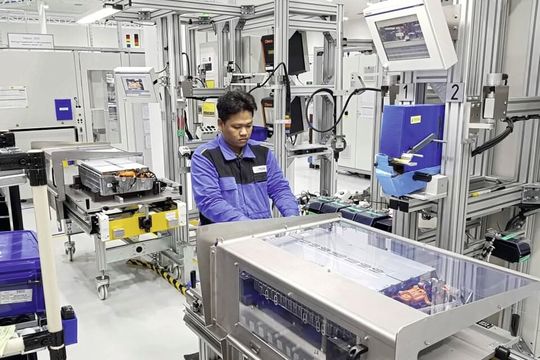
Early mover: Since late 2019, Mercedes-Benz has been producing drive batteries for local CKD production near Bangkok.
(Image: Mercedes-Benz AG)
BMW and Mercedes-Benz Gear Up—Volkswagen Watches
Mercedes-Benz launched its own battery production facility for HEVs in Bangkok back in 2019, costing around 100 million euros (approx. 116 million USD). The existing CKD assembly, also managed by TAAP, is being expanded. Thirteen models are being locally produced.
BMW is currently building a new battery assembly plant in Rayong for 42 million euros (approx. 48 million USD), with 36 million (approx. 42 million USD) allocated for equipment and machinery. The Munich-based company will also assemble a model of the all-electric Neue Klasse in CKD production in Rayong. In 2024, 8,600 cars and more than 10,000 motorcycles rolled off the production lines at the Thai BMW plant.
Volkswagen does not have production or CKD assembly facilities in Thailand. Various VW models, as well as the Porsche Cayenne, are assembled from CKD kits in Malaysia, while a Skoda CKD production facility operates in Vietnam. (kt)
Future-Proof Authentication with Universal RFID Readers



:quality(80)/p7i.vogel.de/wcms/9f/5e/9f5ebdd436f99ade82edb3b60628c9f9/0132744768v1.jpeg "During welding, molten, glowing metal particles fly around. To ensure the welder is well protected, there are several things to consider. This includes protection from head to toe, covering the body, hands (image), and even feet. Arbeitsschutz-Express provides advice here ... (Image:Nitras)")
:quality(80)/p7i.vogel.de/wcms/80/92/8092cd36dac1d263ca6e705b8a7b0a69/0132724408v1.jpeg "New infrastructure projects in Kazakhstan aim to bring Europe and Asia closer together on the so-called Middle Corridor. (Image:Die Astana Times)")
:quality(80)/p7i.vogel.de/wcms/7d/1b/7d1b6a432c52f68600583b25f7d5c80d/0113143253v1.jpeg "In our China Market Insider, we regularly provide you with relevant information directly from China. (Image:© Eisenhans - stock.adobe.com)")
:quality(80)/p7i.vogel.de/wcms/09/42/09426afd0e023190089bd8c1c36c432f/0132473007v1.jpeg "Particularly in the area of solid carbide cutters, Pferd Tools has thousands of variants in its portfolio. (Image:Pferd Tools)")
:quality(80)/p7i.vogel.de/wcms/11/b0/11b041587fe5783597a78530b628ed7c/0132682714v1.jpeg "Symbolic image: New US rules could make market access more difficult for foreign providers of mobile robots and connected inverters. (Image:Dall-E / AI-generated)")
:quality(80)/p7i.vogel.de/wcms/f2/2d/f22d62adcc688c71e6bea844be9c2a9c/0132344529v1.jpeg "IO-Link is an important component for the Smart Factory. With high transmission speeds, additional data, simplified wiring, and easy integration, IO-Link offers crucial advantages for automation processes. (Image:Baumer)")
:quality(80)/p7i.vogel.de/wcms/2b/00/2b00bf86ad24c2db6c80b9edda1bb375/aufmacher-iotmaxx-gateways-cmykv1.jpeg "With the freely programmable Linux gateways from IoTmaxx, individual integration requirements can be implemented. They are now also available in customized switch cabinets from IoTmaxx. (Source: IoTmaxx GmbH)")
:quality(80)/p7i.vogel.de/wcms/6a/ab/6aab1e6c486540a1587dd92605efa931/0132684773v1.jpeg "Autonomous execution of workflows in the assembly of car doors at Audi. (Image:Mimic Robotics / Audi)")
:quality(80)/p7i.vogel.de/wcms/ca/90/ca90a13919cdade100d393bb3d2f4b3a/0132724138v1.jpeg "Improved cooling concept: Thanks to the cavity microstructure, known as vascular metamaterials, not only are volume and weight reduced, but the cooling capacity is also increased. (Image:Automoteam)")
:quality(80)/p7i.vogel.de/wcms/79/7d/797da27ccb047d5f70ba1d067db9aa81/newsimage425644v1.jpeg "Porous ceramic cubes from the 3D printer use energy-efficient evaporative cooling and noticeably reduce the temperature. (Source: Lunghammer - TU Graz)")
:quality(80)/p7i.vogel.de/wcms/ee/27/ee27620db6bb24e898d15a9452578774/titel-pumpev1.jpeg "Pressure fluctuations and flow forces directly influence the mechanical behavior of technical systems. Multiphysics analyses reveal critical interactions already in the early development stages. (Source: Merkle CAE Solutions)")
:quality(80)/p7i.vogel.de/wcms/47/a6/47a65bc9763ddfc99d52e7d9e48e8220/najwa-abdel-latif-shingle-matrix-fraunhofer-isev1.png "The project manager at Fraunhofer ISE, Najwa Abdel Latif, inspects the interconnected solar cells on the shingle matrix stringer at Fraunhofer ISE. (Source: Fraunhofer ISE / Sophia Bächle)")
:quality(80)/p7i.vogel.de/wcms/90/bb/90bb490f64a7eb60cf1805d9fdb541f0/353166-1-5v1.jpeg "A new electric car is almost always better for the climate than continuing to drive with a combustion engine. (Source: Volvo)")
:quality(80)/p7i.vogel.de/wcms/93/a5/93a52e2b9980dd2fe4823c8054d33c75/0132691285v1.jpeg "At the test bench, data from approximately 240 analog channels is measured. In total, including the channels captured via CAN, around 900 channels are recorded and monitored at the test bench. (Image: Liebherr)")
:quality(80)/p7i.vogel.de/wcms/0a/5c/0a5c469cb4bb53f28ff81c7689ebd868/0132728214v1.jpeg "Junghyun Kwon, Executive Vice President, Head of Autonomous Driving at Hyundai. (Image:Hyundai)")
:quality(80)/p7i.vogel.de/wcms/fd/f4/fdf477763e22c638539d9c204e6428f7/0132654523v1.jpeg "77 percent of EV batteries were manufactured in Asia, primarily in China, in 2025. This is an increase of 7 percent compared to 2024. (Image: AI-generated)")
:quality(80)/p7i.vogel.de/wcms/da/39/da39a38e5c07b0461d44b1a4660aa24f/0132715760v1.jpeg "Product innovation: Innodisk announces GMSL2 camera modules and adapter board series. (Image: Innodisk)")
:quality(80)/p7i.vogel.de/wcms/83/a9/83a9493ad202f37e188f3323c56aa2c6/0132672260v1.jpeg "After Moore's Law: Packaging is becoming the most important driver for semiconductor technology. (Image: ©Svitlana - stock.adobe.com)")
:quality(80)/p7i.vogel.de/wcms/1c/ba/1cba2c23c75d7e5d18f726598dc00708/0132680361v1.jpeg "Symbolic image: Data centers, chips, and circuit boards represent the real AI infrastructure—the fragile bubble represents the high expectations for its continued growth. (Image:Dall-E / AI-generated)")
:quality(80)/p7i.vogel.de/wcms/df/b6/dfb6fc4bd19a03eaff97541bd402c942/newsimage425602v1.png "In their work, researchers at Fraunhofer SIT first create deepfakes themselves to train the system. (Source: Fraunhofer SIT)")
:fill(fff,0)/p7i.vogel.de/companies/69/de/69de1b7403b0d/simtos-logo.jpeg "simtos-logo (SIMTOS)")

:quality(80):fill(efefef,0)/p7i.vogel.de/wcms/67/ae/67ae0b9ac31f8/elatec-wp-universal-reader.png "Elatec WP Universal Reader")
:quality(80)/p7i.vogel.de/wcms/cd/ff/cdff8e0ba245e820c96c1cb8782a5c18/leapmotor-br-c3-bcssel-2026-4096x2302v1v1.jpeg "Japanese and Korean manufacturers once came to Europe. Now a wave of new brands from China is following (pictured: Leapmotor). (Image:Wehner - VCG)")
:quality(80)/p7i.vogel.de/wcms/a3/f9/a3f98c1ba10194508e78d79d1b33632b/0130842702v1.jpeg "Vehicle assembly at Magna for the Chinese manufacturer Xpeng: According to a new report by AlixPartners, Chinese OEMs want to almost triple their production abroad by 2030. (Image:Peter Reiter Photography)")