The AI hunger is placing new demands on chip development. Monolithic SoCs are increasingly reaching technical and economic limits. Arm promises an alternative with chiplets.
CSA: Arm is working on the "Chiplet System Architecture" for an open market.
(Image: AI-generated)
Chiplets consist of modular, reusable building blocks that can be combined into individual system-on-chip solutions. However, for this architecture to truly scale, binding standards are required. Arm is working on exactly this with the Chiplet System Architecture (CSA) approach – an open framework for interoperable and reusable chiplet components.
Chiplets as a Response to Specialized AI Requirements
"Ultimately, chiplets will only gain acceptance if they are easy for software developers to use," Eddie Ramirez of Arm is certain. They can be specifically tailored to concrete computing tasks – for example, through the choice of specialized computing or memory components. AI workloads come with particular requirements: A language model in the data center requires different resources than a neural network in an autonomous vehicle or a machine learning module on an edge device. The consequence is a multitude of different design points, which can hardly be efficiently covered with traditional SoCs. Their modular structure allows computing, memory, and I/O components to be flexibly combined.
Especially in data centers, traditional SoC architectures are reaching physical and economic limits. The number of parameters in AI models is now doubling within a few months, while efficiency gains through smaller process nodes are increasingly stagnating. At the same time, energy demand is rising rapidly.
For generic chip systems, it is becoming increasingly difficult to efficiently handle all workloads. The use of individual functional modules creates new opportunities for tailored computing components.
From Semi-Custom Designs to Modular Reuse
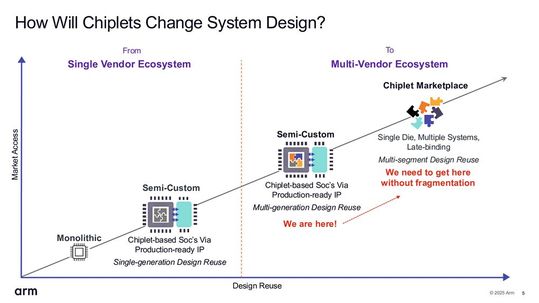
How will chiplets change system design?
(Image: Arm)
Currently, chiplet-based systems are mostly implemented as semi-custom designs by individual manufacturers. In this process, a company develops all the required modules itself – a labor-intensive process that hardly allows for economies of scale. The result: high development costs, duplicated qualification efforts, and low flexibility. From Arm's perspective, this model is not sustainable in the long term – especially considering the aspect of Total Cost of Ownership (TCO).
"If a single provider develops all chiplets, costs rise – and the TCO model becomes hardly sustainable," warns Eddie Ramirez. Only through comprehensive reuse – across product lines, generations, and manufacturers – do chiplets unleash their economic potential. This not only lowers TCO, but also significantly reduces development and qualification efforts.
The goal: reuse instead of customization – with positive TCO instead of increasing complexity. Similar to the principle of platform economics, the same could apply to chip design: Those who focus on reusable components instead of exclusive custom solutions not only reduce costs but also accelerate innovation. Chiplets would thus become what containers have become for software development: portable, standardized, combinable. This requires a consistently modular architecture – with clearly defined interfaces, standardized communication protocols, and interoperable control components. This opens up new business models, such as an open market for standardized chiplet components that can be flexibly assembled into SoCs. Ramirez sums it up: The industry needs a market "where chiplets are viewed as products and not as individual solutions."
The Path to an Open Chiplet Architecture
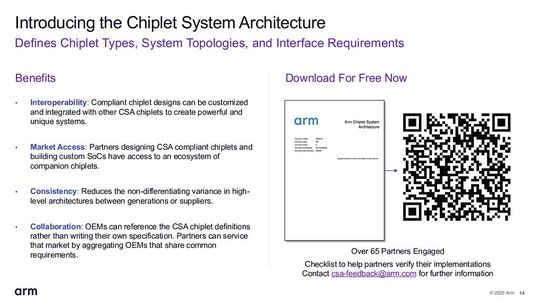
The Chiplet System Architecture by Arm introduced
(Image: Arm)
To achieve the goal of a marketable chiplet modular system, Arm defines not only electrical interfaces with the CSA (Chiplet System Architecture) but also a holistic architectural model. This includes several fundamental principles that are embedded in the CSA specification:
No Hidden State: Alle internen Zustände der Chiplets müssen explizit dokumentiert sein, um eine zuverlässige Systeminitialisierung zu ermöglichen.
Unified Discovery: Ein einheitliches Verfahren zur automatisierten Erkennung der Chiplets im System reduziert Integrationsaufwand.
Scalable Boot: Die Systemstartprozesse müssen flexibel auf unterschiedliche Kombinationen von Chiplets reagieren können.
Manageable Security: Sicherheitsfunktionen, etwa zur Authentifizierung oder Verschlüsselung, werden als systemweite Dienste gedacht.
Implementation is ensured by a tiered control model:
Ein zentraler CSA Manager koordiniert die Systeminitialisierung und Firmwareverteilung.
Jeder Chiplet besitzt einen lokalen Chiplet Controller, der Konfigurationsdaten entgegennimmt und sicherheitskritische Funktionen kapselt.
This architectural model is intended to enable the integration of chiplets from different manufacturers into a SoC under common rules – without proprietary special solutions. The focus is not solely on the electrical connection but also on aspects such as security, system control, and firmware integration.
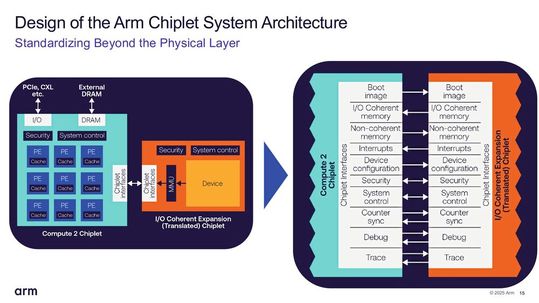
Standardization beyond the physical level
(Image: Arm)
Protocols such as UCIE, AMBA CHI, or the CSA specification define how chiplets communicate with each other physically and logically. The CSA specification includes mechanisms for automated chiplet discovery, standardized power domains, defined boot and reset sequences, as well as protocols for error handling and system monitoring. This is the only way to reliably combine components of different origins without requiring significant integration effort. Arm is actively working to establish and further develop these standards – always with the goal of reducing development complexity and promoting the reusability of designs.
Standardization thus becomes a prerequisite for a functioning chiplet market, both on a technical and procedural level. Only through uniform rules can heterogeneous components be securely integrated and manufactured on an industrial scale. "What we have been missing is a systemic view of the architecture – not just the physical interfaces," says Ramirez.
Date: 08.12.2025
Naturally, we always handle your personal data responsibly. Any personal data we receive from you is processed in accordance with applicable data protection legislation. For detailed information please see our privacy policy.
Consent to the use of data for promotional purposes
I hereby consent to Vogel Communications Group GmbH & Co. KG, Max-Planck-Str. 7-9, 97082 Würzburg including any affiliated companies according to §§ 15 et seq. AktG (hereafter: Vogel Communications Group) using my e-mail address to send editorial newsletters. A list of all affiliated companies can be found here
Newsletter content may include all products and services of any companies mentioned above, including for example specialist journals and books, events and fairs as well as event-related products and services, print and digital media offers and services such as additional (editorial) newsletters, raffles, lead campaigns, market research both online and offline, specialist webportals and e-learning offers. In case my personal telephone number has also been collected, it may be used for offers of aforementioned products, for services of the companies mentioned above, and market research purposes.
Additionally, my consent also includes the processing of my email address and telephone number for data matching for marketing purposes with select advertising partners such as LinkedIn, Google, and Meta. For this, Vogel Communications Group may transmit said data in hashed form to the advertising partners who then use said data to determine whether I am also a member of the mentioned advertising partner portals. Vogel Communications Group uses this feature for the purposes of re-targeting (up-selling, cross-selling, and customer loyalty), generating so-called look-alike audiences for acquisition of new customers, and as basis for exclusion for on-going advertising campaigns. Further information can be found in section “data matching for marketing purposes”.
In case I access protected data on Internet portals of Vogel Communications Group including any affiliated companies according to §§ 15 et seq. AktG, I need to provide further data in order to register for the access to such content. In return for this free access to editorial content, my data may be used in accordance with this consent for the purposes stated here. This does not apply to data matching for marketing purposes.
Right of revocation
I understand that I can revoke my consent at will. My revocation does not change the lawfulness of data processing that was conducted based on my consent leading up to my revocation. One option to declare my revocation is to use the contact form found at https://contact.vogel.de. In case I no longer wish to receive certain newsletters, I have subscribed to, I can also click on the unsubscribe link included at the end of a newsletter. Further information regarding my right of revocation and the implementation of it as well as the consequences of my revocation can be found in the data protection declaration, section editorial newsletter.
Cooperation Instead of Silos: The Ecosystem is Growing
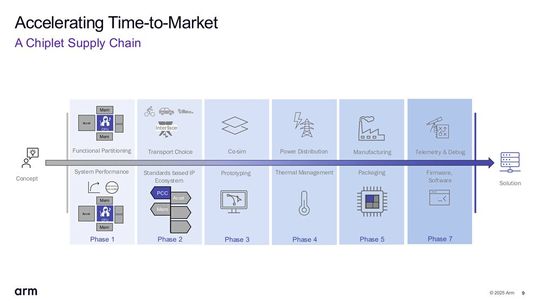
Accelerating market launch: A chiplet supply chain
(Image: Arm)
For chiplets to become scalable and economical, more than just technical standards are needed. A functioning ecosystem is also required. This is exactly what Arm is working on with the "Total Design" program. The goal is to bring together all relevant players along the value chain: IP providers, foundries, EDA tool manufacturers, design houses, and OEMs. This network aims to ensure that chiplets are not only developed but also efficiently combined, manufactured, and integrated into products.
A concrete example is the LeapFrog project. Among the participating partners, in addition to Arm itself, are companies like Cadence and Synopsys (EDA), GlobalFoundries (Foundry), MediaTek (SoC), as well as several system providers. This cross-section of the industry demonstrates how broad the cooperative basis for standardized chiplet systems has become. "With LeapFrog, we are showing that it is possible to build a system with multiple partners that delivers more performance than a conventional GPU and is three times as efficient," says Ramirez.
Multiple companies contribute specialized chiplets, which merge into a powerful, energy-efficient overall system through standardized interfaces. Collaboration along the entire development chain thus becomes a key competency.
LeapFrog also demonstrates that chiplets developed once can be reused in multiple products – a key advantage for time-to-market and TCO. Involved are not only SoC designers but also EDA providers, IP developers, manufacturers, and OEMs. The project serves not only as a technology demo but also as a prototype for a scalable approach to combining standardized chiplets into market-ready systems.
"It is a good sign that OEMs are now no longer asking only for SoCs in their RFIs, but for chiplets," reports Ramirez. Demand is starting to shift – away from monolithic design towards modular thinking.
Technical Key Topics: Firmware, Security, and Packaging
The path to a standardized and widely adopted chiplet architecture is technically challenging. Three key areas are in focus: security, firmware, and packaging.
"When you split designs, the firmware becomes more complex. We need to work on modular approaches," explains Ramirez. This refers to frameworks that enable configurable firmware components, such as scalable boot sequences and standardized management interfaces for chiplet combinations. The goal is a dynamic firmware structure that automatically adapts to the system configuration, comparable to modular driver architectures in software development. Instead of monolithic code, firmware structures are needed that dynamically adapt to different chiplet combinations.
Security is not only about protecting individual components but also about secure communication and trust-building between chiplets – a challenge when multiple providers are involved. Finally, packaging poses a key hurdle: For chiplets from various sources to work reliably together in a system, differences in manufacturing technologies, thermal design, and physical interfaces must be technically addressed, for example through coordinated packaging standards and testing methods.
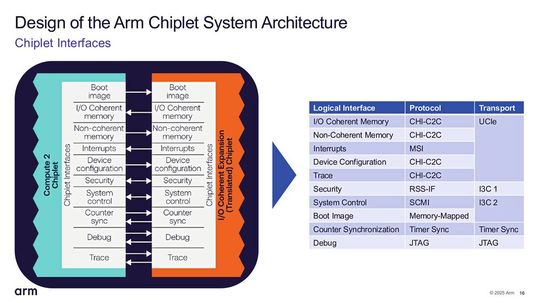
Chiplet interfaces
(Image: Arm)
A key aspect here is the chain of trust: To securely integrate chiplets from different providers, mechanisms such as signed firmware packages, certificate chains, and independent security anchors at the hardware level are required. Building trust thus becomes a dynamic task – not as an add-on, but as an integral part of the system architecture. Close coordination between chip developers, foundries, and OSATs is crucial here.
Conclusion: Standardized chiplets open up new possibilities
The transition to standardized chiplet architectures is on the verge of a turning point, comparable to the shift from proprietary server hardware to open cloud platforms. What has long been a reality in software, namely modular, reusable components, could trigger a paradigm shift in chip development.
This development requires not only technical standards but also coordinated alignment of interests within the ecosystem, as well as trust across company boundaries. Only then can an open market for chiplets be established that is more than just a technical promise.
The decisive factor will be whether manufacturers, tool providers, foundries, and OEMs can be committed to common interfaces and architectural principles. If successful, chiplets could not only shorten development cycles and make designs more flexible but also establish a new economy of modular semiconductor platforms, similar to how software libraries and platform APIs have shaped the IT world. (mc)



:quality(80)/p7i.vogel.de/wcms/dd/08/dd086510d9ae7b50181f6070e4463b44/0129363730v1.jpeg "Typical application for ionizing devices: Wrapping films. (Picture: ©Adobe Stock/SMC)")
:quality(80)/p7i.vogel.de/wcms/35/57/3557c819943c53acec41a0ccba87da4f/0130049064v1.jpeg "Researchers at the Fraunhofer IWU in Chemnitz have long known that many typical sheet metal parts can be manufactured more cost-effectively using hollow embossing rollers. Now there is news to report ... (Image:Fraunhofer IWU)")
:quality(80)/p7i.vogel.de/wcms/59/02/590246e3b3f415c65edbee377c14ca77/26-06-pi-fraunhofer-iws-41450-direktplattieren-pic-01-7771x4369v1v1.jpeg "The Fraunhofer IWS has developed the new \"direct laser cladding\" process, which creates a functional layer directly on the base body by applying a strip-shaped metal to rotationally symmetrical components in a spiral and bonding it locally by laser. (Image:Christoph Wilsnack/Fraunhofer IWS)")
:quality(80)/p7i.vogel.de/wcms/73/60/73608418789b1d9c393f5e2fa974eda2/0130209906v1.jpeg "The robots of the X6 generation from b+m enable very high painting quality and are also particularly compact and easy to maintain. (Image:Beckhoff)")
:quality(80)/p7i.vogel.de/wcms/78/e9/78e9188c25a8a94e67c34c9bf8ffe495/visual-agile-20robots-20and-20google-20deepmind-20partner-20to-20bring-20intelligence-20to-20robotics-2500x1406v1v1.jpeg "Together, the partners are developing adaptable, intelligent robots for a wide range of applications (Image:Agile Robots SE)")
:quality(80)/p7i.vogel.de/wcms/e7/66/e7669ecf0260ae8fc54c214e34e4902a/0130316817v1.jpeg "Siemens and Palo Alto Networks offer tested cybersecurity solution for industrial 5G. (Image:Siemens)")
:quality(80)/p7i.vogel.de/wcms/9f/55/9f55324832c4f426958031375124d9de/siemens-20ubtech-20hmnd-1920x1079v1v1.png "Ready for the factory floor: While Ubtech is planning mass production, Siemens is already testing humanoids in real factory applications in Erlangen. (Image:Siemens)")
:quality(80)/p7i.vogel.de/wcms/11/36/113695ed260e29c8c2d9d39dc5f9d869/0130213768v1.jpeg "AI can work cheaply in China and deliver the results rapidly all over the world. (Image:Dall-E / AI-generated)")
:quality(80)/p7i.vogel.de/wcms/62/5f/625f41e87ebfef156a98c8e6393e32fd/0130211654v1.jpeg "Axial flux motors have some advantages over radial flux motor—but their production is currently still expensive. (Image:RWTH Aachen University)")
:quality(80)/p7i.vogel.de/wcms/77/9b/779b0685d010dfe45c9c2cb1cfecd467/0128886425v1.jpeg "The BlueEye is the first \"real\" hyperspectral camera for the UV range and covers the wavelength range from 220 to 380nm. (Image:Inno-spec GmbH)")
:quality(80)/p7i.vogel.de/wcms/e4/51/e451d52ce0182fb0aaa46a5774f832ef/26-04-pi-fraunhofer-iws-21160-bioslide-pic-01-4128x2321v1v1.jpeg "With the BioSlide research project, the Fraunhofer IWS is investigating how sliding systems can be designed to be more sustainable and energy-efficient. New materials can be tested in a particularly application-oriented manner on this plain bearing test stand. (Image:Fraunhofer IWS)")
![Thanks to advanced 3D printing technology, a more efficient use of resources should contribute to lower-emission aviation—this is the goal of ['skai]-lab. (Image:Oleksandr Pashchenko - stock.adobe.com / AI-generated)](https://cdn1.vogel.de/nghHNSbySccfOjG3n1qCA-FVOjQ=/288x162/smart/filters:format(jpg):quality(80)/p7i.vogel.de/wcms/62/64/626424c97a16e69f871bf216c9629c2a/adobestock-1927043193--c2-a9-20oleksandr-20pashchenko-20-e2-80-93-20stock-adobe-com-ki-generiertv1v1.jpeg "Thanks to advanced 3D printing technology, a more efficient use of resources should contribute to lower-emission aviation—this is the goal of ['skai]-lab. (Image:Oleksandr Pashchenko - stock.adobe.com / AI-generated)")
:quality(80)/p7i.vogel.de/wcms/c3/c4/c3c4ce270b083eeac55654148611f064/0130237945v1.jpeg "China is not giving up on hydrogen, but is intensifying its efforts. (Image:freely licensed from Pixabay)")
:quality(80)/p7i.vogel.de/wcms/4e/c0/4ec0bd19390b169edfa23677373dcdf1/0130260089v1.jpeg "Renewable fuels can supply European road traffic, according to a study. (Image:Aral)")
:quality(80)/p7i.vogel.de/wcms/6f/c9/6fc9050301d745cad25585c6780f8f51/0130197341v1.jpeg "Production facilities are a worthwhile target and are therefore at risk. (Image:ABB Robotics)")
:quality(80)/p7i.vogel.de/wcms/b6/62/b662adc2cec8227d8172509bbfb6ee42/25c0207-107-4961x2789v1v1.jpeg "The GLB is the second model based on Mercedes' new MMA platform. Apparently, Geely's platform is better and cheaper, which is why the two companies are negotiating a partnership. (Image:Mercedes-Benz)")
:quality(80)/p7i.vogel.de/wcms/4d/dd/4dddf438e91f394c04a095dbfd109d1c/0130236430v1.jpeg "Measurement modules: The 720301 module in combination with the SL2000 enables RMS and power calculations, among other things. (Image:Yokogawa)")
:quality(80)/p7i.vogel.de/wcms/61/fc/61fcf95f5cca15494ad18343901ae585/0130317237v1.jpeg "With the AGI CPU, Arm says it is taking a \"historic step\": With the processor aimed at AI in data centers, the company is presenting itself for the first time as a provider of its own chips, not just as a pure IP licensor. (Image:Arm)")
:quality(80)/p7i.vogel.de/wcms/82/90/8290dfe3595b6c6b33726ae8b76172c7/0130319587v1.jpeg "The concept image illustrates how the pattern of tiny protrusions and depressions created on the substrate (MgO, bottom) controls the arrangement of atoms in the superconducting material (YBCO, top). At the interface between the two layers, an electronic structure enables superconductivity to occur at higher temperatures than previously possible. (Image:Chalmers University of Technology / Riccardo Arpaia)")
:fill(fff,0)/p7i.vogel.de/companies/67/eb/67eba621ef6ea/logo2.png "logo2 (Wuxi InfiMotion)")
:quality(80)/p7i.vogel.de/wcms/e7/96/e796bc1109f50cc0fc4f3ae65872eb6c/0126005000v1.jpeg "(Image: Arm)")
:quality(80)/p7i.vogel.de/wcms/7e/f7/7ef760d7e6d40dc4490eec6635e303a8/0126004999v1.jpeg "(Image: Arm)")
:quality(80)/p7i.vogel.de/wcms/87/62/8762e5c947f311422d8572dc7e9132e8/0126004975v1.jpeg "(Image: Arm)")
:quality(80)/p7i.vogel.de/wcms/57/43/5743614704e103fe09aa59bec3cd6724/0126004971v1.jpeg "Artificial intelligence impacts all layers of the technology spectrum.(Image: Arm)")
:quality(80)/p7i.vogel.de/wcms/9e/8a/9e8adbe44b638f2dbb3868da4b88d078/0128608904v1.jpeg "The illustrated automotive SoC model utilizes modular chiplets and showcases a future where adaptable designs offer customization, scalability, and faster innovation cycles. (Image:Imec)")
:quality(80)/p7i.vogel.de/wcms/eb/94/eb94a9e1462da95af76b560f1dd32c19/0126804626v1.jpeg "The requirements for automotive chips are clear. However, opinions differ on the right chip technology. (Image:NXP)")