As a specialist in high-precision positioning solutions, Steinmeyer Mechatronics realizes inspection systems for testing and measurement technology, customized to the individual tasks of the customer - focusing on the selection of the drive.
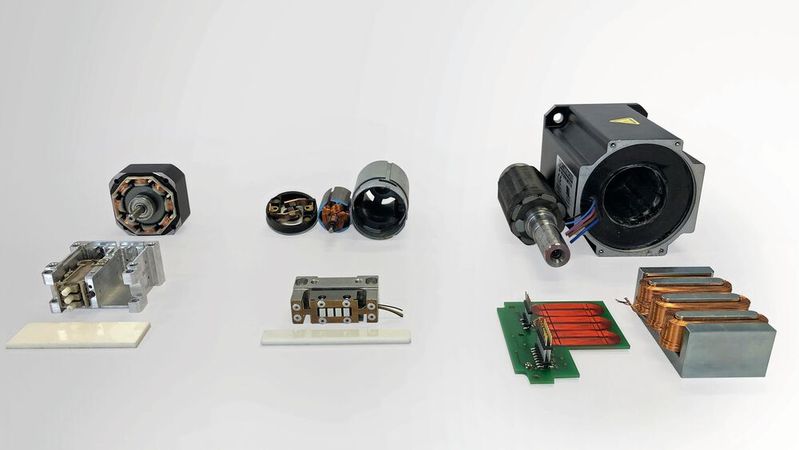
The main types of drives for inspection systems include DC, AC, stepper, linear, and piezoelectric motors.
(Image: Steinmeyer Mechatronics)
Inspection systems are an integral part of many manufacturing lines. They contribute to improving product quality, reducing defect rates, increasing process efficiency, and saving costs. High-tech industries such as the semiconductor industry, medical technology, or the pharmaceutical industry even demand a comprehensive quality control and documentation. However, monitoring and control in the production process also play an important role in other industries, with a growing trend. Each application and industry have different requirements for inspection systems - whether it be heavy loads, large travel distances, high throughput, minimal particle generation, or extreme stability in the picometer range. This has an impact on the choice of drive. But which one is the right one?
The agony of choice
The most important types of drives for inspection systems include DC, AC, stepper, linear, and piezo motors. In addition, there are other motor principles such as magnetostriction, memory effect, chemical drives, ultrasonic motors, and thermal expansion. However, these are not commercially available in a safe and suitable manner for mass production. Steinmeyer Mechatronics, a specialist in high-precision positioning solutions from Dresden, works on 50 new developments every year in all conceivable industries that require µm precision.
In addition, the company has extensive application experience in the use of all common types of drives - including vacuum and magnet freedom, as well as completely exotic special cases. "The drive should be tailored to the application, and not to the solution that the supplier is accustomed to or finds most convenient. Otherwise, compromises will be made that either result in additional development costs or compromises the quality of the product," emphasizes Elger Matthes, Development and Product Management at Steinmeyer Mechatronics.
Finding the optimum
The selection of the drive is always a compromise between speed, accuracy, load, and travel distance. In addition, other criteria such as stiffness (static stability, immunity to external vibrations), dynamics (cycle time, acceleration), linearity (resonances, controllability), and environmental conditions (temperature, vacuum, cleanroom, magnetism, etc.) play a role in the decision-making process. Integration aspects (fit tolerances, maintenance), requirements for installation space and price, as well as factors such as industrial maturity, lifespan, availability, and support should also be taken into account. "Careful and wise consideration and weighing of these factors is required," emphasizes Elger Matthes, explaining, "The most important thing is to understand what the customer needs - and then, based on this understanding, select the optimum solution from the many possibilities." This requires a keen sense of the application requirements, years of experience, and deep knowledge of drive and motor technology.
AC motors: specialists for heavy loads
For large loads in harsh environments, a combination of an AC motor and ball screw drive is a suitable option - just like in a specific application for in-line quality control with laser optics in the machine tool industry. The laser optics weigh 26 kg and require powerful drives. AC motors are well-suited for this task. They are simple in construction, robustly built, suitable for industrial use, exceptionally durable, and offer high speeds and medium torque. These AC motors feature an external stationary coil system with three phases, in which a magnetic system rotates. Electronics provide a sinusoidal rotating field, which the rotor follows.
The so-called electronically commutated DC motors (BLDC = "brushless DC motor" or ec-motor = "electronically commutated motor") are essentially AC motors with built-in electronics in the motor that handle the commutation. BLDC motors are well-suited for achieving a constant speed without the need for specific position control. "AC motors" refer to AC servomotors here, not induction machines. The term "servo" describes the ability of a motor to deliver full torque even at standstill. In addition, movements much smaller than one revolution can be controlled.
DC motors: classics for high speeds and small torques
Electrodynamic drives such as AC motors utilize the electrodynamic effect, which is the force acting on current-carrying conductors in a magnetic field. The current is proportional to the load, and the voltage is proportional to the rotational speed or velocity. This allows electrodynamic drives to be very sensitive and precise, capable of controlling movements on a sub-µm scale. For positioning tasks, they require a measurement system or an encoder. DC motors and linear motors also operate based on this principle.
Date: 08.12.2025
Naturally, we always handle your personal data responsibly. Any personal data we receive from you is processed in accordance with applicable data protection legislation. For detailed information please see our privacy policy.
Consent to the use of data for promotional purposes
I hereby consent to Vogel Communications Group GmbH & Co. KG, Max-Planck-Str. 7-9, 97082 Würzburg including any affiliated companies according to §§ 15 et seq. AktG (hereafter: Vogel Communications Group) using my e-mail address to send editorial newsletters. A list of all affiliated companies can be found here
Newsletter content may include all products and services of any companies mentioned above, including for example specialist journals and books, events and fairs as well as event-related products and services, print and digital media offers and services such as additional (editorial) newsletters, raffles, lead campaigns, market research both online and offline, specialist webportals and e-learning offers. In case my personal telephone number has also been collected, it may be used for offers of aforementioned products, for services of the companies mentioned above, and market research purposes.
Additionally, my consent also includes the processing of my email address and telephone number for data matching for marketing purposes with select advertising partners such as LinkedIn, Google, and Meta. For this, Vogel Communications Group may transmit said data in hashed form to the advertising partners who then use said data to determine whether I am also a member of the mentioned advertising partner portals. Vogel Communications Group uses this feature for the purposes of re-targeting (up-selling, cross-selling, and customer loyalty), generating so-called look-alike audiences for acquisition of new customers, and as basis for exclusion for on-going advertising campaigns. Further information can be found in section “data matching for marketing purposes”.
In case I access protected data on Internet portals of Vogel Communications Group including any affiliated companies according to §§ 15 et seq. AktG, I need to provide further data in order to register for the access to such content. In return for this free access to editorial content, my data may be used in accordance with this consent for the purposes stated here. This does not apply to data matching for marketing purposes.
Right of revocation
I understand that I can revoke my consent at will. My revocation does not change the lawfulness of data processing that was conducted based on my consent leading up to my revocation. One option to declare my revocation is to use the contact form found at https://contact.vogel.de. In case I no longer wish to receive certain newsletters, I have subscribed to, I can also click on the unsubscribe link included at the end of a newsletter. Further information regarding my right of revocation and the implementation of it as well as the consequences of my revocation can be found in the data protection declaration, section editorial newsletter.
Characteristic of DC motors is that within a stationary magnetic arrangement, a coil system rotates, which is connected to the two outer terminals via slip rings and contacts the coil necessary for movement during rotation (mechanical commutation) - in a sense, the reverse of the AC motors described above. DC motors have a compact design and offer extreme dynamics, making them ideal for applications with high speeds and low torques. Their control is simple because only one phase needs to be regulated.
A typical application example is an XY-Z portal for roughness measurement. This allows for repeatabilities of 0.5 µm and very smooth measurement runs.
Linear motors: ideal solution for long travel distances and high speeds
When it comes to long travel distances and high speeds, linear motors are the technology of choice. An application example is the inspection of large panels after laser cutting. This was implemented using an air-bearing portal system with an integrated linear encoder, which achieved travel distances of 1,600 mm and 1,150 mm in the XY axes, as well as positioning speeds of 1,500 mm/s (peak: 2,200 mm/s). Electrodynamic linear motors are essentially "unwound" versions of AC servos or BLDC motors. They can be classified as "iron-core" (DLM) or "ironless" (eDLM). In the first case, a runner with coils wound around an iron core is moved over a ladder-shaped magnet arrangement. In the second case, it is a cast housing consisting of three coils positioned between two magnet systems. Electrodynamic linear motors operate without wear and offer very high speeds and extreme accelerations. It is important to note the significant detent force of the iron-core linear motor resulting from the reluctance effect of the iron core. On the other hand, ironless linear motors have no detent force, ensuring a very smooth operation.
Stepper motors: can be used without a measuring system
Not always is an additional measurement system, as is mandatory for AC, DC, linear, and piezo motors, desirable as it increases complexity and costs. When the focus is on simplicity, robustness, and cost-effectiveness, open-loop systems are ideal. With stepper motors, positions can be reached simply by counting the steps, eliminating the need for feedback-controlled control. The result is easy control and a robust structure. Stepper motors offer limited acceleration and speed, but this is generally not required for typical applications such as microscope stages. As an example, an application with a positioning speed of 25 mm/s (peak: 50 mm/s) can be mentioned. The XY cross table with a travel distance of 100 mm has a repeatability of 2.5 µm and allows for the positioning of loads up to 10 kg.
Stepper motors can sometimes be temperamental. They exhibit erratic behavior, resonance issues during startup, and a sharp drop in drive torque with increasing speed. However, the approximately three times higher torque compared to DC motors of the same size proves useful in combination with lead screws and micro-stepping to achieve sufficiently small step sizes. Due to their design with a toothed rotor with permanent magnets, they have holding torque and operate in a detent manner.
Piezoelectric motors: extremely high resolution in the nanometer range
Piezomotors are also self-locking. Their biggest advantage, however, lies in their very high resolution in the nanometer range and excellent stability after movement. Achieving repeatability of 0.05 µm and static deviations of <50 pm/min is not a problem. The semiconductor industry also benefits from this in the inspection of nanostructures. One solution is a UHV 3-axis system in a magnet-free design with travel distances of 160 mm for the X-axis and 20 mm each for the Y and Z axes (vertical). Thanks to specially developed piezomotors, loads of up to 2 kg can be positioned.
Piezomotors utilize the piezoelectric effect, which involves the change in length of a crystal in an electric field. Typically, this change is around 1.5 parts per thousand. In order to achieve macroscopic displacements in the millimeter range, multiple piezostacks are combined in piezomotors to create movable legs that perform quasi-continuous motion when pressed against a hard surface. The force is transmitted to the rotor ceramic through friction. Four basic principles have emerged for piezomotors: inchworm, oscillator, traveling wave motor, and stick-slip motor. Each principle has different characteristics and covers a wide range of applications. The control of piezomotors is highly specialized and requires a lot of experience during commissioning.
The best possible drive solution for every application.
Whether it's surface inspection, component measurement, or PCB inspection, whether it's automatic optical inspection (AOI), manual inspection, or 3D measurements, the drive plays a crucial role in the performance of the inspection solution. Steinmeyer Mechatronics understands the specific requirements of different applications and industries and realizes inspection systems that are characterized by perfect flatness, minimal tolerances for pitch and yaw, and smooth operation. "Despite our close proximity to the screw drive technology within the Steinmeyer Group, we approach the choice of components without any reservations. The top priority is to find the best possible solution for the positioning task within the given cost framework," says Elger Matthes.
By the way: At the Dresden site, all departments - development, mechanics, electronics, software, production, assembly, testing laboratories, and test center - work together under one roof. This enables optimal utilization of synergies and enables the quick and uncomplicated realization of specific customer requirements. All departments are involved in finding solutions.



:quality(80)/p7i.vogel.de/wcms/53/f7/53f7dadbe4d656a3fd4f4077445f29f6/0129828707v1.jpeg "Thanks to its compact design and drilling/unscrewing function, the Fire Birdie is suitable for applications with limited installation space and frequent tool changes. (Image:Marcel Kraibühler)")
:quality(80)/p7i.vogel.de/wcms/da/4d/da4da8d34671dc6bce80e496212de877/0129850788v1.jpeg "Mate-XT Go supports the arms and shoulders during overhead work and repetitive tasks and is designed to significantly reduce muscle strain in everyday working life. (Image:Comau)")
:quality(80)/p7i.vogel.de/wcms/95/97/95976dbaac68b249eb65e74c5aad5300/0129651893v1.jpeg "The C2.0 centric clamps, the S2 fixed jaw clamps and the \"gredoc\" zero-point clamping systems are used for machining the raw parts. Fastening is carried out with width across flats 27. (Image:Gressel)")
:quality(80)/p7i.vogel.de/wcms/57/1b/571b8895efb299d70846bbdbd7af2338/0130043886v1.jpeg "Servo hydraulics independent of the control system: The servo hydraulics software module is integrated directly into the b Maxx 5500 servo drive (pictured: Mehmet Sari, Export Sales Manager at Hürsan Pres (left), Özgür Deniz Demirbaş, Country Manager at Baumüller Turkey) (Image:Baumüller)")
:quality(80)/p7i.vogel.de/wcms/3b/27/3b27f6c5848be73acecb04054bf0a146/0130115209v1.jpeg "Spectroscopic glucose measurement with infrared spectroscopy enables more regular measurements without physical strain. (Image:Endrich)")
:quality(80)/p7i.vogel.de/wcms/3f/cc/3fccb748b0fe16f1f61249d94c72f126/0130149439v1.jpeg "Requirements for integrated power supply systems: Precise AC and DC power supply systems that not only provide energy, but also reliably combine measurement, analysis and system integration. (Image:Schulz Electronic)")
:quality(80)/p7i.vogel.de/wcms/fd/93/fd93e01c16f5a4709278499d981a459c/0130061090v1.jpeg "Revealed: These servo drives are assembled at Aerotech in Fürth. (Image:Aerotech)")
:quality(80)/p7i.vogel.de/wcms/cb/8a/cb8ae7f5205365efce3e7285154fc3cf/0130132198v1.jpeg "Markus Huber (left) and Nicolai Friis from TU Wien know how to make quantum computers multidimensional in order to perform computing operations even better. (Image:TU Vienna / A. Rommel)")
:quality(80)/p7i.vogel.de/wcms/63/21/6321beb732bf7d92640df46d7aa77573/0130125122v1.jpeg "As part of the Carbon Lab Factory Lausitz, a pilot plant for the production of sustainable, cost-effective and competitive carbon fibers will be built at the Guben site. (Image:Fraunhofer IAP / Kristin Stein)")
:quality(80)/p7i.vogel.de/wcms/53/4f/534fe0f168f6ee070ded4a48faca4cef/business-wire-main-image-1103x620v1.jpeg "The new UR AI Trainer, developed by Universal Robots and Scale AI, is the first direct lab-to-factory solution for AI model training.
(Source: Universal Robots)")
:quality(80)/p7i.vogel.de/wcms/08/70/087062e2e1a9b9add5777410dd746ee9/adobestock-1923991605-5607x3156v1v1.jpeg "A new type of tactile sensor, inspired by human skin, even recognizes grains of sand. (Image:Curioso.Photography - stock.adobe.com)")
:quality(80)/p7i.vogel.de/wcms/7f/08/7f087d7013424d123ab7275cd2e3fe55/adobestock-809456218--c2-a9-20degimages-20-e2-80-93-20stock-adobe-com-ki-generiert-4179x2351v1v1.jpeg "The digital upgrading of existing machines conserves resources, saves energy and reduces the need for new production. (Image:Degimages - stock.adobe.com/AI-generated)")
:quality(80)/p7i.vogel.de/wcms/90/db/90db3087d3af0560fcdb4dbc42443ce1/0130157448v1.jpeg "The switch to SDV is the most complex transformation the industry has ever had to master. The end consumer gets a vehicle that gains rather than loses value over its lifetime. (Image:Sonatus)")
:quality(80)/p7i.vogel.de/wcms/73/f0/73f00bb99a23197db05bb584fe78f20f/0130080581v1.jpeg "The \"China Speed\" analysis by Roland Berger shows that the speed of development has only a limited connection with labor costs. (Image:freely licensed at Pexels)")
:quality(80)/p7i.vogel.de/wcms/2f/5b/2f5ba6a150b52c2b8efada560c5cdafe/0130143442v1.jpeg "Automotive suppliers are facing a severe crisis, which is primarily due to a combination of structural change and economic problems. (Image:freely licensed at Pexels)")
:quality(80)/p7i.vogel.de/wcms/22/d0/22d03cd48e992435338b59464c428d41/0129739814v1.jpeg "More electric vehicles on the roads mean a higher demand for electricity - which should ideally be covered by renewable energies. (Image:BMW)")
:quality(80)/p7i.vogel.de/wcms/94/7a/947ac066b98cbcd3470e83ff9da3e25f/0130096114v1.jpeg "The use of amorphous steels in the stator enables a significant reduction in losses and increases the efficiency of modern electric motors in vehicle drives. (Image:Horse Powertrain)")
:quality(80)/p7i.vogel.de/wcms/e5/f1/e5f171d3d7ae021332cc0aeae4d6e299/0130127049v1.jpeg "In collaboration with Shanghai Jiao Tong University, Lenovo has presented a silicon anode battery under the name \"ED1000\" as a proof of concept for mobile workstations. (Image:Lenovo)")
:quality(80)/p7i.vogel.de/wcms/fa/69/fa696e59706b96fff02283dd74cc2398/0130129635v1.jpeg "Samsung Co-CEO Jun Young-hyun wants to respond to the AI-driven boom in demand in the memory market with contracts for up to five years. This should provide more planning security in the traditionally volatile storage business. At the same time, however, this is likely to increase the pressure on customers to secure precise long-term requirements, prices and supply chains. (Image:Samsung)")
:quality(80)/p7i.vogel.de/wcms/31/a8/31a883a47b86634c382923e78fd9a4c9/0130133225v1.jpeg "Figure 1: GMSL-capable point-to-point connection. (Image:ADI)")
:fill(fff,0)/images.vogel.de/vogelonline/companyimg/76800/76895/65.jpg "FAULHABER_120mm.jpg ()")
:fill(fff,0)/p7i.vogel.de/companies/67/eb/67eba621ef6ea/logo2.png "logo2 (Wuxi InfiMotion)")
:quality(80)/p7i.vogel.de/wcms/04/52/045296a1e0e4c04bae8a7a6f02487c66/0124864728v1.jpeg "Drivetrain Analyzer Cloud, a powerful solution from the Siemens Xcelerator portfolio, helps companies significantly reduce the energy consumption of their drive systems through energy-based maintenance. (Image:Siemens)")
:quality(80)/p7i.vogel.de/wcms/62/93/62934fd6900b930a0db9493be3d931ba/0127310246v1.jpeg "Servomotors without housings can be used very efficiently in confined spaces. (Image:TQ-Robotics)")