Protective doors should not only guarantee the required safety, but they must also ensure production efficiency. This raises the question for those responsible for production safety: What kind of protection or safety guard is really needed?
The modular safety door system from Pilz offers a flexible and customized safety door solution with individual components tailored to the requirements: from the safety door sensor, door handle modules, escape releases, and a pushbutton unit to the diagnostic system and evaluation device. The solution enables not only the safeguarding of safety doors but also access authorization management.
(Image: Pilz)
The application case itself dictates which safety door is the right one. The product standard EN ISO 14119 guides the way, as it closely links the topic of safety with the very diverse application situations.
Therefore, it must be carefully considered in the design phase which type of protective door is suitable. A swing and sliding door? Or a hood, flap, or roller door? In addition, they must consider the type of monitoring, the switch type, and the appropriate safety interlock for the protective door in their planning. Another essential criterion is found in the installation situation itself: should or must it be concealed? If there is a space-critical situation, safety interlocks like the safety switch with interlock PSENmlock Mini from Pilz are suitable. It has a compact design and offers high protection against tampering.
Gallery
Moreover, users must check if particularly harsh environmental conditions prevail. With robust interlocks like the PSENslock 2 safety interlock from Pilz, with its hygienic design and stainless steel elements, protective door monitoring with process interlock can be implemented safely even in the harshest environmental conditions. It is important that the protection class IP 67/IP 6K9K is provided. The locking force (force that keeps the door closed through the permanent magnet even when de-energized) can be individually adjusted using an RFID tag.
When process protection, when personal protection?
The question of the type of interlock depends on the overrun time. If the time to reach the danger point is longer than the overrun time, a process interlock is sufficient. In this case, the priority is to protect the process itself and prevent unwanted production interruptions. However, if the intervention time is shorter than the overrun time, a safe interlock is required. This is also referred to as personnel protection. This applies to machines that are still running down, such as robotic applications. The safety device may only unlock here when the machine is in a safe state and has come to a complete stop. Only when there is no longer any danger from the machine should opening the protective door be possible.
For process protection, an interlock based on the working current principle is sufficient, for example. The interlock is provided by a magnet. For unlocking, the magnet is deactivated again. A functional principle, such as that offered by the electromagnetic safety interlock PSENslock 2 from Pilz. It combines safe protective door monitoring with an integrated electromagnet.
For personnel protection, the bistable interlock principle is often used—this is employed, for example, in the PSENmlock and PSENmlock Mini safety interlocks from Pilz. The last state is maintained in the event of a power failure, so the door remains either closed and held or open. High safety is ensured by the two-channel control of the lifting magnet: In the event of a fault, the OSSDs are switched off, but the interlock remains. It can then be selectively unlocked by deactivating it once.
Suitable protective device for every performance level
The choice of the appropriate protective device, depending on process or personnel protection, is based on the Performance Level (PL). This is determined using a risk assessment according to EN ISO 13849–1. The determining factors for the assessment are the severity of possible injuries, the frequency and duration of exposure to the hazard, and the avoidability of hazards. PLe indicates the highest risk.
Multiple safety interlocks are often used in a system. It is necessary to connect them. With diagnostic solutions like Safety Device Diagnostics (SDD) from Pilz, extensive diagnostic and status information can be implemented alongside a safe series connection and targeted control of individual sensors. Advantage: It allows defining exactly which door can be unlocked and opened after shutdown, for example, when maintenance work is pending in a system. Otherwise, when the unlocking function is requested, all series-connected protective doors would open at once. This could become a safety issue if a person enters the danger zone unnoticed at another protective device.
Date: 08.12.2025
Naturally, we always handle your personal data responsibly. Any personal data we receive from you is processed in accordance with applicable data protection legislation. For detailed information please see our privacy policy.
Consent to the use of data for promotional purposes
I hereby consent to Vogel Communications Group GmbH & Co. KG, Max-Planck-Str. 7-9, 97082 Würzburg including any affiliated companies according to §§ 15 et seq. AktG (hereafter: Vogel Communications Group) using my e-mail address to send editorial newsletters. A list of all affiliated companies can be found here
Newsletter content may include all products and services of any companies mentioned above, including for example specialist journals and books, events and fairs as well as event-related products and services, print and digital media offers and services such as additional (editorial) newsletters, raffles, lead campaigns, market research both online and offline, specialist webportals and e-learning offers. In case my personal telephone number has also been collected, it may be used for offers of aforementioned products, for services of the companies mentioned above, and market research purposes.
Additionally, my consent also includes the processing of my email address and telephone number for data matching for marketing purposes with select advertising partners such as LinkedIn, Google, and Meta. For this, Vogel Communications Group may transmit said data in hashed form to the advertising partners who then use said data to determine whether I am also a member of the mentioned advertising partner portals. Vogel Communications Group uses this feature for the purposes of re-targeting (up-selling, cross-selling, and customer loyalty), generating so-called look-alike audiences for acquisition of new customers, and as basis for exclusion for on-going advertising campaigns. Further information can be found in section “data matching for marketing purposes”.
In case I access protected data on Internet portals of Vogel Communications Group including any affiliated companies according to §§ 15 et seq. AktG, I need to provide further data in order to register for the access to such content. In return for this free access to editorial content, my data may be used in accordance with this consent for the purposes stated here. This does not apply to data matching for marketing purposes.
Right of revocation
I understand that I can revoke my consent at will. My revocation does not change the lawfulness of data processing that was conducted based on my consent leading up to my revocation. One option to declare my revocation is to use the contact form found at https://contact.vogel.de. In case I no longer wish to receive certain newsletters, I have subscribed to, I can also click on the unsubscribe link included at the end of a newsletter. Further information regarding my right of revocation and the implementation of it as well as the consequences of my revocation can be found in the data protection declaration, section editorial newsletter.
There is no "one-size-fits-all" standard situation for protection. However, there is a rule of thumb for the safety of people and machines: The more dangerous the situation behind a safety door, the more secure the protection or monitoring of the separating protective device must be designed.



:quality(80)/p7i.vogel.de/wcms/a0/47/a04725ef9bd09fb6c9341a1bea1b5d93/0130443083v1.jpeg "Here, a type of plastic pallet is produced by thermoforming (vacuum forming or deep drawing) at the corresponding division of New England Plastics in the USA. This division, which specializes in so-called liners, is now part of Ringmetall ... (Image:New England Plastics)")
:quality(80)/p7i.vogel.de/wcms/23/99/23992bf2dcdc432c9b7209c34a4a7c48/0129733089v1.jpeg "Stork relies on the modular Neoswiss turning system from Iscar to shorten the set-up times for its sliding headstock lathes and work more productively. (Image:Iscar)")
:quality(80)/p7i.vogel.de/wcms/7d/e2/7de2923434b2f1a78ba5482d8d335269/0113143253v1.jpeg "In our China Market Insider we regularly provide you with relevant information directly from China. (Image:© Eisenhans - stock.adobe.com)")
:quality(80)/p7i.vogel.de/wcms/9d/2b/9d2b802f800e5caf17b2831e74228cd3/screenshot-202026-03-03-20103822-609x343v1v1.png "Visual comparison: on the left, a clean, burr-free cut edge; on the right, typical burr formation with oxidation discoloration. This illustrates how strongly parameter control and gas management influence the quality of the result. (CO₂ laser, oxygen cutting gas, sheet thickness approx. 15 mm). (Image:Picture: Rime)")
:quality(80)/p7i.vogel.de/wcms/b7/36/b736dfebc16c42d6901d0d0e1f390493/3d-druck-20factory-20--20ki-20generiert-1920x1079v1.png "(Source: AI-generated)")
:quality(80)/p7i.vogel.de/wcms/79/b2/79b21aad663f4a7bd4472afc1c1afc62/0130433994v1.jpeg "Mission Joyride: The free-flying robot (shown here in the rendering) will relieve the ISS crew of logistics tasks from 2027 with its two mechanical arms. (Image:Icarus Robotics)")
:quality(80)/p7i.vogel.de/wcms/6b/45/6b4546fa6ebf305c3660326909363f32/0130437089v1.jpeg "Industrial AI in action: Rockwell Automation presents practical solutions for self-controlling production systems at the Hannover Messe. (Image:Rainer Jensen, Deutsche Messe)")
:quality(80)/p7i.vogel.de/wcms/78/e9/78e9188c25a8a94e67c34c9bf8ffe495/visual-agile-20robots-20and-20google-20deepmind-20partner-20to-20bring-20intelligence-20to-20robotics-2500x1406v1v1.jpeg "Together, the partners are developing adaptable, intelligent robots for a wide range of applications (Image:Agile Robots SE)")
:quality(80)/p7i.vogel.de/wcms/59/a2/59a2b11f0aa1b700eff02addd5de8703/adobestock-1788280853--c2-a9-20satria-20-e2-80-93-20stock-adobe-com-5081x2860v1v1.jpeg "Quantum computers require extreme cooling to temperatures close to absolute zero in order to keep qubits stable. (Image:satria - stock.adobe.com)")
:quality(80)/p7i.vogel.de/wcms/49/38/493876a248943456b7e4a6db6edfc454/0130230765v1.jpeg "Safe and reliable in aircraft construction: light-curing adhesive bond combined with universal fastening elements. (Source: Delo)")
:quality(80)/p7i.vogel.de/wcms/b5/c7/b5c749d16c8a2e789c1469c2c8c1c387/0130452780v1.jpeg "Volvo Trucks completes road tests with its new hydrogen-powered trucks. (Image:Volvo Trucks)")
:quality(80)/p7i.vogel.de/wcms/ba/69/ba6975f417a85147084f38dc2cd209e2/0130451386v1.jpeg "Together with Nvidia, Hyundai wants to develop an architecture that will be used for level 4 robotaxis (image) as well as for level 2 customer vehicles. (Image:Hyundai)")
:quality(80)/p7i.vogel.de/wcms/93/4d/934de334b47abaa526c78cba1417d7af/0130343495v1.jpeg "The new SU7 is available in three price categories, \"Standard\", \"Pro\" and \"Max\" (Image:Xiaomi)")
:quality(80)/p7i.vogel.de/wcms/df/a0/dfa048434bb94f1b7d030e346b25b3ae/0130373541v1.jpeg "From August, BMW will be producing the i3 at its main plant in Munich - which the car manufacturer has extensively rebuilt for this purpose. (Image:Rainer Haeckl)")
:quality(80)/p7i.vogel.de/wcms/ee/09/ee09acbd6dc896df25affaa9e871e6e5/0130440053v1.jpeg "IMS chip module for simple system integration into an ion mobility spectrometer. (Image:Fraunhofer IPMS)")
:quality(80)/p7i.vogel.de/wcms/10/6c/106cd22de5f68a0f74639d654827228c/0130345302v1.jpeg "Made in India: According to the India Electronics and Semiconductor Association (IESA), the country should be able to produce between 75 and 80 million chips by the beginning of 2027, once the plants currently under construction become operational. (Image:Pixabay (Montage: Sebastian Gerstl))")
:quality(80)/p7i.vogel.de/wcms/a5/ed/a5ed6fda029d362732a293d6b19d74c4/0130444216v1.jpeg "Thirteen executives from the Chinese chip industry have drawn up a plan to achieve an 80% self-sufficiency rate for semiconductors by 2030. (Image:Maxim_Kazmin - stock.adobe.com)")
:quality(80)/p7i.vogel.de/wcms/31/a6/31a646018b34d8e0a44bfc8bf17837f6/0130361632v1.jpeg "For many companies, PFAS are considered indispensable in electronics production. (Image:freely licensed)")
:fill(fff,0)/images.vogel.de/vogelonline/companyimg/76800/76895/65.jpg "FAULHABER_120mm.jpg ()")
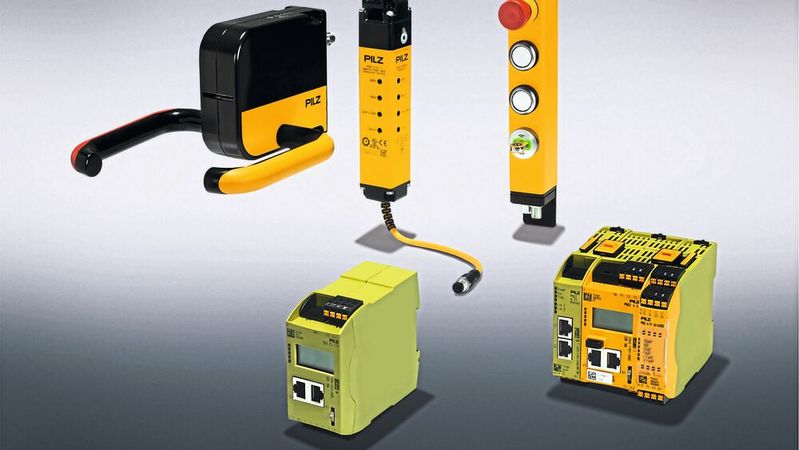
:quality(80)/p7i.vogel.de/wcms/40/97/40974cbd2ca32d197fb11bbe93955cc2/0121524381v1.jpeg "The modular safety door system from Pilz offers a flexible and customized safety door solution with individual components tailored to the requirements: from the safety door sensor, door handle modules, escape releases, and a pushbutton unit to the diagnostic system and evaluation device. The solution enables not only the safeguarding of safety doors but also access authorization management.(Image: Pilz)")
:quality(80)/p7i.vogel.de/wcms/af/29/af29acbd0d28b33bca9bed8dc63dc449/0120302162v1.jpeg "With its compact size of just 30 mm × 30 mm × 159 mm, the PSENmlock Mini safety guard from Pilz always finds a place even in space-critical applications.(Image: Pilz)")
:quality(80)/p7i.vogel.de/wcms/d4/52/d452a9205cf284fbafa3f807318107c8/0122026430v1.jpeg "The modular safety door system from Pilz offers a flexible and customized safety door solution with individual components tailored to the requirements.(Image: Pilz)")
:quality(80)/p7i.vogel.de/wcms/1f/ab/1fab2dd98ab5cdbd6f6d7b8fd48fa4fd/0120293284v1.jpeg "Both individually and in series, the new PSENslock 2 safety guard from Pilz is universally applicable for safety door protection and is designed for the highest safety category PL e, Cat. 4 according to EN ISO 13849.(Image: Pilz)")
:quality(80)/p7i.vogel.de/wcms/13/a7/13a7136b41539004914c8cae185297eb/0125416798v1.jpeg "For the safeguarding of protective doors with interlocking switches, ISO 14119 defines the design principles. Now there will be a new version of the standard. (Image:Pilz GmbH & Co. KG)")
:quality(80)/p7i.vogel.de/wcms/a2/b6/a2b6b4a78c10e6d95ba4e439f685b26c/0125124261v1.jpeg "Euchner combines its robust safety components with the advantages of secure communication via IO-Link Safety. (Image:Euchner GmbH + Co. KG)")