Few acronyms have been used as ubiquitously in the context of industry digitization as AI (Artificial Intelligence). But what exactly is AI, how can it be classified? Where is it already being used in the industry and what potential does it hold for this?
Artificial Intelligence can be a crucial key to a more efficient, sustainable, and above all, competitive industry.
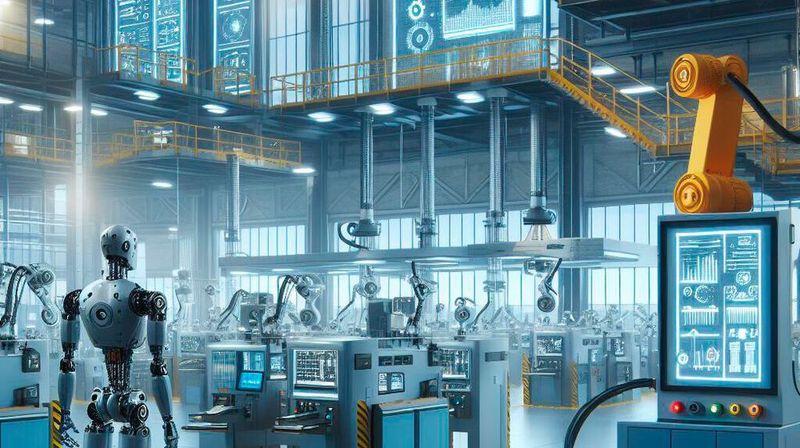
(Image: Created with AI.)
Artificial Intelligence (AI) is a subfield of computer science that deals with the development of technologies that mimic cognitive competencies or abilities that have hitherto been reserved for humans, e.g. logical thinking, learning, planning or creative action.
AI has long been a part of many areas of everyday life, whether it's voice assistants like Alexa, Cortana, Siri, and Google Assistant. AI can also be found in the form of special algorithms in online shops that are supposed to influence the search and purchasing behavior of customers. Solutions like ChatGPT, Gemini, Bluewillow, Bing Image Creator, Playground AI, or Jasper Art, for example, were introduced about a year ago, showing a wide range of mostly internet-based programs that give an idea of what artificial intelligence can do when it comes to text or image creation.
No wonder that many different industrial sectors have been dealing with the promising possibilities of artificial intelligence on many company levels in connection with Industry 4.0, the IIoT, and the rapidly increasing digital transformation of production.
The term AI comes from
The term "Artificial Intelligence" was probably coined in the 1950s by the American computer scientist John McCarthy, who used this term in preparation for the so-called Dartmouth Conference in 1955. The conference, during which researchers presented the future goals and also visions in the field of AI, is often referred to as the birth of artificial intelligence.
The first AI systems looked like
Five years after the conference, in 1960, Donald Michie, considered a leading British expert in the field of artificial intelligence, developed the "Machine Educable Noughts And Crosses Engine" (MENACE). This precursor to a computer, based on exactly 304 matchboxes, could learn the game of Tic-Tac-Toe. In the boxes, each of which represented a possible game situation, the possible moves were stored by differently colored beads. Depending on whether a game was lost or won, Michie removed the corresponding beads or added beads of the same color. In this way, the system learned successful moves and after a few hundred games, it was unbeatable.
Eliza, which was developed by American computer scientist Prof. Joseph Weizenbaum as an experiment in the field of psychotherapy, is considered one of the first chatbots. With Eliza, the scientist wanted to demonstrate how quickly people are inclined to interact with a computer when it behaves like a real psychotherapist. The development had two unique features: It could communicate like a human in the form of screen texts, understood natural language and responded accordingly, which required a completely new kind of programming that was not bound to rigid command chains.
There are different types of AI
Generally, the currently existing forms of artificial intelligence can be divided into:
Static AI - they refer to models that are designed to perform specific tasks. The models based on existing data aim to solve specific problems, with the fixed algorithms unable to autonomously generate new content.
Generative AI - This is an artificial intelligence that can independently create content such as texts, images, and videos. In contrast to static AI, the focus of generative AI is on generating new content. Such content is hardly distinguishable from that produced by humans. The models generate content from a plethora of existing data and are used, for example, to create designs, music, or text content.
In addition, the following are differentiated:
Weak AI: In the context of static and generative AI, we also talk about weak AI (Narrow AI or Artificial Narrow Intelligence, ANI). Examples of such weak AI are systems for face recognition, for weather forecasts or also algorithms that give product recommendations in online shops, to name just a few examples.
Strong AI: The third and fourth types of artificial intelligence are called "strong AI" (General Artificial Intelligence, GAI or Artificial General Intelligence, AGI) and "Superhuman Artificial Intelligence" or also "Artificial Super Intelligence" (ASI). These AIs do not currently exist. The idea behind ASI is an AI that is as intelligent or even more intelligent than a human, possessing superhuman cognitive abilities. In contrast to weak AI, which solve specific application problems, strong AI is supposed to have a general, general intelligence that includes logical thinking, decision-making in uncertainties, planning, learning, communication in natural language, and other properties. Strong AIs are supposed to help develop machines that are indistinguishable from the human mind and can possess consciousness and self-awareness.
Date: 08.12.2025
Naturally, we always handle your personal data responsibly. Any personal data we receive from you is processed in accordance with applicable data protection legislation. For detailed information please see our privacy policy.
Consent to the use of data for promotional purposes
I hereby consent to Vogel Communications Group GmbH & Co. KG, Max-Planck-Str. 7-9, 97082 Würzburg including any affiliated companies according to §§ 15 et seq. AktG (hereafter: Vogel Communications Group) using my e-mail address to send editorial newsletters. A list of all affiliated companies can be found here
Newsletter content may include all products and services of any companies mentioned above, including for example specialist journals and books, events and fairs as well as event-related products and services, print and digital media offers and services such as additional (editorial) newsletters, raffles, lead campaigns, market research both online and offline, specialist webportals and e-learning offers. In case my personal telephone number has also been collected, it may be used for offers of aforementioned products, for services of the companies mentioned above, and market research purposes.
Additionally, my consent also includes the processing of my email address and telephone number for data matching for marketing purposes with select advertising partners such as LinkedIn, Google, and Meta. For this, Vogel Communications Group may transmit said data in hashed form to the advertising partners who then use said data to determine whether I am also a member of the mentioned advertising partner portals. Vogel Communications Group uses this feature for the purposes of re-targeting (up-selling, cross-selling, and customer loyalty), generating so-called look-alike audiences for acquisition of new customers, and as basis for exclusion for on-going advertising campaigns. Further information can be found in section “data matching for marketing purposes”.
In case I access protected data on Internet portals of Vogel Communications Group including any affiliated companies according to §§ 15 et seq. AktG, I need to provide further data in order to register for the access to such content. In return for this free access to editorial content, my data may be used in accordance with this consent for the purposes stated here. This does not apply to data matching for marketing purposes.
Right of revocation
I understand that I can revoke my consent at will. My revocation does not change the lawfulness of data processing that was conducted based on my consent leading up to my revocation. One option to declare my revocation is to use the contact form found at https://contact.vogel.de. In case I no longer wish to receive certain newsletters, I have subscribed to, I can also click on the unsubscribe link included at the end of a newsletter. Further information regarding my right of revocation and the implementation of it as well as the consequences of my revocation can be found in the data protection declaration, section editorial newsletter.
At present, the capabilities of generative AI are particularly valued, as they can create new things from existing large amounts of data through targeted analyses and thus offer immense potential for many areas of everyday life as well as industry.
The intelligence of AI is created through a learning process
The actual intelligence of AI is generated through previously programmed processes or machine learning. Generative AI for this purpose analyze immensely large amounts of data e.g. with deep learning as well as neural networks and create new content from this, for example.
The differences between machine learning and deep learning lie primarily in the way learning works and thus also the complexity of the task:
In machine learning, a computer identifies specific patterns from existing data. Since the computer is able to independently capture the structures in the data and create new models, no solution path needs to be given. Model building with machine learning is either supervised or unsupervised, but always requires human intervention to adjust and optimize the generated models.
Deep Learning is, in a sense, a specialized form of machine learning. The basis for this are artificial neural networks that are modeled after the human brain. The neural networks process complex structures in unstructured data, such as images, texts, or speech. Compared to machine learning, deep learning requires less human intervention as it automatically extracts features from the existing data and learns from errors in this context.
In conclusion, deep learning is the advanced form of machine learning that is based on complex neural networks and thus gains deep insights into large data sets. Deep learning requires much more computational power and amounts of data than machine learning. This enables deep learning to solve highly complex problems and develop completely new applications, e.g. in the areas of text, image, or speech processing.
What distinguishes AI from humans?
AI differs from human intelligence in many areas. For instance, an AI is based on algorithms and pre-set programming, while human intelligence is founded on cognitive processes such as learning, understanding, perception, problem-solving, and above all, emotions.
Humans have the ability to adapt flexibly to new situations, environments, task definitions, and the associated challenges. AI in its current form is not capable of this to the same extent or range.
Human intelligence encompasses creative abilities, emotional intelligence, and imagination, which AI does not possess. An AI can analyze large amounts of data and create something new based on this to a certain extent. However, it is not creative in the same way as humans and also not capable of understanding emotions or developing empathy.
An AI can be more efficient when it comes to performing repetitive tasks and analyzing large amounts of data, while humans are especially suited for tasks that require creativity, intuition, and emotional intelligence.
In all conceivable industrial sectors, large amounts of data are generated which can be used in many ways through targeted, result-oriented analysis. The continuing digitalization and increasingly powerful generative AI open up multi-layered potential for completely new and thus more efficient solutions. AI can thus be a decisive key for a more efficient, sustainable and above all competitive industry.
- Predictive Maintenance: AI can predict when a machine might fail, thereby preventing downtime. - Quality Control: AI can analyze data or images to identify defects in products. - Process Optimization: AI can identify the most efficient way to utilize resources. - Worker Safety: AI can analyze patterns to anticipate and prevent accidents. - Supply Chain Management: AI can predict demand and optimize logistical processes. - Energy Management: AI can aid in energy consumption reduction. - Customer Service: AI can enhance customer interactions, for example through chatbots.
Generative AI can be used for the simulation and design of components and thus for the development of new product designs and concepts, for example with the help of new CAE methods and additive manufacturing processes.
In the broad field of industrial services, AI can help develop and offer personalized services, thus making customer support more efficient.
In maintenance, AI is used for predictive maintenance of machines, systems, and processes to more precisely determine the timing of upcoming service work and minimize plant downtime. For example, in the power plant industry, generative AI based on digital twins and neural networks has been in use for many years to monitor complex processes in order to reduce failures and plan upcoming revisions better or more specifically.
Using AI, machines can not only automatically detect potential errors, but also optimize their energy consumption during operation and carry out quality checks during production and adjust as necessary.
For some industrial areas, robots that can be controlled by voice thanks to AI and thus can be used completely intuitively, i.e. without programming knowledge, are conceivable.
By comparing historical and real-time data, AI is capable of making supply chains more efficient, thus helping to optimize logistics on the roads in a sustainable way.
In internal logistics, AI can be used to control transports, with the solutions then finding their own way through the factory halls.



:quality(80)/p7i.vogel.de/wcms/53/f7/53f7dadbe4d656a3fd4f4077445f29f6/0129828707v1.jpeg "Thanks to its compact design and drilling/unscrewing function, the Fire Birdie is suitable for applications with limited installation space and frequent tool changes. (Image:Marcel Kraibühler)")
:quality(80)/p7i.vogel.de/wcms/95/97/95976dbaac68b249eb65e74c5aad5300/0129651893v1.jpeg "The C2.0 centric clamps, the S2 fixed jaw clamps and the \"gredoc\" zero-point clamping systems are used for machining the raw parts. Fastening is carried out with width across flats 27. (Image:Gressel)")
:quality(80)/p7i.vogel.de/wcms/57/1b/571b8895efb299d70846bbdbd7af2338/0130043886v1.jpeg "Servo hydraulics independent of the control system: The servo hydraulics software module is integrated directly into the b Maxx 5500 servo drive (pictured: Mehmet Sari, Export Sales Manager at Hürsan Pres (left), Özgür Deniz Demirbaş, Country Manager at Baumüller Turkey) (Image:Baumüller)")
:quality(80)/p7i.vogel.de/wcms/c2/57/c257474faf6095a24bacfd98524bc7f8/0130090188v1.jpeg "With the Coromill MR20 milling system, the cutting tool specialist Sandvik Coromant is bringing a product that should make a name for itself in tool and mold making, as well as in aerospace components, to what the manufacturer claims it can do ... (Image:Sandvik Coromant)")
:quality(80)/p7i.vogel.de/wcms/fd/93/fd93e01c16f5a4709278499d981a459c/0130061090v1.jpeg "Revealed: These servo drives are assembled at Aerotech in Fürth. (Image:Aerotech)")
:quality(80)/p7i.vogel.de/wcms/ad/9d/ad9d709c690b7420468ea3d935a1c97f/fairground1-webp-2560-2560x1440v1.jpeg "(Source: Messe Frankfurt (HK) Ltd Taiwan Branch)")
:quality(80)/p7i.vogel.de/wcms/ab/23/ab2371c186380215b8311d1aeb4e47df/0130095643v1.jpeg "Geointelligent supply chain management provides valuable information, for example, about which control unit a microchip is installed in. (Picture: ©Aleksandr Matveev - stock.adobe.com)")
:quality(80)/p7i.vogel.de/wcms/b4/01/b401c197e3591f2bec3fb84ae810ac80/0130096280v1.jpeg "Only prophecies of doom! Jensen Huang, the head of chip giant Nvidia, dismisses any concerns that the huge sums currently being invested in AI data centers will not turn a profit one day ... (Image:Nvidia)")
:quality(80)/p7i.vogel.de/wcms/da/4d/da4da8d34671dc6bce80e496212de877/0129850788v1.jpeg "Mate-XT Go supports the arms and shoulders during overhead work and repetitive tasks and is designed to significantly reduce muscle strain in everyday working life. (Image:Comau)")
:quality(80)/p7i.vogel.de/wcms/3f/cc/3fccb748b0fe16f1f61249d94c72f126/0130149439v1.jpeg "Requirements for integrated power supply systems: Precise AC and DC power supply systems that not only provide energy, but also reliably combine measurement, analysis and system integration. (Image:Schulz Electronic)")
:quality(80)/p7i.vogel.de/wcms/cb/8a/cb8ae7f5205365efce3e7285154fc3cf/0130132198v1.jpeg "Markus Huber (left) and Nicolai Friis from TU Wien know how to make quantum computers multidimensional in order to perform computing operations even better. (Image:TU Vienna / A. Rommel)")
:quality(80)/p7i.vogel.de/wcms/94/7a/947ac066b98cbcd3470e83ff9da3e25f/0130096114v1.jpeg "The use of amorphous steels in the stator enables a significant reduction in losses and increases the efficiency of modern electric motors in vehicle drives. (Image:Horse Powertrain)")
:quality(80)/p7i.vogel.de/wcms/90/db/90db3087d3af0560fcdb4dbc42443ce1/0130157448v1.jpeg "The switch to SDV is the most complex transformation the industry has ever had to master. The end consumer gets a vehicle that gains rather than loses value over its lifetime. (Image:Sonatus)")
:quality(80)/p7i.vogel.de/wcms/73/f0/73f00bb99a23197db05bb584fe78f20f/0130080581v1.jpeg "The \"China Speed\" analysis by Roland Berger shows that the speed of development has only a limited connection with labor costs. (Image:freely licensed at Pexels)")
:quality(80)/p7i.vogel.de/wcms/2f/5b/2f5ba6a150b52c2b8efada560c5cdafe/0130143442v1.jpeg "Automotive suppliers are facing a severe crisis, which is primarily due to a combination of structural change and economic problems. (Image:freely licensed at Pexels)")
:quality(80)/p7i.vogel.de/wcms/22/d0/22d03cd48e992435338b59464c428d41/0129739814v1.jpeg "More electric vehicles on the roads mean a higher demand for electricity - which should ideally be covered by renewable energies. (Image:BMW)")
:quality(80)/p7i.vogel.de/wcms/3b/27/3b27f6c5848be73acecb04054bf0a146/0130115209v1.jpeg "Spectroscopic glucose measurement with infrared spectroscopy enables more regular measurements without physical strain. (Image:Endrich)")
:quality(80)/p7i.vogel.de/wcms/e5/f1/e5f171d3d7ae021332cc0aeae4d6e299/0130127049v1.jpeg "In collaboration with Shanghai Jiao Tong University, Lenovo has presented a silicon anode battery under the name \"ED1000\" as a proof of concept for mobile workstations. (Image:Lenovo)")
:quality(80)/p7i.vogel.de/wcms/fa/69/fa696e59706b96fff02283dd74cc2398/0130129635v1.jpeg "Samsung Co-CEO Jun Young-hyun wants to respond to the AI-driven boom in demand in the memory market with contracts for up to five years. This should provide more planning security in the traditionally volatile storage business. At the same time, however, this is likely to increase the pressure on customers to secure precise long-term requirements, prices and supply chains. (Image:Samsung)")
:quality(80)/p7i.vogel.de/wcms/31/a8/31a883a47b86634c382923e78fd9a4c9/0130133225v1.jpeg "Figure 1: GMSL-capable point-to-point connection. (Image:ADI)")
:fill(fff,0)/p7i.vogel.de/companies/67/eb/67eba621ef6ea/logo2.png "logo2 (Wuxi InfiMotion)")
:quality(80)/p7i.vogel.de/wcms/9f/59/9f5914e814b92138262a652418a14d7f/0125202214v1.jpeg "Machine learning is a subset of artificial intelligence that enables computer systems to learn from data and experiences and improve independently. (Image: ©WrightStudio - stock.adobe.com)")
:quality(80)/p7i.vogel.de/wcms/a6/b5/a6b50b0de22c2ed822af7e73fd92f5a1/0123753659v1-999x562v1.jpeg "AI in robotics is already a reality for many companies. (Picture: ABB Robotics; Yaskawa; Delta; Neura Robotics)")