From
konstruktionspraxis | Translated by AI
7 min Reading Time
Rolling bearings enable rotational movements and thus load transfers with minimal friction through the rolling motion of rolling elements. How is a rolling bearing composed and how does it generally function? An overview of a multifaceted technology.
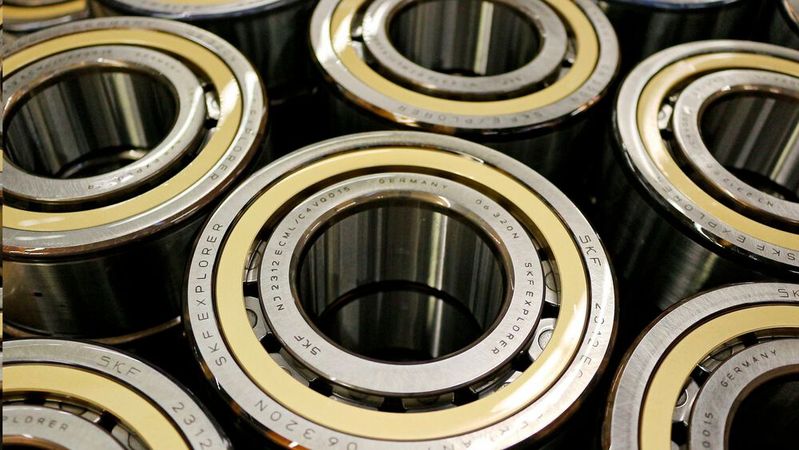
Rolling bearings can be divided into ball bearings and roller bearings. Spherical roller bearings, like in the picture here, can take high loads in both directions. They are self-aligning and can compensate for misalignments and shaft deflections without significantly increasing friction losses or temperature.
(Image: SKF)
The term "rolling bearing" serves in this context as a collective term or umbrella term for all bearings in which rolling elements perform a rolling motion and transfer the load between two opposing surfaces.
What Components Make Up a Rolling Bearing?
A rolling bearing essentially consists of an inner ring, an outer ring, a cage, and so-called rolling elements. The rolling elements move on a bearing raceway as essential components of a rolling bearing and are enclosed by a cage.
In principle, a distinction can be made regarding design and assembly between:
Self-retaining rolling bearings, which are manufactured and assembled as a complete unit. They require no additional adjustment or preload.
Non-self-retaining rolling bearings, which consist of separate components. These must be installed and adjusted separately during assembly to achieve correct bearing clearance. Such bearings require preloading to avoid clearance and increase stiffness.
Where Are Rolling Bearings Used?
As machine elements, rolling bearings create a movable connection between two components, such as a shaft and housing, allowing load transfers with minimal friction compared to plain bearings. They are capable of accommodating radial, axial, and combined forces. They are used, for example, in
Machine tools
Robots (for example in precision and reduction gears)
in conveyor technology
in pumps
compressors
vehicles (such as wheel bearings and gearboxes)
ship propellers
aircraft engines
helicopters
wind turbines
as well as in everyday products like electric toothbrushes.
Since rolling bearings are generally standardized in their dimensions, they can be maintained and replaced with comparatively little effort.
How does a Rolling Bearing Work?
As mentioned earlier, a rolling bearing consists of the components inner ring, outer ring, a cage, and rolling elements. The inner ring is usually mounted on a shaft or axle, and the outer ring is mounted in the housing. The inside of the outer ring and the outside of the inner ring form the bearing raceway, where the rolling elements are located. The rolling elements rotate around their own axis and move on the raceway surface. As a central component, the cage ensures that the rolling elements are guided in the bearing at a constant distance from each other, allowing the inner and outer rings to move with minimal friction. To keep friction low and the bearing from wearing, the raceways on the inside of the outer ring and the outside of the inner ring must be lubricated.
What are the Main Types of Rolling Bearings?
Fundamentally, rolling bearings can be divided into
ball bearings and
roller bearings
which enable either point or line contact.
—ball bearings
Ball bearings have spherical rolling elements that create a point contact with the bearing raceways. The rolling elements thus touch only a very small area of the bearing raceways. Ball bearings include:
Deep Groove Ball Bearings—Deep groove ball bearings are somewhat of a classic among rolling bearings, as they are very versatile. The ball bearings have deep raceways (grooves) in which the rolling elements move. Deep groove ball bearings are suitable for accommodating both moderate radial and axial forces and are preferably used in small and medium-sized electric motors.
Angular Contact Ball Bearings—Angular contact ball bearings are characterized by inner and outer raceways offset from each other, allowing the rolling elements to move at a certain angle to each other. This enables the bearings to accommodate both axial and radial forces. The larger the contact angle, the higher the axial load capacity. Angular contact ball bearings are available in single-row and double-row designs. Single-row angular contact ball bearings can only accommodate axial forces in one direction, whereas double-row angular contact ball bearings can accommodate axial forces in both directions. By applying a preload, angular contact ball bearings can be adapted to an application to prevent bearing play and increase bearing stiffness.
Spherical Ball Bearings—Spherical ball bearings are double-row bearings consisting of an inner ring with two ball raceways and an outer ring. The raceway of the outer ring has a spherical shape and matches the curvature angle of the bearing. Spherical ball bearings are preferably used where a shaft and housing are not perfectly aligned with each other. The angle of the spherical ball bearing can be adjusted, allowing for compensation of shaft deflections, misalignments, or angular errors.
Date: 08.12.2025
Naturally, we always handle your personal data responsibly. Any personal data we receive from you is processed in accordance with applicable data protection legislation. For detailed information please see our privacy policy.
Consent to the use of data for promotional purposes
I hereby consent to Vogel Communications Group GmbH & Co. KG, Max-Planck-Str. 7-9, 97082 Würzburg including any affiliated companies according to §§ 15 et seq. AktG (hereafter: Vogel Communications Group) using my e-mail address to send editorial newsletters. A list of all affiliated companies can be found here
Newsletter content may include all products and services of any companies mentioned above, including for example specialist journals and books, events and fairs as well as event-related products and services, print and digital media offers and services such as additional (editorial) newsletters, raffles, lead campaigns, market research both online and offline, specialist webportals and e-learning offers. In case my personal telephone number has also been collected, it may be used for offers of aforementioned products, for services of the companies mentioned above, and market research purposes.
Additionally, my consent also includes the processing of my email address and telephone number for data matching for marketing purposes with select advertising partners such as LinkedIn, Google, and Meta. For this, Vogel Communications Group may transmit said data in hashed form to the advertising partners who then use said data to determine whether I am also a member of the mentioned advertising partner portals. Vogel Communications Group uses this feature for the purposes of re-targeting (up-selling, cross-selling, and customer loyalty), generating so-called look-alike audiences for acquisition of new customers, and as basis for exclusion for on-going advertising campaigns. Further information can be found in section “data matching for marketing purposes”.
In case I access protected data on Internet portals of Vogel Communications Group including any affiliated companies according to §§ 15 et seq. AktG, I need to provide further data in order to register for the access to such content. In return for this free access to editorial content, my data may be used in accordance with this consent for the purposes stated here. This does not apply to data matching for marketing purposes.
Right of revocation
I understand that I can revoke my consent at will. My revocation does not change the lawfulness of data processing that was conducted based on my consent leading up to my revocation. One option to declare my revocation is to use the contact form found at https://contact.vogel.de. In case I no longer wish to receive certain newsletters, I have subscribed to, I can also click on the unsubscribe link included at the end of a newsletter. Further information regarding my right of revocation and the implementation of it as well as the consequences of my revocation can be found in the data protection declaration, section editorial newsletter.
—roller bearings
Roller bearings have conical, cylindrical, or barrel-shaped rolling elements that provide line contact with the raceways of the inner and outer rings.
Typical roller bearings include, for example:
Cylindrical Roller Bearings—Cylindrical roller bearings can endure high radial loads and are suitable for high speeds despite the line contact of the rolling elements. The rolling elements or rollers are guided within one of the bearing rings between fixed flanges (edges on the inner and outer ring of the bearing for guiding the rolling elements and transmitting axial loads) and are connected to the respective ring as a unit by the cage. Thus, one of the bearing rings can be removed to mount the rings separately.
Tapered Roller Bearings—Tapered roller bearings are line-guided roller bearings with conically arranged rolling elements. The inner and outer rings as well as the rolling elements are arranged so that their apexes meet at a common point. This arrangement results in an axial force where the rolling elements theoretically roll without sliding friction. Preferred applications for these bearings include heavily loaded industrial gearboxes, shipbuilding, as well as agricultural and construction machinery.
Spherical Roller Bearings—Spherical roller bearings have spherically ground raceways, allowing the rows of rolling elements to swivel around the axis of rotation. The barrel-shaped rolling elements can swivel with their axis inclined to the axis of rotation of the bearing (thus they are angularly movable), enabling spherical roller bearings to compensate for shaft deflections, alignment errors, and misalignments. Furthermore, they can accommodate very high axial and radial forces, making them ideal for use in very large machines, such as wind turbines (main rotor bearings) or ship propellers.
Needle bearings—Needle bearings are particularly compact designs of rolling bearings, whose rolling elements are relatively long in relation to the diameter of the cylindrical rollers. The rolling elements are therefore also referred to as needles or needle rollers. Needle bearings are particularly suitable for applications with limited space, where high radial forces may sometimes need to be accommodated.
What are the Advantages And Disadvantages of Ball And Roller Bearings?
Ball Bearings are particularly suitable for applications with high speeds. Due to their design with spherical rolling elements and thus a point contact with the raceways, they enable an extremely low-friction operation. Among the most commonly used ball bearings are deep groove ball bearings, as they can accommodate both radial and axial forces. Other widely used ball bearing variants include angular contact ball bearings and spherical ball bearings. Overall, ball bearings are the preferred choice in a wide range of machines and devices when a precise and reliable support of rotating parts is required.
Roller Bearings can accommodate higher radial and axial loads than ball bearings due to the line contact between rolling elements and raceways. They are therefore more suitable for applications where very high loads impact the bearings. Moreover, compared to ball bearings, roller bearings are less sensitive to shocks, vibrations, and oscillations. Certain types of roller bearings, such as cylindrical roller bearings, can also compensate for shaft expansions, which ball bearings cannot do. However, the robust design and the ability to handle high load capacities in roller bearings come at the cost of increased friction of the rolling elements on the raceways of the inner and outer rings, making them more suitable for applications with lower speeds. Due to their more complex design, roller bearings are also more difficult to mount and dismount compared to ball bearings and have lower guiding accuracy.
What Factors are Relevant When Selecting Rolling Bearings?
As is often the case, the selection of a rolling bearing depends on the specific requirements of an application and requires a careful consideration of the advantages and disadvantages of the various bearing types. The following factors are relevant when selecting a rolling bearing in this context:
space constraints
load
misalignment
accuracy
speed
quiet operation
stiffness
axial displacement
installation and removal
sealing
Who Invented it?
Sources do not consistently agree on who invented the rolling bearing. As early as around 2,500 BC, the Egyptians transported heavy loads on sliding skids over long distances. Later, elongated wooden rollers were placed between the transport surface for the loads and the skids. One could say that this was the first roller bearing.
Leonardo da Vinci is credited with inventing the first ball bearing. The rolling elements were made of wood and were subject to increased wear depending on the load.
The first patent for a ball bearing was granted in 1794 to the Welsh inventor Philip Vaughan. In his patent specification, he described how iron balls should be placed between a wheel and the axle of a cart to allow the cart wheels to rotate freely with reduced friction.
The Parisian bicycle mechanic Jules Suiray is associated with the first radial ball bearing, which he developed in 1869. The English racing cyclist James Moore won the first Paris-Rouen race with a bicycle that used these radial bearings.
Another inventor in the field of ball and ball bearing technology is Friedrich Fischer, who founded the "First Automatic Cast Steel Ball Factory Friedrich Fischer AG," later known as FAG Kugelfischer, in 1896.
Suppliers of Rolling Bearings
AWT
Blis ball screw drives
C&U Europe Holding
Findling Wälzlager
Franke
Frika
Fröhlich & Dörken
GMN Paul Müller Industrie
Hecht Kugellager
HQW Precision
HWG Horst Weidner
IBC Wälzlager
Interprecise Donath
IST Europe
Karl Diederichs
KIS Antriebstechnik
Kugel- und Rollenlagerwerk Leipzig
NTN Wälzlager
Norelem Normelemente
Rodriguez
Schaeffler
SKF
Timken
Tyrolit
Zanuso Kugellager
The list is an excerpt without a claim to completeness.
Secure and Compliant Authentication in Laboratories



:quality(80)/p7i.vogel.de/wcms/ed/8b/ed8b365dc82b2bdbe2efddca4089c79a/0130059646v1.jpeg "High-feed milling cutter in engagement and when reaching the maximum radial cutting depth. (Image:Walter)")
:quality(80)/p7i.vogel.de/wcms/a0/db/a0dbbf658663393c67520575f3a0e6b4/0131325829v1.jpeg "This is an example of a 3D-printed metal part that can be purchased via the Unionfab platform. The Shanghai-based service provider has now expanded its additive manufacturing capabilities ... (Image:Unionfab)")
:quality(80)/p7i.vogel.de/wcms/fc/a2/fca2d9c7102f10159c10b810e0042395/0131356689v1.jpeg "The Bosch Group has to reinvent itself in many areas. This costs money and, unfortunately, many jobs. To justify these measures, the management also refers to the values that founder Robert Bosch once established for himself ... (Image:Bosch)")
:quality(80)/p7i.vogel.de/wcms/82/3f/823fe5b4be2ff607b114c46cc5154dba/0131320405v1.jpeg "Thyssenkrupp has announced that the realignment of its automotive business is continuing. However, this now also has the consequence that a plant in the USA will no longer produce chassis for a full year ... (Image:thyssenkrupp)")
:quality(80)/p7i.vogel.de/wcms/f3/8f/f38faf493aab4e05033cc999f1d00a16/dtm-founders-1280x719v1.png "Martin Schilling is a European tech ecosystem leader, entrepreneur, and startup operator known for scaling tech companies and supporting deep tech founders. (Source: DTM)")
:quality(80)/p7i.vogel.de/wcms/0a/22/0a22ee2682ff6c6907f78c6fb7e65667/0131215395v1.jpeg "The use of robots in day-to-day care is being tested and further developed in pilot projects such as this House of Generations. (Picture:APA-Images / dpa / Waltraud Grubitzsch)")
:quality(80)/p7i.vogel.de/wcms/0a/2c/0a2c8c41b29b1dfe6c1b4ec65a4be595/0131290447v1.jpeg "Quantum computing threatens most current encryption algorithms. (Picture: ©Jori - stock.adobe.com)")
:quality(80)/p7i.vogel.de/wcms/b0/e1/b0e1cb7972aec0ad967bb087948cde16/0131361412v1.jpeg "Google has enjoyed great success with its AI chip Tensor. Now a new idea has brought the company together with the financial investor Blackstone. For many billions of dollars, the company now wants to build data centers that use the Tensor ... (Image:Google)")
:quality(80)/p7i.vogel.de/wcms/7d/b1/7db122e6de5f617d1342bb329eacf69d/adobestock-791450621--c2-a9-20imageflow-20-e2-80-93-20stock-adobe-com-5250x2952v1v1.jpeg "As the number of electric cars increases, so does the demand for lithium-ion batteries and the need for battery recycling technologies (symbolic image) (Image:ImageFlow - stock.adobe.com)")
:quality(80)/p7i.vogel.de/wcms/fc/b6/fcb6e8e646ca2cf11d6fc3d06479dbf5/2026-05-delo-building-photo-2400x1350v1v1.jpeg "Aerial view of the Delo site in Windach including the \"Forum\" and new laboratory building construction projects. (Image:Delo)")
:quality(80)/p7i.vogel.de/wcms/d4/65/d465ab0293db9125763560c71d900c73/adobestock-179817344--c2-a9-20industrieblick-20-e2-80-93-20stock-adobe-com-7611x4279v1v1.jpeg "The global kerosene market is around 100 billion gallons per year. How much influence the alternative aviation fuel could have on this remains to be seen over the next few years. (Image:industrieblick - stock.adobe.com)")
:quality(80)/p7i.vogel.de/wcms/78/10/7810cea1046df8ccf33db854c1bc73ae/img02-dual-monitor-setupv1.jpeg "The requirements for industrial automation solutions are changing rapidly. Systems are becoming more individualized, project lead times shorter - and international standards more complex. (Source: WSCAD)")
:quality(80)/p7i.vogel.de/wcms/1b/cd/1bcd23447de40ef118adfac23c35858f/0123523831v1.jpeg "Ford plants in Cologne-Niehl (Germany) (Image:Ford)")
:quality(80)/p7i.vogel.de/wcms/93/6c/936c08b80da1f39f7cb6038b6328cd67/0131368219v2v1.jpeg "BMW unveiled the Vision Alpina in the garden of the Villa d'Este on Lake Como (Image:SP-X/Mario Hommen)")
:quality(80)/p7i.vogel.de/wcms/b9/aa/b9aaea2caf16e6dc354c06c6ad00a918/0131354665v1.jpeg "The new 100/1000BASE-T1 single-pair Ethernet PHYs from Microchip combine MACsec security, time-critical networking and functional safety. (Image:Microchip)")
:quality(80)/p7i.vogel.de/wcms/fc/a6/fca67934a356cdcaff233b44371f94a9/0131346154v1.jpeg "In order to make its e-car production more independent, Xiaomi will manufacture batteries and electric motors itself in future. The subsidiary Beijing Xiaomi Jingxu Technology has been founded for this purpose. (Image:Xiaomi)")
:quality(80)/p7i.vogel.de/wcms/4f/ef/4fefaa65bb3cf4165e759a280fbc49dd/0131368512v1.jpeg "Crescendo platform from Empower Semiconductor for \"Vertical Power Delivery\" (VPD). According to the news agency Bloomberg and Reuters, Analog Devices is interested in acquiring the manufacturer of power management chips for AI loads in data centers. (Image:Empower Semiconductor)")
:quality(80)/p7i.vogel.de/wcms/e9/72/e972c95b4a060cbd5e07bd2bc7e0a754/0131341947v1.jpeg "Strategic partnership: IONOS and Q.ANT want to work together on photonic computing in the future. (Image:Q.ANT)")
:quality(80)/p7i.vogel.de/wcms/e4/e6/e4e6ed55884470a59a94670bb96ce0ab/0131354452v1.jpeg "Intelligent, networked kitchen appliances such as this French door fridge from Samsung still have a chance on the German market—but not in China. (Image:Samsung)")
:quality(80)/p7i.vogel.de/wcms/40/b2/40b206348d8ee5dc2034ebded5099740/0131355751v1.jpeg "The program is intended to provide simplified access to modern EDA (Electronic Design Automation) software for smaller companies, start-ups and research institutions. (Image:Siemens EDA)")
:quality(80):fill(efefef,0)/p7i.vogel.de/wcms/67/ac/67acb931a438c/elatec-wp-gmp.png "Elatec WP GMP")
:quality(80)/p7i.vogel.de/wcms/c7/0e/c70e7d014eca846c4a835f1e10b89335/0125940639v1.jpeg "The KLLT profile rail guides adapt well to substructures with minor shape errors, which are often found in handling axes and assembly automation. (Image:Schaeffler)")
:quality(80)/p7i.vogel.de/wcms/73/41/73412c1a6fe312e62e55bdb9bd223fdc/0128086375v1.jpeg "Specifically for cleanrooms such as in battery production or the semiconductor industry, Igus has developed a new cleanroom-compatible ball bearing made of wear-resistant high-performance plastics. (Image:Igus)")