How can battery production in Europe be operated economically despite Chinese dominance? This was discussed by the participants of Battery Manufacturing Day 2025 in Karlsruhe, Germany.
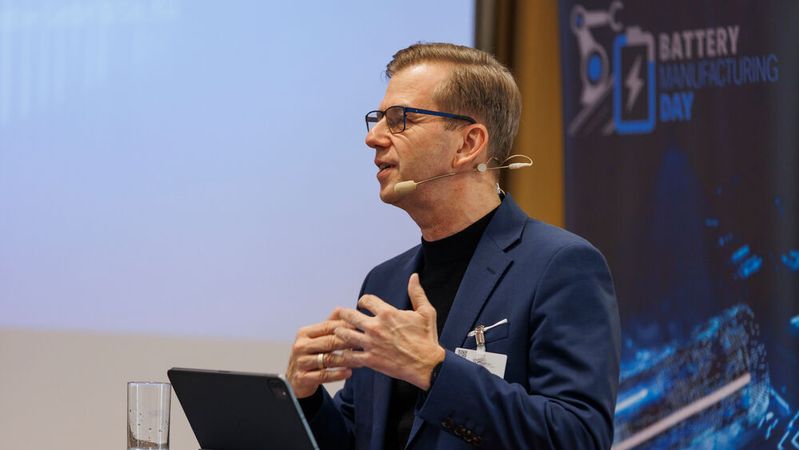
Sascha Kleinert, CEO of Accumotive, opened the Battery Manufacturing Day: "No battery will leave my plant that is not OK," he said in his presentation on Mercedes battery production in Kamenz.
(Image: Eidens-Holl)
The joint conference of "Automobil Industrie" and "MM Maschinenmarkt" once again attracted around 120 participants to Karlsruhe this year. They exchanged ideas over two days about the key trends in battery production.
Electric vehicles built in Europe are almost always equipped with cells from China, and partly from South Korea. By 2030, the EU aims to be 90 percent self-sufficient. However, this is unlikely to succeed, said Tim Wicke. As the research associate at the Fraunhofer Institute for Systems and Innovation Research ISI explained, only about one-third (642 GWh) of the cell factories announced for 2030 are "very likely" to be realized. This would cover at least 50 to 60 percent of Europe's demand.
LFP Cells from Norway
The Norwegian company Morrow Batteries has just built a cell factory. The plant in southern Norway's Arendal can produce lithium iron phosphate (LFP) cells with a capacity of one gigawatt-hour per year — primarily for stationary energy storage, and partly for commercial vehicles. Christin-Marie Boudgoust from Morrow Batteries reported on the challenges faced even when constructing such a relatively small factory. The production is only partially European. The production lines come from South Korea, and the cathode materials from China. Boudgoust appealed: "We must believe in the European battery industry, stay committed, improve access to financing, and receive more support from governments for a European battery supply chain."
Sascha Kleinert presented a battery plant that has been successfully operating for many years. He is the CEO of the Mercedes-Benz subsidiary Accumotive, which has been assembling batteries in Kamenz since 2012, including the new fifth battery generation, used in the Mercedes CLA. With these batteries, for example, performance density has been increased by replacing screws with adhesive bonds. The adhesive is applied with a precision of tenths of a millimeter and very precisely dosed. This was only achievable with an automated solution. Where employees are involved manually, great attention is paid to ergonomics and safety. A special feature: every battery is tested for leakage using a helium-based process.
Close Collaboration is Crucial
For the successful establishment of battery production, close collaboration between the equipment supplier and the customer, starting as early as the design phase, is crucial. This was emphasized by Jens Kiefer, Director Lead Plant Schaeffler Special Machinery Erlangen. He worked with the supplier Webasto to transform its site in Schierling from a roof module plant into a battery module assembly facility. For Kiefer, it is also clear: "The prices from Asia are extremely challenging. It is important to develop machine and equipment concepts together with customers that stand out from the market."
The conference participants also gained insight into the development of advanced production technologies during their visit to the Karlsruhe Research Factory for AI-Integrated Production. The facility is operated by the Fraunhofer Institutes IOSB and ICT, as well as the wbk Institute of Production Science at KIT, and also focuses on battery production.
In addition to purely battery operation, the fuel cell is considered a CO2-free alternative, especially for heavy long-distance vehicles. Stefan Dwenger from EPKO presented to the conference participants how complex the manufacturing of the bipolar plates contained within them is. The joint venture between ElringKlinger and OP Mobility (formerly Plastic Omnium) produces fuel cell stacks and their components, such as the bipolar plates. These plates, made from extremely thin steel or titanium sheets, must distribute the reaction gases very homogeneously and dissipate the reaction heat. For this, ultra-fine structures must be incorporated with the utmost precision. To ensure this, complex multi-stage forming processes and adherence to very tight tolerances are required.
Date: 08.12.2025
Naturally, we always handle your personal data responsibly. Any personal data we receive from you is processed in accordance with applicable data protection legislation. For detailed information please see our privacy policy.
Consent to the use of data for promotional purposes
I hereby consent to Vogel Communications Group GmbH & Co. KG, Max-Planck-Str. 7-9, 97082 Würzburg including any affiliated companies according to §§ 15 et seq. AktG (hereafter: Vogel Communications Group) using my e-mail address to send editorial newsletters. A list of all affiliated companies can be found here
Newsletter content may include all products and services of any companies mentioned above, including for example specialist journals and books, events and fairs as well as event-related products and services, print and digital media offers and services such as additional (editorial) newsletters, raffles, lead campaigns, market research both online and offline, specialist webportals and e-learning offers. In case my personal telephone number has also been collected, it may be used for offers of aforementioned products, for services of the companies mentioned above, and market research purposes.
Additionally, my consent also includes the processing of my email address and telephone number for data matching for marketing purposes with select advertising partners such as LinkedIn, Google, and Meta. For this, Vogel Communications Group may transmit said data in hashed form to the advertising partners who then use said data to determine whether I am also a member of the mentioned advertising partner portals. Vogel Communications Group uses this feature for the purposes of re-targeting (up-selling, cross-selling, and customer loyalty), generating so-called look-alike audiences for acquisition of new customers, and as basis for exclusion for on-going advertising campaigns. Further information can be found in section “data matching for marketing purposes”.
In case I access protected data on Internet portals of Vogel Communications Group including any affiliated companies according to §§ 15 et seq. AktG, I need to provide further data in order to register for the access to such content. In return for this free access to editorial content, my data may be used in accordance with this consent for the purposes stated here. This does not apply to data matching for marketing purposes.
Right of revocation
I understand that I can revoke my consent at will. My revocation does not change the lawfulness of data processing that was conducted based on my consent leading up to my revocation. One option to declare my revocation is to use the contact form found at https://contact.vogel.de. In case I no longer wish to receive certain newsletters, I have subscribed to, I can also click on the unsubscribe link included at the end of a newsletter. Further information regarding my right of revocation and the implementation of it as well as the consequences of my revocation can be found in the data protection declaration, section editorial newsletter.
The Framework Conditions Have Changed
"The challenges are the same as four years ago, but the framework conditions have changed. Therefore, we need to find different answers," stated Robert Braun, head of the Competence Center for Emission-Free Mobility at Daimler Truck. He noted that diesel is gaining importance again in the USA, while battery and fuel cell trucks face particular difficulties there. This makes flexible and highly scalable production systems for decarbonized drivetrains essential. In light of uncertainties and the significantly higher value creation share in CO2-free drivetrains, vertical integration is more important than ever.
Simulation can save a lot of time and improve results in battery and battery cell development. However, simulation tools are often so complex that only a few experts can use them. The simulation specialists at Comsol Multiphysics aim to change that. With a tool they developed, presented by Johannes Sperber, simulation experts at OEMs or suppliers can create relatively easy-to-use simulation apps tailored to specific purposes from complex simulation programs, which they can then provide to development engineers.
E-Mobility Only Works With Special Fluids
An electric drivetrain requires hardly any lubricants compared to a combustion engine, but e-mobility only functions with special fluids, as Damian Weinzierl and Jan Mair from the lubricant manufacturer Fuchs explained. In vehicle operation, these are primarily coolants. They are crucial in the drivetrain as well as in charging technology to quickly dissipate large amounts of heat, thereby increasing efficiency or allowing components to be designed smaller.
Everyone wants to reduce costs and reach the market faster. Achim Geese from the switch cabinet specialist Rittal and Sven Haumann from Eplan highlighted the immense potential in the seamless digitization of the entire value chain. The key lies in data continuity, enabling all participants to use and share the same data. In such a connected ecosystem, projects can be accelerated by up to 80 percent, they emphasized.
AI Models Lack Expertise
Artificial intelligence seems to be everywhere. However, because most generic language models lack expertise, almost all pilot projects in the industry fail, reported Andreas Geiss. He is responsible for the automotive industry at the AI company Aleph Alpha. If language models are not trained with the necessary domain-specific knowledge, they at best provide superficial answers, said Geiss. Together with OEMs, they have demonstrated that AI can also be trained with domain knowledge, enabling the AI to subsequently detect errors in the development process or suggest solutions to developers.
Nicolas Bogdanski addressed a sensitive topic. The expert from TÜV Rheinland presented the current status of the EU Battery Regulation. While a manufacturer can stand out from competitors with the extensive data covered by it, such as a small CO2 footprint or high recycled content, the regulation, with its stringent requirements for documentation of the entire supply chain and data provision, is also "another hurdle for manufacturers," explained Bogdanski.
Moreover, according to the TÜV expert, the EU has established a timeline that it does not adhere to itself. As a result, some regulations that should already be in effect are still pending. Furthermore, it remains unclear if and how they will become valid.
So what to do? In any case, it would likely be a good idea to collect and document as much data as possible in one's own production and supply chain to be prepared for everything.



:quality(80)/p7i.vogel.de/wcms/3e/7c/3e7c26f44c68545fc7318597b6b65903/0133649650v1.jpeg "The flexible Heller circular storage system can store and process pallets measuring both 630 millimeters by 630 millimeters and 800 millimeters by 800 millimeters—even in mixed-mode operation. This makes the entire production line particularly flexible. (Image:Brighter)")
:quality(80)/p7i.vogel.de/wcms/16/29/162983885950ec1df27ab441bfe88613/0133132549v1.jpeg "Bernd Hermeler is the CEO of Cemecon AG. He studied mechanical engineering at RWTH Aachen University (Germany)—the very university from which the company emerged as a spin-off 40 years ago. Today, Hermeler is responsible for the global strategy of the coating specialist, which, with branches in Europe, the U.S., China, Japan, and India, is considered the global technology leader in the coating of cutting tools. (Image: Cemecon AG)")
:quality(80)/p7i.vogel.de/wcms/af/81/af81b53cb4926dcadc20ba369a29d412/0132695968v1.jpeg "International venture capital is increasingly flowing into the machining industry. Here are the players that entrepreneurs and CEOs should keep an eye on right now. (Image: ©NDABCREATIVITY - stock.adobe.com)")
:quality(80)/p7i.vogel.de/wcms/ba/ec/baecd2e3783dee11913096f7d58e1232/bild-1-kammerer-kgt-f-r-elektrozylinder-300dpi-2000px-printv1.jpeg "Kammerer ball screw for use in an electric cylinder (Source: Kammerer)")
:quality(80)/p7i.vogel.de/wcms/c8/d0/c8d0c68a98e4eff417e2bacc58da92b7/aveva-world-media-kitv1.jpeg "Predictive maintenance should not be a matter of plant size or budget, but rather a matter of the proper integration of data collection, analysis, and feedback to operators. (Source: Aveva)")
:quality(80)/p7i.vogel.de/wcms/f2/3b/f23bff6710f706981c703b3110407075/geralt-traffic-signs-663368v1.jpeg "Nearly all of the manufacturing companies surveyed worldwide measure AI outcomes in some form, but only 49 percent rigorously calculate the ROI of AI. (Source: )")
:quality(80)/p7i.vogel.de/wcms/aa/3e/aa3e2603a812f8e7d33c00ba8ae28c9f/0133507886v1.jpeg "With the Iggy Rob, igus is bringing a humanoid robot into factories for a price of 47,999 euros ($54,718). (Image: igus)")
:quality(80)/p7i.vogel.de/wcms/92/64/92645c64ffbb6980976d39102388d120/0113143253v1.jpeg "In our China Market Insider, we regularly provide you with relevant information straight from China. (Image:© Eisenhans - stock.adobe.com)")
:quality(80)/p7i.vogel.de/wcms/9c/16/9c16e4aa02594fe4bf82ead736562b07/directhop1-scaledv1.jpeg "Light as a feather, but without feathers: The University of Washington's robot, which weighs just one gram, uses a bionic direct-drive system to catapult itself into the air with centimeter-level precision. (Source: Mark Stone/University of Washington)")
:quality(80)/p7i.vogel.de/wcms/e7/94/e794290f265afbd0ffc7a06c4fe9d425/adobestock-1887113836--hypnotics-14-stock-adobe-com-ki-generiertv1.jpeg "In both autonomous driving and industrial production, there is growing skepticism as to whether full autonomy is always desirable. (Source: © Hypnotics 14 – stock.adobe.com / AI-generated)")
:quality(80)/p7i.vogel.de/wcms/a8/71/a8712e5c6ef536228444ab5275cedfe2/adobestock-340905887--gorodenkoff-stock-adobe-comv1.jpeg "A new position paper outlines the conditions that the business community, academia, and policymakers must jointly establish in order to ensure the long-term viability of industry in Germany and Europe. (Source: © Gorodenkoff – stock.adobe.com)")
:quality(80)/p7i.vogel.de/wcms/7d/eb/7deb25ca674fa4c781a9d1fab083f7cf/parker-entwicklungszentrum-hresv1.jpeg "The centerpiece of the Parker Center for Drive and Control Technology in Offenbach is the exhibition area. (Source: Parker Hannifin)")
:quality(80)/p7i.vogel.de/wcms/62/22/6222a3ca663580238612c681f0492833/0133698820v1v1.jpeg "After Audi, Volkswagen, and Seat launched a recall due to a steering bolt that was not corrosion-resistant over time, Skoda is now also affected, with nearly two million cars worldwide reportedly involved ... (Image:Skoda)")
:quality(80)/p7i.vogel.de/wcms/8e/3a/8e3ab3a0abfad28bff5c118125846b75/0133699650v1v1.jpeg "Electric car pioneer Tesla has had its ups and downs in recent years. After a boom in orders, sales figures are now falling again, but things are going better than analysts had predicted ... (Image:AI-generated)")
:quality(80)/p7i.vogel.de/wcms/20/ac/20ac36a2fb2151cda6e078dd3aeb62ae/0133645903v1.jpeg "Tesla plans to offer autonomous driving throughout Europe. (Image:Tesla)")
:quality(80)/p7i.vogel.de/wcms/f8/90/f890fc4b08048472b9b4b436a2da442b/ai-catl-sodium-batteries-vs-lithium-revolutionv1.jpeg "CATL has often faced criticism because of its high market share. This time, a government ministry is stepping in—indirectly. (Image:CATL)")
:quality(80)/p7i.vogel.de/wcms/67/3d/673d8f6f14bd030b53b61800a0aeb06d/0133548286v1.jpeg "Overview: If even a single critical component is missing, the entire production process can come to a standstill. Proactive procurement is intended to mitigate such bottlenecks early on. (Image:Dall-E / AI-generated)")
:quality(80)/p7i.vogel.de/wcms/b3/8d/b38d7e914a0a51c24db7e93c8a8420e2/0133672676v1.jpeg "Figure 1: Today, the AT cut is most commonly used for quartz crystals. The double-twisted SC cut further enhances the stability and aging resistance of OCXO oscillators. (Image:Q-Tech)")
:quality(80)/p7i.vogel.de/wcms/40/34/4034915f85470ad8264659267e4f02d0/0133655653v1.jpeg "Cariad, Volkswagen's software subsidiary, continues to struggle. Now, another round of layoffs has been announced, which will result in the loss of many jobs ... (Image:Cariad)")
:quality(80)/p7i.vogel.de/wcms/e4/2a/e42af12e2a0816bb3d25fac9932903e9/0133646920v1.jpeg "TSMC's U.S. headquarters in Arizona: According to various media reports, the world's largest contract semiconductor manufacturer may be planning to build up to six additional fabs in the state of Texas. (Image:TSMC)")
:fill(fff,0)/images.vogel.de/vogelonline/companyimg/76800/76895/65.jpg "FAULHABER_120mm.jpg ()")
:fill(fff,0)/p7i.vogel.de/companies/69/88/69882c428938e/tmts2026-ticec-banner-en-2000px.png "tmts2026-ticec-banner-en-2000px (https://www.tmts.tw/en)")
:fill(fff,0)/p7i.vogel.de/companies/69/de/69de1b7403b0d/simtos-logo.jpeg "simtos-logo (SIMTOS)")
:quality(80)/p7i.vogel.de/wcms/56/17/5617b8e3194e562ba18c8500dfa53e7a/0128000556v1.jpeg "Visit to the Karlsruhe Research Factory: Battery production in the wbk hall.(Image: VCG)")
:quality(80)/p7i.vogel.de/wcms/1d/fd/1dfd714c38b800441031d756ea990a11/0128000563v1.jpeg "AI potential pilot in the Fraunhofer IOSB hall.(Image: VCG)")
:quality(80)/p7i.vogel.de/wcms/1e/e2/1ee2d32e2aa86ad1ea3f85e4f5295df4/bild-2-1300cm-c2-b2-2048x1320-2048x1151v1v1.jpeg "The Center for Solar Energy and Hydrogen Research Baden-Württemberg (ZSW) presents a concept for the world's largest PEM fuel cell stack with an active area of 1,300 square centimetres. Pictured is the 15-cell demonstrator in the test stand at HyFaB. (Image:ZSW / Elvira Eberhardt)")
:quality(80)/p7i.vogel.de/wcms/8d/03/8d033ccdd7ed47d955ee2723f07ed9ca/0132562176v1.jpeg "Mahle plans to showcase its system approach for the electrification of heavy commercial vehicles at the IAA Transportation 2026. (Image: Mahle)")