From 2027, VW will be building the ID Every1, presumably as the VW ID Up, in Palmela, Portugal. Volkswagen is also giving the 30-year-old plant south of Lisbon an ecological makeover.
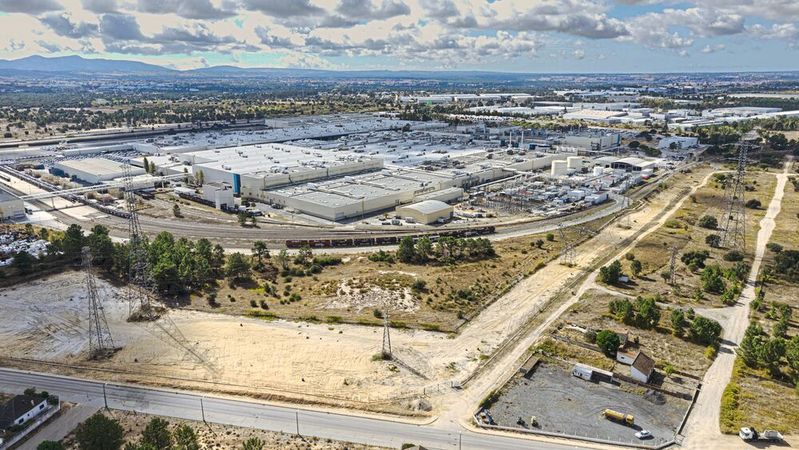
The green belt of VW Palmela - including two geothermal fields and a new paint shop.
(Image: VW Group)
In 1991, the automotive world was amazed at so much community spirit in the rather solitary car industry: Volkswagen and Ford set up a car factory in faraway Portugal as a joint venture to produce a colorful mix of VW Sharan, Seat Alhambra and Ford Galaxy brands half an hour's drive south of Lisbon. Ford left the company in 1999.
Palmela became Wolfsburg's small but mighty satellite. The VW Eos rolled off the production line there, as did the VW Scirocco and the successor model to the VW Sharan and Seat Alhambra. Since 2022, the VW T-Roc has exclusively filled the factory, which operates in three shifts, seven days a week. 236,000 units of the small crossover SUV were produced in 2024.
VW ID Every1: The Price is Hot
The Portuguese VW plant, which currently employs 4,850 people, has been somewhat out of the spotlight over the years. But now it's time to turn on the headlights! The entry-level electric model ID Every1 is set to become a cornerstone of Volkswagen's electric strategy, presumably as the VW ID Up. VW wants to prove that not only the Chinese can build affordable electric cars. Palmela will have to show that this is possible.
"A €20,000 Volkswagen from Europe for Europe" (~$24,000) is how Volkswagen advertises the all-electric small car. The drawback: Volkswagen still needs a lot of time to get it on the road. Until 2027, which is still a long way off in these times of "China Speed". Well, Wolfsburg is responsible for that.
Environmental Requirements Exceeded
The team in Palmela is proud to have won the contract for the new model that is so important for Volkswagen. Details of future production are still being kept strictly confidential. Tobias Bahr, Chief Environmental Officer of the Volkswagen Group, has high praise for the plant: the Portuguese have exceeded the Wolfsburg specifications with regard to "environmentally friendly production". Palmela, says Bahr, is a "lighthouse plant of the Group-wide Zero Impact Factory initiative, under which decarbonization and sustainability measures are being driven forward at all 112 of the Group's production sites."
The achievements in figures: Since 2010, the plant's energy requirements have fallen by almost 45 percent, CO2 emissions and waste have each been reduced by 80 percent, water consumption by 63 percent and VOC emissions by 57 percent. Measured according to VW's internal "Environmental Impact Factors", the plant has achieved a 65 percent reduction in the environmental impact of production per vehicle since 2010. The target from Wolfsburg was 45 percent by 2025.
The target is 75 percent by 2030. The impact factors include primary energy emissions, air pollutants, waste and wastewater, as well as the local water risk.
$355 Million for Decarbonization and Sustainability
The new painting line will play a key role on the road to the "Zero Impact Factory". It is scheduled to start up in 2027 together with the ID Every1. A new hall is currently being built for it. Dürr is supplying the system, a state-of-the-art project: Integrated Paint Process (IPP), use of low-VOC paints, dry separation of overspray, electrified drying ovens. Energy: exclusively renewable. In 2029, the existing cathodic dip coating plant will also be modernized and electrified .
Two geothermal fields covering a total of 47,000 square meters are also currently under construction on the factory premises. Boreholes up to 120 meters deep are being drilled at 366 locations. From next year, the extracted water, which has a stable temperature of 19 degrees, will be used to heat and cool the plants and buildings. A pipe network with a total length of 81 kilometers will be created for this purpose. "This will reduce the plant's energy consumption by 25 percent. We will also reduce the operating costs for air conditioning in the plant," explains plant manager Thomas Hegel Gunther.
Margarida Pereira, Head of Product Management and Planning at Volkswagen Autoeuropa, has defined goals for production in Palmela that go far beyond environmental and climate protection and CO2 reduction: "Increasing efficiency and designing future-oriented production." The new paint shop is an important step in this direction, as the existing paint shop, which is over 30 years old, is the plant's largest energy consumer, accounting for 63% of total energy consumption and therefore also a cost-intensive one. "With the commissioning of the new paint shop, we will reduce energy consumption per vehicle by 30 percent and CO2 emissions by up to 50 percent," says Pereira.
Date: 08.12.2025
Naturally, we always handle your personal data responsibly. Any personal data we receive from you is processed in accordance with applicable data protection legislation. For detailed information please see our privacy policy.
Consent to the use of data for promotional purposes
I hereby consent to Vogel Communications Group GmbH & Co. KG, Max-Planck-Str. 7-9, 97082 Würzburg including any affiliated companies according to §§ 15 et seq. AktG (hereafter: Vogel Communications Group) using my e-mail address to send editorial newsletters. A list of all affiliated companies can be found here
Newsletter content may include all products and services of any companies mentioned above, including for example specialist journals and books, events and fairs as well as event-related products and services, print and digital media offers and services such as additional (editorial) newsletters, raffles, lead campaigns, market research both online and offline, specialist webportals and e-learning offers. In case my personal telephone number has also been collected, it may be used for offers of aforementioned products, for services of the companies mentioned above, and market research purposes.
Additionally, my consent also includes the processing of my email address and telephone number for data matching for marketing purposes with select advertising partners such as LinkedIn, Google, and Meta. For this, Vogel Communications Group may transmit said data in hashed form to the advertising partners who then use said data to determine whether I am also a member of the mentioned advertising partner portals. Vogel Communications Group uses this feature for the purposes of re-targeting (up-selling, cross-selling, and customer loyalty), generating so-called look-alike audiences for acquisition of new customers, and as basis for exclusion for on-going advertising campaigns. Further information can be found in section “data matching for marketing purposes”.
In case I access protected data on Internet portals of Vogel Communications Group including any affiliated companies according to §§ 15 et seq. AktG, I need to provide further data in order to register for the access to such content. In return for this free access to editorial content, my data may be used in accordance with this consent for the purposes stated here. This does not apply to data matching for marketing purposes.
Right of revocation
I understand that I can revoke my consent at will. My revocation does not change the lawfulness of data processing that was conducted based on my consent leading up to my revocation. One option to declare my revocation is to use the contact form found at https://contact.vogel.de. In case I no longer wish to receive certain newsletters, I have subscribed to, I can also click on the unsubscribe link included at the end of a newsletter. Further information regarding my right of revocation and the implementation of it as well as the consequences of my revocation can be found in the data protection declaration, section editorial newsletter.
Consistently Working Towards Greater Sustainability
Various modernization measures that have been implemented in the existing paint shop in recent years also show that sustainability and efficiency, and therefore also cost optimization, go hand in hand. These included heat recovery from the dryer exhaust air, new heat recovery and ventilation systems and making the operating temperature of the systems more flexible: instead of keeping it at a constant 23 degrees, it is now regulated to between 21 and 25 degrees depending on the outside temperature. The latter measure alone reduced energy consumption by almost 1,600 MWh per year.
In terms of logistics, Pereira and her team brought the suppliers on board. From 2017 to 2025, over 700 individual projects were implemented to optimize the packaging and transport of components and parts, including from the adjacent supplier park. Most of them were based on suggestions for improvement from employees. The focal points: Avoidance of packaging material and higher packing density in the transport containers. The result: 454 tons of cardboard and 70 tons of plastic were saved within five years. Calculated per vehicle: a reduction of 30 percent. Cost savings: seven million euros.
"Key Role" also for Soft Skills
Plant Manager Thomas Hegel Gunther sees the plant as playing a "key role within the Volkswagen Group". Many an example of best practice makes its way from Palmela into the Group network. This applies not only to technology applications or process optimization, but also to soft skills. For example, the plant promotes environmental awareness among its employees and their families as part of the "Rebirth" program and in cooperation with local NGOs.
The initiative has been very popular, with 850 participants so far. For example, trees are planted together and waste is collected on the beach. Employee children learn to explore and experience nature at vacation camps. The "Rebirth" initiative was communicated within the Group and offers great potential for implementation across all locations.



:quality(80)/p7i.vogel.de/wcms/53/f7/53f7dadbe4d656a3fd4f4077445f29f6/0129828707v1.jpeg "Thanks to its compact design and drilling/unscrewing function, the Fire Birdie is suitable for applications with limited installation space and frequent tool changes. (Image:Marcel Kraibühler)")
:quality(80)/p7i.vogel.de/wcms/da/4d/da4da8d34671dc6bce80e496212de877/0129850788v1.jpeg "Mate-XT Go supports the arms and shoulders during overhead work and repetitive tasks and is designed to significantly reduce muscle strain in everyday working life. (Image:Comau)")
:quality(80)/p7i.vogel.de/wcms/95/97/95976dbaac68b249eb65e74c5aad5300/0129651893v1.jpeg "The C2.0 centric clamps, the S2 fixed jaw clamps and the \"gredoc\" zero-point clamping systems are used for machining the raw parts. Fastening is carried out with width across flats 27. (Image:Gressel)")
:quality(80)/p7i.vogel.de/wcms/57/1b/571b8895efb299d70846bbdbd7af2338/0130043886v1.jpeg "Servo hydraulics independent of the control system: The servo hydraulics software module is integrated directly into the b Maxx 5500 servo drive (pictured: Mehmet Sari, Export Sales Manager at Hürsan Pres (left), Özgür Deniz Demirbaş, Country Manager at Baumüller Turkey) (Image:Baumüller)")
:quality(80)/p7i.vogel.de/wcms/3b/27/3b27f6c5848be73acecb04054bf0a146/0130115209v1.jpeg "Spectroscopic glucose measurement with infrared spectroscopy enables more regular measurements without physical strain. (Image:Endrich)")
:quality(80)/p7i.vogel.de/wcms/3f/cc/3fccb748b0fe16f1f61249d94c72f126/0130149439v1.jpeg "Requirements for integrated power supply systems: Precise AC and DC power supply systems that not only provide energy, but also reliably combine measurement, analysis and system integration. (Image:Schulz Electronic)")
:quality(80)/p7i.vogel.de/wcms/fd/93/fd93e01c16f5a4709278499d981a459c/0130061090v1.jpeg "Revealed: These servo drives are assembled at Aerotech in Fürth. (Image:Aerotech)")
:quality(80)/p7i.vogel.de/wcms/cb/8a/cb8ae7f5205365efce3e7285154fc3cf/0130132198v1.jpeg "Markus Huber (left) and Nicolai Friis from TU Wien know how to make quantum computers multidimensional in order to perform computing operations even better. (Image:TU Vienna / A. Rommel)")
:quality(80)/p7i.vogel.de/wcms/63/21/6321beb732bf7d92640df46d7aa77573/0130125122v1.jpeg "As part of the Carbon Lab Factory Lausitz, a pilot plant for the production of sustainable, cost-effective and competitive carbon fibers will be built at the Guben site. (Image:Fraunhofer IAP / Kristin Stein)")
:quality(80)/p7i.vogel.de/wcms/53/4f/534fe0f168f6ee070ded4a48faca4cef/business-wire-main-image-1103x620v1.jpeg "The new UR AI Trainer, developed by Universal Robots and Scale AI, is the first direct lab-to-factory solution for AI model training.
(Source: Universal Robots)")
:quality(80)/p7i.vogel.de/wcms/08/70/087062e2e1a9b9add5777410dd746ee9/adobestock-1923991605-5607x3156v1v1.jpeg "A new type of tactile sensor, inspired by human skin, even recognizes grains of sand. (Image:Curioso.Photography - stock.adobe.com)")
:quality(80)/p7i.vogel.de/wcms/7f/08/7f087d7013424d123ab7275cd2e3fe55/adobestock-809456218--c2-a9-20degimages-20-e2-80-93-20stock-adobe-com-ki-generiert-4179x2351v1v1.jpeg "The digital upgrading of existing machines conserves resources, saves energy and reduces the need for new production. (Image:Degimages - stock.adobe.com/AI-generated)")
:quality(80)/p7i.vogel.de/wcms/90/db/90db3087d3af0560fcdb4dbc42443ce1/0130157448v1.jpeg "The switch to SDV is the most complex transformation the industry has ever had to master. The end consumer gets a vehicle that gains rather than loses value over its lifetime. (Image:Sonatus)")
:quality(80)/p7i.vogel.de/wcms/73/f0/73f00bb99a23197db05bb584fe78f20f/0130080581v1.jpeg "The \"China Speed\" analysis by Roland Berger shows that the speed of development has only a limited connection with labor costs. (Image:freely licensed at Pexels)")
:quality(80)/p7i.vogel.de/wcms/2f/5b/2f5ba6a150b52c2b8efada560c5cdafe/0130143442v1.jpeg "Automotive suppliers are facing a severe crisis, which is primarily due to a combination of structural change and economic problems. (Image:freely licensed at Pexels)")
:quality(80)/p7i.vogel.de/wcms/22/d0/22d03cd48e992435338b59464c428d41/0129739814v1.jpeg "More electric vehicles on the roads mean a higher demand for electricity - which should ideally be covered by renewable energies. (Image:BMW)")
:quality(80)/p7i.vogel.de/wcms/94/7a/947ac066b98cbcd3470e83ff9da3e25f/0130096114v1.jpeg "The use of amorphous steels in the stator enables a significant reduction in losses and increases the efficiency of modern electric motors in vehicle drives. (Image:Horse Powertrain)")
:quality(80)/p7i.vogel.de/wcms/e5/f1/e5f171d3d7ae021332cc0aeae4d6e299/0130127049v1.jpeg "In collaboration with Shanghai Jiao Tong University, Lenovo has presented a silicon anode battery under the name \"ED1000\" as a proof of concept for mobile workstations. (Image:Lenovo)")
:quality(80)/p7i.vogel.de/wcms/fa/69/fa696e59706b96fff02283dd74cc2398/0130129635v1.jpeg "Samsung Co-CEO Jun Young-hyun wants to respond to the AI-driven boom in demand in the memory market with contracts for up to five years. This should provide more planning security in the traditionally volatile storage business. At the same time, however, this is likely to increase the pressure on customers to secure precise long-term requirements, prices and supply chains. (Image:Samsung)")
:quality(80)/p7i.vogel.de/wcms/31/a8/31a883a47b86634c382923e78fd9a4c9/0130133225v1.jpeg "Figure 1: GMSL-capable point-to-point connection. (Image:ADI)")
:fill(fff,0)/images.vogel.de/vogelonline/companyimg/76800/76895/65.jpg "FAULHABER_120mm.jpg ()")
:fill(fff,0)/p7i.vogel.de/companies/69/88/69882c428938e/tmts2026-ticec-banner-en-2000px.png "tmts2026-ticec-banner-en-2000px (https://www.tmts.tw/en)")
:fill(fff,0)/p7i.vogel.de/companies/67/eb/67eba621ef6ea/logo2.png "logo2 (Wuxi InfiMotion)")
:quality(80)/p7i.vogel.de/wcms/f7/46/f7463fce73cce957a98c976326b0a916/0126791869v1.jpeg "Generously spacious: The new BMW plant in Debrecen. 2,000 new jobs have been created there. (Image:BMW Group)")
:quality(80)/p7i.vogel.de/wcms/e7/08/e7082e4f1f287bb702bd07dc8a73e009/0126901054v1.jpeg "VW CEO Oliver Blume is also the head of Porsche. The dual role is a thorn in the side of shareholders. (Image:Porsche)")